Much of the information recorded here was experienced by
Francis M. Wilkinson and/or his family as they were growing up.
Almost every thing that was done on the farm up through
the first quarter of the twentieth century has become obsolete.
Much of it has been forgotten.
After writing “Memories of Francis Marion Wilkinson,”
I continued to recall items of interest that related to him
or effected his every day living. These things were common
place to him but would be unusual to our modern generations,
so I decided to write some of these recollections down also.
Some of these recollections were told by old relatives,
some were from printed sources, but many items were
experienced by me when I was young.
George K. Wilkinson
 PAGE BY PAGE INDEX
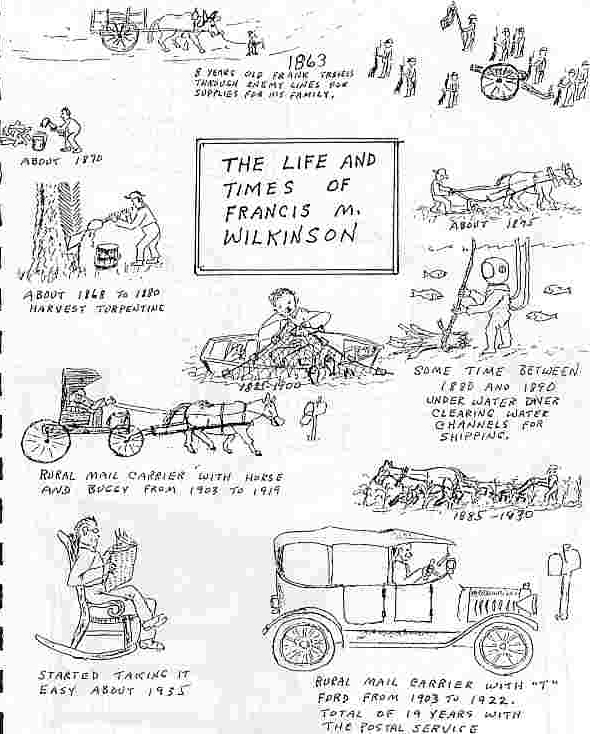
A. The Life and Times of F. M. Wilkinson
B. The Good ? Old Days
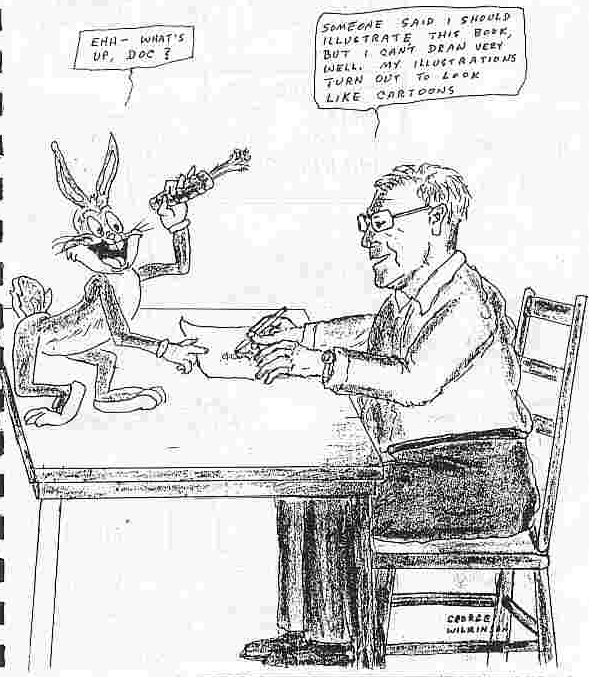
C. Illustration – Whats up Doc?
D. Photo – Author
01. Index – Page by Page
02. index-continued
03. index-continued
04. Recollections of Francis Marion Wilkinson
05. Recollections
06. They called him General Blount
07a. Old Painting – Castle Island
07b. Photo – Castle Island today
08. Old Painting – Confeds shell town
09. This was necessary
10. She remembered times when general
11. One thousand barrels of tar and
12. Document – Official military pass
13. Boy grows up fast.
14. Illustration – boy with ox cart
15. Fuel – our modern day cook
16. Dad used to tell of his experience in
17. Illustration – harvesting turpentine
18. Illustration – tar kiln
19. Pine tar was valuable for med
20. Photo – young Frank Wilkinson
21. Dad worked for his father until
22. Illustration – cooper’s tools
23. Illustration – cobbler’s tools
24. Illustration – Harness maker’s tools
25. Illustration – shave horse and plane
26. copy – draw knives
27. copy – draw knives
28. copy – wedges and mauls
29. copy – froes
30. When Dad left home, the south
31. Illustration – Diver
32. Doctor – Dad became too sick-
33. Yadkin River
34. Shake, rattle and roll
35. Brooms – our modern homes have –
36. Illustration – brooms
37. Mending clothes – clothing was –
38. Illustration – mending stockings
39. Wash day on the farm
40. Illustration – washing clothes
41. Home made soa;
42. making Lye – Lye was origonnally –
43. Illustration – lye barrel
44. Persimmon Beer
45. Illustration – Home made dippers
46. Make molasses
47. Cooking molasses
48. Food for winter
49. Gardens – most people had –
50. Variety was just becoming ripe
51. Education – scurvey
52. Became a farmer
53. Document – 5 pages
94. Copies of typewritten deeds
55. "
56. "
57. "
58. On the 31st day of Dec. 1890
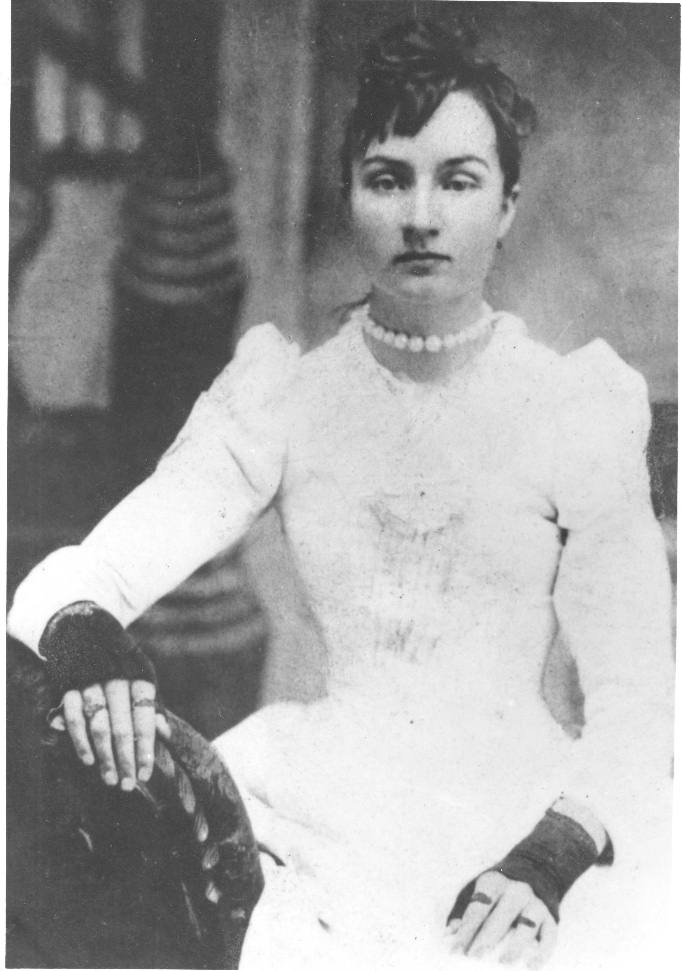
59. Photo – First wedding
60. Photo – Ida E. Pippin Wilkinson
61. Ida E. Pippin – Back in the –
62. Mortgage – On Dec 26, 1893
63. Document – two pages, copy of
64. Original mortgage
65. Ben Field
66. Shooting Marbles
67. Something new at the circus
68. 1903 – Residents in Beaufort County
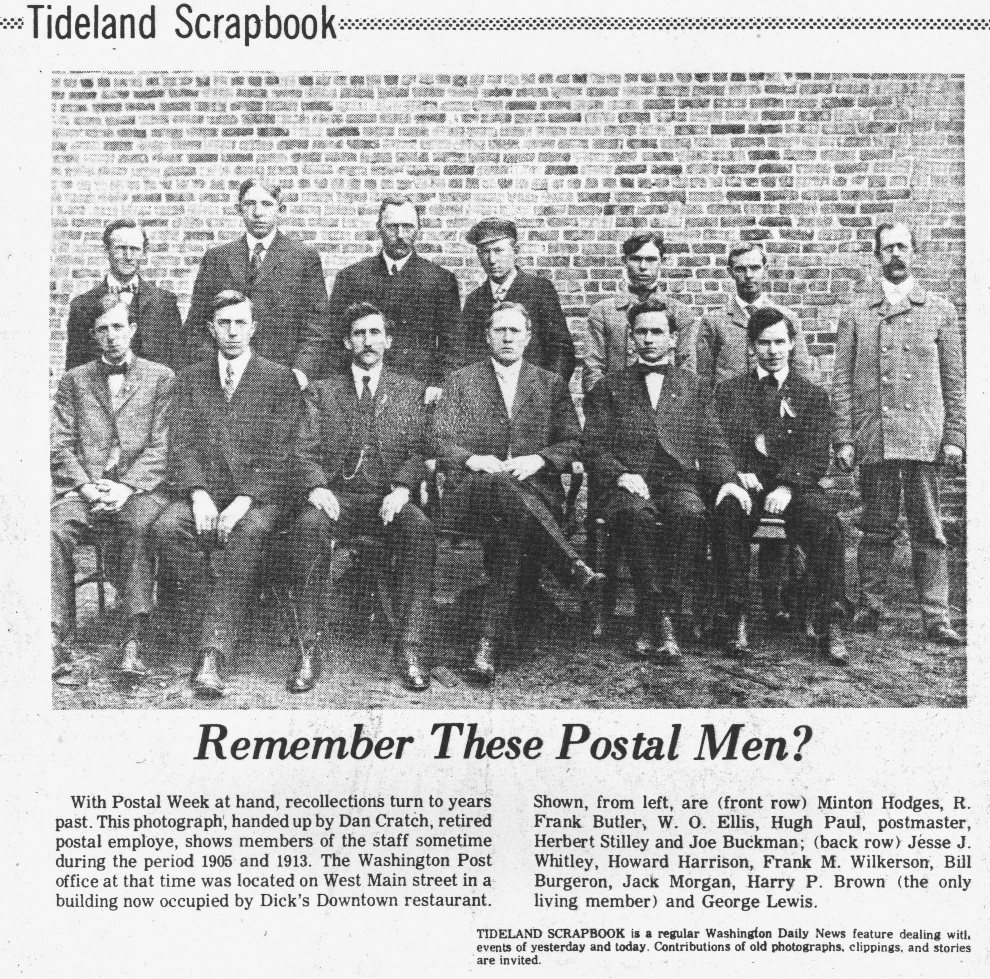
69. Copy – Picture of Post Office staff
70. They were thick “heavy” blankets
71. Illustration – mail carrier’s transportation
72. Copy Picture – Main Street, 1907
73. During this time, Dad and the Burcerons
74. Illustration – Old wall telephone
75. The old record player on the phone
76. Illustration – old record players
77. Copy – Old record player advertisements
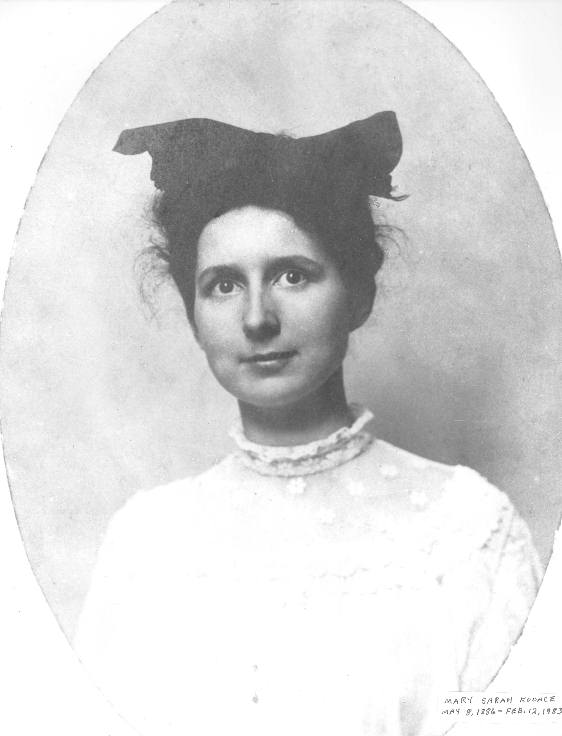
78. Wedding on the 20th Day Nov. 1912
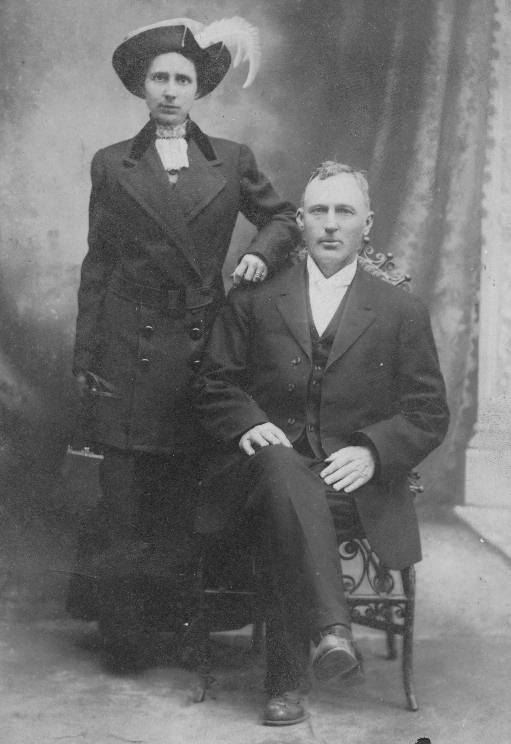
79. Photo – 2nd wedding
80. Photo – Mary Sarah Koonce Wilkinson
81. Sept 3, 1913 – The Weather Bureau
82. Copy pictures – Flood waters in Washington
83. Copy picture – Rail Road Bridge washed away
84. The flood waters came up in to the street
85. Copy – Picture Main Street 1915
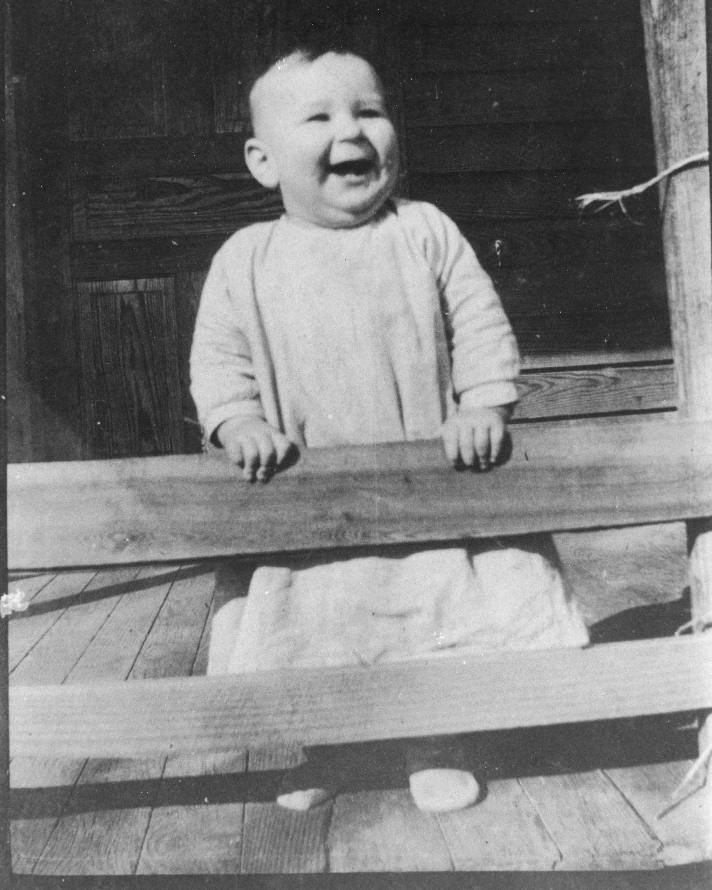
86. Photo – Baby George
87. Dad bought his first auto about 1919
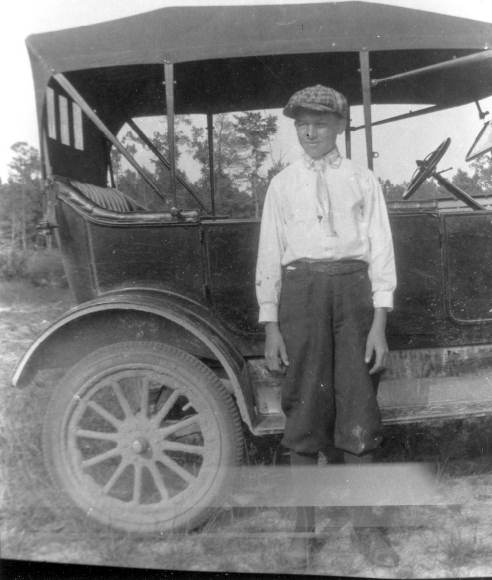
88. Photo – Chilson and Model “T” Ford
89. In later years, he used commercial fertz.
90. Home made tools, back in the days –
91. The old time farmer
92. Continued, old time farmer
93. –of crops-is to be planted
94. Illustration – cotton plows, etc.
95. Illustration – cultivator plows, etc.
96. Illustration – home made plow
97. Illustration – tobacco barn
98. It so happened that Dad had a neighbor
99. There is no plant life in the water
100. When Dad was in the Mail Service
101. All the other brothers and sister
102. Illustration - old gas pump
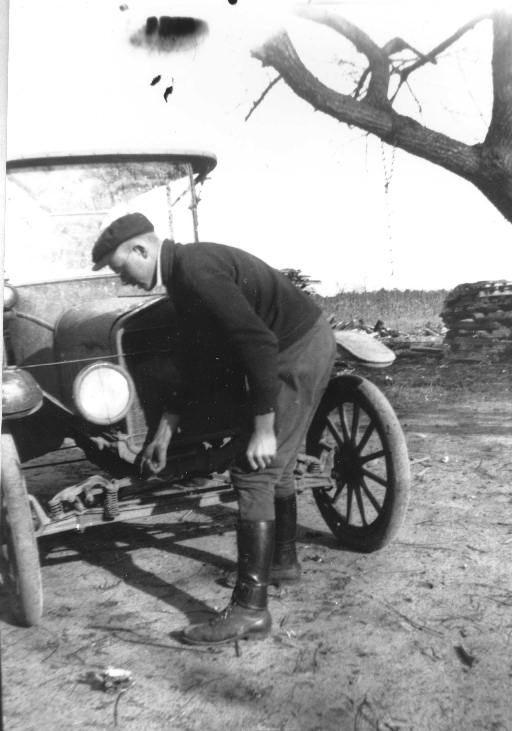
103. Photo – cranking Model “T” Ford
104. Dipped in the tank to see how high
105. Some would open an oyster and say –
106. Buster Keaton was a perfectionist
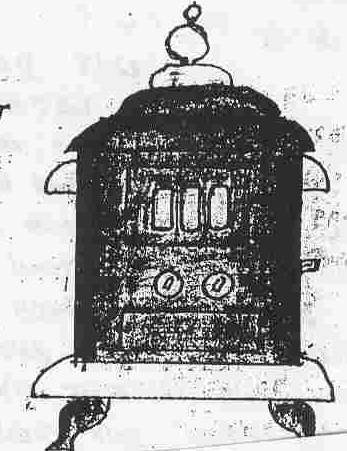
107. Illustration – big hat
108. Public entertainment – opera house
109. Street carnivals
110. While testing his equipment, the diver
111. The show boat was pulled
112. George and Hazel Wilkinson attended
113. Copy picture – show boat
114. Illustration – show boat
115. Copy – picture – interior – show boat
116. Copy – picture – show boat stars
117. Cecil Blount De Mille
118. Theaters – the first play house
119. Main Street, the ground floor
120. Back of the same building that
121. Copy picture – The Glory Days
122. Copy picture – Corner of the old stage
123. Copy picture – Old fancy work
124. Keeping warm – did you ever have
125. Illustration - Dad’s fireplace – den
126. Illustration – Dad’s heater and den
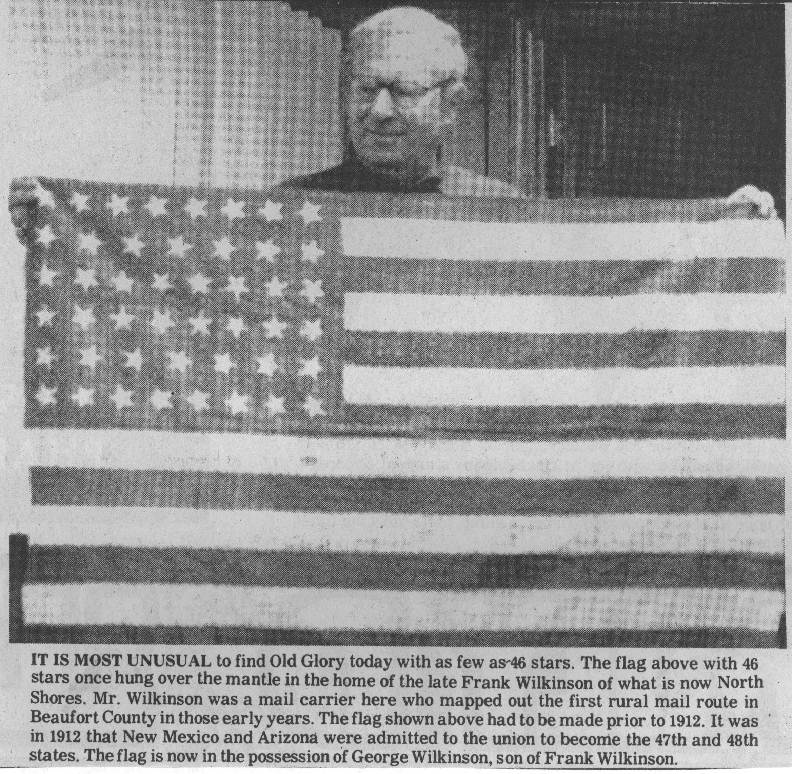
127. Copy picture – Dad’s flag
128. Decorations –Dads bed room – den
129. Until about the year 1922
130. When you went to bed on a cold night
131. Space heaters – about 1922
132. Out door bath room
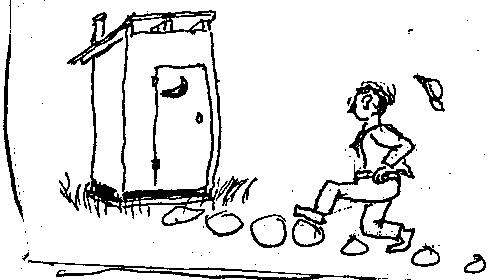
133. The old ‘traditional’ cartoon
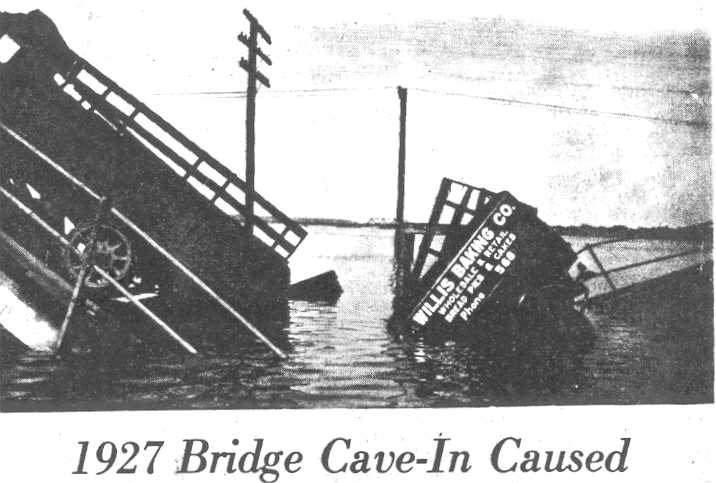
134. Copy picture – 1927 bridge cave-in
135. Hot bread – before heading for home
136. Crow, the super
137. Live stock – Dad had a horse
138. The factory next door
139. He was almost buying his own
140. To stop that, an eight foot
141. Illustration – barge unloads
142. Big factory fire
143. Illustration – big factory fire
144. Tar paper high into the air.
145. Was afraid the weight of the snow
146. Illustration – birds eye view of factory
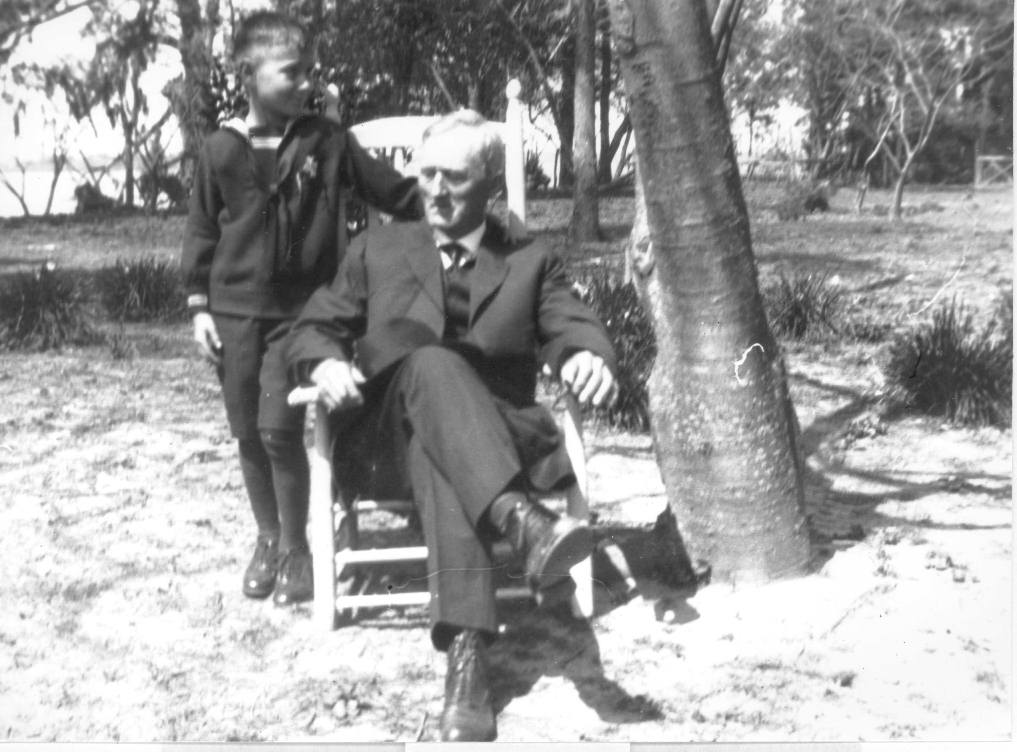
147. Photo – Dad sits in chair on lawn
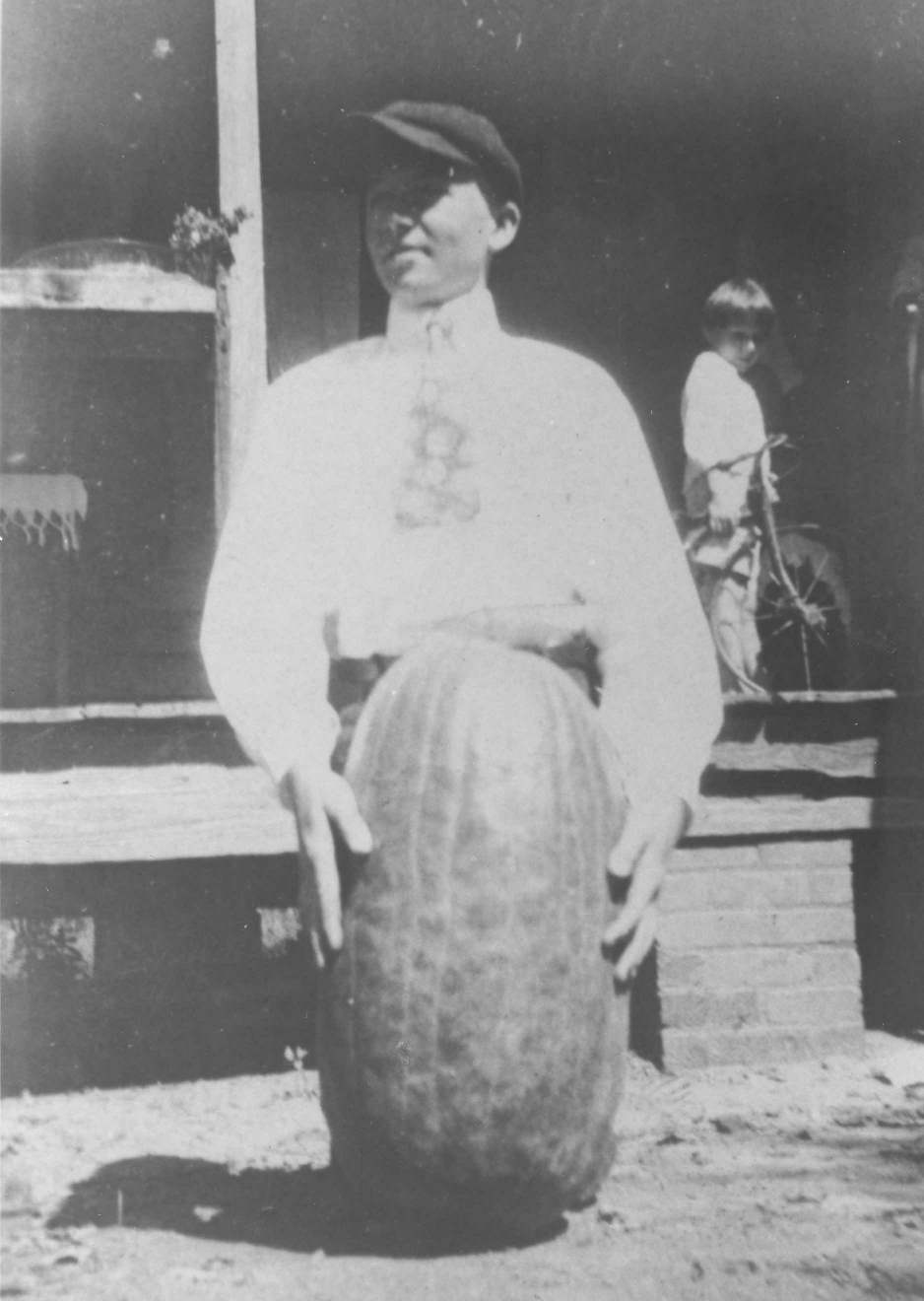
148. Photo – Chilson and 56 pound melon
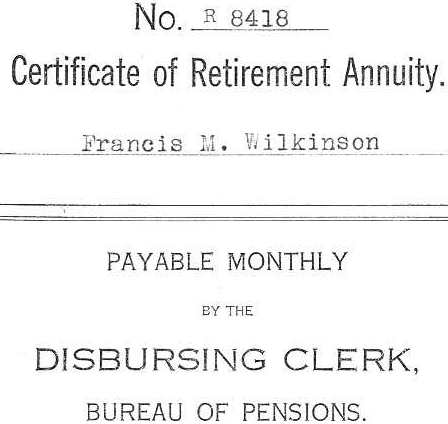
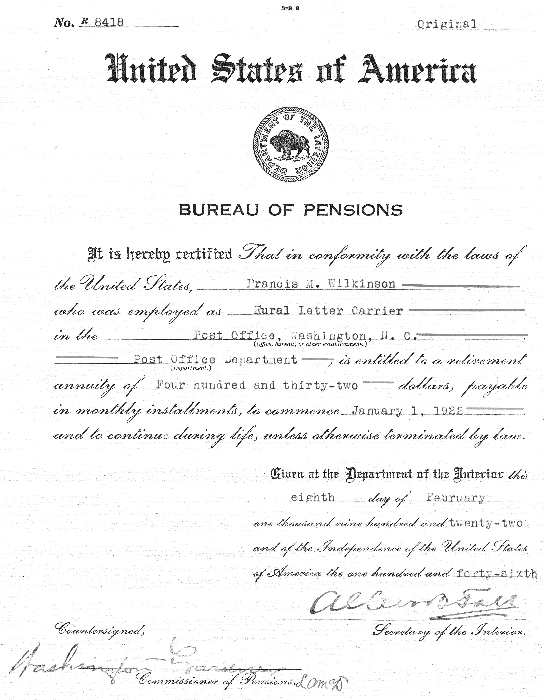
149. Document – U.S. bureau of Pensions
150. News paper clipping – Dad retires
151. About 1924 Dad traded Ford
152. When I reached the ground floor
153. Windows, and it was a 2 door model
154. Mama ran a back yard store
155. There were 4 storage rooms
156. Homeless – we hear a lot about
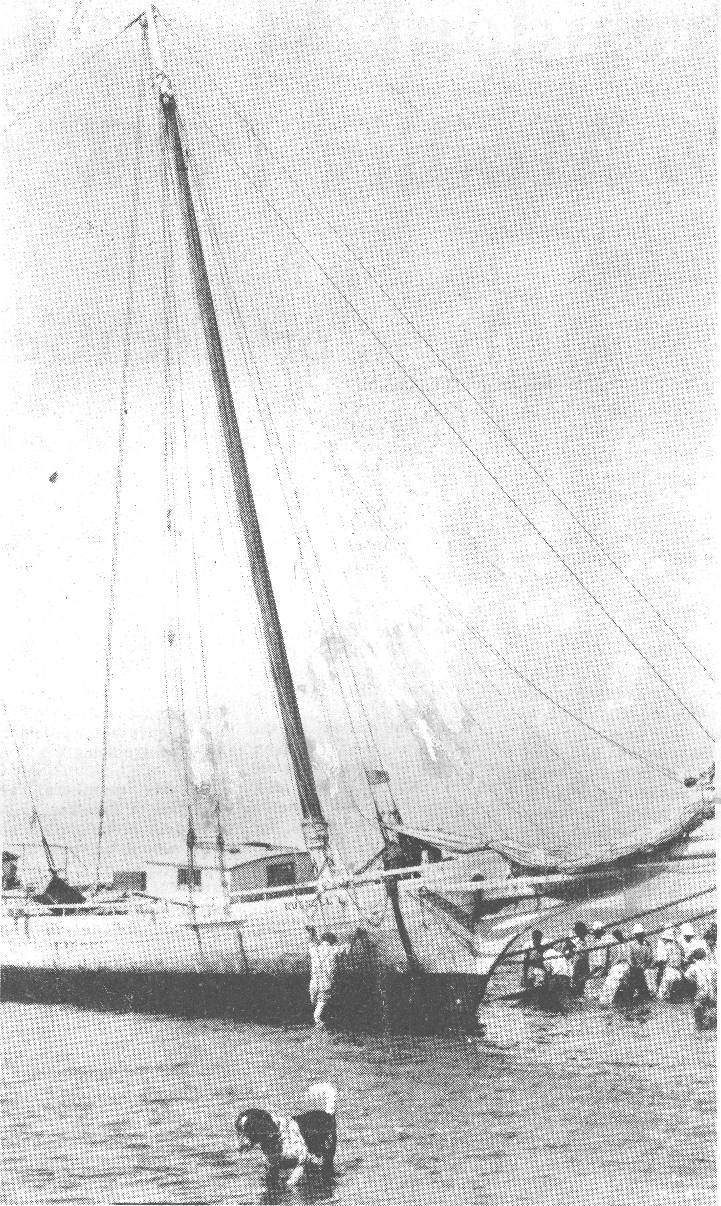
157. Was to keep insects from coming
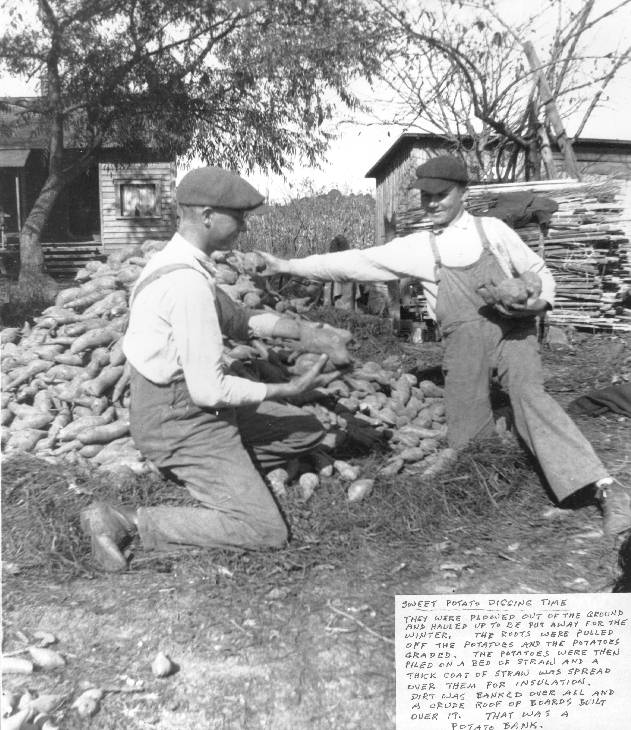
158. Photo – sweet potato harvest
159. Dad had some home made horse
160. Photos – grape vines
161. Good straight grained durable
162. Illustration - Dad’s barn
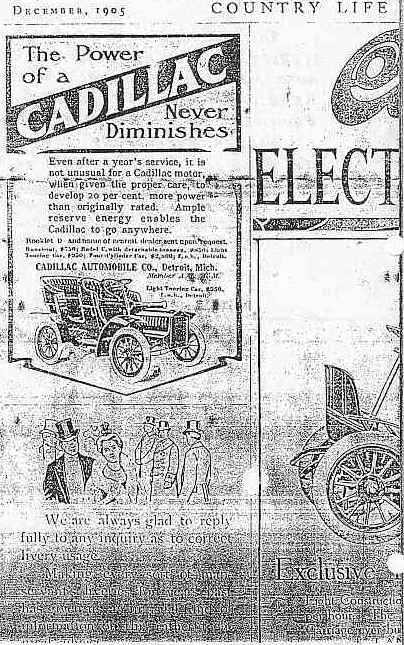
163. As soon as I was old enough
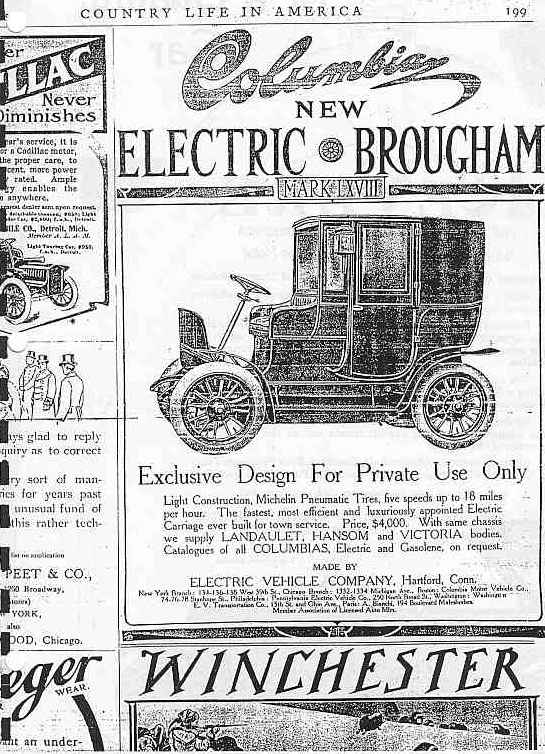
164. Picking through his food
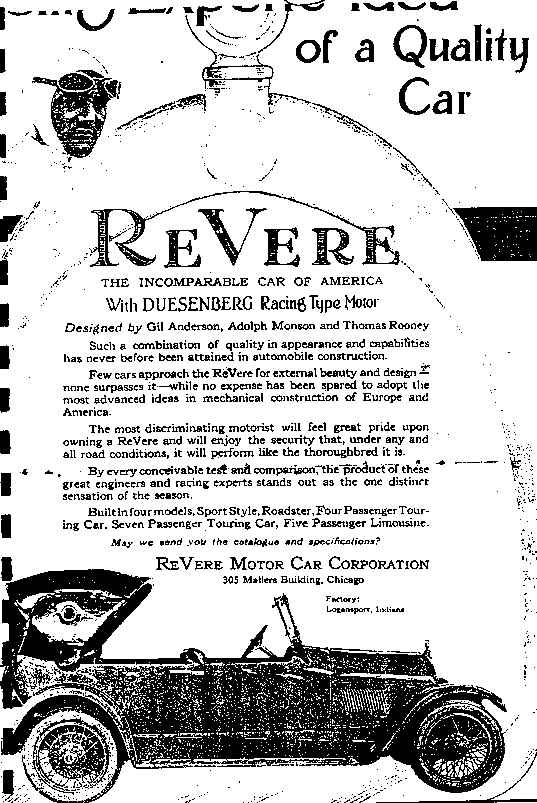
165. The Literary Digest Magazine
166. Photo - Mom and Pop with Star Auto
167. Document – Clifton electric bill
168. Illustration – radios
169. Reunion – on Dad’s 70th birthday
170. by 1929, Dad had been losing
171. Then Dad started leasing land
172. Christmas
173. Transportation
174. The Pamlico River to New York
175. Copy picture – Washington Water front
176. Copy picture – Ocracoke boat
177. Potatoes – in Dad’s time; the
178. There was a long conveyor belt
179. Growth of mechanized transportation
180. With so many rail road locomotives
181. Saw a monsterous contraption
182. Antique cars – Cadillac
183. Antique cars – Columbia Electric
184. Antique cars - Ducenburg
185. Antique cars – Pierce Arrow
186. Antique cars – Franklin Air Cooled
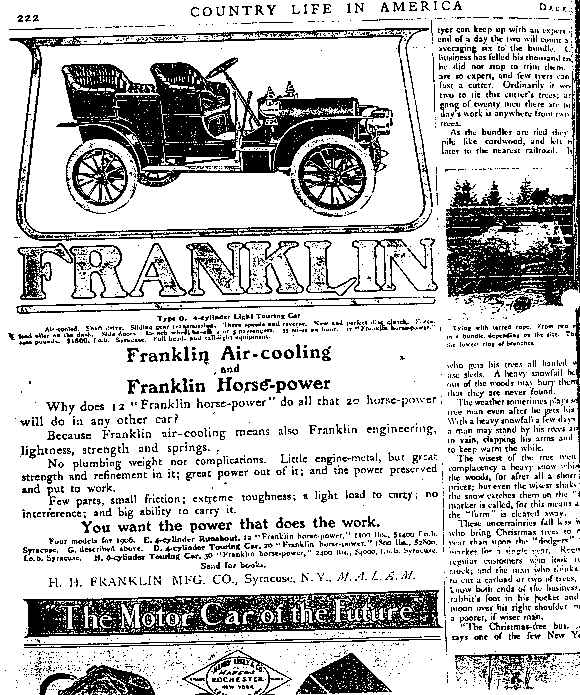
187. Antique cars – 1906 Ford Six
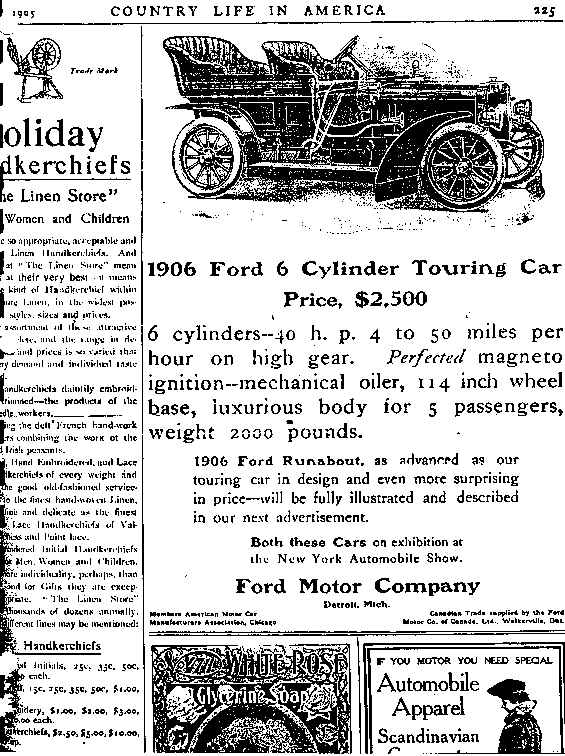
188. Antique cars – Toledo
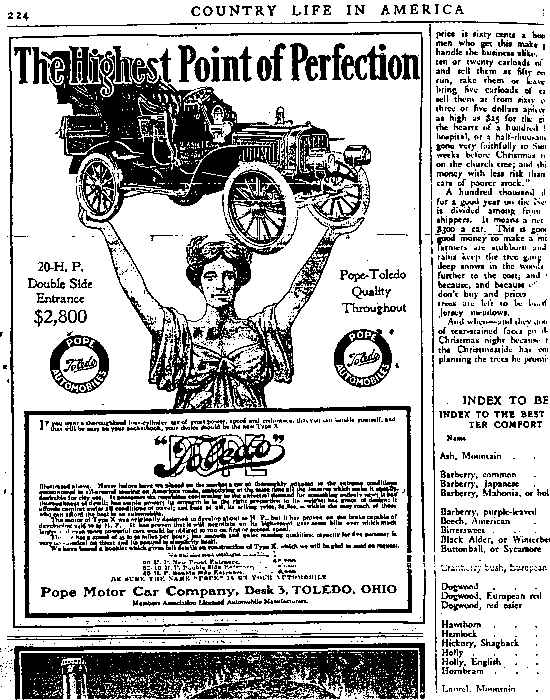
189. Antique cars – Lexington
190. Antique cars – Apperson
191. Possum- turtle
192. Lye hominy
193. Serve hominy with butter
194. Stiff dough that can be formed
195. Home remedies
196. Sulphur and molasses
197. A country hog killing
198. Get a few short logs
199. If the water is too hot
200. The hogs are later taken down
201. After ridding them, a sharp
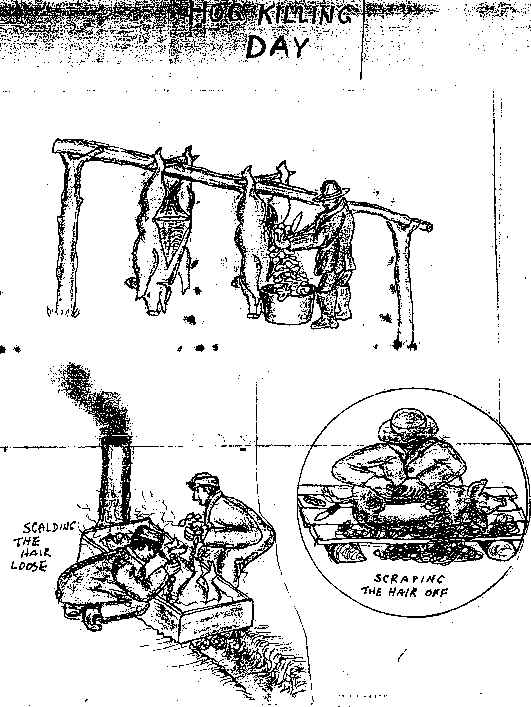
202. Illustration – hogs on gallows
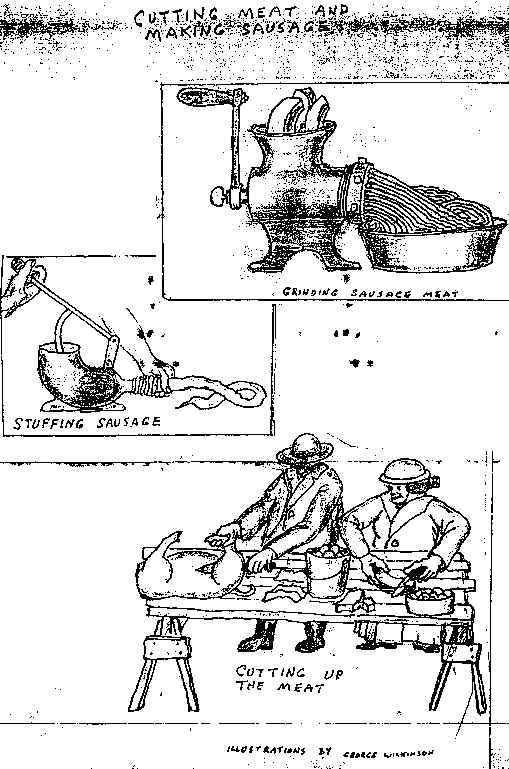
203. Illustration – grinding, cutting
204. Lard and cracklings
205. Illustration – cooking cracklings
206. Neighbors – it takes more workers
207. Chiterlings – this narrator was
208. Start at burning, she also
209. Smoke house – back in the horse
210. Illustration – Dad’s last smoke house
211. Circus Day
212. Given an inch, take a mile
213. There were others who didn’t
214. No smoking, - Dad used to smoke
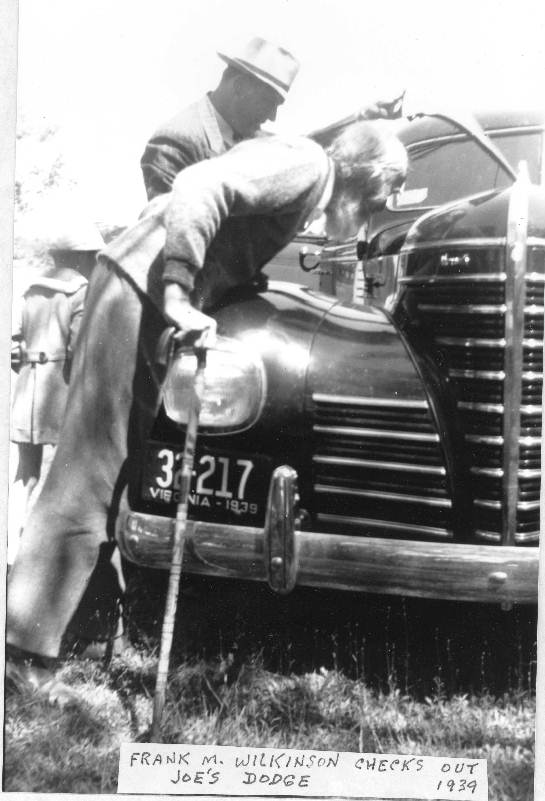
215. Photo – Dad checks out Joe’s car
216. Alcohol – while Dad was in the
217. and he was an ordained minister
218. Overlap – grace
219. The Lord will bless you
220. Why lie about your age
221. Neighbors to the east
222. Charlie Willis attempted to buy
223. Mellons to the Myers farm
224. Mama or Dad would check the beans
225. Cartoon – Jolleys
226. Cartoon – Little Jolley girl
227. Photo – Mom – Dad – Baby Betty
228. Sticks – green tobacco was
229. Him with owing it, he was also
230. Photo – Pop holding Baby Robert
231. Good impressions, it was some time
232. Photo – young Hazel Waters
233. Dad was always a hard worker
234. Dad plowed his garden till
235. Sleeping habit – as I remember
236. Illustration – Dad shaving
237. Town of Bath – a lot of history
238. It was one of the bloodiest pirate
239. While Francis M. Wilkinson was
240. Ride ‘em, cowboy
241. Illustration – for dear life
242. Photo – bookkeeper George
243. English – I remember reading
244. Kitchens old – in the good old
245. Many old time families
246. Metal sink, and ran the water
247. The cat slept under the stove
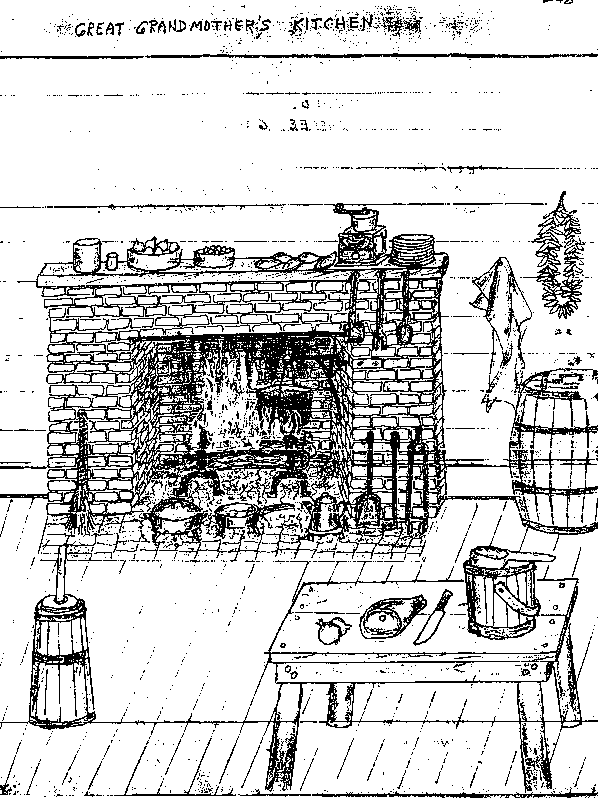
248. Illustration – Great Grandma’s kitchen
249. Illustration – F. M. Wilkinson’s kitchen
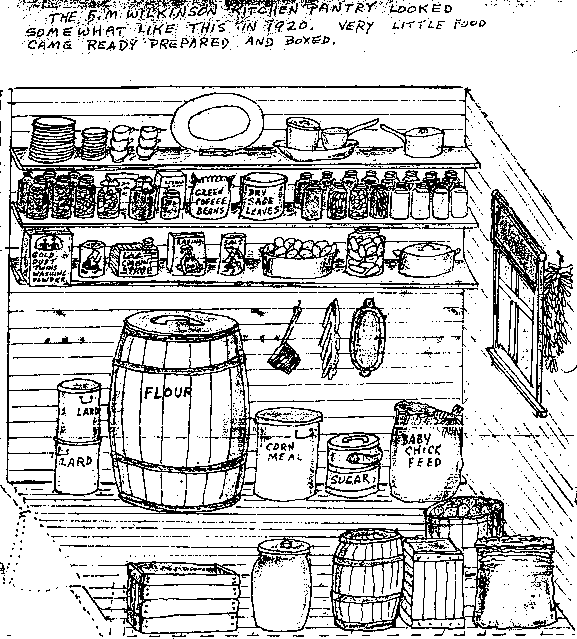
250. Illustration – F. M. Wilkinson’s pantry
251. Out of the mouth of babes
252. Large families – in the 1800’s
253. Dad’s family – although Dad
254. The family Photographs are
255. PHOTOS: Francis Marion Wilkinson
256. Frank M. and Mary K. Wilkinson
257. Group – Chilson, Alma, Guy, Mary K. and Joe
258. 2 groups of F.M.W. children and wives
259. 2 family groups
260. Walter Marion Wilkinson
261. Walter
262. Violet Kathrine Wilkinson
263. Evelyn G. Wilkinson
264. Walter, Evelyn, Robert
265. Bruce A. Wilkinson
266. Bessie Ricks Wilkinson
267. Bruce and family
268. Guy V. Wilkerson
269. Genevieve Gordon Wilkinson
270. Clara Gaither Wilkinson and Guy Wilkinson
271. George and Jacqueline Lowman, Guy and Clara
272. Gwendolyn Caroline Wilkinson
273. Gwen on Steps
274. Gwen and Jake, Gwen and John
275. Joseph G. Wilkinson
276. Helen Powell Wilkinson
277. Joseph C. Wilkinson – U. S. Navy
278. Joe and Helen
279. Francis Chilson Wilkinson
280. Alma Manning Wilkinson
281. Frank C. and Frank M. family group
282. Frank – Alma and children
283. George Wilkinson
284. Hazel Waters Wilkinson
285. Hazel, George, Mary K. Wilkinson
286. View across Wilkinson farm
287. South view, Wilkinson house and yard
288. South view, F. M. Wilkinson’s house
289. Frank Wilkinson’s river front in winter
290. {blank}
291. Wilkinson Family Records
292. Pippin Family Records
293. 5 pages Pippin Family “tree”
294. “
295. “
296. {blank}
297. Obituaries
298. Obituaries
299. {blank}
300. The following copies, old hand written deeds
301. “
302. “
303. 3 pages 1824 – John McWilliams deed
304. “
305. “
306. “
307. 4 pages – 1977 Francis C. Douty deed
308. “
309. “
310. “
311. “
312. 5 pages – 1878 – John Doughty and wife to John B. Ross
313. “
314. “
315. 3 pages –1899- John McDoughty & Henry Dougy to John B. Ross
316. Following - 2 sheets- John Ross to F.A.W.
317. July 1884 – John B. Ross to F.M. Wilkinson
318. Dec 1884 – John b. Ross to F.M. Wilkinson
319. X
320. X
321. 16 pages – Civil War in Washington, N.C.
322. X
323. X
324. X
325. X
326. X
327. X
328. X
329. X
330. X
331. X
332. X
333. X
334. X
335. X
336. Civil War
337. Community Information
Transcribed as written by: Cheryl R. Whitley
PAGE BY PAGE INDEX
A. The Life and Times of F. M. Wilkinson
B. The Good ? Old Days
C. Illustration – Whats up Doc?
D. Photo – Author
01. Index – Page by Page
02. index-continued
03. index-continued
04. Recollections of Francis Marion Wilkinson
05. Recollections
06. They called him General Blount
07a. Old Painting – Castle Island
07b. Photo – Castle Island today
08. Old Painting – Confeds shell town
09. This was necessary
10. She remembered times when general
11. One thousand barrels of tar and
12. Document – Official military pass
13. Boy grows up fast.
14. Illustration – boy with ox cart
15. Fuel – our modern day cook
16. Dad used to tell of his experience in
17. Illustration – harvesting turpentine
18. Illustration – tar kiln
19. Pine tar was valuable for med
20. Photo – young Frank Wilkinson
21. Dad worked for his father until
22. Illustration – cooper’s tools
23. Illustration – cobbler’s tools
24. Illustration – Harness maker’s tools
25. Illustration – shave horse and plane
26. copy – draw knives
27. copy – draw knives
28. copy – wedges and mauls
29. copy – froes
30. When Dad left home, the south
31. Illustration – Diver
32. Doctor – Dad became too sick-
33. Yadkin River
34. Shake, rattle and roll
35. Brooms – our modern homes have –
36. Illustration – brooms
37. Mending clothes – clothing was –
38. Illustration – mending stockings
39. Wash day on the farm
40. Illustration – washing clothes
41. Home made soa;
42. making Lye – Lye was origonnally –
43. Illustration – lye barrel
44. Persimmon Beer
45. Illustration – Home made dippers
46. Make molasses
47. Cooking molasses
48. Food for winter
49. Gardens – most people had –
50. Variety was just becoming ripe
51. Education – scurvey
52. Became a farmer
53. Document – 5 pages
94. Copies of typewritten deeds
55. "
56. "
57. "
58. On the 31st day of Dec. 1890
59. Photo – First wedding
60. Photo – Ida E. Pippin Wilkinson
61. Ida E. Pippin – Back in the –
62. Mortgage – On Dec 26, 1893
63. Document – two pages, copy of
64. Original mortgage
65. Ben Field
66. Shooting Marbles
67. Something new at the circus
68. 1903 – Residents in Beaufort County
69. Copy – Picture of Post Office staff
70. They were thick “heavy” blankets
71. Illustration – mail carrier’s transportation
72. Copy Picture – Main Street, 1907
73. During this time, Dad and the Burcerons
74. Illustration – Old wall telephone
75. The old record player on the phone
76. Illustration – old record players
77. Copy – Old record player advertisements
78. Wedding on the 20th Day Nov. 1912
79. Photo – 2nd wedding
80. Photo – Mary Sarah Koonce Wilkinson
81. Sept 3, 1913 – The Weather Bureau
82. Copy pictures – Flood waters in Washington
83. Copy picture – Rail Road Bridge washed away
84. The flood waters came up in to the street
85. Copy – Picture Main Street 1915
86. Photo – Baby George
87. Dad bought his first auto about 1919
88. Photo – Chilson and Model “T” Ford
89. In later years, he used commercial fertz.
90. Home made tools, back in the days –
91. The old time farmer
92. Continued, old time farmer
93. –of crops-is to be planted
94. Illustration – cotton plows, etc.
95. Illustration – cultivator plows, etc.
96. Illustration – home made plow
97. Illustration – tobacco barn
98. It so happened that Dad had a neighbor
99. There is no plant life in the water
100. When Dad was in the Mail Service
101. All the other brothers and sister
102. Illustration - old gas pump
103. Photo – cranking Model “T” Ford
104. Dipped in the tank to see how high
105. Some would open an oyster and say –
106. Buster Keaton was a perfectionist
107. Illustration – big hat
108. Public entertainment – opera house
109. Street carnivals
110. While testing his equipment, the diver
111. The show boat was pulled
112. George and Hazel Wilkinson attended
113. Copy picture – show boat
114. Illustration – show boat
115. Copy – picture – interior – show boat
116. Copy – picture – show boat stars
117. Cecil Blount De Mille
118. Theaters – the first play house
119. Main Street, the ground floor
120. Back of the same building that
121. Copy picture – The Glory Days
122. Copy picture – Corner of the old stage
123. Copy picture – Old fancy work
124. Keeping warm – did you ever have
125. Illustration - Dad’s fireplace – den
126. Illustration – Dad’s heater and den
127. Copy picture – Dad’s flag
128. Decorations –Dads bed room – den
129. Until about the year 1922
130. When you went to bed on a cold night
131. Space heaters – about 1922
132. Out door bath room
133. The old ‘traditional’ cartoon
134. Copy picture – 1927 bridge cave-in
135. Hot bread – before heading for home
136. Crow, the super
137. Live stock – Dad had a horse
138. The factory next door
139. He was almost buying his own
140. To stop that, an eight foot
141. Illustration – barge unloads
142. Big factory fire
143. Illustration – big factory fire
144. Tar paper high into the air.
145. Was afraid the weight of the snow
146. Illustration – birds eye view of factory
147. Photo – Dad sits in chair on lawn
148. Photo – Chilson and 56 pound melon
149. Document – U.S. bureau of Pensions
150. News paper clipping – Dad retires
151. About 1924 Dad traded Ford
152. When I reached the ground floor
153. Windows, and it was a 2 door model
154. Mama ran a back yard store
155. There were 4 storage rooms
156. Homeless – we hear a lot about
157. Was to keep insects from coming
158. Photo – sweet potato harvest
159. Dad had some home made horse
160. Photos – grape vines
161. Good straight grained durable
162. Illustration - Dad’s barn
163. As soon as I was old enough
164. Picking through his food
165. The Literary Digest Magazine
166. Photo - Mom and Pop with Star Auto
167. Document – Clifton electric bill
168. Illustration – radios
169. Reunion – on Dad’s 70th birthday
170. by 1929, Dad had been losing
171. Then Dad started leasing land
172. Christmas
173. Transportation
174. The Pamlico River to New York
175. Copy picture – Washington Water front
176. Copy picture – Ocracoke boat
177. Potatoes – in Dad’s time; the
178. There was a long conveyor belt
179. Growth of mechanized transportation
180. With so many rail road locomotives
181. Saw a monsterous contraption
182. Antique cars – Cadillac
183. Antique cars – Columbia Electric
184. Antique cars - Ducenburg
185. Antique cars – Pierce Arrow
186. Antique cars – Franklin Air Cooled
187. Antique cars – 1906 Ford Six
188. Antique cars – Toledo
189. Antique cars – Lexington
190. Antique cars – Apperson
191. Possum- turtle
192. Lye hominy
193. Serve hominy with butter
194. Stiff dough that can be formed
195. Home remedies
196. Sulphur and molasses
197. A country hog killing
198. Get a few short logs
199. If the water is too hot
200. The hogs are later taken down
201. After ridding them, a sharp
202. Illustration – hogs on gallows
203. Illustration – grinding, cutting
204. Lard and cracklings
205. Illustration – cooking cracklings
206. Neighbors – it takes more workers
207. Chiterlings – this narrator was
208. Start at burning, she also
209. Smoke house – back in the horse
210. Illustration – Dad’s last smoke house
211. Circus Day
212. Given an inch, take a mile
213. There were others who didn’t
214. No smoking, - Dad used to smoke
215. Photo – Dad checks out Joe’s car
216. Alcohol – while Dad was in the
217. and he was an ordained minister
218. Overlap – grace
219. The Lord will bless you
220. Why lie about your age
221. Neighbors to the east
222. Charlie Willis attempted to buy
223. Mellons to the Myers farm
224. Mama or Dad would check the beans
225. Cartoon – Jolleys
226. Cartoon – Little Jolley girl
227. Photo – Mom – Dad – Baby Betty
228. Sticks – green tobacco was
229. Him with owing it, he was also
230. Photo – Pop holding Baby Robert
231. Good impressions, it was some time
232. Photo – young Hazel Waters
233. Dad was always a hard worker
234. Dad plowed his garden till
235. Sleeping habit – as I remember
236. Illustration – Dad shaving
237. Town of Bath – a lot of history
238. It was one of the bloodiest pirate
239. While Francis M. Wilkinson was
240. Ride ‘em, cowboy
241. Illustration – for dear life
242. Photo – bookkeeper George
243. English – I remember reading
244. Kitchens old – in the good old
245. Many old time families
246. Metal sink, and ran the water
247. The cat slept under the stove
248. Illustration – Great Grandma’s kitchen
249. Illustration – F. M. Wilkinson’s kitchen
250. Illustration – F. M. Wilkinson’s pantry
251. Out of the mouth of babes
252. Large families – in the 1800’s
253. Dad’s family – although Dad
254. The family Photographs are
255. PHOTOS: Francis Marion Wilkinson
256. Frank M. and Mary K. Wilkinson
257. Group – Chilson, Alma, Guy, Mary K. and Joe
258. 2 groups of F.M.W. children and wives
259. 2 family groups
260. Walter Marion Wilkinson
261. Walter
262. Violet Kathrine Wilkinson
263. Evelyn G. Wilkinson
264. Walter, Evelyn, Robert
265. Bruce A. Wilkinson
266. Bessie Ricks Wilkinson
267. Bruce and family
268. Guy V. Wilkerson
269. Genevieve Gordon Wilkinson
270. Clara Gaither Wilkinson and Guy Wilkinson
271. George and Jacqueline Lowman, Guy and Clara
272. Gwendolyn Caroline Wilkinson
273. Gwen on Steps
274. Gwen and Jake, Gwen and John
275. Joseph G. Wilkinson
276. Helen Powell Wilkinson
277. Joseph C. Wilkinson – U. S. Navy
278. Joe and Helen
279. Francis Chilson Wilkinson
280. Alma Manning Wilkinson
281. Frank C. and Frank M. family group
282. Frank – Alma and children
283. George Wilkinson
284. Hazel Waters Wilkinson
285. Hazel, George, Mary K. Wilkinson
286. View across Wilkinson farm
287. South view, Wilkinson house and yard
288. South view, F. M. Wilkinson’s house
289. Frank Wilkinson’s river front in winter
290. {blank}
291. Wilkinson Family Records
292. Pippin Family Records
293. 5 pages Pippin Family “tree”
294. “
295. “
296. {blank}
297. Obituaries
298. Obituaries
299. {blank}
300. The following copies, old hand written deeds
301. “
302. “
303. 3 pages 1824 – John McWilliams deed
304. “
305. “
306. “
307. 4 pages – 1977 Francis C. Douty deed
308. “
309. “
310. “
311. “
312. 5 pages – 1878 – John Doughty and wife to John B. Ross
313. “
314. “
315. 3 pages –1899- John McDoughty & Henry Dougy to John B. Ross
316. Following - 2 sheets- John Ross to F.A.W.
317. July 1884 – John B. Ross to F.M. Wilkinson
318. Dec 1884 – John b. Ross to F.M. Wilkinson
319. X
320. X
321. 16 pages – Civil War in Washington, N.C.
322. X
323. X
324. X
325. X
326. X
327. X
328. X
329. X
330. X
331. X
332. X
333. X
334. X
335. X
336. Civil War
337. Community Information
Transcribed as written by: Cheryl R. Whitley
PAGE 4
RECOLLECTIONS
Of
FRANCIS MARION WILKINSON
This booklet contains bits and pieces of events and
recollections in the life of Frank M. Wilkinson as remembered
by the narrator. These items are being recorded so that his
decendants may get to know him better.
The following pages were copied from notes scribbled
on rough paper and sorted and assembled, and a few copies were
run off on copying machines to distribute to his few close
descendants..
George K. Wilkinson
Page 5
This was the end of an era that began 86 ½ years previously on
July 30, 1956, when a little boy was born.
The two men were carying shovels. They wanted a square Frame
nailed together out of wood strips to form a rectangle about a
yard wide and a little more than two yards long. I don’t remember
the exact dimensions.
It was a cold day – March 4, 1943. There was a light snow falling,
making a thin white cover on the ground.
After I made the frame, the men had me to point out the exact spot
where they were supposed to dig a grave in the old family grave yard.
The frame was a guide to dig by. I pointed out a space Dad has
previously selected between Caroline Lewis Wilkinson, his mother,
and Ida Pippin Wilkinson, his first wife.
Francis Marion Wilkinson had died during the early part of the night
of March 2, 1943, and he was to be buried on the afternoon of the 4th.
My wife, Hazel, had walked over to Dad’s house, and about an hour
later, she came out, shouting for me to hurry over. She said Dad
had had an attack and was dying. When I arrived, Mom was holding
him in her arms. That was the end of a long and interesting life.
Now – Let’s go back to the beginning.
Page 6
They called him General Blount. He was a well-to-do plantation
owner in the south of Beaufort County, North Carolina. Since the
General was a so-called “gentleman farmer”, he trusted the actual
operation of the plantation to a person that our present generation
would call an “agricultural engineer”, or supervisor.
This supervisor was a man named William Henry Wilkinson. Mr.
Wilkinson remained with General Blount until the War Between
the States made farming in the traditional way impossible.
The laborers on Blount’s plantation were not like the migratory
Mexicans, etc. that are often employed now. They were slaves
brought from Africa and bought as you would buy horses and cattle.
William Henry Wilkinson was married to the former Caroline W. Lewis.
This marriage produced 5 children, - three girls and two boys.
On July 30, 1856, Caroline presented Henry with their first boy baby.
They already had three girls, - Emily, Martha and Josephene, but this
baby, named Francis Marion Wilkinson, was their first boy. Boys were
important in those days, as a family’s helper. Girls were useful for
housekeeping, cooking, spinning, weaving, making clothes, washing
and tending the children, but they needed male members in the family
to do the work.
As soon as a child was old enough to do any kind of work, he or she
had duties assigned. One of these duties was pulling lint from cotton
seeds so that the cotton could be carded and prepared for spinning.
Cards were 2 paddles about 4 x 6 inches with one side covered with wire
bristles. A ball of cotton was placed between and the brushes were
rubbed across one another until the cotton formed a soft fluffy oblong
ball. The spinning wheel could pull long threads of fibers from it and
spin or twist it into a strong thread, which could be woven into cloth.
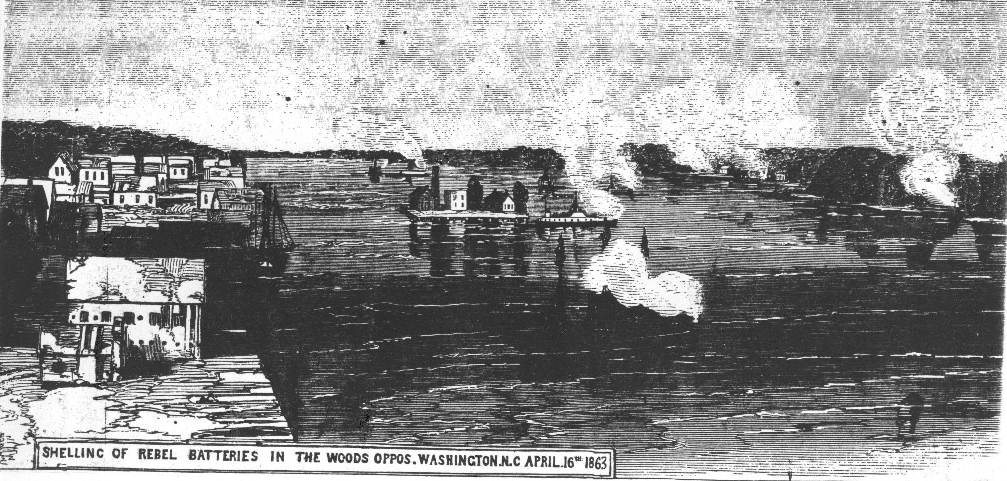
Page 7a 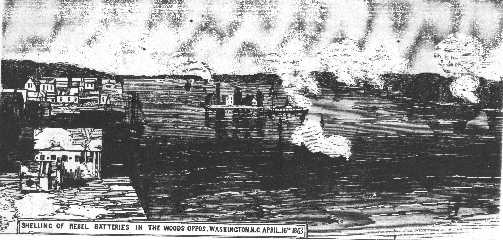 CIVIL WAR – Washington, N.C. – April 16, 1863
The Union forces occupied Washington 3 years and the two opposing armies
fired shells across the river attempting to drive the other out. Castle
Island ‘in center of picture’. There was a mill there to convert oyster
shells to lime. Years later, a “business Woman” moved to the island and
established an entertainment house for sailors and other male clients.
Page 7b Photo
CIVIL WAR – Washington, N.C. – April 16, 1863
The Union forces occupied Washington 3 years and the two opposing armies
fired shells across the river attempting to drive the other out. Castle
Island ‘in center of picture’. There was a mill there to convert oyster
shells to lime. Years later, a “business Woman” moved to the island and
established an entertainment house for sailors and other male clients.
Page 7b Photo 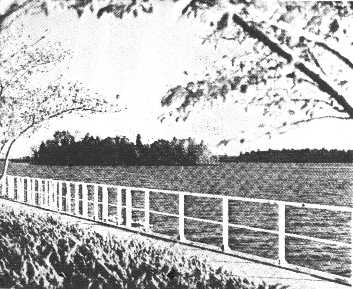 Castle Island – 1990 a jungle with a few goats.
Page 8 Old Painting – Confeds shell town
Page 9
This was necessary to hand-pick the cotton lint from the seeds because
after the Civil Was, most all mills and cotton gins had been destroyed.
Dad would tell us that when he was a child, every night,
each family member was required to pick the lint off of enough cotton
to fill his shoe with cotton seeds, before going to bed. Our modern
kids watch television till bed time.
Back in those days before our waterways were polluted and
over-fished, our rivers and sounds abounded in both finned fish and shell
fish. The streets of our costal towns were paved with oyster shells,
just as modern day dirt roads are sometimes covered with crusted stone.
There is an island in the Pamlico River, just opposite down
town Washington, N.C. , that is called Castle Island. There was once a
mill on the island that processed oyster shells into lime. People said
that buildings on the islands looked like a castle. That’s how the
island got its name. People found other uses for oyster shells besides
making line and paving streets. One was to use them for small dippers
or scoops.
On every farm, there were milk cows. The surpulus milk
became sour and turned to clabber, which was good to eat when sweetene.
Someone at General Blount’s cook house had a long wooden
trough built and it was filled with clabber and sweetened with molasses.
The little Negro children were called in and each was given an oyster
shell to eat with. They would gather around and eat clabber, and Dad,
who was a small boy at the time, said it looked so good, it made him
want to eat clabber. Incidently, old fashioned sour milk clabber is
good with sugar.
Dad’s sister, Martha would recall things that happened
in the period before the Civil War.
Page 10
She remembered times when General Blount and his wife would go for
rides in their carriage. Sometimes, they would take Dad’s sisters
along, with the girls sitting in the foot of the carriage. General
Blount was very cordial and would tip his hat and speak to people
they passed on the road. Mrs. Blount would remark, “My Dear, why
do you speak to those poor Tackeys”?
In 1861, when little Frank was 5 years old, the Civil Was
started. That was the beginning of the end for life as it was known
at that time. Beaufort County became a battle ground. Washington,
N.C. was occupied by the Union Army for three years, and battles were
fought in the streets sometimes. Five forts were built around the
town, and the town was sometimes bombarded by cannon fire from across
the river, and also from land.
General Blount was once warned of yankee soldiers on the
march toward his plantation. He had just finished building a new barn,
and it wa filled with bales of cotton. He knew the Yankees would
destroy the cotton, so he had all the cotton hauled out into the barn
yard and set on fire. When the Yanks arrived, their commanding officer
remarked, “I see some of our men have already been through here”. That
saved Blounts’ new barn. They went on and didn’t disturb anything.
Lets go back a while, before the Union soldiers arrived in
Washington. The confederates made preparations before evacuating in
1861. They destroyed all cotton and naval stores that would be an aid
to the enemy.
At Taft’s Store on the Tar River, they dumped
Page 11
one thousand barrels of tar and turpentine into the river. Later
in the summer, two flat boats carrying four hundred yankee soldiers
from the prison in Salisbury to be exchanged, tied up at Taft’s
Store. That night it was very hot and the soldiers asked to be
allowed to bathe. Permission for a bath was given, and guards were
stationed on each side of the river with torches. As the soldiers
waded in, they stirred up the tar and turpentine from the river bed
and they got all smeared wit it. It was a busy four hundred who
used their ration of meat and a stick to scrape off for dear life
saying “we heard of the Tar River, but we never believed there was
such a place; but we found the whole bed of the river is pure tar”.
The town of Washington, N.C. was occupied by the Union
Army from 1861 to 1864. At the beginning of the war, the town had
a population of 3,000. After the war, the men who returned home
from the fighting found only 600 inhabitants – women, children and
old men. Much of the town was destroyed by fire. It had been
bombarded by cannon fire by the departing Yankees. Before departing,
they had taken the hoses out of the fire station and cut them up in
little pieces a foot long. They set fires and left.
From April 27 to April 30, 1864 the town had
been thoroughly sacked and pillaged by evacuating federal troops.
Private homes and stores, as well as public supplies were looted
and pillaged. An official report states that troops “did not even
respect the charitable institutions, but bursting open the doors of
the Masonic and Odd Fellows Lodges, pillaged them both and hawked
about the streets the regalia and jewels”.
Page 12
OFFICIAL MILITARY PASS
The town of Washington, N.C. was occupied and fortified by the Union
Army for about three years during the Civil War.
The above pass was issued to William Henry Wilkinson so that he and
his family could enter and leave Washington through army check points
when going to and from town.
William Henry Wilkinson was Francis Marion Wilkinson’s father.
Page 13
BOY GROWS UP FAST
As time passed, it became dangerous for any able bodied man
to be seen by union soldiers because he might be arrested as a spy; or
conscripted into the Union Army, so William Henry Wilkinson could no
longer go to town. Somebody had to go to town occasionally for supplies.
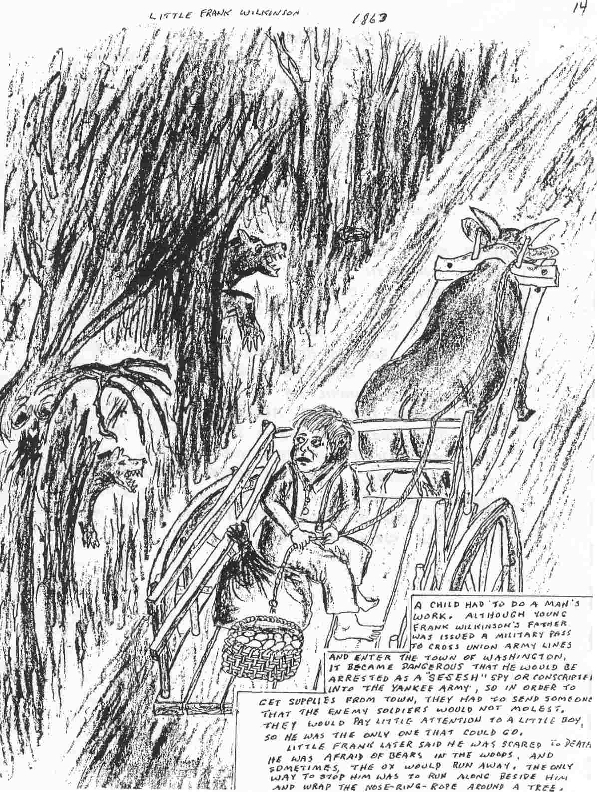
That was when little eight year old Frank had to turn from
boy to man. He had to drive an ox cart through a dirt road with thick
woods on both sides and always the chance of meeting a bear.
Dad told me that sometimes the ox would bolt and try to run
away. There was a rope tied to a ring in his nose. He said he would
have to jump off the cart and run as fast as he could until he came to
a tree that he could wrap the rope around and pull the ox back.
Dad recalled years later that he was very scared to make
those trips, with bears in the woods, the ox unpredictable, and the
Yankee soldiers might do most anything. A child can be more
frightened than an adult in such circumstances.
Page 14 Boy With Ox Cart
Castle Island – 1990 a jungle with a few goats.
Page 8 Old Painting – Confeds shell town
Page 9
This was necessary to hand-pick the cotton lint from the seeds because
after the Civil Was, most all mills and cotton gins had been destroyed.
Dad would tell us that when he was a child, every night,
each family member was required to pick the lint off of enough cotton
to fill his shoe with cotton seeds, before going to bed. Our modern
kids watch television till bed time.
Back in those days before our waterways were polluted and
over-fished, our rivers and sounds abounded in both finned fish and shell
fish. The streets of our costal towns were paved with oyster shells,
just as modern day dirt roads are sometimes covered with crusted stone.
There is an island in the Pamlico River, just opposite down
town Washington, N.C. , that is called Castle Island. There was once a
mill on the island that processed oyster shells into lime. People said
that buildings on the islands looked like a castle. That’s how the
island got its name. People found other uses for oyster shells besides
making line and paving streets. One was to use them for small dippers
or scoops.
On every farm, there were milk cows. The surpulus milk
became sour and turned to clabber, which was good to eat when sweetene.
Someone at General Blount’s cook house had a long wooden
trough built and it was filled with clabber and sweetened with molasses.
The little Negro children were called in and each was given an oyster
shell to eat with. They would gather around and eat clabber, and Dad,
who was a small boy at the time, said it looked so good, it made him
want to eat clabber. Incidently, old fashioned sour milk clabber is
good with sugar.
Dad’s sister, Martha would recall things that happened
in the period before the Civil War.
Page 10
She remembered times when General Blount and his wife would go for
rides in their carriage. Sometimes, they would take Dad’s sisters
along, with the girls sitting in the foot of the carriage. General
Blount was very cordial and would tip his hat and speak to people
they passed on the road. Mrs. Blount would remark, “My Dear, why
do you speak to those poor Tackeys”?
In 1861, when little Frank was 5 years old, the Civil Was
started. That was the beginning of the end for life as it was known
at that time. Beaufort County became a battle ground. Washington,
N.C. was occupied by the Union Army for three years, and battles were
fought in the streets sometimes. Five forts were built around the
town, and the town was sometimes bombarded by cannon fire from across
the river, and also from land.
General Blount was once warned of yankee soldiers on the
march toward his plantation. He had just finished building a new barn,
and it wa filled with bales of cotton. He knew the Yankees would
destroy the cotton, so he had all the cotton hauled out into the barn
yard and set on fire. When the Yanks arrived, their commanding officer
remarked, “I see some of our men have already been through here”. That
saved Blounts’ new barn. They went on and didn’t disturb anything.
Lets go back a while, before the Union soldiers arrived in
Washington. The confederates made preparations before evacuating in
1861. They destroyed all cotton and naval stores that would be an aid
to the enemy.
At Taft’s Store on the Tar River, they dumped
Page 11
one thousand barrels of tar and turpentine into the river. Later
in the summer, two flat boats carrying four hundred yankee soldiers
from the prison in Salisbury to be exchanged, tied up at Taft’s
Store. That night it was very hot and the soldiers asked to be
allowed to bathe. Permission for a bath was given, and guards were
stationed on each side of the river with torches. As the soldiers
waded in, they stirred up the tar and turpentine from the river bed
and they got all smeared wit it. It was a busy four hundred who
used their ration of meat and a stick to scrape off for dear life
saying “we heard of the Tar River, but we never believed there was
such a place; but we found the whole bed of the river is pure tar”.
The town of Washington, N.C. was occupied by the Union
Army from 1861 to 1864. At the beginning of the war, the town had
a population of 3,000. After the war, the men who returned home
from the fighting found only 600 inhabitants – women, children and
old men. Much of the town was destroyed by fire. It had been
bombarded by cannon fire by the departing Yankees. Before departing,
they had taken the hoses out of the fire station and cut them up in
little pieces a foot long. They set fires and left.
From April 27 to April 30, 1864 the town had
been thoroughly sacked and pillaged by evacuating federal troops.
Private homes and stores, as well as public supplies were looted
and pillaged. An official report states that troops “did not even
respect the charitable institutions, but bursting open the doors of
the Masonic and Odd Fellows Lodges, pillaged them both and hawked
about the streets the regalia and jewels”.
Page 12
OFFICIAL MILITARY PASS
The town of Washington, N.C. was occupied and fortified by the Union
Army for about three years during the Civil War.
The above pass was issued to William Henry Wilkinson so that he and
his family could enter and leave Washington through army check points
when going to and from town.
William Henry Wilkinson was Francis Marion Wilkinson’s father.
Page 13
BOY GROWS UP FAST
As time passed, it became dangerous for any able bodied man
to be seen by union soldiers because he might be arrested as a spy; or
conscripted into the Union Army, so William Henry Wilkinson could no
longer go to town. Somebody had to go to town occasionally for supplies.
That was when little eight year old Frank had to turn from
boy to man. He had to drive an ox cart through a dirt road with thick
woods on both sides and always the chance of meeting a bear.
Dad told me that sometimes the ox would bolt and try to run
away. There was a rope tied to a ring in his nose. He said he would
have to jump off the cart and run as fast as he could until he came to
a tree that he could wrap the rope around and pull the ox back.
Dad recalled years later that he was very scared to make
those trips, with bears in the woods, the ox unpredictable, and the
Yankee soldiers might do most anything. A child can be more
frightened than an adult in such circumstances.
Page 14 Boy With Ox Cart 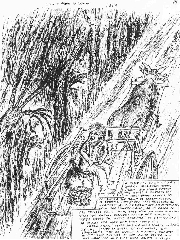 Page 15
FUEL
Our modern day cook has only to turn a knob to start
heat in the kitchen stove. Just flick a thermostat to adjust the
heat in the house.
During the years when Dad was growing up, he had to go
to the woods, cut down threes, cut and split the logs, load the wood
on a cart and haul it to the wood pile at the house. There it was
stacked to dry.
Most rooms, both down stairs and up stairs had fireplaces.
The food was also cooked in a fireplace. Houses were drafty and not
insulated and a lot of the heat from the fire went up the chimney.
Since Dad was the oldest boy in the family, it was his
daily task to keep all the wood-boxes filled. Dry wood had to be
cut and split to fire place size and length and carried in, one arm
load at a time. That included the up-stairs wood-boxes too.
They burned fuel like it grew on trees !
AUNTIE
Young Frank had an aunt that lived with the family.
She occupied an up-stairs room with a fireplace. Occasionally,
some of the wood would be smutty on a side due to forest fires.
Now, Auntie was very particular about not getting her
hands soiled. If she found a piece of smutty wood, she would throw
it out the window. Now our boy thought that if he could carry it
all the way upstairs, she could at least throw it in the fire place.
He never forgot it.
Page 16
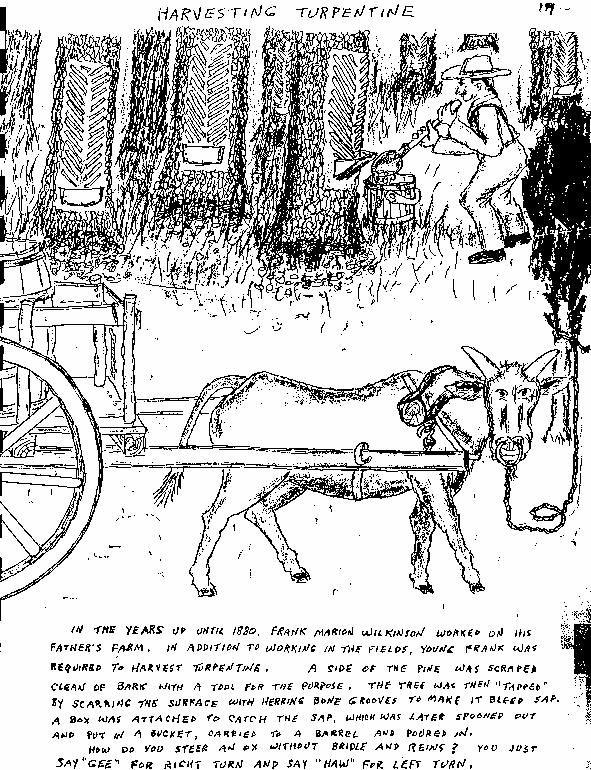
Dad used to tell of his expierence working in the woods
gathering turpentine, when he became old enough. I remember some of
the tools he had that he once had used to harvest turpentine. There
was a “spoon” that he used for dipping pine sap out of “boxes” secured
to the side of a long leaf pine. The “spoon” was about eight inches
wide and about ten inches long, egg shaped, flat, with a sleeve at the
butt end to fasten the handle. He had a bark scraper to remove bark.
A set of herring bone-like grooves were scored into side of the tree
to bleed the sap and send it flowing down the center of the score marks
into the box. The sap was spooned out of the boxes into wooden buckets
and taken to barrels and poured in.
Dad also had some “coopers” tools that he used to make barrels.
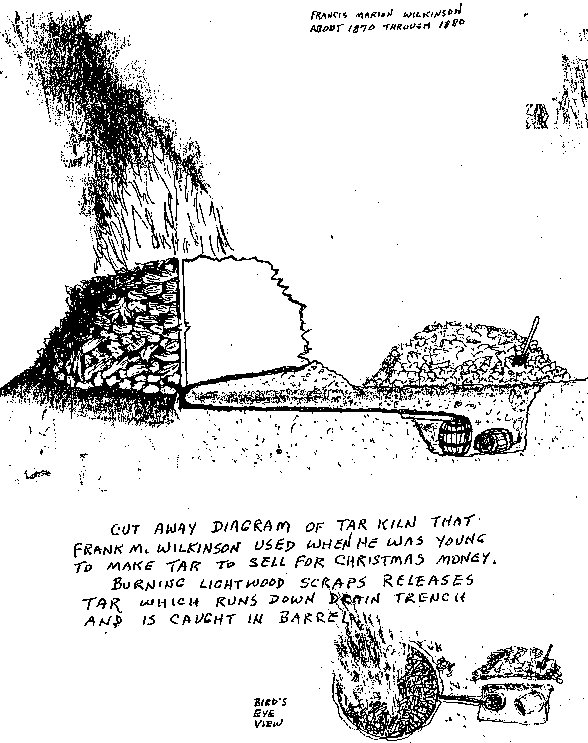
Old lightwood knots and stumps were scattered through the
forest. When this lightwood is burned, concentrated turpentine in the
old wood becomes hot and runs out, in the form of pine tar. Young
Frank would gather lightwood through the year, and in the winter, he
would burn what he called a “tarkil” for Christmas money. His “tarkil”
consisted of a circle in the ground abut 12 or 15 feet in diameter,
draining to the center, with a drainage trench from the center to a
hole in the ground large enough to handle a barrel, located a safe
distance away.
Lightwood was piled in the circle till it was piled high.
When the time came, it was set afire. The tar freed from the burning
lightwood would flow down the chute and into the barrel.
Page 17 Illustration –
Page 15
FUEL
Our modern day cook has only to turn a knob to start
heat in the kitchen stove. Just flick a thermostat to adjust the
heat in the house.
During the years when Dad was growing up, he had to go
to the woods, cut down threes, cut and split the logs, load the wood
on a cart and haul it to the wood pile at the house. There it was
stacked to dry.
Most rooms, both down stairs and up stairs had fireplaces.
The food was also cooked in a fireplace. Houses were drafty and not
insulated and a lot of the heat from the fire went up the chimney.
Since Dad was the oldest boy in the family, it was his
daily task to keep all the wood-boxes filled. Dry wood had to be
cut and split to fire place size and length and carried in, one arm
load at a time. That included the up-stairs wood-boxes too.
They burned fuel like it grew on trees !
AUNTIE
Young Frank had an aunt that lived with the family.
She occupied an up-stairs room with a fireplace. Occasionally,
some of the wood would be smutty on a side due to forest fires.
Now, Auntie was very particular about not getting her
hands soiled. If she found a piece of smutty wood, she would throw
it out the window. Now our boy thought that if he could carry it
all the way upstairs, she could at least throw it in the fire place.
He never forgot it.
Page 16
Dad used to tell of his expierence working in the woods
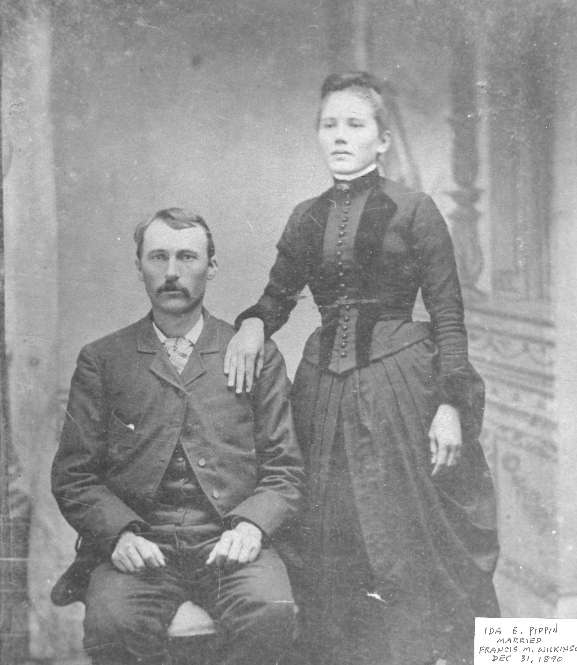
gathering turpentine, when he became old enough. I remember some of
the tools he had that he once had used to harvest turpentine. There
was a “spoon” that he used for dipping pine sap out of “boxes” secured
to the side of a long leaf pine. The “spoon” was about eight inches
wide and about ten inches long, egg shaped, flat, with a sleeve at the
butt end to fasten the handle. He had a bark scraper to remove bark.
A set of herring bone-like grooves were scored into side of the tree
to bleed the sap and send it flowing down the center of the score marks
into the box. The sap was spooned out of the boxes into wooden buckets
and taken to barrels and poured in.
Dad also had some “coopers” tools that he used to make barrels.
Old lightwood knots and stumps were scattered through the
forest. When this lightwood is burned, concentrated turpentine in the
old wood becomes hot and runs out, in the form of pine tar. Young
Frank would gather lightwood through the year, and in the winter, he
would burn what he called a “tarkil” for Christmas money. His “tarkil”
consisted of a circle in the ground abut 12 or 15 feet in diameter,
draining to the center, with a drainage trench from the center to a
hole in the ground large enough to handle a barrel, located a safe
distance away.
Lightwood was piled in the circle till it was piled high.
When the time came, it was set afire. The tar freed from the burning
lightwood would flow down the chute and into the barrel.
Page 17 Illustration – 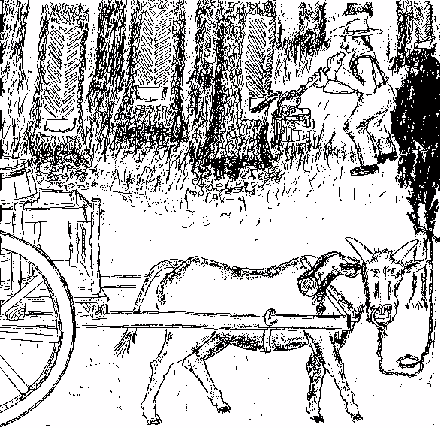 Harvesting Turpentine
Page 18
Harvesting Turpentine
Page 18 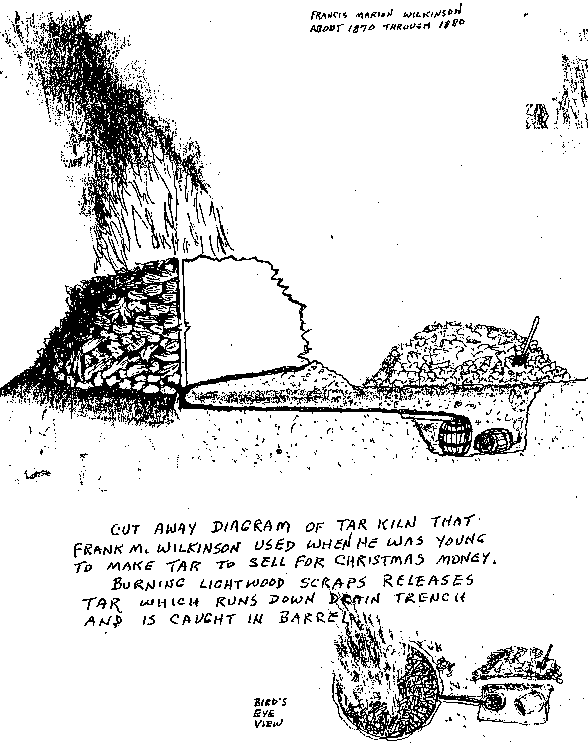 Tar Kiln
Page 19
Pine tar was valuable for medicinal purposes and for
treating rope, wood and numerous other uses back in those times.
People could not freeze food in those days, and home
makers didn’t know much about canning, so the only methods of keeping
food over a period of time was by salting and smoking.
Dad used to recall having lunch in the turpentine woods.
Sometimes, it consisted of corn bread and salt fish. Sometimes, they
wouldn’t get enough salt soaked out of the fish before cooking it and
it would be so salty that, as he said, “I would take a big bite of
corn bread and a little bite of fish”.
Sometimes, when he got thirsty, and didn’t have water with
him, he would cut a straw and drink stale rain water out of a boxed pine.
Dad loved candy. He never got enough of it when he was
growing up. Once, when he was due to get some money, he left his work
in the woods and walked four miles to a store for a nickel’s worth of
candy. He promised to bring the money for the candy as soon as he got
paid. The store deeper told him to first bring the money and he could
get the candy. No credit.
Well, our boy had to walk 4 miles back, empty handed, and
work just as hard as he could to make up for all that lost time.
When Dad became a man, friends learned of his
love for candy, and in his older years, they sometimes gave him a box
of fancy chocolates for Christmas. He would put the box of candy away
and eat one piece about once a week, making it last as long as possible.
Tar Kiln
Page 19
Pine tar was valuable for medicinal purposes and for
treating rope, wood and numerous other uses back in those times.
People could not freeze food in those days, and home
makers didn’t know much about canning, so the only methods of keeping
food over a period of time was by salting and smoking.
Dad used to recall having lunch in the turpentine woods.
Sometimes, it consisted of corn bread and salt fish. Sometimes, they
wouldn’t get enough salt soaked out of the fish before cooking it and
it would be so salty that, as he said, “I would take a big bite of
corn bread and a little bite of fish”.
Sometimes, when he got thirsty, and didn’t have water with
him, he would cut a straw and drink stale rain water out of a boxed pine.
Dad loved candy. He never got enough of it when he was
growing up. Once, when he was due to get some money, he left his work
in the woods and walked four miles to a store for a nickel’s worth of
candy. He promised to bring the money for the candy as soon as he got
paid. The store deeper told him to first bring the money and he could
get the candy. No credit.
Well, our boy had to walk 4 miles back, empty handed, and
work just as hard as he could to make up for all that lost time.
When Dad became a man, friends learned of his
love for candy, and in his older years, they sometimes gave him a box
of fancy chocolates for Christmas. He would put the box of candy away
and eat one piece about once a week, making it last as long as possible.
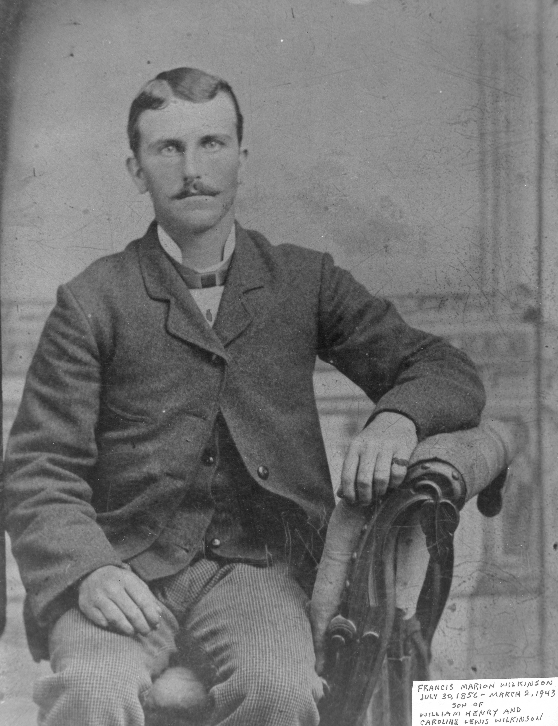
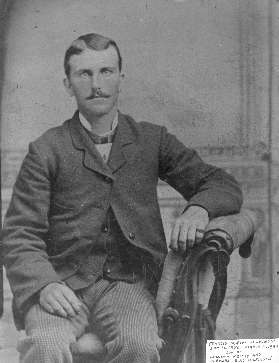 Page 20 Picture: Francis Marion Wilkinson
July 30,1856-March 2, 1943
Son of William Henry and Caroline Lewis Wilkinson
Page 21
Dad worked for his father until he was 24 years old.
Before his father gave him permission to leave home and seek his
fortune on his own. Dad felt that he had been cheated of three
years. When his sons reached maturity he was determined to see
that it didn’t happen to them. When they became 21, he made his
little speech. He wasn’t trying to “push them out of the next”,
but he wanted to let them know they were their own free men.
Dad used to recall a treat that he enjoyed on an
occasional trip to Washington. There was an old colored woman
that cooked molasses ginger bread and sold it on the street. She
sold a square of ginger bread for three cents that was about 2 ½
inches thick and 4 inches square. He said it was almost too good
to eat. It was enough to make him a whole meal.
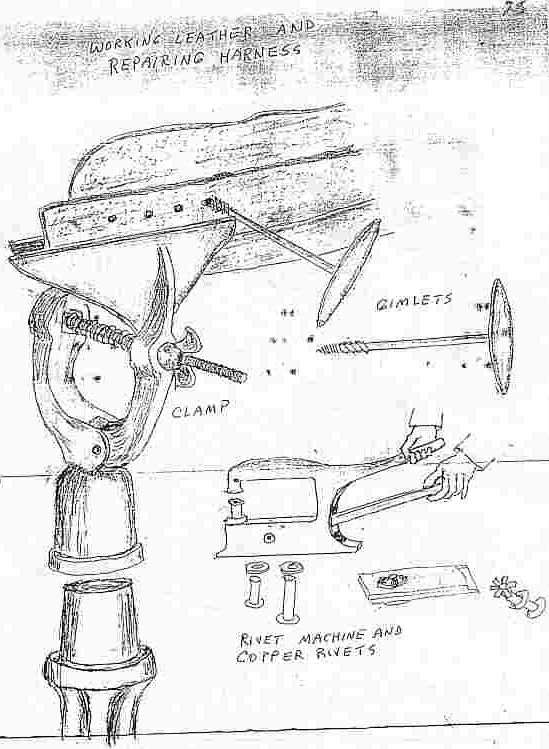
In Dad’s early years, they made and repaired their own
shoes. I rember his set of shoe lasts. That was a set of various
sizes of steel forms to hold a shoe up side down while nails or wood
shoe pegs were driven in the soles. He had bee’s waxed linen thread
for sewing leather, various punches, awls, sewing awls, a few wood
shoe pegs for use as nails and a riveting device for making harness
for horses.
An education was not available to Dad during and right
after the Civil War, so he had to teach himself to read with the help
of a “Blue Back Spelling Book”. I don’t know what was in the book,
but by his description, it sounded like it was more complicated than
anything the kids have today.
Page 22
Page 23
Page 20 Picture: Francis Marion Wilkinson
July 30,1856-March 2, 1943
Son of William Henry and Caroline Lewis Wilkinson
Page 21
Dad worked for his father until he was 24 years old.
Before his father gave him permission to leave home and seek his
fortune on his own. Dad felt that he had been cheated of three
years. When his sons reached maturity he was determined to see
that it didn’t happen to them. When they became 21, he made his
little speech. He wasn’t trying to “push them out of the next”,
but he wanted to let them know they were their own free men.
Dad used to recall a treat that he enjoyed on an
occasional trip to Washington. There was an old colored woman
that cooked molasses ginger bread and sold it on the street. She
sold a square of ginger bread for three cents that was about 2 ½
inches thick and 4 inches square. He said it was almost too good
to eat. It was enough to make him a whole meal.
In Dad’s early years, they made and repaired their own
shoes. I rember his set of shoe lasts. That was a set of various
sizes of steel forms to hold a shoe up side down while nails or wood
shoe pegs were driven in the soles. He had bee’s waxed linen thread
for sewing leather, various punches, awls, sewing awls, a few wood
shoe pegs for use as nails and a riveting device for making harness
for horses.
An education was not available to Dad during and right
after the Civil War, so he had to teach himself to read with the help
of a “Blue Back Spelling Book”. I don’t know what was in the book,
but by his description, it sounded like it was more complicated than
anything the kids have today.
Page 22
Page 23 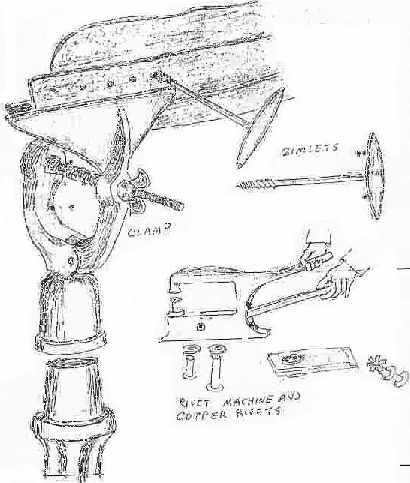 Illustration – cobbler’s tools
Page 24
Page 25 Illustration - through 1930
Old Time Brace does not lock the bit in.
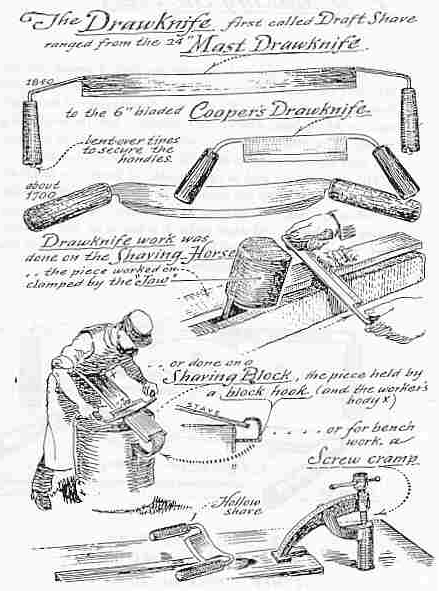
Frank M. Wilkinson's shaving horse. The iron clamp holds work down
while drawing knife. Shaves bits from work.
Long Wood Plane
These antique tools were used by F. M. Wilkinson
Page 26
Illustration – cobbler’s tools
Page 24
Page 25 Illustration - through 1930
Old Time Brace does not lock the bit in.
Frank M. Wilkinson's shaving horse. The iron clamp holds work down
while drawing knife. Shaves bits from work.
Long Wood Plane
These antique tools were used by F. M. Wilkinson
Page 26 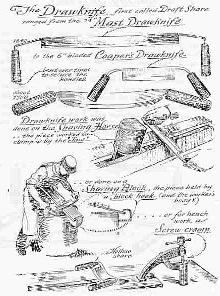 Image – Draw Knives
Page 27
Image – Draw Knives
Page 27  Photo
Page 28
Photo
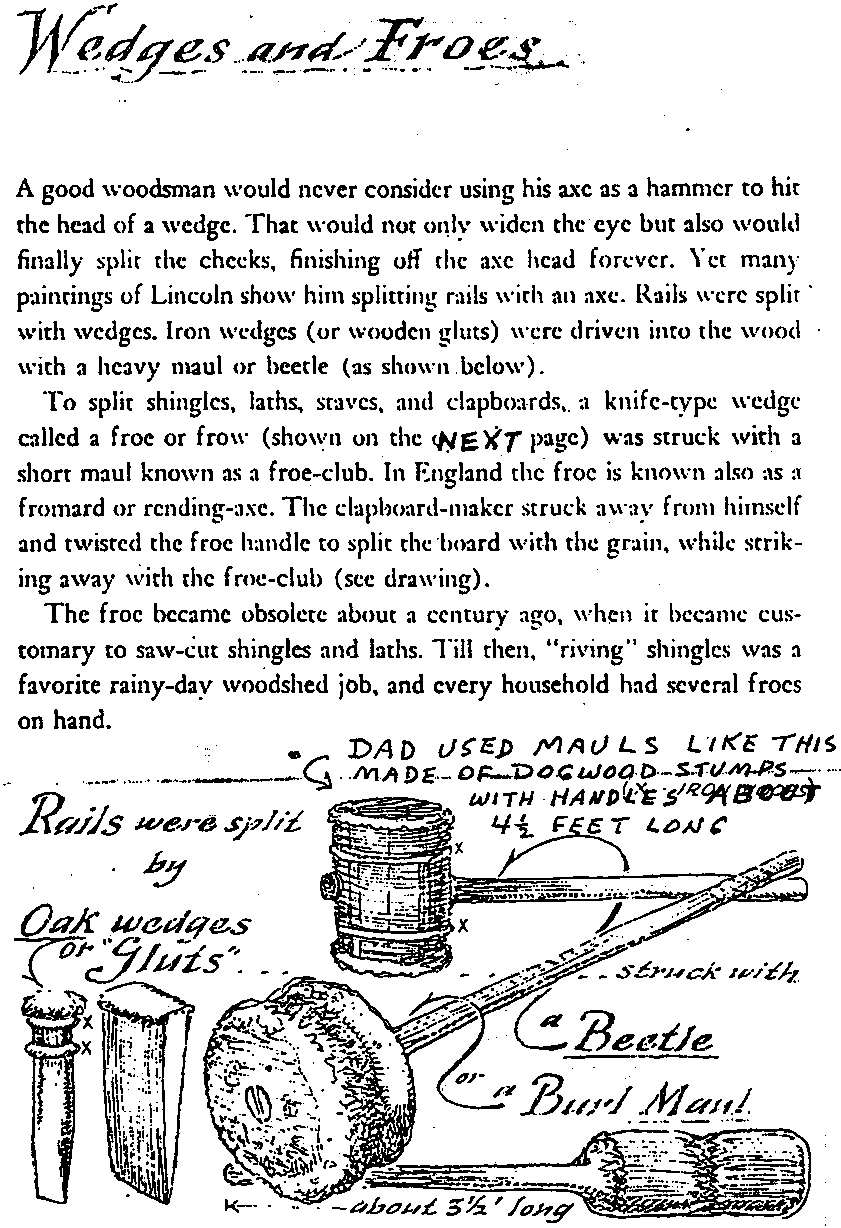
Page 28 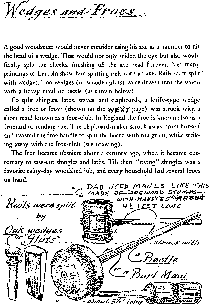 Image – Wedges and Mauls
Page 29
Image – Wedges and Mauls
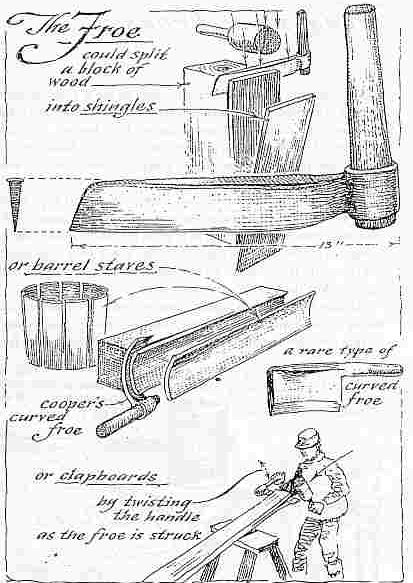
Page 29 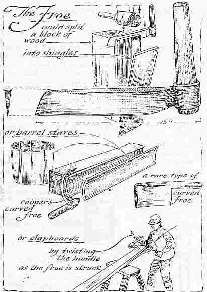 Image – Froes
Page 30
When dad left home, the south was still in the process
of recovering from the aftermath of the Civil War and good jobs were
scarce, and Dad had no schooling.
Dad would tell us about a job he had at a saw mill. He
was paid a whopping $8.00 per month. His task was to keep the saw
dust moved away from the saw, as fast as it accumulated around the
blade. He moved it out in a wheel barrow. It would build up so fast
that he had to run with the wheel barrow to the pile to dump it and
run back or it would pile up ahead of him.
As time moved on, our young man worked at various jobs
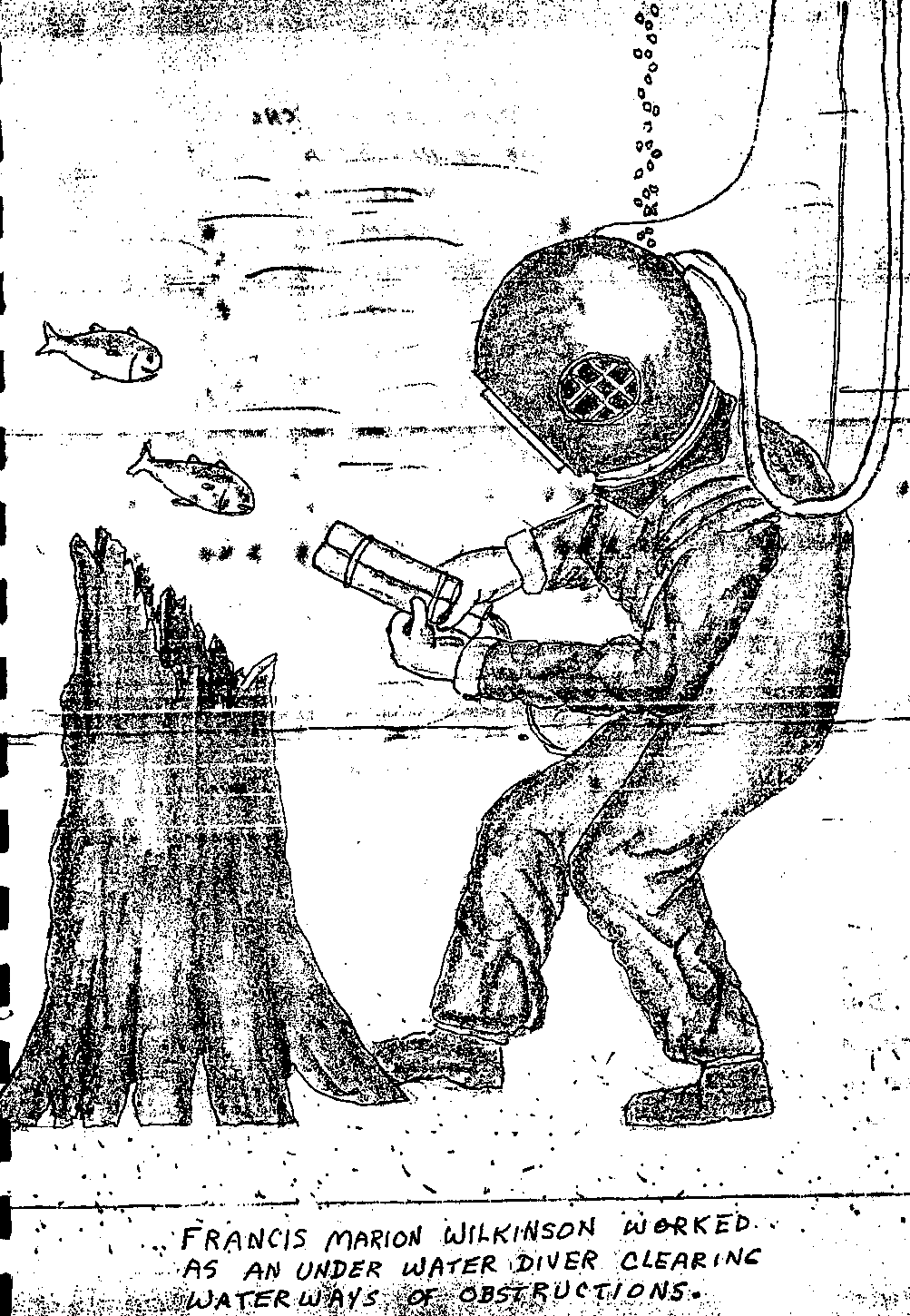
including a job as under water diver. The government was clearing water
ways of stumps and snags that were hazardous to shipping. One of his
duties was to go down and set dynamite charges and blow stumps out of
the river bed or loosen them and break them up so they could be removed.
The captain of the boat became sick and lost his appetite.
He decided he wanted some rice, so Dad volunteered to cook him some.
Dad was not an expert cook but he knew rice had to be boiled, so he
filled a pot with rice, added water and put it on the stove. Soon,
the rice began to swell and overflow. Dad had to stay by the pot,
dipping out the swelling rice and throwing it overboard, to keep from
flooding the galley with rice. From that expierence he learned to put
a little rice and a lot of water.
Page 31
Image – Froes
Page 30
When dad left home, the south was still in the process
of recovering from the aftermath of the Civil War and good jobs were
scarce, and Dad had no schooling.
Dad would tell us about a job he had at a saw mill. He
was paid a whopping $8.00 per month. His task was to keep the saw
dust moved away from the saw, as fast as it accumulated around the
blade. He moved it out in a wheel barrow. It would build up so fast
that he had to run with the wheel barrow to the pile to dump it and
run back or it would pile up ahead of him.
As time moved on, our young man worked at various jobs
including a job as under water diver. The government was clearing water
ways of stumps and snags that were hazardous to shipping. One of his
duties was to go down and set dynamite charges and blow stumps out of
the river bed or loosen them and break them up so they could be removed.
The captain of the boat became sick and lost his appetite.
He decided he wanted some rice, so Dad volunteered to cook him some.
Dad was not an expert cook but he knew rice had to be boiled, so he
filled a pot with rice, added water and put it on the stove. Soon,
the rice began to swell and overflow. Dad had to stay by the pot,
dipping out the swelling rice and throwing it overboard, to keep from
flooding the galley with rice. From that expierence he learned to put
a little rice and a lot of water.
Page 31 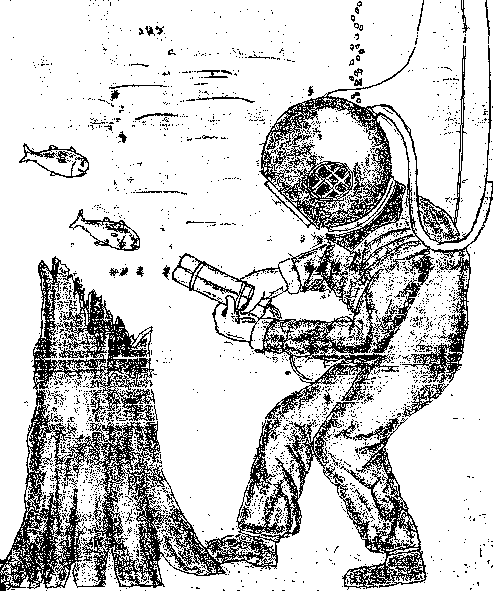 Illustration – Diver
Page 32
DOCTOR
Dad once became too sick to work so he went to see a
doctor for a cure. The doctor examined him and prescribed a bottle
of medicine with instructions to take a dose each day for a week and
he would be well enough to go back to work. That didn’t satisfy Dad
because he wanted to go back to work the next day.
If it took seven applications of the medicine to cure him,
why string it out for a week? He took it all at one time so he could
get well at once. He found it didn’t work that way. He became really
sick that time. He also got a serious lecture from his doctor.
Page 33
YADKIN RIVER
There is a river in North Carolina named the Yakin River.
It begins near Blowing Rock, N.C. and it meanders eastward and on
through a system of lakes and then emerges as the Pee Dee River.
The Pee Dee flows south east through North Carolina and finally
reaches the Atlantic Ocean at George Town, South Carolina.
Dad was once called upon to do something he had not done
before. Far up the Yadkin River were unassembled parts of a steam boat.
They wanted the boat brought down the river. They sent him to put the
steam boat together and launch it and steam it down the river. He went
and he assembled the craft.
Frank Wilkinson was the first person to ever pilot a power
boat down the Yadkin River. He was amused at the people along the river.
They would hide behind trees and point at the smoke belching monster
floating past them on the way down stream.
Because of his experience with river boats and his experience
with the clearing of local waterways, Dad was contacted by the Corp of
Engineers to take over a project to clear the Yadkin River and make it
safe and efficent for river traffic.
This would have been a good job for Dad but he felt that he
was not really qualified. He realized that this would require a person
with the knowledge of surveying and engineering skills that he did not have,
and he had no intentions of trying to fake it. Therefore, he declined.
Page 34
SHAKE, RATTLE AND ROLL
When Dad was about 30 years of age, there was a disturbance that
had every one in the house frightened. Dad immediately guessed what was
happening. Someone said there were people outside trying to turn the house
over, and he ran out to stop them. Dad told them what it actually was.
This was August 31, 1886. Charleston, South Carolina was almost
flattened by an earthquake. Few buildings were left undamaged. 110 people
lost their lives. The quake cracked walls in Chicago 750 miles away; it
was felt over an area of 1.5 million square miles, from Massachusetts to
Wisconsin to Bermuda. It was about 7 on the Richter scale.
Earthquakes are not as frequent in the eastern part of the United
States as they are in the west, but the ones that do occur cover a much larger
area.
page 35
BROOMS
Our modern homes have floors covered with carpet or the floors
may be varnished hard wood or vinyl. The housewife cleans her floors
with a vaccum cleaner, dust mop and stick broom.
Her great grandmother swept her floors with a “straw broom”
and got down on her knees and scrubbed them with water and lye soap.
The wood was bleached almost white.
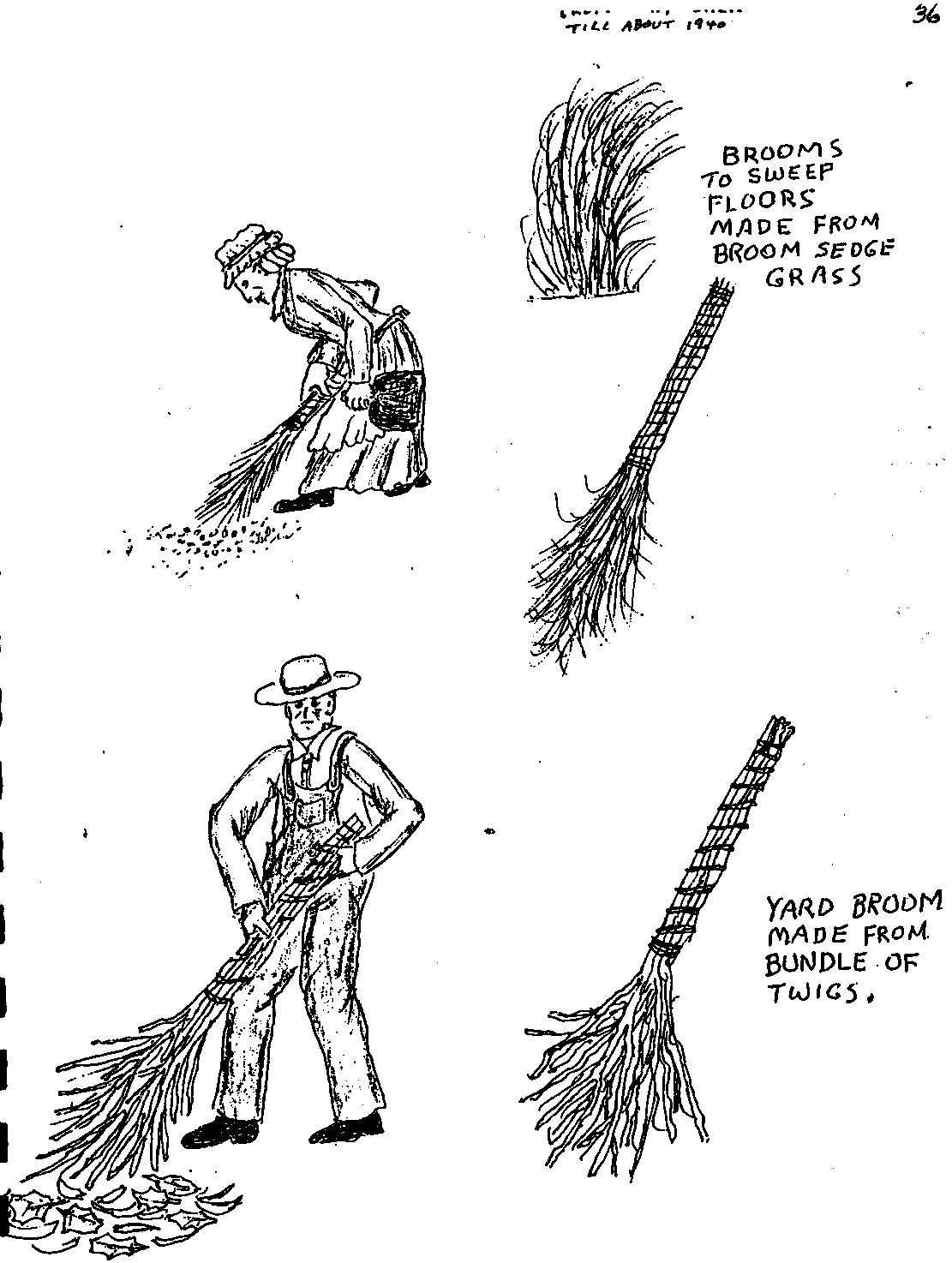
She made her straw broom herself. She cut a bundle of “broom
straw” and wrapped twine around about two feet of the butt ends and used
the bushy ends to sweep with. The broom straw was found on ditch banks
and the un-plowed edges of fields. It looks like a form of grass, about 3
or 4 feet tall with a stiff stem running most of the way up the plant.
Grass like blades run out the sides of the stem and the top is bushy with
fluffy seed pieces that float away in the wind.
YARD BROOMS
She swept the fallen leaves from the yard with a brush broom which was a
bundle of small straight branches with bushy ends cut from small selected
hardwood trees or branches. They were cut about five feet long and the
butt ends were tied into a bundle with wire or strong cord. Fan rakes
had not been invented.
Page 36
Illustration – Diver
Page 32
DOCTOR
Dad once became too sick to work so he went to see a
doctor for a cure. The doctor examined him and prescribed a bottle
of medicine with instructions to take a dose each day for a week and
he would be well enough to go back to work. That didn’t satisfy Dad
because he wanted to go back to work the next day.
If it took seven applications of the medicine to cure him,
why string it out for a week? He took it all at one time so he could
get well at once. He found it didn’t work that way. He became really
sick that time. He also got a serious lecture from his doctor.
Page 33
YADKIN RIVER
There is a river in North Carolina named the Yakin River.
It begins near Blowing Rock, N.C. and it meanders eastward and on
through a system of lakes and then emerges as the Pee Dee River.
The Pee Dee flows south east through North Carolina and finally
reaches the Atlantic Ocean at George Town, South Carolina.
Dad was once called upon to do something he had not done
before. Far up the Yadkin River were unassembled parts of a steam boat.
They wanted the boat brought down the river. They sent him to put the
steam boat together and launch it and steam it down the river. He went
and he assembled the craft.
Frank Wilkinson was the first person to ever pilot a power
boat down the Yadkin River. He was amused at the people along the river.
They would hide behind trees and point at the smoke belching monster
floating past them on the way down stream.
Because of his experience with river boats and his experience
with the clearing of local waterways, Dad was contacted by the Corp of
Engineers to take over a project to clear the Yadkin River and make it
safe and efficent for river traffic.
This would have been a good job for Dad but he felt that he
was not really qualified. He realized that this would require a person
with the knowledge of surveying and engineering skills that he did not have,
and he had no intentions of trying to fake it. Therefore, he declined.
Page 34
SHAKE, RATTLE AND ROLL
When Dad was about 30 years of age, there was a disturbance that
had every one in the house frightened. Dad immediately guessed what was
happening. Someone said there were people outside trying to turn the house
over, and he ran out to stop them. Dad told them what it actually was.
This was August 31, 1886. Charleston, South Carolina was almost
flattened by an earthquake. Few buildings were left undamaged. 110 people
lost their lives. The quake cracked walls in Chicago 750 miles away; it
was felt over an area of 1.5 million square miles, from Massachusetts to
Wisconsin to Bermuda. It was about 7 on the Richter scale.
Earthquakes are not as frequent in the eastern part of the United
States as they are in the west, but the ones that do occur cover a much larger
area.
page 35
BROOMS
Our modern homes have floors covered with carpet or the floors
may be varnished hard wood or vinyl. The housewife cleans her floors
with a vaccum cleaner, dust mop and stick broom.
Her great grandmother swept her floors with a “straw broom”
and got down on her knees and scrubbed them with water and lye soap.
The wood was bleached almost white.
She made her straw broom herself. She cut a bundle of “broom
straw” and wrapped twine around about two feet of the butt ends and used
the bushy ends to sweep with. The broom straw was found on ditch banks
and the un-plowed edges of fields. It looks like a form of grass, about 3
or 4 feet tall with a stiff stem running most of the way up the plant.
Grass like blades run out the sides of the stem and the top is bushy with
fluffy seed pieces that float away in the wind.
YARD BROOMS
She swept the fallen leaves from the yard with a brush broom which was a
bundle of small straight branches with bushy ends cut from small selected
hardwood trees or branches. They were cut about five feet long and the
butt ends were tied into a bundle with wire or strong cord. Fan rakes
had not been invented.
Page 36 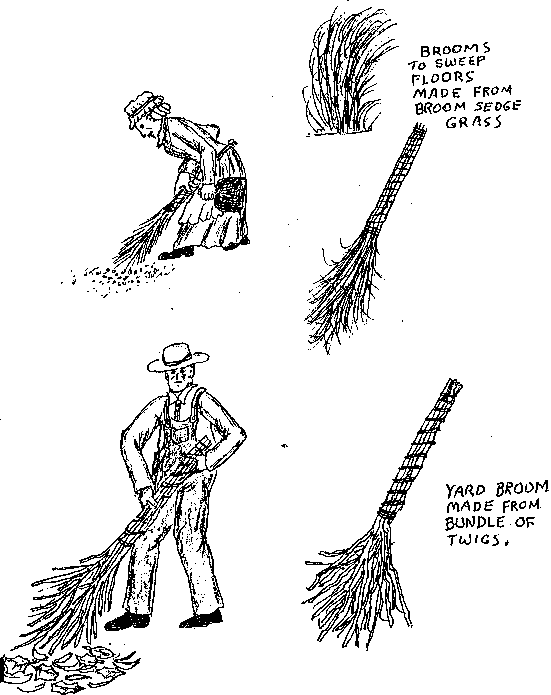 Illustration – Brooms
Brooms to sweep floors made from broom sedge grass
Yard broom made from bundle of twigs
Page 37
Page 38
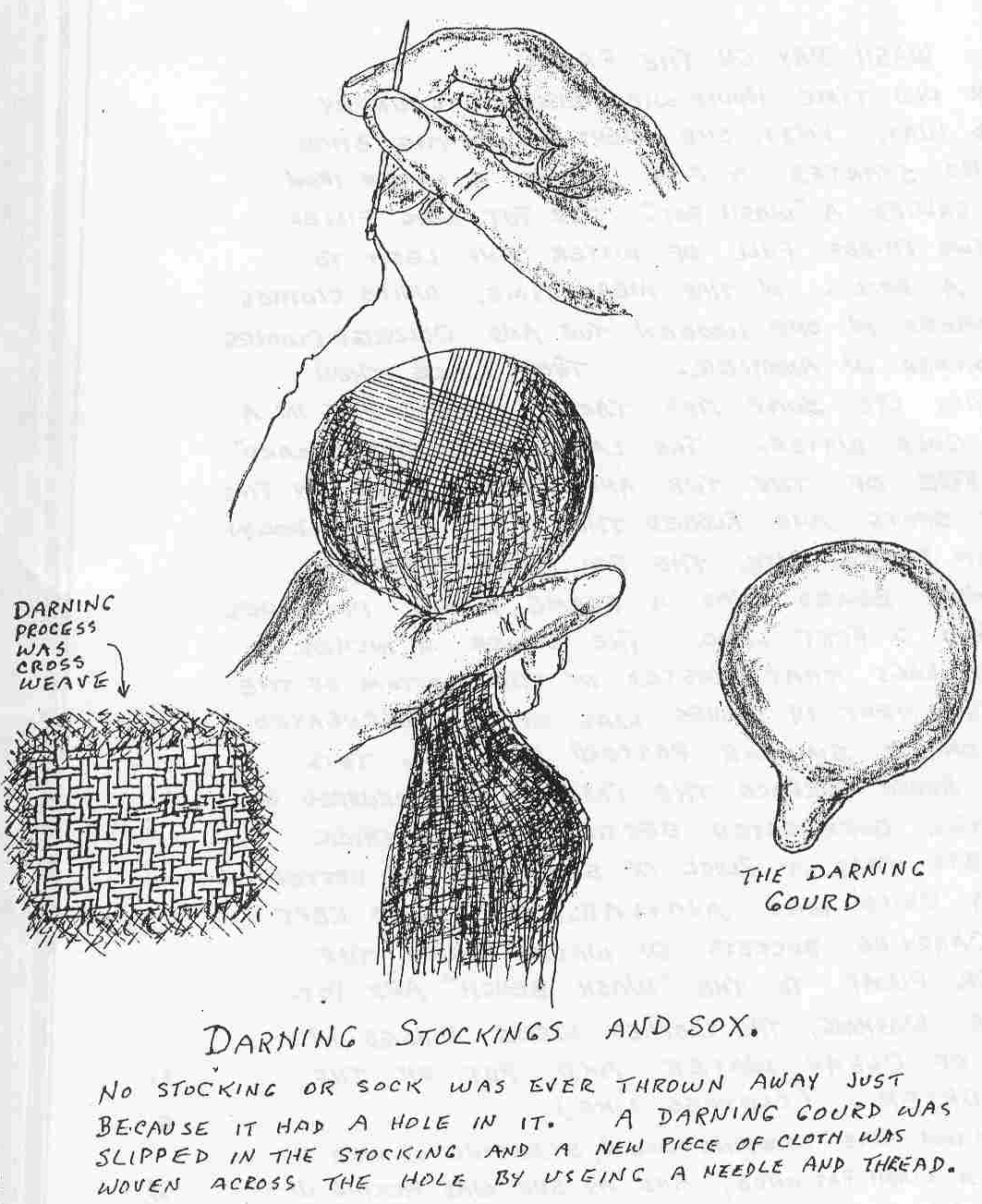
MENDING CLOTHING
Clothing was made from hand spun threads made with a spinning
wheel and woven by hand on a loom. This cloth was dyed and cut and
fashioned with a needle and thread. Worn and ripped clothing was mended,
darned or patched and re-patched as long as possible. Frank Wilkinson
recalled the skill of a relative who could darn a hole in a dress so
skillfully that when she finished, you could not find the place she had
mended.
Knitting played an important part in the wardrobe. Sweaters
and head pieces and especially stockings and sox were made at home. If a
sock had a hole in it, it went into the mending bag. When the housewife
of daughter had a spare moment to sit down, she might get out the old
mending bag and start patching and darning. To darn a sock, she slipped
a “darning Gourd” in the sock and pressed the hole tight against the gourd.
She then proceded to weave threads across the hole and vertically with
needle and thread until she made a new piece of woven cloth where the hole
had been.
Ironing was done with a hollow iron that was filled with live
burning coals. When iron cook stoves became available, cast iron irons
were heated on the stove and tested for “hotness” by licking a finger and
quickly hiting the iron with it. If the moisture on the finger sizzled
just right, the iron was hot enough
Page 38 illustration
No stocking or sock was ever thrown away just because it had a hole in it.
A darning gourd was slipped in the stocking and a new piece of cloth was
woven across the hole by using a needle and thread.
Page 39
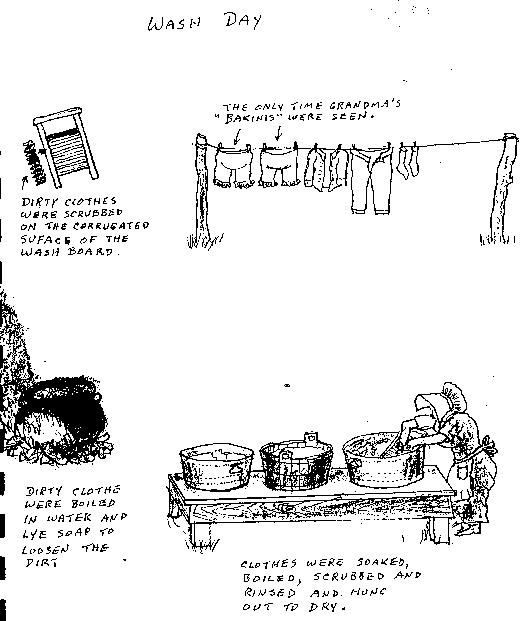
WASH DAY ON THE FARM
Our old time housewife did her laundry the hard way. First,
she went out in the back yard and started a fire around a large iron
kettle called a “wash pot”. The pot was filled about two thirds full of
water and left to come to a boil. In the mean time, white clothes were
soaked in one wooden tub and colored clothes were soaked in another.
They were then boiled with lye soap and taken up and put in a tub of cold
water. The lady put a “wash board” in the side of the tub and rubbed
soap on the dirtiest spots and rubbed the fabric up and down the wash
board until the soil disappeared.
A wash board was a frame about 14 inches wide and 2 feet long.
The lower 4 inches was two legs that rested in the bottom of the tub.
The next 14 inches was either corrugated metal or a similar pattern of
wood. This was the rough surface the fabric was scrubbed on. Above the
corrugated section was a thick cross bar that a block of soak could be
rested on.
If a child was available, he was kept busy carrying buckets of water
from the well or pump to the “wash bench” and pot.
After washing, the clothes were rinsed in a tub of clean
water and put on the solar dryer (clothes line).
My mamma was stooping down, starting a fire around a wash
pot once, and as she was picking up bits of kindleing, one stick started
moving in her hand. She looked. She was holding a black snake. She
screamed and jumped over the pot!
Page 40
Illustration – Brooms
Brooms to sweep floors made from broom sedge grass
Yard broom made from bundle of twigs
Page 37
Page 38
MENDING CLOTHING
Clothing was made from hand spun threads made with a spinning
wheel and woven by hand on a loom. This cloth was dyed and cut and
fashioned with a needle and thread. Worn and ripped clothing was mended,
darned or patched and re-patched as long as possible. Frank Wilkinson
recalled the skill of a relative who could darn a hole in a dress so
skillfully that when she finished, you could not find the place she had
mended.
Knitting played an important part in the wardrobe. Sweaters
and head pieces and especially stockings and sox were made at home. If a
sock had a hole in it, it went into the mending bag. When the housewife
of daughter had a spare moment to sit down, she might get out the old
mending bag and start patching and darning. To darn a sock, she slipped
a “darning Gourd” in the sock and pressed the hole tight against the gourd.
She then proceded to weave threads across the hole and vertically with
needle and thread until she made a new piece of woven cloth where the hole
had been.
Ironing was done with a hollow iron that was filled with live
burning coals. When iron cook stoves became available, cast iron irons
were heated on the stove and tested for “hotness” by licking a finger and
quickly hiting the iron with it. If the moisture on the finger sizzled
just right, the iron was hot enough
Page 38 illustration
No stocking or sock was ever thrown away just because it had a hole in it.
A darning gourd was slipped in the stocking and a new piece of cloth was
woven across the hole by using a needle and thread.
Page 39
WASH DAY ON THE FARM
Our old time housewife did her laundry the hard way. First,
she went out in the back yard and started a fire around a large iron
kettle called a “wash pot”. The pot was filled about two thirds full of
water and left to come to a boil. In the mean time, white clothes were
soaked in one wooden tub and colored clothes were soaked in another.
They were then boiled with lye soap and taken up and put in a tub of cold
water. The lady put a “wash board” in the side of the tub and rubbed
soap on the dirtiest spots and rubbed the fabric up and down the wash
board until the soil disappeared.
A wash board was a frame about 14 inches wide and 2 feet long.
The lower 4 inches was two legs that rested in the bottom of the tub.
The next 14 inches was either corrugated metal or a similar pattern of
wood. This was the rough surface the fabric was scrubbed on. Above the
corrugated section was a thick cross bar that a block of soak could be
rested on.
If a child was available, he was kept busy carrying buckets of water
from the well or pump to the “wash bench” and pot.
After washing, the clothes were rinsed in a tub of clean
water and put on the solar dryer (clothes line).
My mamma was stooping down, starting a fire around a wash
pot once, and as she was picking up bits of kindleing, one stick started
moving in her hand. She looked. She was holding a black snake. She
screamed and jumped over the pot!
Page 40 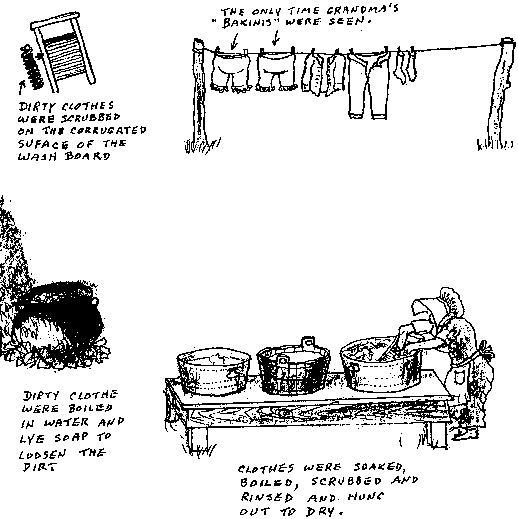 WASH DAY
Dirty clothes were scrubbed on the corrugated surface of the wash board
The only time Grandma’s “bikinis” were seen
Dirty clothes were boiled in water and lye soap to loosen the dirt
Clothes were soaked, boiled, scrubbed and rinsed and hung out to dry
Page 41
HOME MADE SOAP
Our ancestors had to make things they used because some of
those necessities were not available or because it was more economical
to make them themselves. Soap was one of those items.
Nothing useable was thrown away. They saved dirty grease
at hog killing time. They saved left over kitchen grease that could
not be used for cooking. All this fat was saved to make into soap.
Two containers were put over the fire. One was filled with
grease. The other was filled with an alkaline solution called lye.
When hot, they were removed from the fire and the grease was poured in
the lye solution and thoroughly stirred with a wooden paddle.
The soap maker usually knew from experience about how much
of each to use for the best soap. Too much lye burned the user’s skin
and damaged the laundry.
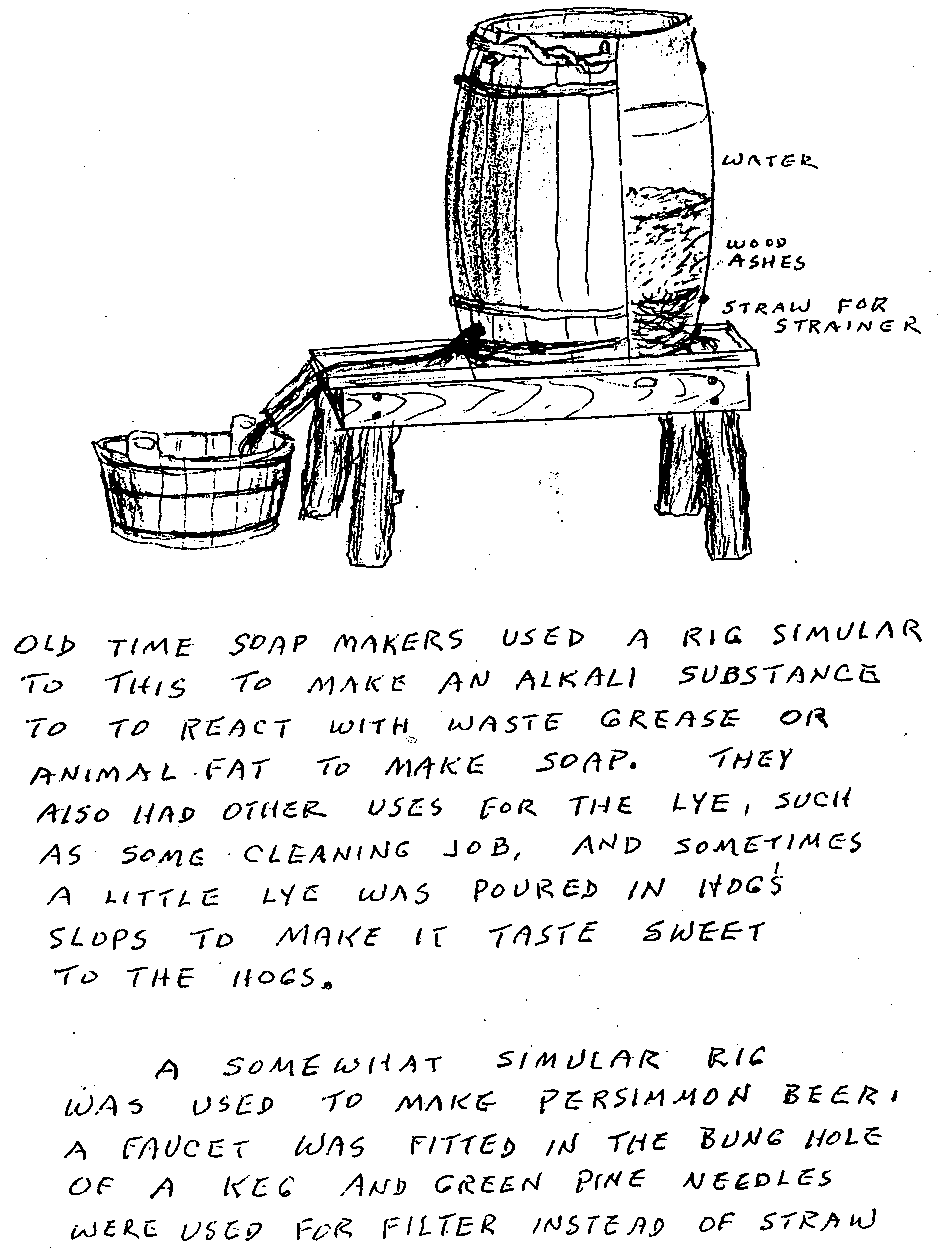
The original home made lye usually produced a soft soap.
Store bought chrystal lye produced a hard soap that could
be cut into blocks.
Care had to be taken to pour the grease into the lye – not
the lye into the hot grease. Mama made that mistake once and her
mixture boiled over and flowed across the floor and almost chased her
out of the kitchen
Page 42
MAKING LYE
Lye was originally a strong alkaline solution obtained by
leaching wood ashes. Its main use was for cleaning and making soap.
To make lye, our ancestors use a simple arrangement. They
made a small slanted platform large enough to hold a barrel. The
slanted platform drained into a tub or some sort of catch vessel. A
barrel with several drain holes in its bottom was placed on the stand.
A layer of clean fine straw lined the bottom of the barrel. The straw
served as a filter. A supply of wood ashes was dumped in over the
straw. Water was poured on the ashes. The water soaked through the
ashes absorbing the alkali and filtered through the straw, out the holes
in the barrel and into the catch vessel as a brown liquid.
Page 43
WASH DAY
Dirty clothes were scrubbed on the corrugated surface of the wash board
The only time Grandma’s “bikinis” were seen
Dirty clothes were boiled in water and lye soap to loosen the dirt
Clothes were soaked, boiled, scrubbed and rinsed and hung out to dry
Page 41
HOME MADE SOAP
Our ancestors had to make things they used because some of
those necessities were not available or because it was more economical
to make them themselves. Soap was one of those items.
Nothing useable was thrown away. They saved dirty grease
at hog killing time. They saved left over kitchen grease that could
not be used for cooking. All this fat was saved to make into soap.
Two containers were put over the fire. One was filled with
grease. The other was filled with an alkaline solution called lye.
When hot, they were removed from the fire and the grease was poured in
the lye solution and thoroughly stirred with a wooden paddle.
The soap maker usually knew from experience about how much
of each to use for the best soap. Too much lye burned the user’s skin
and damaged the laundry.
The original home made lye usually produced a soft soap.
Store bought chrystal lye produced a hard soap that could
be cut into blocks.
Care had to be taken to pour the grease into the lye – not
the lye into the hot grease. Mama made that mistake once and her
mixture boiled over and flowed across the floor and almost chased her
out of the kitchen
Page 42
MAKING LYE
Lye was originally a strong alkaline solution obtained by
leaching wood ashes. Its main use was for cleaning and making soap.
To make lye, our ancestors use a simple arrangement. They
made a small slanted platform large enough to hold a barrel. The
slanted platform drained into a tub or some sort of catch vessel. A
barrel with several drain holes in its bottom was placed on the stand.
A layer of clean fine straw lined the bottom of the barrel. The straw
served as a filter. A supply of wood ashes was dumped in over the
straw. Water was poured on the ashes. The water soaked through the
ashes absorbing the alkali and filtered through the straw, out the holes
in the barrel and into the catch vessel as a brown liquid.
Page 43
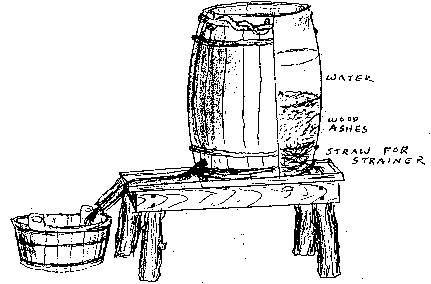 Old time soap makers used a rig similar to this to make an alkali
substance to react with waste grease or animal fat to make soap.
They also had other uses for the lye, such as some cleaning job,
and sometimes a little lye was poured in hog’s slops to make it
taste sweet to the hogs. A somewhat similar rig was used to make
persimmon beer. A faucet was fitted in the bung hole of a keg
and green pine needles were used for filter instead of straw.
Page 44
PERSIMMON BEER
An arrangement similar to the lye barrel was used to
make a drink called Persimmon Beer. A keg or barrel with a faucet
in the bung hole was used. A layer of green pine needles was
placed in the bottom of the keg as a filter. Add some wild myrtle
twigs for flavor. Add a few baked sweet potatoes and some baked
corn bread. Pour in lots of wild persimmons. Pour in water until
persimmons are well covered. Let stand ten days or more. Get the
gourd dipper and draw some and taste. Not bad – really.
Page 45
Old time soap makers used a rig similar to this to make an alkali
substance to react with waste grease or animal fat to make soap.
They also had other uses for the lye, such as some cleaning job,
and sometimes a little lye was poured in hog’s slops to make it
taste sweet to the hogs. A somewhat similar rig was used to make
persimmon beer. A faucet was fitted in the bung hole of a keg
and green pine needles were used for filter instead of straw.
Page 44
PERSIMMON BEER
An arrangement similar to the lye barrel was used to
make a drink called Persimmon Beer. A keg or barrel with a faucet
in the bung hole was used. A layer of green pine needles was
placed in the bottom of the keg as a filter. Add some wild myrtle
twigs for flavor. Add a few baked sweet potatoes and some baked
corn bread. Pour in lots of wild persimmons. Pour in water until
persimmons are well covered. Let stand ten days or more. Get the
gourd dipper and draw some and taste. Not bad – really.
Page 45
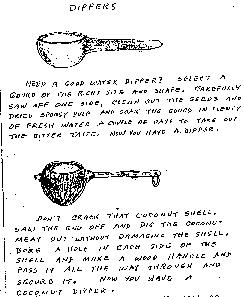 Need a good water dipper? Select a gourd of the right size and
shape. Carefully saw off one side, clean out the seeds and dried
spongy pulp and soak the gourd in plenty of fresh water a couple
of days to take out the bitter taste. Now you have a dipper.
Don’t crack that coconut shell. Saw the end off and dig the coconut
meat out without damaging the shell. Bore a hole in each side of
the shell and make a wood handle and pass it all the way through and
secure it. Now you have a coconut dipper. Hang it on a post by the
well or pump so that you and your passers-by will have something to
drink from. Rinse off the tobacco juice left by previous users
before drinking.
Page 46
MAKE MOLASSES
If our ancestors wanted something sweet to eat or drink,
they usually had to grow their own. To do that, they planted a crop
of sugar cane or sorghum.
When growing, it looks like a cross between a corn patch
and a bamboo thicket. At harvest, the leaves are stripped from the
stalks and the stalks are cut and hauled up to where a cane mill is
set up.
Someone in the area usually had a cane mill and it could
be set up when and where needed.
The main part of the mill consisted of a press which was
a pair of vertical rollers. There were turned by a mule. A long pole
was fastened overhead and geared to the rollers. The mule pulled the
end of the pole around and around in a circle activating the rollers.
An operator stood at the press feeding stalks in as space
was available. There could be at least six or eight stalks in the
rollers at a time as they passed through.
The rollers exerted great pressure squeezing the juice out.
The juice flowed down in a catch vessel.
Along with the juice press came the cooking vat.
Page 47
COOKING MOLASSES
A cooking vat was set up to cook the juice down, much the
same way as maple syrup is cooked.
The vat consisted of a vessel with a copper bottom and was
possibly six or eight feet long and four feet wide. There sides were
possibly a foot high.
A fire pit or trench was dug in the ground or it could
temporarily set up on bricks. Fuel was fed to the fire at one end
and a smoke stack was placed in the other end of the fire pit.
The watery juice was boiled and constantly stirred with a
wooden paddle to prevent it from scortching. When it was cooked down
to a fraction of its original bulk, it became thick brown mouth
watering delicious molasses.
Page 48
FOOD FOR WINTER
People of bygone days planned ahead to keep food on the
table. Hanging in the smoke house were smoked hams, shoulders, bacon
and sausage. There was salt port and salt fish. They stored sweet
potatoes in mounds called sweet potato banks which was a large pile
of potatoes covered with a foot thick layer of pine straw, over which
was a protective layer of 4 to 6 inches of soil. Over this bank was
a rough rain shelter made of scrap lumber. They planted a spring crop
of Irish potatoes and a fall crop which furnished potatoes through the
winter.
Bundles of onions and strings of red peppers hung in the
pantry. Dried and preserved fruits lined the pantry shelves and they
canned some fruits and tomatoes in glass jars. They were not always
successful in canning meats and vegetables because they were still
learning how to time the periods to boil and destroy the bacteria
that spoils some types of foods.
They dried surplus beans and peas in summer for winter use.
Until winter became too severe, they had collards and a
few other vegetables in the garden.
The took corn and wheat to the grist mill to have it ground
into meal and flour. The miller kept 1/5 of the grain for grinding.
Page 49
GARDENS
Most people had a few herbs in their garden. One herb in
most gardens was the sage bush. Some grew mint and other herbs. They
could get bay leaves from the woods to season meats and freshly made
lard. Every one grew hot red pepper. Some of it was strung, with the
aid of a needle and strong thread, into long strings and tied into a
circle and dried. Some hot pepper was put in bottles and filled with
vinegar to make hot “pepper vinegar”.
I remember How Frank M. Wilkinson planned his garden so he
would have a steady supply of vegetables most of the year.
He visited ditch banks and hedge rows in the summer and dug
wild asparagus roots which he transplanted in his garden.
Asparagus was his first fresh vegetable in the spring. When
it came time to stop cutting asparagus, it was time to pick early dwarf
garden peas. When they stopped producing, he had a larger late variety
of peas ready to start harvesting. From that he had a variety of greens
and other vegetables ready. He had a wide variety of vegetables for the
table all spring, summer and fall.
He had a system for planting sweet corn. In the early
spring he planted a variety of small early sweet corn and at the same
time he planted a standard variety. When the early variety was used up,
the standard.
page 50 missing
page 51 missing
page 52
BECAME A FARMER
Frank Wilkinson grew up on a farm and he knew that he could make
a successful carrer of it so he began looking for available farm land.
One plot he considered was located adjoining Washington’s east
side, which is now part of the town. Another plot he considered is now
part of the town of Washington Park.
Certain events possibly led him to buy the land that became
his permanent farm and home.
On July first, 1884 John B. Ross and his wife, Emily, who
was Frank’s sister, mortgaged 27 acres of land to Frank M. Wilkinson for
$500.00.
Of the 27 acres, John B. Ross and wife owned a total of 83
acres, more or less. The 83 acres was more land than either of the other
two plots he had considered.
For reasons I don’t know of, the Rosses sold the 83 acres to
Frank M. Wilkinson.
On December 30th, 1884, a deed was drawn up and John B. and
Emily W. Ross sold the farm to F. M. Wilkinson for $1800.00.
A typed copy of that deed follows on the next pages.
Copies of old original deeds to this land appears in the back
of this book starting back in 1824 and following through to copies for the
origonal deeds to John B. Ross.
Page 53
STATE OF NORTH CAROLINA
BEAUFORT COUNTY
THIS DEED, made this 30th day of December, 1884
By John B. Ross and Emily W. Ross, his wife, of Beaufort
County and state of North Carolina of the first part to Frank
H. Wilkinson of Beaufort County and state of North Carolina of
The second part.
WITNESSETH:
That said John B. Ross and wife for and in
Consideration of the sum of eighteen hundred dollars ($1800.00)
To them paid by Frank M. Wilkens, the receipt of which is
Hereby acknowledged, have bargained and sold and by these
Presents does bargain sell and convey to said Frank M. Wilkens
And his heirs of the right, title, interest and estate of the
Party of the first part in and to a tract of land in Long Acre
Township, Beaufort County, state of North Carolina, adjoining
The lands of Howard Wiswall and others described as follows, viz:
Being the share or lot of land decreed by F. M. McWilliams in
The division of the estate of his father, John McWilliams, as
Will appear by reference to said sale for partition in the court
Of pleas and quarterly sessions of Beaufort County and containing
Twenty-seven (27) acres, more or less, it being the land
Conveyed to the said John. D. Doughty by Thomas B. Bowen by deed
Dated September 25, 1877, and recorded in the register’s
Office of Beaufort County in book 43, pages 246 and 247, also
One other tract or partial, situated in the state and county
Aforesaid on the north side of the Pamlico River containing
Twenty-seven (27) acres, it being the lot or partial drawn by
Frances C. McWilliams, wife of the said John D. Doughty, in the
Partition among the heirs at law of John McWilliams to which
Partition references is made for a more particular description
Page 54
Also the life estate of the said John D. Doughty in twenty-seven
(27) acres of land more or less, adjoining the two pieces
hereinbefore conveyed, it being the piece of land drawn by
Sarah McWilliams at the partition among the heirs at law of
John McWilliams deceased, also see deed from the heirs of John
McWilliams to John B. Ross registered in the register’s office
Of Beaufort County in book 43 pages 469 and 470, making in all
eighty-three (83) acres.
TO HAVE AND TO HOLD, the aforesaid tract or
Partial of land and all privileges and appurtenances there to
Belonging to the said Frank H. Wilkinson and his heirs and assigns
To only use and behoof forever.
And the said John B. Ross and wife covenant that
They are seized of said premises in fee, and have right to
Convey the same in fee simple; that the same are free and clear
From all encumbrances and that they will warrant and defend
Said title to the same against the claims of all persons whatso-
Ever.
In testimony whereof, the said John, B. Ross and
Wife have hereunto set their hands and seals, the day and year
Above written.
John B. Ross (seal)
Emily W. Ross (seal)
State of North Carolina
Beaufort County
I, G. Wilkens, clerk of the superior court, do
Hereby certify that John B. Ross and Emily W. Ross, his wife,
Appeared before me this day and acknowledged the due execution
Of the annexed deed of conveyance, and the said Emily W. Ross
Being by me privately examined, separate and apart from
Page 55
Fear or compulsion of her said husband or of any other person,
And that she doth still voluntarily assent thereto.
Let the same with this certificate be registered.
Witness my hand this 1st day of January, 1885
G. Wilkins
Clerk Superior Court
Received for registration Jan 1, 1885.
At 4:00 p.m. and registered January 8, 1885
B. Stilley
Register
Registered in book 58, page 26,
Beaufort County Records.
Page 56
THIS INDENTURE made and entered into this 15th
day of January , 1878 by and between John D. Doughty and wife, Frances C.
Doughty parties of the first part and John B. Ross party of the second
part all of the county of Beaufort and state of North Carolina.
WITNESSETH:
That the said parties of the first part for and
in consideration of the sum of $700.00 to them paid by the said party of
the second part the receipt whereof is hereby admitted have given, granted,
bargained, and sold, and by these presents to give, grant, bargain, sell,
and convey to the said party of the second part and his heirs the following
described tracts or lots of land situated in the county and state aforesaid
on the north side of the Pamlico River adjoining the land of Howard Wiswall
and others, being the share or lot of land drawn by F. M. McWilliams in
the division of the estate of his father John McWilliams, as will appear by
reference to said suit for partition in the court of pleas and quarter
sessions of Beaufort County and containing twenty-seven (27) acres more it
less, it being the land conveyed to the said John, D. Doughty by Thomas B.
Bowen by deed dated September 25, 1877 and recorded in the registar’s
office of Beaufort County in book 43, pages 246 and 247; also one other
tract or partial of land situated in the state and County aforesaid on the
north side of the Pamlico River containing twenty-seven 927) acres, it being
the land or tract drawn by Frances C. McWilliams, wife of the said John D.
Doughty in the partition among the heirs at law of John McWilliams to
which partition reference is made for a more particular description, also
the life estate of the said John D. Doughty in twenty-seven (27) acres of
land more or less adjoining the two tracts hereinbefore conveyed, it being
the tract of land drawn by Sarah McWilliams at the _____ ? _____ ? _____.
Page 57
TO HAVE AND TO HOLD with all the privileges thereto
belonging to the said party of the second part his heirs and assigns first
two tracts, and as to the third tract, second part for the life of the said
John D. Doughty and the said parties of the first part do hereby warrant and
defend the lands and tenements aforesaid, to the said party of the second
part his heirs and assigns against the lawful claims of any and all persons.
In testimony whereof the said parties of the first
part have hereunto set their hands and seals the day and year aforesaid.
John D. Doughty (seal)
Frances D. Doughty (seal)
Witness:
John G. Blount
STATE OF NORTH CAROLINA IN THE PROBATE COURT
BEAUFORT COUNTY JANUARY 15, 1878
Personally appeared before me John G. Blount,
Probate Judge for said county, John D. Doughty and Frances C. Doughty
his wife, and acknowledged the due execution by them of the foregoing
deed, and therefore, the said Frances C. Doughty being by me privately
examined separate and apart from her said husband, touching her free
consent in her execution of the said deed, and she doth on such her
examination declare that she has executed the same freely of her own will
and accord, and without any force, fear, or undue influence of her said
husband or any other person, and did still voluntarily assent thereto.
THEREFORE, let the said deed and this certificate be registered.
John C. Blount
Probate Judge
page 58
On the 31st day of December, 1890
Francis Marion Wilkinson
and
Ida E. Pippin
were joined in marriage.
He was 34 years of age & She was 22 years of age.
This union produced the following children:
February 11, 1892 --Walter Marion-- lived 71 years
May 11, 1893 --Bruce Arnold-- lived 93 years
December 12, 1894 --Ida L.-- lived 19 months
May 16, 1896 --Guy Vernon-- lived 88 years
July 2, 1898 --Gwendolyn Caroline-- lived 83 years
September 11, 1900 --William G.-- lived 7 months
January 4, 1902 --Joseph Garland-- lived 94 years
June 6, 1904 --Francis Chilson-- lived 74 years
page 59 Photo
Need a good water dipper? Select a gourd of the right size and
shape. Carefully saw off one side, clean out the seeds and dried
spongy pulp and soak the gourd in plenty of fresh water a couple
of days to take out the bitter taste. Now you have a dipper.
Don’t crack that coconut shell. Saw the end off and dig the coconut
meat out without damaging the shell. Bore a hole in each side of
the shell and make a wood handle and pass it all the way through and
secure it. Now you have a coconut dipper. Hang it on a post by the
well or pump so that you and your passers-by will have something to
drink from. Rinse off the tobacco juice left by previous users
before drinking.
Page 46
MAKE MOLASSES
If our ancestors wanted something sweet to eat or drink,
they usually had to grow their own. To do that, they planted a crop
of sugar cane or sorghum.
When growing, it looks like a cross between a corn patch
and a bamboo thicket. At harvest, the leaves are stripped from the
stalks and the stalks are cut and hauled up to where a cane mill is
set up.
Someone in the area usually had a cane mill and it could
be set up when and where needed.
The main part of the mill consisted of a press which was
a pair of vertical rollers. There were turned by a mule. A long pole
was fastened overhead and geared to the rollers. The mule pulled the
end of the pole around and around in a circle activating the rollers.
An operator stood at the press feeding stalks in as space
was available. There could be at least six or eight stalks in the
rollers at a time as they passed through.
The rollers exerted great pressure squeezing the juice out.
The juice flowed down in a catch vessel.
Along with the juice press came the cooking vat.
Page 47
COOKING MOLASSES
A cooking vat was set up to cook the juice down, much the
same way as maple syrup is cooked.
The vat consisted of a vessel with a copper bottom and was
possibly six or eight feet long and four feet wide. There sides were
possibly a foot high.
A fire pit or trench was dug in the ground or it could
temporarily set up on bricks. Fuel was fed to the fire at one end
and a smoke stack was placed in the other end of the fire pit.
The watery juice was boiled and constantly stirred with a
wooden paddle to prevent it from scortching. When it was cooked down
to a fraction of its original bulk, it became thick brown mouth
watering delicious molasses.
Page 48
FOOD FOR WINTER
People of bygone days planned ahead to keep food on the
table. Hanging in the smoke house were smoked hams, shoulders, bacon
and sausage. There was salt port and salt fish. They stored sweet
potatoes in mounds called sweet potato banks which was a large pile
of potatoes covered with a foot thick layer of pine straw, over which
was a protective layer of 4 to 6 inches of soil. Over this bank was
a rough rain shelter made of scrap lumber. They planted a spring crop
of Irish potatoes and a fall crop which furnished potatoes through the
winter.
Bundles of onions and strings of red peppers hung in the
pantry. Dried and preserved fruits lined the pantry shelves and they
canned some fruits and tomatoes in glass jars. They were not always
successful in canning meats and vegetables because they were still
learning how to time the periods to boil and destroy the bacteria
that spoils some types of foods.
They dried surplus beans and peas in summer for winter use.
Until winter became too severe, they had collards and a
few other vegetables in the garden.
The took corn and wheat to the grist mill to have it ground
into meal and flour. The miller kept 1/5 of the grain for grinding.
Page 49
GARDENS
Most people had a few herbs in their garden. One herb in
most gardens was the sage bush. Some grew mint and other herbs. They
could get bay leaves from the woods to season meats and freshly made
lard. Every one grew hot red pepper. Some of it was strung, with the
aid of a needle and strong thread, into long strings and tied into a
circle and dried. Some hot pepper was put in bottles and filled with
vinegar to make hot “pepper vinegar”.
I remember How Frank M. Wilkinson planned his garden so he
would have a steady supply of vegetables most of the year.
He visited ditch banks and hedge rows in the summer and dug
wild asparagus roots which he transplanted in his garden.
Asparagus was his first fresh vegetable in the spring. When
it came time to stop cutting asparagus, it was time to pick early dwarf
garden peas. When they stopped producing, he had a larger late variety
of peas ready to start harvesting. From that he had a variety of greens
and other vegetables ready. He had a wide variety of vegetables for the
table all spring, summer and fall.
He had a system for planting sweet corn. In the early
spring he planted a variety of small early sweet corn and at the same
time he planted a standard variety. When the early variety was used up,
the standard.
page 50 missing
page 51 missing
page 52
BECAME A FARMER
Frank Wilkinson grew up on a farm and he knew that he could make
a successful carrer of it so he began looking for available farm land.
One plot he considered was located adjoining Washington’s east
side, which is now part of the town. Another plot he considered is now
part of the town of Washington Park.
Certain events possibly led him to buy the land that became
his permanent farm and home.
On July first, 1884 John B. Ross and his wife, Emily, who
was Frank’s sister, mortgaged 27 acres of land to Frank M. Wilkinson for
$500.00.
Of the 27 acres, John B. Ross and wife owned a total of 83
acres, more or less. The 83 acres was more land than either of the other
two plots he had considered.
For reasons I don’t know of, the Rosses sold the 83 acres to
Frank M. Wilkinson.
On December 30th, 1884, a deed was drawn up and John B. and
Emily W. Ross sold the farm to F. M. Wilkinson for $1800.00.
A typed copy of that deed follows on the next pages.
Copies of old original deeds to this land appears in the back
of this book starting back in 1824 and following through to copies for the
origonal deeds to John B. Ross.
Page 53
STATE OF NORTH CAROLINA
BEAUFORT COUNTY
THIS DEED, made this 30th day of December, 1884
By John B. Ross and Emily W. Ross, his wife, of Beaufort
County and state of North Carolina of the first part to Frank
H. Wilkinson of Beaufort County and state of North Carolina of
The second part.
WITNESSETH:
That said John B. Ross and wife for and in
Consideration of the sum of eighteen hundred dollars ($1800.00)
To them paid by Frank M. Wilkens, the receipt of which is
Hereby acknowledged, have bargained and sold and by these
Presents does bargain sell and convey to said Frank M. Wilkens
And his heirs of the right, title, interest and estate of the
Party of the first part in and to a tract of land in Long Acre
Township, Beaufort County, state of North Carolina, adjoining
The lands of Howard Wiswall and others described as follows, viz:
Being the share or lot of land decreed by F. M. McWilliams in
The division of the estate of his father, John McWilliams, as
Will appear by reference to said sale for partition in the court
Of pleas and quarterly sessions of Beaufort County and containing
Twenty-seven (27) acres, more or less, it being the land
Conveyed to the said John. D. Doughty by Thomas B. Bowen by deed
Dated September 25, 1877, and recorded in the register’s
Office of Beaufort County in book 43, pages 246 and 247, also
One other tract or partial, situated in the state and county
Aforesaid on the north side of the Pamlico River containing
Twenty-seven (27) acres, it being the lot or partial drawn by
Frances C. McWilliams, wife of the said John D. Doughty, in the
Partition among the heirs at law of John McWilliams to which
Partition references is made for a more particular description
Page 54
Also the life estate of the said John D. Doughty in twenty-seven
(27) acres of land more or less, adjoining the two pieces
hereinbefore conveyed, it being the piece of land drawn by
Sarah McWilliams at the partition among the heirs at law of
John McWilliams deceased, also see deed from the heirs of John
McWilliams to John B. Ross registered in the register’s office
Of Beaufort County in book 43 pages 469 and 470, making in all
eighty-three (83) acres.
TO HAVE AND TO HOLD, the aforesaid tract or
Partial of land and all privileges and appurtenances there to
Belonging to the said Frank H. Wilkinson and his heirs and assigns
To only use and behoof forever.
And the said John B. Ross and wife covenant that
They are seized of said premises in fee, and have right to
Convey the same in fee simple; that the same are free and clear
From all encumbrances and that they will warrant and defend
Said title to the same against the claims of all persons whatso-
Ever.
In testimony whereof, the said John, B. Ross and
Wife have hereunto set their hands and seals, the day and year
Above written.
John B. Ross (seal)
Emily W. Ross (seal)
State of North Carolina
Beaufort County
I, G. Wilkens, clerk of the superior court, do
Hereby certify that John B. Ross and Emily W. Ross, his wife,
Appeared before me this day and acknowledged the due execution
Of the annexed deed of conveyance, and the said Emily W. Ross
Being by me privately examined, separate and apart from
Page 55
Fear or compulsion of her said husband or of any other person,
And that she doth still voluntarily assent thereto.
Let the same with this certificate be registered.
Witness my hand this 1st day of January, 1885
G. Wilkins
Clerk Superior Court
Received for registration Jan 1, 1885.
At 4:00 p.m. and registered January 8, 1885
B. Stilley
Register
Registered in book 58, page 26,
Beaufort County Records.
Page 56
THIS INDENTURE made and entered into this 15th
day of January , 1878 by and between John D. Doughty and wife, Frances C.
Doughty parties of the first part and John B. Ross party of the second
part all of the county of Beaufort and state of North Carolina.
WITNESSETH:
That the said parties of the first part for and
in consideration of the sum of $700.00 to them paid by the said party of
the second part the receipt whereof is hereby admitted have given, granted,
bargained, and sold, and by these presents to give, grant, bargain, sell,
and convey to the said party of the second part and his heirs the following
described tracts or lots of land situated in the county and state aforesaid
on the north side of the Pamlico River adjoining the land of Howard Wiswall
and others, being the share or lot of land drawn by F. M. McWilliams in
the division of the estate of his father John McWilliams, as will appear by
reference to said suit for partition in the court of pleas and quarter
sessions of Beaufort County and containing twenty-seven (27) acres more it
less, it being the land conveyed to the said John, D. Doughty by Thomas B.
Bowen by deed dated September 25, 1877 and recorded in the registar’s
office of Beaufort County in book 43, pages 246 and 247; also one other
tract or partial of land situated in the state and County aforesaid on the
north side of the Pamlico River containing twenty-seven 927) acres, it being
the land or tract drawn by Frances C. McWilliams, wife of the said John D.
Doughty in the partition among the heirs at law of John McWilliams to
which partition reference is made for a more particular description, also
the life estate of the said John D. Doughty in twenty-seven (27) acres of
land more or less adjoining the two tracts hereinbefore conveyed, it being
the tract of land drawn by Sarah McWilliams at the _____ ? _____ ? _____.
Page 57
TO HAVE AND TO HOLD with all the privileges thereto
belonging to the said party of the second part his heirs and assigns first
two tracts, and as to the third tract, second part for the life of the said
John D. Doughty and the said parties of the first part do hereby warrant and
defend the lands and tenements aforesaid, to the said party of the second
part his heirs and assigns against the lawful claims of any and all persons.
In testimony whereof the said parties of the first
part have hereunto set their hands and seals the day and year aforesaid.
John D. Doughty (seal)
Frances D. Doughty (seal)
Witness:
John G. Blount
STATE OF NORTH CAROLINA IN THE PROBATE COURT
BEAUFORT COUNTY JANUARY 15, 1878
Personally appeared before me John G. Blount,
Probate Judge for said county, John D. Doughty and Frances C. Doughty
his wife, and acknowledged the due execution by them of the foregoing
deed, and therefore, the said Frances C. Doughty being by me privately
examined separate and apart from her said husband, touching her free
consent in her execution of the said deed, and she doth on such her
examination declare that she has executed the same freely of her own will
and accord, and without any force, fear, or undue influence of her said
husband or any other person, and did still voluntarily assent thereto.
THEREFORE, let the said deed and this certificate be registered.
John C. Blount
Probate Judge
page 58
On the 31st day of December, 1890
Francis Marion Wilkinson
and
Ida E. Pippin
were joined in marriage.
He was 34 years of age & She was 22 years of age.
This union produced the following children:
February 11, 1892 --Walter Marion-- lived 71 years
May 11, 1893 --Bruce Arnold-- lived 93 years
December 12, 1894 --Ida L.-- lived 19 months
May 16, 1896 --Guy Vernon-- lived 88 years
July 2, 1898 --Gwendolyn Caroline-- lived 83 years
September 11, 1900 --William G.-- lived 7 months
January 4, 1902 --Joseph Garland-- lived 94 years
June 6, 1904 --Francis Chilson-- lived 74 years
page 59 Photo 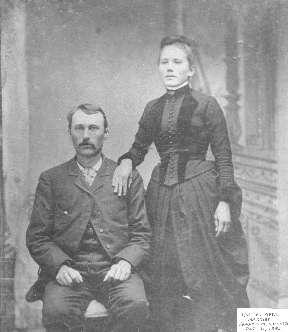 Frank Wilkinson and first wife, Ida Pippin Wilkinson 12-31-1890
page 60 Photo
Frank Wilkinson and first wife, Ida Pippin Wilkinson 12-31-1890
page 60 Photo 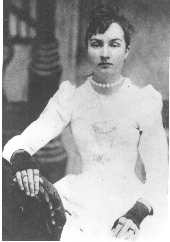 Ida E. Pippin Wilkinson
page 61
IDA E. PIPPIN WILKINSON
Back in the “Good Old Days” before motion pictures,
television and radio, people had to furnish their own entertainment.
They had barn dances and picnics, and the ladies had quilting parties.
The men played baseball and had shooting matches.
Baseball? Yes, even George Washington played baseball.
In the homes, they played games, such as checkers and card
games. They sang songs together. If a musical instrument was
available, they sang along with music.
Miss Ida E. Pippin and her sister, Lucy were musicians. Lucy
played the violon, Ida the piano and organ. Ida was a talented musician.
She played the church organ. She also taught music lessons.
Ida was well known in her area for her skill at nursing the
sick. She was called by both white and black folks when anyone was sick.
Neighbors always sent for her to deliver babies.
Ida E. Wilkinson had many friends among both white and black,
and if she needed help, her friends were always willing and anxious to
help “Miss Ida”.
page 62
MORTGAGE
On December 26th, 1893 F. M. Wilkinson and wife, Ida E. signed
a mortgage on the farm for the sum of $400.00 payable on the first day of
January, 1898 at eight percent interest.
F. M. Wilkinson was indebeted to George H. Brown, Jr. by a note
of that date. In case of failure to pay, the whole bond would be considered
due and payable and the holder of the bond could sell the land at public
sale at the court house door to the highest bidder.
signed by: F. M. Wilkinson
Ida E. Wilkinson
This bond was paid and canceled Jan. 22, 1913. Dad said he
paid the interest when due, but he would save up a sum of money to pay on
the principal and Judge Brown would refuse to take it. He would tell Dad,
“Frank, when you can pay me the whole amount of the loan at one time, I
will take it. I am not going to take it piece-meal”.
On several occasions, he almost had the amount saved up, but
had to use some to pay doctors bills and other emergencies. During that
twenty years, he was paying interest on the entire amount.
Judge Brown was smart. He knew how to make money.
At his widow’s death, his money was left to the town of
Washington to build a library to be named – The George H. and Laura E.
Brown Library.
page 63
photo copy mortgage
On Dec. 26, 1893 F. M. Wilkinson and wife obtained a loan of $400.00 from
Geo. H. Brown at 8% interest. Loan was secured by a mortgage on 83 acres
of farm property. The loan was paid off 20 years later, Jan. 22, 1913.
page 64
mortgage
page 65
BEN FIELD
Farmers sometime give names to areas of their farms so family
members will know which part of the farm he is referring to. Dad had a
section of bottom land that was referred to as the “rice patch”, although
it had been years since he cultivated rice.
There was a clearing near the edge of the woods that was
the “Ben Field”.
Before the Civil War, there was an outlaw black man named Ben
Soon. Been soon lived in the woods in a range stretching from Washington,
N.C. to New Bern, N.C. He made his living by raiding farms in his
territory for supplies. any white man that got in his way, he shot. Ben
Soon set up camps in various spots. Dad’s Ben Field had once been one of
Ben Soon’s camps. It was dangerous for a white man to go in the woods
because if Ben Soon saw him, he might shoot him
Dad’s father, William Henry Wilkinson and another white man
were in the woods, walking a log when a gun was fired and William Henrys
companion fell dead from Ben Soon’s ambush.
When the civil war started, Washington and New Bern were
occupied by the union army. Ben Soon went to the union army headquarters
in New Bern and boasted about how many white southern men he had killed.
Ben was taken into custody, tried for murder by a military
court and hanged.
page 66
SHOOTING MARBLES
Before television and TV games were invented, kids entertained
themselves with such things as games. One popular game consisted of a
circle drawn on the ground and knocking marbles out of the ring with a
glass or hollow steel “shooter” marble. The shooter was wedged in the
crook of the index finger and thumped or shot out with the thumb. The
shooter served in a similar manner as a cue ball does when playing billiards
If you are able to red a very old deed in the back of this
book, you will notice John McWilliams bought 200 acres of land in 1824
which was surveyed, using cedar stumps, pine trees, etc as survey markers
instead of iron rods, as is used at present.
One of the line markers between Dad’s farm and Mrs. Lucy Myers’
farm was an old pine tree about ten years from the river shore.
On an occasion, many years ago, some men chased a black
beau up that pine tree. They had nothing in their guns but small shot
and that only stung the bear and made him angry.
Dad solved the problem. He rammed a glass marble down the
barrel of an old muzzle loaded gun and fired away, and got his bear.
That was Dad’s way to shoot marbles.
page 67
SOMETHING NEW AT THE CIRCUS
Dad always grew a crop of sweet potatoes for home consumption
and he would occasionally sell a bushel if someone asked to buy them.
His main sweet potato crop as a variety called Porto Rico Yams. He also
panted a few Hayman potatoes. Most people prefer the Porto Rico’s which
cook to a rich deep orange color under the skins. The Haymon potatoes
cook to a pale creamy yellow under the skin.
Dad used to tell of a time when he took Walter and Bruce
to the circus when they were small children. He bought each of them a
banana. Bruce peeled his and took a bite and said to Walter, “Buddy
this is the best Hayman tater I ever did eat”.
After they went in to the main tent the show started. An
elephant was brought in to the ring. Walter exclaimed excitedly, “Look
Papa, younder is a horse with a tail at each end”!
page 68
1903
Residents in Beaufort County had no rural mail delivery in
1903, and dad was contacted and asked if he would organize a rural mail
route out of Washington. He took a sample mail box from house to house,
explaining what rural mail delivery would be like. some objected, for fear
their taxes would increase to pay for the service. He had to explain the
2 cent stamp paid the cost of delivery. some would see him coming with
his sample mail box and think it was a doctor’s medicine kit and before
he could speak – “Doctor, they ain’t nobody sick at our house, but Mrs.
Alligood down the road a piece is laid up with something and needs some
doctoring”.
He eventually got his route established and it grew to be too
long for one carrier, so it was divided in two and Will Burgeron was
assigned the second route.
Dad carried the mail nineteen years and he used a horse and
buggy to deliver in all but the last three years. He bought a model “T”
ford and used it the last three years.
Dad would get out of bed at 4:00 o’clock every morning, get
breakfast and report for work at the post office at 6:00 o’clock.
“Neither rain nor snow nor the gloom of night” stopped this
man from his rounds.
When there was a freezing wind and snow, he tried to keep
warm in his open buggy by keeping a lighted lantern between his knees
and his lap covered with a heavy “buggy blanket”. There were such
things as buggy blankets at that time.
page 69
Ida E. Pippin Wilkinson
page 61
IDA E. PIPPIN WILKINSON
Back in the “Good Old Days” before motion pictures,
television and radio, people had to furnish their own entertainment.
They had barn dances and picnics, and the ladies had quilting parties.
The men played baseball and had shooting matches.
Baseball? Yes, even George Washington played baseball.
In the homes, they played games, such as checkers and card
games. They sang songs together. If a musical instrument was
available, they sang along with music.
Miss Ida E. Pippin and her sister, Lucy were musicians. Lucy
played the violon, Ida the piano and organ. Ida was a talented musician.
She played the church organ. She also taught music lessons.
Ida was well known in her area for her skill at nursing the
sick. She was called by both white and black folks when anyone was sick.
Neighbors always sent for her to deliver babies.
Ida E. Wilkinson had many friends among both white and black,
and if she needed help, her friends were always willing and anxious to
help “Miss Ida”.
page 62
MORTGAGE
On December 26th, 1893 F. M. Wilkinson and wife, Ida E. signed
a mortgage on the farm for the sum of $400.00 payable on the first day of
January, 1898 at eight percent interest.
F. M. Wilkinson was indebeted to George H. Brown, Jr. by a note
of that date. In case of failure to pay, the whole bond would be considered
due and payable and the holder of the bond could sell the land at public
sale at the court house door to the highest bidder.
signed by: F. M. Wilkinson
Ida E. Wilkinson
This bond was paid and canceled Jan. 22, 1913. Dad said he
paid the interest when due, but he would save up a sum of money to pay on
the principal and Judge Brown would refuse to take it. He would tell Dad,
“Frank, when you can pay me the whole amount of the loan at one time, I
will take it. I am not going to take it piece-meal”.
On several occasions, he almost had the amount saved up, but
had to use some to pay doctors bills and other emergencies. During that
twenty years, he was paying interest on the entire amount.
Judge Brown was smart. He knew how to make money.
At his widow’s death, his money was left to the town of
Washington to build a library to be named – The George H. and Laura E.
Brown Library.
page 63
photo copy mortgage
On Dec. 26, 1893 F. M. Wilkinson and wife obtained a loan of $400.00 from
Geo. H. Brown at 8% interest. Loan was secured by a mortgage on 83 acres
of farm property. The loan was paid off 20 years later, Jan. 22, 1913.
page 64
mortgage
page 65
BEN FIELD
Farmers sometime give names to areas of their farms so family
members will know which part of the farm he is referring to. Dad had a
section of bottom land that was referred to as the “rice patch”, although
it had been years since he cultivated rice.
There was a clearing near the edge of the woods that was
the “Ben Field”.
Before the Civil War, there was an outlaw black man named Ben
Soon. Been soon lived in the woods in a range stretching from Washington,
N.C. to New Bern, N.C. He made his living by raiding farms in his
territory for supplies. any white man that got in his way, he shot. Ben
Soon set up camps in various spots. Dad’s Ben Field had once been one of
Ben Soon’s camps. It was dangerous for a white man to go in the woods
because if Ben Soon saw him, he might shoot him
Dad’s father, William Henry Wilkinson and another white man
were in the woods, walking a log when a gun was fired and William Henrys
companion fell dead from Ben Soon’s ambush.
When the civil war started, Washington and New Bern were
occupied by the union army. Ben Soon went to the union army headquarters
in New Bern and boasted about how many white southern men he had killed.
Ben was taken into custody, tried for murder by a military
court and hanged.
page 66
SHOOTING MARBLES
Before television and TV games were invented, kids entertained
themselves with such things as games. One popular game consisted of a
circle drawn on the ground and knocking marbles out of the ring with a
glass or hollow steel “shooter” marble. The shooter was wedged in the
crook of the index finger and thumped or shot out with the thumb. The
shooter served in a similar manner as a cue ball does when playing billiards
If you are able to red a very old deed in the back of this
book, you will notice John McWilliams bought 200 acres of land in 1824
which was surveyed, using cedar stumps, pine trees, etc as survey markers
instead of iron rods, as is used at present.
One of the line markers between Dad’s farm and Mrs. Lucy Myers’
farm was an old pine tree about ten years from the river shore.
On an occasion, many years ago, some men chased a black
beau up that pine tree. They had nothing in their guns but small shot
and that only stung the bear and made him angry.
Dad solved the problem. He rammed a glass marble down the
barrel of an old muzzle loaded gun and fired away, and got his bear.
That was Dad’s way to shoot marbles.
page 67
SOMETHING NEW AT THE CIRCUS
Dad always grew a crop of sweet potatoes for home consumption
and he would occasionally sell a bushel if someone asked to buy them.
His main sweet potato crop as a variety called Porto Rico Yams. He also
panted a few Hayman potatoes. Most people prefer the Porto Rico’s which
cook to a rich deep orange color under the skins. The Haymon potatoes
cook to a pale creamy yellow under the skin.
Dad used to tell of a time when he took Walter and Bruce
to the circus when they were small children. He bought each of them a
banana. Bruce peeled his and took a bite and said to Walter, “Buddy
this is the best Hayman tater I ever did eat”.
After they went in to the main tent the show started. An
elephant was brought in to the ring. Walter exclaimed excitedly, “Look
Papa, younder is a horse with a tail at each end”!
page 68
1903
Residents in Beaufort County had no rural mail delivery in
1903, and dad was contacted and asked if he would organize a rural mail
route out of Washington. He took a sample mail box from house to house,
explaining what rural mail delivery would be like. some objected, for fear
their taxes would increase to pay for the service. He had to explain the
2 cent stamp paid the cost of delivery. some would see him coming with
his sample mail box and think it was a doctor’s medicine kit and before
he could speak – “Doctor, they ain’t nobody sick at our house, but Mrs.
Alligood down the road a piece is laid up with something and needs some
doctoring”.
He eventually got his route established and it grew to be too
long for one carrier, so it was divided in two and Will Burgeron was
assigned the second route.
Dad carried the mail nineteen years and he used a horse and
buggy to deliver in all but the last three years. He bought a model “T”
ford and used it the last three years.
Dad would get out of bed at 4:00 o’clock every morning, get
breakfast and report for work at the post office at 6:00 o’clock.
“Neither rain nor snow nor the gloom of night” stopped this
man from his rounds.
When there was a freezing wind and snow, he tried to keep
warm in his open buggy by keeping a lighted lantern between his knees
and his lap covered with a heavy “buggy blanket”. There were such
things as buggy blankets at that time.
page 69 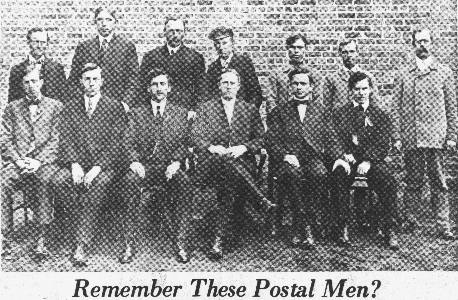 Tideland Scrapbook – Remember these Postal Men?
page 70
They {buggy blankets} were thick heavy blankets made of course fiber,
and they made good insulation for lap and legs. His was printed with
large red roses on a black background.
This blanket was finally stolen out of the open model “T”
ford, one night along with a lantern while left unattended in a circus
parking lot.
Dad’s fingers would get so cold in the winter that it would
become difficult to separate mail or pick up letters.
One incident he recalled was the time a snuff dipping lady
bought a stamp and licked all the glue off the stamp so it wouldn’t stick.
She held the snuff smeared stamp up to him and said, “will you lick this
stamp for me? I can’t get it to stick”.
On December 31, 1906 Dad’s wife, Ida Pippin Wilkinson died
in childbirth, leaving children, including Joe who was less than five
years old, and Chilson who was about 2 ½ years old. Their grandmother,
Caroline Lewis Wilkinson died September 14, 1911, leaving Joe and
Chilson still quite young without a woman in the house. Gwendolyn was
only 13 years old.
Of the 19 years that Dad delivered the mail, He only lost
one day from work. that was the day his wife, Ida, was buried. He
was absent from work a few others times from sickness, such as mumps
and the influenza, but he used his vacation leave to cover it.
Through the years that he delivered the mail, they never
gave the Postal Employees Christmas Day off.
Page 71 Illustration
Francis M. Wilkinson delivered the U.S. mail for 19 years, 16 of
these years, he delivered by horse and buggy through heat of summer,
and through chill of winter. The last three years, he delivered by
use of a Model “T” Ford.
GOOD OLD DAYS
Page 72
Photo
Main street looking east towards Market Street in Washington, N.C. in
1907 Unpaved street minus street lights. Horse drawn vehicles only.
Page 73
During this time, dad and the Burgerons shared a party telephone
line. They jointly owned the wire and poles from Washington Park to the
houses, and had to pay for line repairs.
Dad’s phone consisted of a wood base and box on the wall with a
hand cranked ringer-generator, and a black ear piece on a cord, and a
mouth piece on an adjustable arm that could be lifted up or down for a
short or tall person.
The phone was as useful then as it would be today. Sometimes,
dad had to call the house when he was off on the road. It was useful
to call the doctor, who then made house calls.
The Burgeron Farm was about a quarter mile down river from dad’s
place. They had a variety of fruit trees, large scuppernong grape arbor,
figs, etc. along with regular farming operations. The boys had motorcycles.
Mr. Ben Burgeron, the daddy, called “Pa”, owned one of several saloons in
Washington.
Mr. Ben Burgeron never bought commercial fertilizer for his farm.
He mixed his own. He also distilled his own whiskey for his saloon, until
prohibition closed all legal whiskey sales. Mr. Burgeron had a government
licensed whiskey distillery.
Dad met a young lady who worked at J. K. Hoyt’s Department Store
as stenographer and bookkeeper. This was Miss Mary Koonce. She and dad
became interested in one another and they occasionally “courted” over the
telephone. Since the phone was a party line, the Burgerons could listen
in on their court-ship. Sometimes, they would play………….
Page 74 Illustration - This is the type telephone dad had on the wall in the hall.
Page 75
The record player in the phone. That obviously made private conversations
impossible. The background music would also be disruptive.
The record player was one of those old Edison Victrolas with a
large amplifier horn shaped like a morning glory blossom. The records
were cylinder in shape, 2 1/8 inches in diameter and 4 inches long, and
with grooves cut around the outside of the cylinder.
About 35 years later I had an occasion to do some remodeling in the
Burgeron house and along with various antiques I noticed was 2 victrolas in
the parlor with morning glory horns.
The house was built on a foundation of 12” X 12” square hand hewn
sills, mortised and fastened with wood pegs. The studs (posts) were hand
hewn or hand sawn 4 X 4 and 4 X 6. The screws in the door hinges were
made by a black smith. The brass door locks were as large as cigar boxes.
We dug lead bullets out of the doors and door faceing that had lodged
there during a shoot out in the civil war.
The walls were plastered with a mix of oyster shell lime, sand and
hog’s hair spread over hand split wood laths. All nails used were square
iron nails. All Frame work was mortissed and pegged.
If you are not familuar with those old time record players, I
have provided the following illustrations.
Page 76 Illustration - Examples of old time “talking machines”
Victor Talking Machine Company
Other styles Victor and Victrola $ 12 to $450. September 1919
Edison also produced a disc record – 9 ½ inches across and ¼ inch thick.
The above machine also came with “morning Glory” type horn.
This old cylinder type Edison record is 2 1?8 inches in diameter and 4
inches long. Cylinder walls ¼ inch thick. _Title _ “ Bonnie Blue Flag
Polka” and Old South Quartet.
Page 77 Illustration - The Brunswick Ad
All phonographs in one
The Tone Amplifier
Music Lovers Choose the Brunswick
Dad bought a Victrola simular to the above.
Page 78 (missing)
Page 79
Tideland Scrapbook – Remember these Postal Men?
page 70
They {buggy blankets} were thick heavy blankets made of course fiber,
and they made good insulation for lap and legs. His was printed with
large red roses on a black background.
This blanket was finally stolen out of the open model “T”
ford, one night along with a lantern while left unattended in a circus
parking lot.
Dad’s fingers would get so cold in the winter that it would
become difficult to separate mail or pick up letters.
One incident he recalled was the time a snuff dipping lady
bought a stamp and licked all the glue off the stamp so it wouldn’t stick.
She held the snuff smeared stamp up to him and said, “will you lick this
stamp for me? I can’t get it to stick”.
On December 31, 1906 Dad’s wife, Ida Pippin Wilkinson died
in childbirth, leaving children, including Joe who was less than five
years old, and Chilson who was about 2 ½ years old. Their grandmother,
Caroline Lewis Wilkinson died September 14, 1911, leaving Joe and
Chilson still quite young without a woman in the house. Gwendolyn was
only 13 years old.
Of the 19 years that Dad delivered the mail, He only lost
one day from work. that was the day his wife, Ida, was buried. He
was absent from work a few others times from sickness, such as mumps
and the influenza, but he used his vacation leave to cover it.
Through the years that he delivered the mail, they never
gave the Postal Employees Christmas Day off.
Page 71 Illustration
Francis M. Wilkinson delivered the U.S. mail for 19 years, 16 of
these years, he delivered by horse and buggy through heat of summer,
and through chill of winter. The last three years, he delivered by
use of a Model “T” Ford.
GOOD OLD DAYS
Page 72
Photo
Main street looking east towards Market Street in Washington, N.C. in
1907 Unpaved street minus street lights. Horse drawn vehicles only.
Page 73
During this time, dad and the Burgerons shared a party telephone
line. They jointly owned the wire and poles from Washington Park to the
houses, and had to pay for line repairs.
Dad’s phone consisted of a wood base and box on the wall with a
hand cranked ringer-generator, and a black ear piece on a cord, and a
mouth piece on an adjustable arm that could be lifted up or down for a
short or tall person.
The phone was as useful then as it would be today. Sometimes,
dad had to call the house when he was off on the road. It was useful
to call the doctor, who then made house calls.
The Burgeron Farm was about a quarter mile down river from dad’s
place. They had a variety of fruit trees, large scuppernong grape arbor,
figs, etc. along with regular farming operations. The boys had motorcycles.
Mr. Ben Burgeron, the daddy, called “Pa”, owned one of several saloons in
Washington.
Mr. Ben Burgeron never bought commercial fertilizer for his farm.
He mixed his own. He also distilled his own whiskey for his saloon, until
prohibition closed all legal whiskey sales. Mr. Burgeron had a government
licensed whiskey distillery.
Dad met a young lady who worked at J. K. Hoyt’s Department Store
as stenographer and bookkeeper. This was Miss Mary Koonce. She and dad
became interested in one another and they occasionally “courted” over the
telephone. Since the phone was a party line, the Burgerons could listen
in on their court-ship. Sometimes, they would play………….
Page 74 Illustration - This is the type telephone dad had on the wall in the hall.
Page 75
The record player in the phone. That obviously made private conversations
impossible. The background music would also be disruptive.
The record player was one of those old Edison Victrolas with a
large amplifier horn shaped like a morning glory blossom. The records
were cylinder in shape, 2 1/8 inches in diameter and 4 inches long, and
with grooves cut around the outside of the cylinder.
About 35 years later I had an occasion to do some remodeling in the
Burgeron house and along with various antiques I noticed was 2 victrolas in
the parlor with morning glory horns.
The house was built on a foundation of 12” X 12” square hand hewn
sills, mortised and fastened with wood pegs. The studs (posts) were hand
hewn or hand sawn 4 X 4 and 4 X 6. The screws in the door hinges were
made by a black smith. The brass door locks were as large as cigar boxes.
We dug lead bullets out of the doors and door faceing that had lodged
there during a shoot out in the civil war.
The walls were plastered with a mix of oyster shell lime, sand and
hog’s hair spread over hand split wood laths. All nails used were square
iron nails. All Frame work was mortissed and pegged.
If you are not familuar with those old time record players, I
have provided the following illustrations.
Page 76 Illustration - Examples of old time “talking machines”
Victor Talking Machine Company
Other styles Victor and Victrola $ 12 to $450. September 1919
Edison also produced a disc record – 9 ½ inches across and ¼ inch thick.
The above machine also came with “morning Glory” type horn.
This old cylinder type Edison record is 2 1?8 inches in diameter and 4
inches long. Cylinder walls ¼ inch thick. _Title _ “ Bonnie Blue Flag
Polka” and Old South Quartet.
Page 77 Illustration - The Brunswick Ad
All phonographs in one
The Tone Amplifier
Music Lovers Choose the Brunswick
Dad bought a Victrola simular to the above.
Page 78 (missing)
Page 79 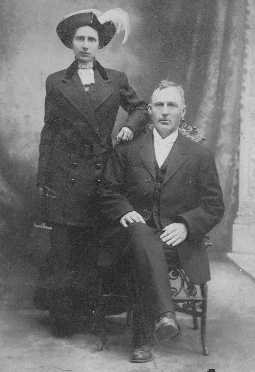 Frank Wilkinson & 2nd Wife Mary Sarah Koonce Wilkinson
Nov. 20, 1912.
Page 80
Frank Wilkinson & 2nd Wife Mary Sarah Koonce Wilkinson
Nov. 20, 1912.
Page 80 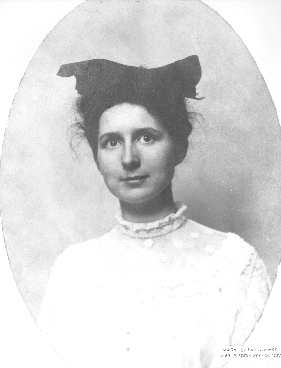 Mary Sarah Koonce
Page 81
SEPTEMBER 3, 1913
The weather bureau now gives names to this type of weather
disturbance. In 1913, it was just a bad storm.
Eastern North Carolina was swept by a severe hurricane. The eye of
the storm passed over Washington, N.C..
When dad left for work before daylight that morning, mama said it
looked like the wind might blow his buggy over. He reported for work,
but the carriers were not sent out in the storm that day.
In the meantime at home, the tide began to rise. Dad had lumber stored
under the house for the purpose of making a second story on the house.
The lumber floated away. Chickens were seen riding across the field on
a floating door.
The family loaded up in a horse drawn cart and left the house. They
were given shelter in a house on a hill about half mile from home.
Water came up to the floor and caked up the flour in the bottom of the
flour barrel.That afternoon, dad and Will Burgeron could not get home by
land because the bridges were washed away, so they took a row boat. Dad
said Will was scared to death because the water was so rough. The waves
were so high they could’nt see over the top when the boat was in a trough
between two waves. If the boat had turned sideway to the waves, it would
probably have been swamped. If that had happened, they wouldnt have had
a chance. They were luck and made it home safe.
Page 82 Photos
September 3, 1913 Hurricane
Top – Dr. Baynor’s home, corner of Bonner and Water Streets completely
surrounded by flood waters which swept low lying parts of Washington.
Bottom left photo displays the Beaufort County bridge and keeper’s house
listing into the Pamlico River. Parts of the bridge was washed away and
traffic was disrupted until repairs were made. Bottom right photo depicts
the east side of Market Street between Main and Water Streets as flood
waters inundated the down town area.
Page 83 Photo - Turbulent Pamlico left Norfolk Southern rail trestle a
mass of debris.
Page 84
The flood water came up into the streets in parts of Washington
and they were going down the streets in boats. Bridges were out. Even
the rail road bridge was destroyed. Many business houses had heavy losses.
The day after the storm, dad delivered the mail as well as he
could under the circumstances. Roads were blocked with trees and
bridges were washed out. He had to detour through the woods to get
around downed trees and stop and make temporary repairs to bridges
sufficiently enough to get his horse and buggy across. He had to do so
much wadeing through water fixing bridges that he had removed his pants
and only covered his lap with the buggy blanket. A lady came out and
bought a 2 cent stamp with a nickel. He stood up to get change out of
his pocket. After he stood up, he realized he wasn’t wearing pants.
Back in those “Good Old Days” of the horse and buggy, Washington
Park had less than a dozen houses. It was not called Town of Washington
Park. There were many open fields. Someone landed a “flying machine” in
one of the open fields and was chargeing $15.00 to see it. It must have
been near the road because they were stopping traffic coming off the
bridge into Washington Park, to collect the $15.00 fee. They refused to
led dad pass without paying. He was quick to tell them they were
interfering with the United States Mail and he could quickly get legal
action. They took down the bar and let him through.
Page 85 Photo - place here
10:14 PM 10/8/2003
Main Street in 1915
This is how Main Street looked in 1915 as viewed from the corner of Market
Street. The picture was taken from “Pen and Picture Sketches” on Greater
Washington. The brochure from which the picture was taken was provided
the Daily News by J. Phil Roberson.
Page 86
Mary Sarah Koonce
Page 81
SEPTEMBER 3, 1913
The weather bureau now gives names to this type of weather
disturbance. In 1913, it was just a bad storm.
Eastern North Carolina was swept by a severe hurricane. The eye of
the storm passed over Washington, N.C..
When dad left for work before daylight that morning, mama said it
looked like the wind might blow his buggy over. He reported for work,
but the carriers were not sent out in the storm that day.
In the meantime at home, the tide began to rise. Dad had lumber stored
under the house for the purpose of making a second story on the house.
The lumber floated away. Chickens were seen riding across the field on
a floating door.
The family loaded up in a horse drawn cart and left the house. They
were given shelter in a house on a hill about half mile from home.
Water came up to the floor and caked up the flour in the bottom of the
flour barrel.That afternoon, dad and Will Burgeron could not get home by
land because the bridges were washed away, so they took a row boat. Dad
said Will was scared to death because the water was so rough. The waves
were so high they could’nt see over the top when the boat was in a trough
between two waves. If the boat had turned sideway to the waves, it would
probably have been swamped. If that had happened, they wouldnt have had
a chance. They were luck and made it home safe.
Page 82 Photos
September 3, 1913 Hurricane
Top – Dr. Baynor’s home, corner of Bonner and Water Streets completely
surrounded by flood waters which swept low lying parts of Washington.
Bottom left photo displays the Beaufort County bridge and keeper’s house
listing into the Pamlico River. Parts of the bridge was washed away and
traffic was disrupted until repairs were made. Bottom right photo depicts
the east side of Market Street between Main and Water Streets as flood
waters inundated the down town area.
Page 83 Photo - Turbulent Pamlico left Norfolk Southern rail trestle a
mass of debris.
Page 84
The flood water came up into the streets in parts of Washington
and they were going down the streets in boats. Bridges were out. Even
the rail road bridge was destroyed. Many business houses had heavy losses.
The day after the storm, dad delivered the mail as well as he
could under the circumstances. Roads were blocked with trees and
bridges were washed out. He had to detour through the woods to get
around downed trees and stop and make temporary repairs to bridges
sufficiently enough to get his horse and buggy across. He had to do so
much wadeing through water fixing bridges that he had removed his pants
and only covered his lap with the buggy blanket. A lady came out and
bought a 2 cent stamp with a nickel. He stood up to get change out of
his pocket. After he stood up, he realized he wasn’t wearing pants.
Back in those “Good Old Days” of the horse and buggy, Washington
Park had less than a dozen houses. It was not called Town of Washington
Park. There were many open fields. Someone landed a “flying machine” in
one of the open fields and was chargeing $15.00 to see it. It must have
been near the road because they were stopping traffic coming off the
bridge into Washington Park, to collect the $15.00 fee. They refused to
led dad pass without paying. He was quick to tell them they were
interfering with the United States Mail and he could quickly get legal
action. They took down the bar and let him through.
Page 85 Photo - place here
10:14 PM 10/8/2003
Main Street in 1915
This is how Main Street looked in 1915 as viewed from the corner of Market
Street. The picture was taken from “Pen and Picture Sketches” on Greater
Washington. The brochure from which the picture was taken was provided
the Daily News by J. Phil Roberson.
Page 86 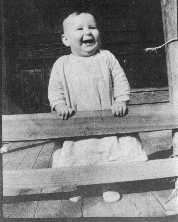 Baby George Wilkinson
Dad’s last surviving child was b. Feb 10, 1915 to Frank & Mary Wilkinson.
Page 87
Dad bought his first automobile about 1919. That was the
model “T” Ford I mentioned previously. That model did not have a self
starter. You had to start it yourself with a hand crank. Dad had
rheumatism in his right arm and had difficulty cranking it so Joe or
Chilson (Frank, Jr) went with him to drive on his mail route.
Sometimes, especially in cold weather, the Ford was hard to start
in the morning. One thing that helped was to jack up one rear wheel so
the drive shaft and gears could turn freely in stiff grease. If they
couldn’t start it in time, Dad would take the buggy to town, sort his
mail and by that time, they usually had it running and would meet him
where our lane met River Road ( now NC 32). There, he would trade buggy
for car and proceed on his way.
When dad delivered mail with a horse, it was necessary to keep
3 horses all the time. He kept a horse and a spare for the road, and a
farm horse. The spare could also pull a plow.
With so many horses to feed, he had to plant about half the farm
in corn and hay for horse feed.
In dad’s early years of farming, corn was planted in 4 foot squares.
They plowed furrows 4 feet apart, length way the field and 4 feet apart
across the field, marking in off in squares. A hole was dug at each cross
point and a few shovel fulls of manure or wood mold was put in as organic
fertilizer. Wood mold was well rotted leaves from the ground in the woods.
This stuff was covered and one hill of corn planted in that square.
Page 88
Baby George Wilkinson
Dad’s last surviving child was b. Feb 10, 1915 to Frank & Mary Wilkinson.
Page 87
Dad bought his first automobile about 1919. That was the
model “T” Ford I mentioned previously. That model did not have a self
starter. You had to start it yourself with a hand crank. Dad had
rheumatism in his right arm and had difficulty cranking it so Joe or
Chilson (Frank, Jr) went with him to drive on his mail route.
Sometimes, especially in cold weather, the Ford was hard to start
in the morning. One thing that helped was to jack up one rear wheel so
the drive shaft and gears could turn freely in stiff grease. If they
couldn’t start it in time, Dad would take the buggy to town, sort his
mail and by that time, they usually had it running and would meet him
where our lane met River Road ( now NC 32). There, he would trade buggy
for car and proceed on his way.
When dad delivered mail with a horse, it was necessary to keep
3 horses all the time. He kept a horse and a spare for the road, and a
farm horse. The spare could also pull a plow.
With so many horses to feed, he had to plant about half the farm
in corn and hay for horse feed.
In dad’s early years of farming, corn was planted in 4 foot squares.
They plowed furrows 4 feet apart, length way the field and 4 feet apart
across the field, marking in off in squares. A hole was dug at each cross
point and a few shovel fulls of manure or wood mold was put in as organic
fertilizer. Wood mold was well rotted leaves from the ground in the woods.
This stuff was covered and one hill of corn planted in that square.
Page 88 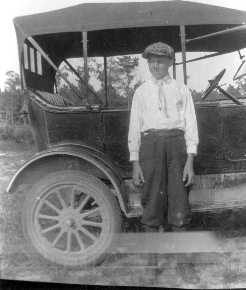 Young teenaged Chilson Wilkinson stands beside the new Ford.
Page 89
In later years, he used comercial fertilizer.
When the corn stalk matured and just before the leaves (or blades)
on the stalk were ready to start turning yellow, the blades were stripped
from the stalk, tied in bundles and hung on a broken stalk to dry in the
sun. When dry, three or four of these bundles were tied into a larger
bundle and hauled to the barn and stored for “fodder”. This fodder was
used the same as hay for feed.
Stripping fodder was hot, itchy, tireing work that blistered and
tore skin from fingers and hands. It was just the way of life on the old
time farm.
Dad bought the first horse drawn cotton planter in the
neighborhood. It had 2 large wooden disc wheels, one on either side of a
green hopper box. The wheels turned an eight inch metal drum in the
bottom of the hopper. The drum had teeth that would grap the seeds and
drop them in the row. The machine opened the row to receive the seed and
then closed it over the seed.
A neighbor borrowed the cotton planter. When dad finally located
it, it was in the other side of Beaufort County. It had been borrowed from
one to another ‘till no one even knew who it belonged to.
Dad raised scuppernog grapes, watermellons and cantelopes to sell
to local merchants. He saved his seeds from the best of the crop each year
so that he constantly improved his varieties of cantelopes and watermellons.
Page 90
HOME MADE TOOLS
Back in the days before every household tool and utensil was made
commercially, people had to rely on home made products to work with. If
they broke a tool handle, they made another one. They made their own
baskets, wood buckets, wood tubs and barrels, or had some one in the
neighborhood to do it for them. Most of their plows were home made.
The black smith made plow points, horse shoes, axes, froes,
and most anything of metal that was needed. The old time black smith
was far more skilled at metal work than modern metal workers. He could
bend, twist or shape a piece of hot metal to make almost any simple
shape. He could weld two pieces of metal by heating them and hammering
them together. He could cut a bar of steel by heating it and cutting
it with a cold chisel as easily as cutting a stick of butter.
Modern metal workers cut with acetylene torches or electric
saws and weld with electric arc welders. They shape their material
with lathes and milling machines.
The country black smith had no need for such equipment.
Page 91 (with illustrations) about 1900 - 1930
The old time farmer prepared his land for planting by starting
in the fall and winter pileing and burning the residue so it could be
plowed. Ditch banks and hedge rows were shrubbed of previous year’s
growth. This shrubbing was done with a heavy hook ended ax called a
bush ax. It required many hours of finger blistering work through the
winter to do this work.
After the ditch banks and fields were cleared of the previous
year’s growth, plowing could begin. The “turn plow” would cut about
eight inches deep and lift and turn a furrow of soil about eight or
ten inches wide. A man and horse could break about one acre of land
in five continous hours of work. Then the surface would have to
leveled by dragging over the plowed surface with large grate-like
drag called a spike tooth harrow.
A modern tractor can break up about forty acres in the same
5 hour period and drag it at the same time.
The tractor can clear ditch banks with a mowing attachment
and cut field stalks in………..
Page 92 & 93
After the ground is broken, it must be prepared for planting.
When the weather warms in the spring and the danger of frost is past,
spring planting begins. Most crops on old time farms were planted in
rows 3 ½ feet apart and 4 feet apart. Corn rows were 4 feet, with
stalks thinned to 20” to 24 inches apart.
This method was used in the period around 1925.
First, rows opened, usually with a turn plow. Two poles, sharpened to
a point at one end, are set up in the field, one at the center of first row and
one at far end of field on first row. Start plowing out a furrow at front of
field, in line with the 2 distant poles, sighting down the two poles as you
would use sights on a gun barrel. As you arrive at each pole, take it up and
re-set it over the width of 2 rows. On your rturn trip across the field,
plow between first furrows, making single width rows. The horse soon
learns to head straight for the pole and stop.
After the rows are opened, fertilizer is applied, at a specified
tunnage per acre. A turn plow passes on each side of the row, banking a
ridge of dirt over the fertilizer. Another pass with a drag flattens part
of the ridge. Then a mechanical planter passes if that type of crop is to
be planted. If the planter is not designed for the seed to be planted,
then several other operations take place.
A seed groove is opened in the row. The seeds are dropped by hand
and either covered with the foot or a special wooden drag covers them.
Modern tractor open 4 rows at a time, apply fertilizer, plant the
seeds and cover them all in one fast operation.
The old time farmer had to chop weeds and grass out of his crop
land every 10 days to 2 weeks and plow or the unwanted growth would
crowd out his crops. Boll weevils would spoil his cotton. Tobacco worms
would have to be picked off of each leaf by hand, in the hot August
sunshine.
The modern farmer uses herbicides to rid his crops of grasses
and weeds. Pesticides takes care of worms and bugs.
It used to take the farmer’s family and several tennant
families to run one fair sized farm. A modern mechanized farmer needs
several fair sized farms to have a reasonable income.
Ride through the country and you will see many old abandoned
tennant houses along the way.
Page 94 illustrations
The cotton plow which had parts of various sizes that could be used
separately or in combination to preform various plowing operations.
The turn plow. The steel mould board was invented for this plow and it
revolutionized farming for the American farmer in colonial days. George
Washington and Thomas Jefferson expiermented with the steel mould board.
The spike tooth harrow – useful for smootheing over plowed fields.
These “store bought” plows were to be found on every small farm. Some
larger farms had two horse turn plows and cultivators and harrows.
Page 95 illustrations through 1930
PLOWS – STORE BOUGHT
The cultivator was used to keep weeds and grass under control in the
rows of growing crops. There was an assortment of plow points for
various jobs.
Frank Wilkinson bought a cotton planter like this. He loaned it to
a neighbor. He located it some time later on the other side of the
county. It had been loaned from neighbor to neighbor until no one
knew who owned it.
The Fertilizer distributor.
Page 96 illustrations possibly dates back as far as 1870 to 1930
A home made plow to be used to make a groove in the top of the row to
drop seeds in.
This home made drag was used to scrape the tops of rows off flat to
prepare for planting.
This home made drag was also used to scrape the tops off of the rows.
The above are some of the home made plows on the farm of Francis
Marion Wilkinson.
Page 97 illustrations
Looping leaf tobacco on sticks to hang in the tobacco barn. It
will be dried in the barn with heat from a wood burning furnace,
24 hours a day, 5 days.
July 1923
Page 98
It so happened that dad had a neighbor that wanted to raise
melons as good and sweet as dad’s, so he asked him one day, “Frank,
how come your watermellons are so sweet?”. Dad jokingly told him that
he put a cup full of sugar under each hill of melons when he planted them.
The next summer, the man came to dad , very angry. “Frank,
I went to town and hauled a whole barrel of sugar to my place and
planted my melon patch with a whole cup full of sugar under each hill
and they are no sweeter than before”.
Dad was surprised that he didn’t catch the joke the first time.
He was sure he would’nt fall for it again, so he just told him he
should put two cup fulls instead of one.
The next summer – you guessed it. Two barrels of sugar. Same
kind of mellons. P.T. Barnum said “There’s a sucker born every minute”.
To suppliment his living off farming, dad fished and salted them
down for future use. On one occasion, his nets were so full of fish that
they overloaded his boat and it swamped with water over the side before
he reached shore. That’s more fish than a present day fisherman would
catch in a month out of our much poluted river.
I have seen a drastic drop in marine life in our river in the
last 60 years. There used to be water lillies, several kinds of sea
weeds, an abundance of crabs, flounder and plenty of other fish to catch
with hook or net.
Page 99
There is no plant life in the water, very few fish, and crabs
are almost non-existant a couple of miles down stream from Washington.
I once heard dad say he sold a barrel of salted shad for three
cents each. The same fish would now cost about $5.00 each from the fish
store. Incidentally, he never got paid for his barrel of 3 cent shad.
After dad’s father, William Henry Wilkinson died, his mother,
Caroline Lewis Wilkinson came to live with him.
The old home place was somewhere near an area in Beaufort
County called Wilmar. Dad paid taxes on the place for a number of
years but none of the other heirs took an interest in it or helped
pay taxes so he finally stopped.
Then, his sister Emily’s son, Jesse B. Ross, paid the
taxes after dad stopped. When Jesse died, the place was finally
sold, presumable for taxes. All the heirs, cousins by the dozens,
and others including myself signed a release to make the sale final.
If there had been any profit realized, we would have received a share.
I never heard any more from it.
Dad’s mother was near-sighted. She also hated to see cats
sitting on the dining room table. She came in one day and yelled “Get
off the table, you darned cat!” and she slapped the old black tea pot
off the table and across the floor. We guess she should have had eye
glasses.
Page 100
When dad was in the mail service, he had to file a monthly
report with the postal department. These reports required some
arithmetic to figure answers to some standard questions. Since dad
had a total of three weeks education, it was’nt easy.
I once picked up a piece of scratch paper that had some of
his mathematical calculations on it. He did his multiplying by
adding. For example, nine times 275 would be a column of 275 written
down nine times and added. He made it work for him.
He was never taught to read, but he read the Washington
Daily News from cover to cover every night. He also read his bible,
the Progressive Farmer Magazine, The Literary Digest Magazine, The
Southern Planter Magazine and a publication called the R.F.D. News.
He occasionally studied his world atlas. He could say the abc’s
backward faster than I can say them forward.
Dad’s second wife, Mary was delivered of her second child by
caesarean section on May 23, 1917. It was a girl with black hair.
Unfortunately, she only lived a few hours. Hospitals were not
equipped to give the kind of post natal care that babies get now.
They either lived or they did’nt.
Many years later, Gwendolyn recalled her expierence in the
event to me. She had deep regrets about their inability to save the
baby. Gwendolyn was the only girl in the family and she had always
wished for a sister. She said it was a beautiful baby.
I also wished they could have saved her. I would have
enjoyed having a little sister near my age.
See Page 101 after images for 102 & 103 below:
Page 102 illustration
Frank M. Wilkinson bought gasoline for his model “T” Ford from
a country general store for 18 cents per gallon. The pump
delivered one gallon each time the cylinder was cranked all the
way up. I might not have my picture accurate because it has
been 70 years since I saw the pump.
Page 103
Young teenaged Chilson Wilkinson stands beside the new Ford.
Page 89
In later years, he used comercial fertilizer.
When the corn stalk matured and just before the leaves (or blades)
on the stalk were ready to start turning yellow, the blades were stripped
from the stalk, tied in bundles and hung on a broken stalk to dry in the
sun. When dry, three or four of these bundles were tied into a larger
bundle and hauled to the barn and stored for “fodder”. This fodder was
used the same as hay for feed.
Stripping fodder was hot, itchy, tireing work that blistered and
tore skin from fingers and hands. It was just the way of life on the old
time farm.
Dad bought the first horse drawn cotton planter in the
neighborhood. It had 2 large wooden disc wheels, one on either side of a
green hopper box. The wheels turned an eight inch metal drum in the
bottom of the hopper. The drum had teeth that would grap the seeds and
drop them in the row. The machine opened the row to receive the seed and
then closed it over the seed.
A neighbor borrowed the cotton planter. When dad finally located
it, it was in the other side of Beaufort County. It had been borrowed from
one to another ‘till no one even knew who it belonged to.
Dad raised scuppernog grapes, watermellons and cantelopes to sell
to local merchants. He saved his seeds from the best of the crop each year
so that he constantly improved his varieties of cantelopes and watermellons.
Page 90
HOME MADE TOOLS
Back in the days before every household tool and utensil was made
commercially, people had to rely on home made products to work with. If
they broke a tool handle, they made another one. They made their own
baskets, wood buckets, wood tubs and barrels, or had some one in the
neighborhood to do it for them. Most of their plows were home made.
The black smith made plow points, horse shoes, axes, froes,
and most anything of metal that was needed. The old time black smith
was far more skilled at metal work than modern metal workers. He could
bend, twist or shape a piece of hot metal to make almost any simple
shape. He could weld two pieces of metal by heating them and hammering
them together. He could cut a bar of steel by heating it and cutting
it with a cold chisel as easily as cutting a stick of butter.
Modern metal workers cut with acetylene torches or electric
saws and weld with electric arc welders. They shape their material
with lathes and milling machines.
The country black smith had no need for such equipment.
Page 91 (with illustrations) about 1900 - 1930
The old time farmer prepared his land for planting by starting
in the fall and winter pileing and burning the residue so it could be
plowed. Ditch banks and hedge rows were shrubbed of previous year’s
growth. This shrubbing was done with a heavy hook ended ax called a
bush ax. It required many hours of finger blistering work through the
winter to do this work.
After the ditch banks and fields were cleared of the previous
year’s growth, plowing could begin. The “turn plow” would cut about
eight inches deep and lift and turn a furrow of soil about eight or
ten inches wide. A man and horse could break about one acre of land
in five continous hours of work. Then the surface would have to
leveled by dragging over the plowed surface with large grate-like
drag called a spike tooth harrow.
A modern tractor can break up about forty acres in the same
5 hour period and drag it at the same time.
The tractor can clear ditch banks with a mowing attachment
and cut field stalks in………..
Page 92 & 93
After the ground is broken, it must be prepared for planting.
When the weather warms in the spring and the danger of frost is past,
spring planting begins. Most crops on old time farms were planted in
rows 3 ½ feet apart and 4 feet apart. Corn rows were 4 feet, with
stalks thinned to 20” to 24 inches apart.
This method was used in the period around 1925.
First, rows opened, usually with a turn plow. Two poles, sharpened to
a point at one end, are set up in the field, one at the center of first row and
one at far end of field on first row. Start plowing out a furrow at front of
field, in line with the 2 distant poles, sighting down the two poles as you
would use sights on a gun barrel. As you arrive at each pole, take it up and
re-set it over the width of 2 rows. On your rturn trip across the field,
plow between first furrows, making single width rows. The horse soon
learns to head straight for the pole and stop.
After the rows are opened, fertilizer is applied, at a specified
tunnage per acre. A turn plow passes on each side of the row, banking a
ridge of dirt over the fertilizer. Another pass with a drag flattens part
of the ridge. Then a mechanical planter passes if that type of crop is to
be planted. If the planter is not designed for the seed to be planted,
then several other operations take place.
A seed groove is opened in the row. The seeds are dropped by hand
and either covered with the foot or a special wooden drag covers them.
Modern tractor open 4 rows at a time, apply fertilizer, plant the
seeds and cover them all in one fast operation.
The old time farmer had to chop weeds and grass out of his crop
land every 10 days to 2 weeks and plow or the unwanted growth would
crowd out his crops. Boll weevils would spoil his cotton. Tobacco worms
would have to be picked off of each leaf by hand, in the hot August
sunshine.
The modern farmer uses herbicides to rid his crops of grasses
and weeds. Pesticides takes care of worms and bugs.
It used to take the farmer’s family and several tennant
families to run one fair sized farm. A modern mechanized farmer needs
several fair sized farms to have a reasonable income.
Ride through the country and you will see many old abandoned
tennant houses along the way.
Page 94 illustrations
The cotton plow which had parts of various sizes that could be used
separately or in combination to preform various plowing operations.
The turn plow. The steel mould board was invented for this plow and it
revolutionized farming for the American farmer in colonial days. George
Washington and Thomas Jefferson expiermented with the steel mould board.
The spike tooth harrow – useful for smootheing over plowed fields.
These “store bought” plows were to be found on every small farm. Some
larger farms had two horse turn plows and cultivators and harrows.
Page 95 illustrations through 1930
PLOWS – STORE BOUGHT
The cultivator was used to keep weeds and grass under control in the
rows of growing crops. There was an assortment of plow points for
various jobs.
Frank Wilkinson bought a cotton planter like this. He loaned it to
a neighbor. He located it some time later on the other side of the
county. It had been loaned from neighbor to neighbor until no one
knew who owned it.
The Fertilizer distributor.
Page 96 illustrations possibly dates back as far as 1870 to 1930
A home made plow to be used to make a groove in the top of the row to
drop seeds in.
This home made drag was used to scrape the tops of rows off flat to
prepare for planting.
This home made drag was also used to scrape the tops off of the rows.
The above are some of the home made plows on the farm of Francis
Marion Wilkinson.
Page 97 illustrations
Looping leaf tobacco on sticks to hang in the tobacco barn. It
will be dried in the barn with heat from a wood burning furnace,
24 hours a day, 5 days.
July 1923
Page 98
It so happened that dad had a neighbor that wanted to raise
melons as good and sweet as dad’s, so he asked him one day, “Frank,
how come your watermellons are so sweet?”. Dad jokingly told him that
he put a cup full of sugar under each hill of melons when he planted them.
The next summer, the man came to dad , very angry. “Frank,
I went to town and hauled a whole barrel of sugar to my place and
planted my melon patch with a whole cup full of sugar under each hill
and they are no sweeter than before”.
Dad was surprised that he didn’t catch the joke the first time.
He was sure he would’nt fall for it again, so he just told him he
should put two cup fulls instead of one.
The next summer – you guessed it. Two barrels of sugar. Same
kind of mellons. P.T. Barnum said “There’s a sucker born every minute”.
To suppliment his living off farming, dad fished and salted them
down for future use. On one occasion, his nets were so full of fish that
they overloaded his boat and it swamped with water over the side before
he reached shore. That’s more fish than a present day fisherman would
catch in a month out of our much poluted river.
I have seen a drastic drop in marine life in our river in the
last 60 years. There used to be water lillies, several kinds of sea
weeds, an abundance of crabs, flounder and plenty of other fish to catch
with hook or net.
Page 99
There is no plant life in the water, very few fish, and crabs
are almost non-existant a couple of miles down stream from Washington.
I once heard dad say he sold a barrel of salted shad for three
cents each. The same fish would now cost about $5.00 each from the fish
store. Incidentally, he never got paid for his barrel of 3 cent shad.
After dad’s father, William Henry Wilkinson died, his mother,
Caroline Lewis Wilkinson came to live with him.
The old home place was somewhere near an area in Beaufort
County called Wilmar. Dad paid taxes on the place for a number of
years but none of the other heirs took an interest in it or helped
pay taxes so he finally stopped.
Then, his sister Emily’s son, Jesse B. Ross, paid the
taxes after dad stopped. When Jesse died, the place was finally
sold, presumable for taxes. All the heirs, cousins by the dozens,
and others including myself signed a release to make the sale final.
If there had been any profit realized, we would have received a share.
I never heard any more from it.
Dad’s mother was near-sighted. She also hated to see cats
sitting on the dining room table. She came in one day and yelled “Get
off the table, you darned cat!” and she slapped the old black tea pot
off the table and across the floor. We guess she should have had eye
glasses.
Page 100
When dad was in the mail service, he had to file a monthly
report with the postal department. These reports required some
arithmetic to figure answers to some standard questions. Since dad
had a total of three weeks education, it was’nt easy.
I once picked up a piece of scratch paper that had some of
his mathematical calculations on it. He did his multiplying by
adding. For example, nine times 275 would be a column of 275 written
down nine times and added. He made it work for him.
He was never taught to read, but he read the Washington
Daily News from cover to cover every night. He also read his bible,
the Progressive Farmer Magazine, The Literary Digest Magazine, The
Southern Planter Magazine and a publication called the R.F.D. News.
He occasionally studied his world atlas. He could say the abc’s
backward faster than I can say them forward.
Dad’s second wife, Mary was delivered of her second child by
caesarean section on May 23, 1917. It was a girl with black hair.
Unfortunately, she only lived a few hours. Hospitals were not
equipped to give the kind of post natal care that babies get now.
They either lived or they did’nt.
Many years later, Gwendolyn recalled her expierence in the
event to me. She had deep regrets about their inability to save the
baby. Gwendolyn was the only girl in the family and she had always
wished for a sister. She said it was a beautiful baby.
I also wished they could have saved her. I would have
enjoyed having a little sister near my age.
See Page 101 after images for 102 & 103 below:
Page 102 illustration
Frank M. Wilkinson bought gasoline for his model “T” Ford from
a country general store for 18 cents per gallon. The pump
delivered one gallon each time the cylinder was cranked all the
way up. I might not have my picture accurate because it has
been 70 years since I saw the pump.
Page 103 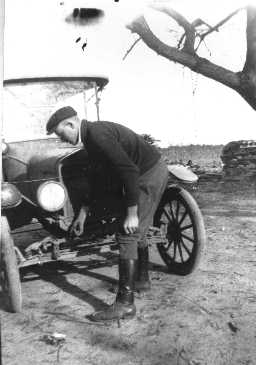 Pop’s new model “T” Ford automobile
Francis Chilson Wilkinson – cranking
It had kerocine parking lights and tail light. The head lights
ran on magneto. The faster the engine turned, the brighter the
lights. It had a spark coil for each cylinder (4). You cranked
it on 6 volt dry cell battery and then switched over to magneto.
The gas tank was under the front seat. Lift the cushion and
there it was. No filter on the carborator.
Page 101 & 104
All the other brothers and sister had grown up and left home
by the time I was ten years of age. That left me to be the only
young one at home.
I needed some one to help me plow and chop wood and shrub
ditch banks. __Just Kidding __. But Seriously, I would have
enjoyed having another child in the home.
I have made previous mention of dad’s Ford. It had special
features not found on modern cars. It had kenosine parking lights on
either side of the windshield (which was never lit), and a kerosine
tail light.
It was a custom while dad was a mail carrier, and a long
time after, to make use of all available daylight working time at
home, and go shopping at night. Many people did it back then.
The stores stayed open from seven a.m. to midnight.
The usual procedure was to load the family in the “T”
Ford and crank up and start to town. The dirt roads were bumpy,
and I don’t think the car had shock absorbers, because the bumps
in the road would bounce the passengers up against the cloth top
sometimes.
After we were on the way, dad would ask the driver,
“did you light that rare lamp”? Dad used quaint english
sometimes. Then we would stop at Alfred Clark’s General Store,
at the intersection of Brick Kiln Road and River Road, and we
would get gasoline. The Clarks lived upstairs, and had a
business on the ground floor. They sold everything from soda
crackers to horse collars.
Mr. Clark would come out and start pumping gas. The gas
tank was located under the driver’s seat cushion. The gas guage
was a wooden stick dipped in the tank to see how high up the
stick got wet. The gas pump had a hand crank that was turned to
raise a plunger through a cylinder that held exactly one gallon.
Every time the plunger was cranked up, it was another gallon, at
18 cents per gallon.
Mr. Clark was a heavy set man with a growth on the side of
his neck the size of a hen’s egg. I think it was called a goiter.
Mrs. Clark was an inquisitive woman very much like the store
keepers wife on the television story, “Little House on the Prairie”.
Their son Bryan was sort of spoiled, and throught his entire
lifetime, he worked hard, but never could save a single dollar. He
lived his final years on welfare.
After gassing up, we would leave Clark’s with a tank full of
18 cent gas and head up town. The first few blocks of Main Street
were not paved. Then you came to the part that was paved with bricks.
When the car was parked, dad and mom would go to McClure’s
Store with the grocery list. A box full of groceries usually cost
about three dollars. Dad would go over to Dudley’s Fish Market and
if Mr. Dudley had some nice trout or mackrel that weighed about 2
pounds or more, he would buy some. If he didn’t, Mr. Dudley would
stop dad before he reached the counter and say, “sorry Frank, But
I don’t have what you want this time”.
In oyster season, there would be six to a dozen oyster
boats tied up at the docks and oyster men would swarm prospective
customers, praising their oysters.
Page 105
Some would open an oyster and say “taste this oyster, Mister.
It’s fat and fresh and as big as your foot”. Dad would get a
quart or more already opened. Sometimes he would get a bushel
in the shell.
Other items he would get at the meat market was beef
steak and stew beef. We raised our own pork and poultry.
Occasionally mom and dad would do other shopping. Then
they headed for the picture show. The movies were black and
white silent movies. The piano player up front selected music
to set the mood for whatever was showing on the screen. Sad
music for tear jerkers, fast music for a chase.
The pop corn boy would walk up and down the aisles
calling out, “get your pop karn – both de-lish-us and
new-trish-shus, get your pop karn”.
The actors would move their arms and mouths furiously
and what they were supposed to be saying would print on the
screen. Someone sitting behind you who could barely read would
slowly read out loud what he could of part of the lines before
it flashed off, and that would confuse everyone around him.
Some of the actors and actresses were famous silent
screen stars; like Mary Pickford and Pearl White to name a few.
Then there were the western heroes such as Buck Jones who would
actually kiss the girl on the mouth at the end of the picture.
Tom Mix never-never would kiss a girl in front of a camera.
We had some good comedians such as Ben Turpin, the guy
with the square mustache, Fatty Arbuckel, Charlie Chaplin and
his child side-kick, Little Jackie Coogan and of course, the
famous Buster Keaton who never changed his facial expression.
Page 106
Buster Keaton was a perfectionist. He didn’t rely on
stunt men to do his difficult parts. He did them himself.
Every Saturday, the theater showed an episode of a
serial called “The Perils of Pauline” where they would get the
girl out of last week’s life threatening danger, and end up with
her in another perilous episode, continued to next week, but
some way, the managed to get her out next week.
After the show, Pop would take mom and I to Worthy and
Ethridge Drug Store and he would treat us to a chocolate ice
cream soda. They were delicious!
I can’t remember much about how Joe spent his time on
those trips, but I think Chilson spent a part of his time at
the pool room. He picked up some spending money working there
part time.
A few years later, talking pictures were introduced to
the public. Then came technicolor pictures.
Dad took mom and I se see “Cleopatria” starring Caludette
Colbert. She was real pretty in technicolor. In one scene,
Cleopatria was bathing in a large pool of milk. The slaves were
milking she-asses and carring jars of milk and pouring in the
bath. Dad nudged mom and grinned and pointed to several cats
standing around the bath drinking milk.
Page 107 illustration
Back in the good old days, every lady wore a hat. It was
customary to buy the hat and have the lady running the millinary
shop to decorate it like the customer wanted it. Sometimes the
decorations were elaborate. You especially noticed in when you
sat behind her in the theater.
Page 108
PUBLIC ENTERTAINMENT
There was an “opera house” in Washington located on
the second floor of a building on the north east corner of
Market and Main Streets.
Traveling theatre companies made their rounds of towns
and the opera house was one of their stops. The public was
always anxious for entertainment, so the house was usually
filled.
On one particular night, the house was packed, waiting
for the show to begin. The actors and actresses were on the
stage behind the closed curtain preparing for the preformance.
The curtain was designed to raise by winding around
a long pole like an up-side-down window shade.
The two boys who pulled the ropes to raise the curtain
were waiting for their cue.
One of the actresses was wearing a long flowing dress
and she happened to be on stage backed up behind the curtain.
By some mistake, the boys thought they had the cue so
they started vigorously raising the curtain. As the curtain
began to roll up around the pole and rise, it caught the skirt
of the actress. The audience saw the curtain rising and the
surprised lady standing on stage with the curtain slowly
pulling her dress up and lifting her off her feet. Everyone
in the audience was roaring with laughter.
They got the curtain back down and after the actress
regained her composure, the show started. Unfortunately,
every time this actress came on, the audience would again
roar with laughter.
Page 109
STREET CARNIVALS
One of the first motion pictures of any length was
“The Great Train Robbery” which was made in 1903. Sometime
afterward this film was the feature attraction in one of the
the tent shows in the Hatch-Adams Carnival showing for the
first time in Washington, N.C.
Did you ever catch yourself humming tunes from songs by
Jerome Kern and Oscar Hammerstein like “old man ribber, he
don’t do nothing, he just keeps rolling along”, “pick up dat
bale, git a little drunk and you land in jail” “can’t help
lovin’ that man o’mine”. These songs were written for the
long running play “Show Boat”.
Show Boat novel sold 320,000 copies in the United
States the first 12 years the book was published. Show
Boat has been made into several movies, adapted from the
novel by Edna Ferber. This novel has been translated and
sold in eleven countries. Musical and dramatic rights
were sold to Jerome Kern and Oscar Hammerstein. The
broadway production was produced by Florence Zigfield.
Where was this novel born?
In Frank M. Wilkinson Country - on the banks
of the Pamlico River.
Page 110
CAPTAIN JAMES ADAMS
Captain James Adams came to Washington, N.C. with a
carnival. One of the feature attractions was a high dive act.
They set up a tall ladder with a small platform near its top
on Market Street between Main and Second Streets. While
testing his equipment, the diver fell to the ground when a
guy rope became loose and caused the ladder to break. He
was seriously injured and spent several months in the hospital.
A fire destroyed valuable costumes needed in another
feature act. From these misfortunes, James Adams quit the
carnival business and decided to enter into the theatre business.
FLOATING THEATRE
James Adams had observed the flat bottom barges or
scows used by the Washington lumber companies so he decided
one could be modeled into a floating theatre.
Captain George Leach, President of the Eureka Lumber
Company of Washington furnished a barge – 122 feet long and
32 feet wide and furnished the lumber, and Chauncey’s Boat
Yard did the work. The flat bottom boat would float in 14
inches of water.
Every time Guy Wilkinson went to town he would go by
Chauncey’s Boat Yard on the river in down town Washington
and when he came home, he would up-date the family on the
progress of the floating theatre they were building.
In addition to the stage and auditorium The James
Adams also had room for living and dining quarters for cast
and crew of 26 and storage space. All personnel had at
least two or more jobs on board.
Page 111 & 112
The show boat was pulled by the boat from town to
town on the shores of North Carolina and Virginia waters,
remaining in each town a week, and each night a different
play was presented.
The James Adams Floating Palace Theatre presented
its first public preformance in Washington in the spring of
1914. The plays they presented were usually “tear-jerkers”.
Novelist Edna Ferber heard of a floating theatre
making the rounds of the river towns of North Carolina and
Virginia and she wanted to write a novel based on the theme
of a show boat, so she came to Washington in 1924 to contact
the James Adams Floating Palace Theatre, but it had finished
its season and was tied up for the winter in Elizabeth City,
but it would be back in Bath, N.C. for a new season in April
1925.
Edna Ferber came to Bath in April 1925 and was invited
on board where she lived for a while, attending rehersals,
selling tickets, serving as a walk-on actress, dining with the
crew and cast, and becoming a temporary member of the troupe.
She went back to New York and used her material to
write her novel, using some of the actual caracters she met
in her book. She based her Show Boat on the Mississippi River.
George and Hazel Wilkinson attended two shows in the
late nineteen thirties or early nineteen forties. The acting
was good. They had a good orchestra (tug boat crew) and we
can still remember some of a song by the male singer.
They tied up at dock side back of the old Louise Hotel.
They had temporary utilities conections including phone.
Possibly due to objections of the local movie theatre owner
who owned 2 theatres, they were required to buy expensive
one year license to show one week. Captain Adams told his
audience that would be the last visit the theatre would make
to its birth place.
Page 113 photo
The James Adams Floating Theatre, renamed The Original Show
boat following publication of Edna Ferber’s book. Shown here
in winter quarters it is docked at Water Street in Elizabeth
city. (All photos courtesy of Fred Fearing, reproduced by
T. H. Pearce, published with “Showboating in the Albemarle”
by Joseph O. Green, III, in “The State,” February 15, 1972)
THE STATE, November 1979
Page 114 illustration
The James Adams Floating Palace Theater. Your narrator only
saw this boat twice, both times at night, fifty years ago,
so my illustration is not accurate. One of the things I
noticed was a row of steel post and guy rods along the side
to protect the hull from stress of unbalanced loads.
Customers boarded a gang way up front and purchased tickets
and went in the front end and selected a seat. The theater
was connected with telephone and city utilities. The music
and shows were good.
Page 115 photo
The theatre intself, inside the boat, had a seating capacity
of 700, and measured 122 x 34 feet. Most of the plays were
“tear jerkers”.
Page 116 photo
Two of the showboat’s leading ladies; the lady on the left
is probably Beulah Adams Hunter, billed as “The Mary Pickford
Of The Rivers”. Her husband Charles Hunter (______) welcomed
Edna Ferber aboard and helped her with her book. Many people
later saw the Hunters reflected as characters in “Show Boat”.
Page 117
CECIL BLOUNT DE MILLE
Viewers all over the world have seen and are still
watching famous motion pictures byone of the outstanding
motion picture directors of all time. Cecil B. De Mille.
He directed such pictures as “King Of Kings” and “The Ten
Commandments” and other master pieces of motion picture art.
Cecil B. DeMille was a local man. He was born and
raised in Washington, North Carolina. His birthplace was
across the corner from the site of the old high school
building on Bridge and Second Streets.
Frank Wilkinson was acquainted with members of his
mother’s family.
Unfortunately, the last owner of the Cecil B. DeMille
home sold the property to an oil company which demolished this
historic home and built a filling station.
Page 118 & 119 & 120
THEATERS
The first play house in Washington, N.C. that we have
record of was called The Opera House. It was located on the
second floor of a building on the north east corner of Market
and Main Streets. Local plays were sometimes presented and
traveling theater companies presented vaudivilles and plays
on its stage to packed audiences.
There was no radio or television for entertainment,
and the old spring wound “talking machine” was a novelty and
curiosity that few families owned.
The recorded sounds for these machines came either
on a thick disc or a cylinder about two inches in diameter
and four inches long. The records turned much faster than
our present disc records. The needle or stylus picked up
vibrations off the record and sent them into a small drum
head or diaphram that connected to a long wood or composition
horn for amplification. No electricity was involved.
I don’t know when The Opera House closed, but there
was a new theater that opened in 1913 that appropriately was
named “The New Theater”.
The New Theater was located on the second floor of
a building in down town Washington, N.C. on Main Street.
The ground floor of the building currently houses a shoe
store, a long wide hall way and a soda shop. The soda shop
was origonally Shaw’s Soda Shop. It is now Jean’s Grill.
The remains of the old “New Theater” are still
there, a ghost of a reminder of the past. All the seats
have been removed and used else-where.
I remember the New Theater as the first picture
show I ever attended as a child with my parents. My parents
usually attended every Saturday night and we saw a short
comedy, a feature film and an installemen of a serial. The
serial would compare to modern soap operas on T.V. except
the star actor was always left in an impossible and often
life threatening situation to be continued next week!
The New Theater often presented vaudeville shows.
All through the silent movie, the piano player down
front played “mood music” to fit the scene on the screen.
It is showed a sad scene, he played sad music. If a chase
was in progress, he played music to fit the scene.
TURNAGE
In 1930, Mr. Collier A. Turnage opened a large
beautifully designed theater on the ground floor in the
back of the same building that housed the old New Theater.
The old New Theater was closed. The newly opened theater
was named for its owner “Turnage Theater”. This was entered
through a long wide hallway between a shoe store and Shaw’s
Soda Shop.
The Turnage showed only the best movies. I remember
the first showing of “Gone With The Wind”. The line waiting
to buy tickets was long enough to stretch around the block.
Mr. Turnage opened another theater across the street
to show “B” class movies. This was named for his wife. It
was called the “Rita Theater”. The Rita closed when television
became popular and took away customers.
It was in the nineteen eighties before the Turnage
Theater closed its doors and sent its customers to a triple
cinema at the Washington Shopping Mall.
Some time after World War Two, a drive in theater
opened on River road and one opened in Chocowinity. They
are now just memories.
Page 121 photo
The Turnage Theater, its glory days gone forever.
THE GLORY DAYS ARE GONE AT TURNAGE Ric Carter photos
Page 122 photo and news article
Page 123 photo
Fancy wordwork marks the spot where the theater’s chandelier
once hung.
Page 124
KEEPING WARM
Pop’s new model “T” Ford automobile
Francis Chilson Wilkinson – cranking
It had kerocine parking lights and tail light. The head lights
ran on magneto. The faster the engine turned, the brighter the
lights. It had a spark coil for each cylinder (4). You cranked
it on 6 volt dry cell battery and then switched over to magneto.
The gas tank was under the front seat. Lift the cushion and
there it was. No filter on the carborator.
Page 101 & 104
All the other brothers and sister had grown up and left home
by the time I was ten years of age. That left me to be the only
young one at home.
I needed some one to help me plow and chop wood and shrub
ditch banks. __Just Kidding __. But Seriously, I would have
enjoyed having another child in the home.
I have made previous mention of dad’s Ford. It had special
features not found on modern cars. It had kenosine parking lights on
either side of the windshield (which was never lit), and a kerosine
tail light.
It was a custom while dad was a mail carrier, and a long
time after, to make use of all available daylight working time at
home, and go shopping at night. Many people did it back then.
The stores stayed open from seven a.m. to midnight.
The usual procedure was to load the family in the “T”
Ford and crank up and start to town. The dirt roads were bumpy,
and I don’t think the car had shock absorbers, because the bumps
in the road would bounce the passengers up against the cloth top
sometimes.
After we were on the way, dad would ask the driver,
“did you light that rare lamp”? Dad used quaint english
sometimes. Then we would stop at Alfred Clark’s General Store,
at the intersection of Brick Kiln Road and River Road, and we
would get gasoline. The Clarks lived upstairs, and had a
business on the ground floor. They sold everything from soda
crackers to horse collars.
Mr. Clark would come out and start pumping gas. The gas
tank was located under the driver’s seat cushion. The gas guage
was a wooden stick dipped in the tank to see how high up the
stick got wet. The gas pump had a hand crank that was turned to
raise a plunger through a cylinder that held exactly one gallon.
Every time the plunger was cranked up, it was another gallon, at
18 cents per gallon.
Mr. Clark was a heavy set man with a growth on the side of
his neck the size of a hen’s egg. I think it was called a goiter.
Mrs. Clark was an inquisitive woman very much like the store
keepers wife on the television story, “Little House on the Prairie”.
Their son Bryan was sort of spoiled, and throught his entire
lifetime, he worked hard, but never could save a single dollar. He
lived his final years on welfare.
After gassing up, we would leave Clark’s with a tank full of
18 cent gas and head up town. The first few blocks of Main Street
were not paved. Then you came to the part that was paved with bricks.
When the car was parked, dad and mom would go to McClure’s
Store with the grocery list. A box full of groceries usually cost
about three dollars. Dad would go over to Dudley’s Fish Market and
if Mr. Dudley had some nice trout or mackrel that weighed about 2
pounds or more, he would buy some. If he didn’t, Mr. Dudley would
stop dad before he reached the counter and say, “sorry Frank, But
I don’t have what you want this time”.
In oyster season, there would be six to a dozen oyster
boats tied up at the docks and oyster men would swarm prospective
customers, praising their oysters.
Page 105
Some would open an oyster and say “taste this oyster, Mister.
It’s fat and fresh and as big as your foot”. Dad would get a
quart or more already opened. Sometimes he would get a bushel
in the shell.
Other items he would get at the meat market was beef
steak and stew beef. We raised our own pork and poultry.
Occasionally mom and dad would do other shopping. Then
they headed for the picture show. The movies were black and
white silent movies. The piano player up front selected music
to set the mood for whatever was showing on the screen. Sad
music for tear jerkers, fast music for a chase.
The pop corn boy would walk up and down the aisles
calling out, “get your pop karn – both de-lish-us and
new-trish-shus, get your pop karn”.
The actors would move their arms and mouths furiously
and what they were supposed to be saying would print on the
screen. Someone sitting behind you who could barely read would
slowly read out loud what he could of part of the lines before
it flashed off, and that would confuse everyone around him.
Some of the actors and actresses were famous silent
screen stars; like Mary Pickford and Pearl White to name a few.
Then there were the western heroes such as Buck Jones who would
actually kiss the girl on the mouth at the end of the picture.
Tom Mix never-never would kiss a girl in front of a camera.
We had some good comedians such as Ben Turpin, the guy
with the square mustache, Fatty Arbuckel, Charlie Chaplin and
his child side-kick, Little Jackie Coogan and of course, the
famous Buster Keaton who never changed his facial expression.
Page 106
Buster Keaton was a perfectionist. He didn’t rely on
stunt men to do his difficult parts. He did them himself.
Every Saturday, the theater showed an episode of a
serial called “The Perils of Pauline” where they would get the
girl out of last week’s life threatening danger, and end up with
her in another perilous episode, continued to next week, but
some way, the managed to get her out next week.
After the show, Pop would take mom and I to Worthy and
Ethridge Drug Store and he would treat us to a chocolate ice
cream soda. They were delicious!
I can’t remember much about how Joe spent his time on
those trips, but I think Chilson spent a part of his time at
the pool room. He picked up some spending money working there
part time.
A few years later, talking pictures were introduced to
the public. Then came technicolor pictures.
Dad took mom and I se see “Cleopatria” starring Caludette
Colbert. She was real pretty in technicolor. In one scene,
Cleopatria was bathing in a large pool of milk. The slaves were
milking she-asses and carring jars of milk and pouring in the
bath. Dad nudged mom and grinned and pointed to several cats
standing around the bath drinking milk.
Page 107 illustration
Back in the good old days, every lady wore a hat. It was
customary to buy the hat and have the lady running the millinary
shop to decorate it like the customer wanted it. Sometimes the
decorations were elaborate. You especially noticed in when you
sat behind her in the theater.
Page 108
PUBLIC ENTERTAINMENT
There was an “opera house” in Washington located on
the second floor of a building on the north east corner of
Market and Main Streets.
Traveling theatre companies made their rounds of towns
and the opera house was one of their stops. The public was
always anxious for entertainment, so the house was usually
filled.
On one particular night, the house was packed, waiting
for the show to begin. The actors and actresses were on the
stage behind the closed curtain preparing for the preformance.
The curtain was designed to raise by winding around
a long pole like an up-side-down window shade.
The two boys who pulled the ropes to raise the curtain
were waiting for their cue.
One of the actresses was wearing a long flowing dress
and she happened to be on stage backed up behind the curtain.
By some mistake, the boys thought they had the cue so
they started vigorously raising the curtain. As the curtain
began to roll up around the pole and rise, it caught the skirt
of the actress. The audience saw the curtain rising and the
surprised lady standing on stage with the curtain slowly
pulling her dress up and lifting her off her feet. Everyone
in the audience was roaring with laughter.
They got the curtain back down and after the actress
regained her composure, the show started. Unfortunately,
every time this actress came on, the audience would again
roar with laughter.
Page 109
STREET CARNIVALS
One of the first motion pictures of any length was
“The Great Train Robbery” which was made in 1903. Sometime
afterward this film was the feature attraction in one of the
the tent shows in the Hatch-Adams Carnival showing for the
first time in Washington, N.C.
Did you ever catch yourself humming tunes from songs by
Jerome Kern and Oscar Hammerstein like “old man ribber, he
don’t do nothing, he just keeps rolling along”, “pick up dat
bale, git a little drunk and you land in jail” “can’t help
lovin’ that man o’mine”. These songs were written for the
long running play “Show Boat”.
Show Boat novel sold 320,000 copies in the United
States the first 12 years the book was published. Show
Boat has been made into several movies, adapted from the
novel by Edna Ferber. This novel has been translated and
sold in eleven countries. Musical and dramatic rights
were sold to Jerome Kern and Oscar Hammerstein. The
broadway production was produced by Florence Zigfield.
Where was this novel born?
In Frank M. Wilkinson Country - on the banks
of the Pamlico River.
Page 110
CAPTAIN JAMES ADAMS
Captain James Adams came to Washington, N.C. with a
carnival. One of the feature attractions was a high dive act.
They set up a tall ladder with a small platform near its top
on Market Street between Main and Second Streets. While
testing his equipment, the diver fell to the ground when a
guy rope became loose and caused the ladder to break. He
was seriously injured and spent several months in the hospital.
A fire destroyed valuable costumes needed in another
feature act. From these misfortunes, James Adams quit the
carnival business and decided to enter into the theatre business.
FLOATING THEATRE
James Adams had observed the flat bottom barges or
scows used by the Washington lumber companies so he decided
one could be modeled into a floating theatre.
Captain George Leach, President of the Eureka Lumber
Company of Washington furnished a barge – 122 feet long and
32 feet wide and furnished the lumber, and Chauncey’s Boat
Yard did the work. The flat bottom boat would float in 14
inches of water.
Every time Guy Wilkinson went to town he would go by
Chauncey’s Boat Yard on the river in down town Washington
and when he came home, he would up-date the family on the
progress of the floating theatre they were building.
In addition to the stage and auditorium The James
Adams also had room for living and dining quarters for cast
and crew of 26 and storage space. All personnel had at
least two or more jobs on board.
Page 111 & 112
The show boat was pulled by the boat from town to
town on the shores of North Carolina and Virginia waters,
remaining in each town a week, and each night a different
play was presented.
The James Adams Floating Palace Theatre presented
its first public preformance in Washington in the spring of
1914. The plays they presented were usually “tear-jerkers”.
Novelist Edna Ferber heard of a floating theatre
making the rounds of the river towns of North Carolina and
Virginia and she wanted to write a novel based on the theme
of a show boat, so she came to Washington in 1924 to contact
the James Adams Floating Palace Theatre, but it had finished
its season and was tied up for the winter in Elizabeth City,
but it would be back in Bath, N.C. for a new season in April
1925.
Edna Ferber came to Bath in April 1925 and was invited
on board where she lived for a while, attending rehersals,
selling tickets, serving as a walk-on actress, dining with the
crew and cast, and becoming a temporary member of the troupe.
She went back to New York and used her material to
write her novel, using some of the actual caracters she met
in her book. She based her Show Boat on the Mississippi River.
George and Hazel Wilkinson attended two shows in the
late nineteen thirties or early nineteen forties. The acting
was good. They had a good orchestra (tug boat crew) and we
can still remember some of a song by the male singer.
They tied up at dock side back of the old Louise Hotel.
They had temporary utilities conections including phone.
Possibly due to objections of the local movie theatre owner
who owned 2 theatres, they were required to buy expensive
one year license to show one week. Captain Adams told his
audience that would be the last visit the theatre would make
to its birth place.
Page 113 photo
The James Adams Floating Theatre, renamed The Original Show
boat following publication of Edna Ferber’s book. Shown here
in winter quarters it is docked at Water Street in Elizabeth
city. (All photos courtesy of Fred Fearing, reproduced by
T. H. Pearce, published with “Showboating in the Albemarle”
by Joseph O. Green, III, in “The State,” February 15, 1972)
THE STATE, November 1979
Page 114 illustration
The James Adams Floating Palace Theater. Your narrator only
saw this boat twice, both times at night, fifty years ago,
so my illustration is not accurate. One of the things I
noticed was a row of steel post and guy rods along the side
to protect the hull from stress of unbalanced loads.
Customers boarded a gang way up front and purchased tickets
and went in the front end and selected a seat. The theater
was connected with telephone and city utilities. The music
and shows were good.
Page 115 photo
The theatre intself, inside the boat, had a seating capacity
of 700, and measured 122 x 34 feet. Most of the plays were
“tear jerkers”.
Page 116 photo
Two of the showboat’s leading ladies; the lady on the left
is probably Beulah Adams Hunter, billed as “The Mary Pickford
Of The Rivers”. Her husband Charles Hunter (______) welcomed
Edna Ferber aboard and helped her with her book. Many people
later saw the Hunters reflected as characters in “Show Boat”.
Page 117
CECIL BLOUNT DE MILLE
Viewers all over the world have seen and are still
watching famous motion pictures byone of the outstanding
motion picture directors of all time. Cecil B. De Mille.
He directed such pictures as “King Of Kings” and “The Ten
Commandments” and other master pieces of motion picture art.
Cecil B. DeMille was a local man. He was born and
raised in Washington, North Carolina. His birthplace was
across the corner from the site of the old high school
building on Bridge and Second Streets.
Frank Wilkinson was acquainted with members of his
mother’s family.
Unfortunately, the last owner of the Cecil B. DeMille
home sold the property to an oil company which demolished this
historic home and built a filling station.
Page 118 & 119 & 120
THEATERS
The first play house in Washington, N.C. that we have
record of was called The Opera House. It was located on the
second floor of a building on the north east corner of Market
and Main Streets. Local plays were sometimes presented and
traveling theater companies presented vaudivilles and plays
on its stage to packed audiences.
There was no radio or television for entertainment,
and the old spring wound “talking machine” was a novelty and
curiosity that few families owned.
The recorded sounds for these machines came either
on a thick disc or a cylinder about two inches in diameter
and four inches long. The records turned much faster than
our present disc records. The needle or stylus picked up
vibrations off the record and sent them into a small drum
head or diaphram that connected to a long wood or composition
horn for amplification. No electricity was involved.
I don’t know when The Opera House closed, but there
was a new theater that opened in 1913 that appropriately was
named “The New Theater”.
The New Theater was located on the second floor of
a building in down town Washington, N.C. on Main Street.
The ground floor of the building currently houses a shoe
store, a long wide hall way and a soda shop. The soda shop
was origonally Shaw’s Soda Shop. It is now Jean’s Grill.
The remains of the old “New Theater” are still
there, a ghost of a reminder of the past. All the seats
have been removed and used else-where.
I remember the New Theater as the first picture
show I ever attended as a child with my parents. My parents
usually attended every Saturday night and we saw a short
comedy, a feature film and an installemen of a serial. The
serial would compare to modern soap operas on T.V. except
the star actor was always left in an impossible and often
life threatening situation to be continued next week!
The New Theater often presented vaudeville shows.
All through the silent movie, the piano player down
front played “mood music” to fit the scene on the screen.
It is showed a sad scene, he played sad music. If a chase
was in progress, he played music to fit the scene.
TURNAGE
In 1930, Mr. Collier A. Turnage opened a large
beautifully designed theater on the ground floor in the
back of the same building that housed the old New Theater.
The old New Theater was closed. The newly opened theater
was named for its owner “Turnage Theater”. This was entered
through a long wide hallway between a shoe store and Shaw’s
Soda Shop.
The Turnage showed only the best movies. I remember
the first showing of “Gone With The Wind”. The line waiting
to buy tickets was long enough to stretch around the block.
Mr. Turnage opened another theater across the street
to show “B” class movies. This was named for his wife. It
was called the “Rita Theater”. The Rita closed when television
became popular and took away customers.
It was in the nineteen eighties before the Turnage
Theater closed its doors and sent its customers to a triple
cinema at the Washington Shopping Mall.
Some time after World War Two, a drive in theater
opened on River road and one opened in Chocowinity. They
are now just memories.
Page 121 photo
The Turnage Theater, its glory days gone forever.
THE GLORY DAYS ARE GONE AT TURNAGE Ric Carter photos
Page 122 photo and news article
Page 123 photo
Fancy wordwork marks the spot where the theater’s chandelier
once hung.
Page 124
KEEPING WARM 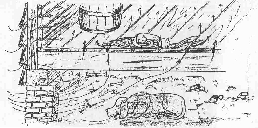 Did you ever have your furnace break down or the fuel give
out in the middle of winter and all the house becomes freezing cold
except a little spot in front of an electric heater or a fireplace?
At the turn of the century, Francis M. Wilkinson and
thousands more people didn’t have it that good. Houses were drafty.
They were not insulated. Most wood houses were constructed with the
framework covered on the outside with a single coat of clapboard. If
the inside rooms were not plastered, they were ceiled with tongue and
groove lumber. The clapboards would shrink and warp allowing wind to
pass through. The ceiling would also shrink allowing the passage of
air. A calendar hanging on the wall would swing on a windy day.
The floors in many houses were tongue and groove lumber,
six or more inches wide, nailed directly to the supporting joist, with
no air or vapor barrier. These tongue and groove boards would shrink,
allowing air to pass through. I have seen newspapers on the floor,
flutter and lift when it was windy outside.
Page 125 illustration
1918 The only means of heating the room was a wood burning fireplace.
Page 126 illustration
About 1922, F. M. Wilkinson installed a wood burning heater in his
bedroom – sitting room.
Page 127
Did you ever have your furnace break down or the fuel give
out in the middle of winter and all the house becomes freezing cold
except a little spot in front of an electric heater or a fireplace?
At the turn of the century, Francis M. Wilkinson and
thousands more people didn’t have it that good. Houses were drafty.
They were not insulated. Most wood houses were constructed with the
framework covered on the outside with a single coat of clapboard. If
the inside rooms were not plastered, they were ceiled with tongue and
groove lumber. The clapboards would shrink and warp allowing wind to
pass through. The ceiling would also shrink allowing the passage of
air. A calendar hanging on the wall would swing on a windy day.
The floors in many houses were tongue and groove lumber,
six or more inches wide, nailed directly to the supporting joist, with
no air or vapor barrier. These tongue and groove boards would shrink,
allowing air to pass through. I have seen newspapers on the floor,
flutter and lift when it was windy outside.
Page 125 illustration
1918 The only means of heating the room was a wood burning fireplace.
Page 126 illustration
About 1922, F. M. Wilkinson installed a wood burning heater in his
bedroom – sitting room.
Page 127  This is the flag that hung on the wall over Frank M. Wilkinson’s
mantel through the years of World War One.
The flag has only 46 stars. It was made before New Mexico became
the 47th state in 1-6-1912 and before Arizona became the 48th state
in 2-14-1912.
PAGE 128
DECORATIONS
This is the flag that hung on the wall over Frank M. Wilkinson’s
mantel through the years of World War One.
The flag has only 46 stars. It was made before New Mexico became
the 47th state in 1-6-1912 and before Arizona became the 48th state
in 2-14-1912.
PAGE 128
DECORATIONS 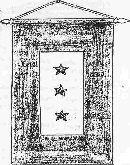 Dad’s sitting room had an American flag draped on the wall
over his mantel piece. It was in support for his country and his three
sons who were in France fighting German Kaiser Wilhelm’s army in World
War One. Also, he had silk plack hanging to the right of the flag that
represented his family’s participation in the military effort. This
silk plack or banner was approximately seven inches wide and eleven
inches high. There was a pencil size rod across the top, tipped on
either end with a wooden gilded spear point. A piece of gold color
silk cord was fastened by the ends to the spear points. The cord was
a hanger so the banner could be hung on the wall. The banner had a
wide red border on the four sides of a white center. In the certer
was displayed the number of five point starts that the family had
in the military service. The stars were blue.
Walter was in the mounted (horse) cavalry. Bruce was in
the army’s early air force as a camera spotter. Guy was in the
infantry. Guy expierenced attacks of poisoned gas.
{Illustration of flag}
page 129
Until about the year 1022, the room that dad used for sitting
and sleeping was warmed ? with a fire place. When it was freezing cold,
and especially when there was a chill wind blowing, you sat close to the
fire and radiant heat baked your front, and your back would have goose
bumps from cold.
BEDDING
Many old time beds had springs consisting of a grill work of
chain link wires hooked upto form a rectangle the size of the bed and the
whole suspended in place with coil stretch springs.
Dad’s mattress was a core of animal hair padded on either side
with cotton. It was very heavy and very – very firm.
When I was young, my room opened in to mom’s and dad’s
room. My mattress was softer than dad’s. It was made of corn shucks,
stripped in bits about half an inch wide and stuffed in the ticking
material.
All beds in the house were padded with a soft “feather bed”.
That was a mattress size ticking, filled with chicken feathers until
it stood at least eight inches thick. When the bed was made up for
another night, the bed had to be patted in the high spots so as to shift
the feathers evenly across the whole bed. That took a little more time
than modern beds.
When you lay in a feather bed, you lay in, not on it. You take
your place in it and the bedding rises up around you as you sink in.
Page 130
When you went to bed on a cold night and in a cold room,
the sheets were ice cold and you would draw up into a ball with
knees touching chin and arms clasped around ankles. The bed
would gradually get warm enough to straighten out.
The sleeper was covered with several home make patch work
quilts. They were so heavy that it was difficult to turn over.
They “bath room” was very convenient. You didn’t even have
to leave your bed side. It was a pot with a flared top rim and it had a
convenient handle on the side. It was slid under the bed in easy reach.
It was necessary to slip the pot far enough under the bed so you wouldn’t
step on the side of the pot and turn it over when getting off the bed.
Also, if it was left too far out, you would step in it and give your foot
a cold bath. Some times, it would get so cold that the pot would freeze
before day. I have seen it happen.
MORNING
Dad had to set his alarm clock for four o’clock a.m. and get
up. He had to report for work at six a.m. at the post office. Durning
World War One, daylight saving time made him get up an hour earlier.
Some one had to start fires in the fire place and in the
kitchen stove. Some one had to go to the barn and feed the horse that
would be on the road.
Page 131
Dad’s sitting room had an American flag draped on the wall
over his mantel piece. It was in support for his country and his three
sons who were in France fighting German Kaiser Wilhelm’s army in World
War One. Also, he had silk plack hanging to the right of the flag that
represented his family’s participation in the military effort. This
silk plack or banner was approximately seven inches wide and eleven
inches high. There was a pencil size rod across the top, tipped on
either end with a wooden gilded spear point. A piece of gold color
silk cord was fastened by the ends to the spear points. The cord was
a hanger so the banner could be hung on the wall. The banner had a
wide red border on the four sides of a white center. In the certer
was displayed the number of five point starts that the family had
in the military service. The stars were blue.
Walter was in the mounted (horse) cavalry. Bruce was in
the army’s early air force as a camera spotter. Guy was in the
infantry. Guy expierenced attacks of poisoned gas.
{Illustration of flag}
page 129
Until about the year 1022, the room that dad used for sitting
and sleeping was warmed ? with a fire place. When it was freezing cold,
and especially when there was a chill wind blowing, you sat close to the
fire and radiant heat baked your front, and your back would have goose
bumps from cold.
BEDDING
Many old time beds had springs consisting of a grill work of
chain link wires hooked upto form a rectangle the size of the bed and the
whole suspended in place with coil stretch springs.
Dad’s mattress was a core of animal hair padded on either side
with cotton. It was very heavy and very – very firm.
When I was young, my room opened in to mom’s and dad’s
room. My mattress was softer than dad’s. It was made of corn shucks,
stripped in bits about half an inch wide and stuffed in the ticking
material.
All beds in the house were padded with a soft “feather bed”.
That was a mattress size ticking, filled with chicken feathers until
it stood at least eight inches thick. When the bed was made up for
another night, the bed had to be patted in the high spots so as to shift
the feathers evenly across the whole bed. That took a little more time
than modern beds.
When you lay in a feather bed, you lay in, not on it. You take
your place in it and the bedding rises up around you as you sink in.
Page 130
When you went to bed on a cold night and in a cold room,
the sheets were ice cold and you would draw up into a ball with
knees touching chin and arms clasped around ankles. The bed
would gradually get warm enough to straighten out.
The sleeper was covered with several home make patch work
quilts. They were so heavy that it was difficult to turn over.
They “bath room” was very convenient. You didn’t even have
to leave your bed side. It was a pot with a flared top rim and it had a
convenient handle on the side. It was slid under the bed in easy reach.
It was necessary to slip the pot far enough under the bed so you wouldn’t
step on the side of the pot and turn it over when getting off the bed.
Also, if it was left too far out, you would step in it and give your foot
a cold bath. Some times, it would get so cold that the pot would freeze
before day. I have seen it happen.
MORNING
Dad had to set his alarm clock for four o’clock a.m. and get
up. He had to report for work at six a.m. at the post office. Durning
World War One, daylight saving time made him get up an hour earlier.
Some one had to start fires in the fire place and in the
kitchen stove. Some one had to go to the barn and feed the horse that
would be on the road.
Page 131 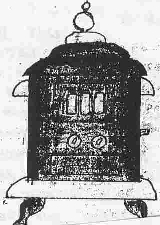 SPACE HEATERS
About 1922, dad bought a wood burning heater for his den
room. That worked better than the fire place bacause it would heat a
whole room instead of just a spot in front of the fire. A fire place
draws most of the heated air up the chimney. A heater utilizes much
of the heat from the combustion gases and passes it through the sides
of the combustion chamber and vent pipe to the room.
A short time later, dad wanted to fix up the “parlour” for
Walter’s bride, Violet, who was coming for a visit. He bought some living
room furniture, and a fancy stove that would burn both coal and wood.
The living room furniture was o.k. for that period, but
would not be considered very appropriate today. There was a mahogany
table with drawer. That was o.k. Then there were a rocking chair, a
straight back chair and a love seat. All had stiff spring seats covered
with a black rubberized fabric. They were not compfortable. The backs
of the seats were unpadded wood.
When Guy announced that he was bringing his first bride,
Genevieve Gordon Wilkinson, Dad bought a heater for the dining room.
A version of that heater is still being sold.
It is called a “box heater”. {includes illustration of heater}
Page 132
OUT DOOR BATHROOM
It was located about two hundred feet from the house and
not far from the chicken house. It was built of pine boards nailed
vertically. It was well ventilated both summer and winter. The problem
with winter ventilation was snow drifting in and covering the bench.
The bench had three “seats” cut in it. One small cut for kids and two
regular for adults.
Imagine walking through two hundred feet of snow to get
there, and then have to rake a thin coat of snow off before you could
sit down.
In the summer, don’t rush out bare footed. You night step
on a chicken “daisy” and have to scrape out between your toes.
You miss all that adventure with indoor bathrooms. You
don’t get a chance to look over old issues of Sears-Roebuck catalouges
that were used in place of that soft sissy paper that now comes in rolls.
Page 132
The old traditional cartoon of the little four foot square
house with the half moon cut in the door is a modern scientific version.
Back in about 1950, I built a number of those by specifications provided
by the N.C. Health Department. They were four feet square with a
concrete slab floor and a concrete stool form.
I once read an account of one of the more fashionable homes
on West Main Street in Washington that had a fine brick structure with a
partition for ladies on one side and gentlemen on the other. Either side
could accomidate up to five passengers at a time.
The president of the Bank of Washington, Jesse B. Ross told
me that when he first started working for the bank as a messenger boy
before the turn of the century, the bank had an out door privy out back.
There was an old black man in Washington whose occupation
was cleaning out privies and loading the sludge in his horse drawn cart.
He hauled it to the country and sold it to farmers for fertilizer.
The modern version of this is the contractor with the tank
truck who pumps out septic tanks. {small illustration of Privy}
Page 134
SPACE HEATERS
About 1922, dad bought a wood burning heater for his den
room. That worked better than the fire place bacause it would heat a
whole room instead of just a spot in front of the fire. A fire place
draws most of the heated air up the chimney. A heater utilizes much
of the heat from the combustion gases and passes it through the sides
of the combustion chamber and vent pipe to the room.
A short time later, dad wanted to fix up the “parlour” for
Walter’s bride, Violet, who was coming for a visit. He bought some living
room furniture, and a fancy stove that would burn both coal and wood.
The living room furniture was o.k. for that period, but
would not be considered very appropriate today. There was a mahogany
table with drawer. That was o.k. Then there were a rocking chair, a
straight back chair and a love seat. All had stiff spring seats covered
with a black rubberized fabric. They were not compfortable. The backs
of the seats were unpadded wood.
When Guy announced that he was bringing his first bride,
Genevieve Gordon Wilkinson, Dad bought a heater for the dining room.
A version of that heater is still being sold.
It is called a “box heater”. {includes illustration of heater}
Page 132
OUT DOOR BATHROOM
It was located about two hundred feet from the house and
not far from the chicken house. It was built of pine boards nailed
vertically. It was well ventilated both summer and winter. The problem
with winter ventilation was snow drifting in and covering the bench.
The bench had three “seats” cut in it. One small cut for kids and two
regular for adults.
Imagine walking through two hundred feet of snow to get
there, and then have to rake a thin coat of snow off before you could
sit down.
In the summer, don’t rush out bare footed. You night step
on a chicken “daisy” and have to scrape out between your toes.
You miss all that adventure with indoor bathrooms. You
don’t get a chance to look over old issues of Sears-Roebuck catalouges
that were used in place of that soft sissy paper that now comes in rolls.
Page 132
The old traditional cartoon of the little four foot square
house with the half moon cut in the door is a modern scientific version.
Back in about 1950, I built a number of those by specifications provided
by the N.C. Health Department. They were four feet square with a
concrete slab floor and a concrete stool form.
I once read an account of one of the more fashionable homes
on West Main Street in Washington that had a fine brick structure with a
partition for ladies on one side and gentlemen on the other. Either side
could accomidate up to five passengers at a time.
The president of the Bank of Washington, Jesse B. Ross told
me that when he first started working for the bank as a messenger boy
before the turn of the century, the bank had an out door privy out back.
There was an old black man in Washington whose occupation
was cleaning out privies and loading the sludge in his horse drawn cart.
He hauled it to the country and sold it to farmers for fertilizer.
The modern version of this is the contractor with the tank
truck who pumps out septic tanks. {small illustration of Privy}
Page 134 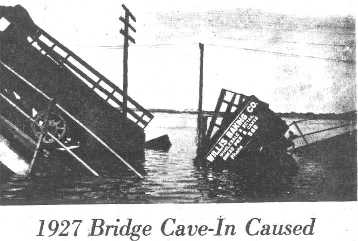 Needed! TExt from News article....
Page 135 missing
Page 136
CROW, THE SUPER
The milk dad poured over his cereal was from
a dairy next door. A Mr. June C. Crow operated a state
inspected dairy complete with horse drawn delivery wagon.
The milk cost 10 cents per quart.
The land west of dad’s farm had a fertilizer factory with
docks to unload sea going barges, and a railroad line with 4 tracks in
the rall yard. They also shipped by water and trucks, or horse drawn
wagons. Mr Crow was superintendant of the factory. Salary, a whopping
$60.00 per week. He also had free use of the farm property that the
company owned. He fertilized his crops with company owned chemicals.
Mr. Crow had 4 mules and 3 carts. The company used a lot
of inert silica (sand) to dilute strong chemicals in manufacturing.
Mr. Crow rented 3 mules and carts at a fee per load, to the company
all summer, to haul sand from a field mine to the silica shed.
Over oa period of years, several acres of sand were mined
from a depth of 5 to 10 feet, leaving two large sand pits, one of which
was within a few feet of dad’s property line. The sand was loaded in
the carts by hand with shovels, about a cubit yard per load.
Mr. Albert Mish was hauling sand one day when the sand bank
caved in and a human skull rolled up to Mr. Mish and landed, facing him,
seeming to be grinning at him. The other guys had to run as fast as they
could to catch Mr. Mish and practially drag him back to his mule and cart.
It was a nice skull. I examined it myself. It had a nice
full set of teeth.
Page 137
LIVESTOCK
Dad had horses, hogs and chickens of his own. He occasionally
had mules, sheep, cows and hogs that were not his own. Mr. Crow’s fences
were not too good and dad often had the neighbor’s livestock feasting on
his field crops.
Mr. Crow kept hogs, a small herd of cows, a herd of sheep,
chickens and mules. He required the night watchman to feed the mules,
and until he started the dairy, he required the watchman tomilk one
cow daily, at no extra pay. A Mr. Messick quit his job one Sunday
morning when the cow kicked a bucket of milk over and ruined his suit.
The watchman had to walk his rounds every hour and “punch”
a paper dial locked in the clock with numbred keys chained at various
stations around the factory. There was a key station in the mule barn
and one in the chicken house. I never thought the insurance company
required his chickens to be watched.
Page 138
THE FACTORY NEXT DOOR
The fertilizer factory next to dad’s farm was situated on
about 80 acres of land which was part of the same parcel of land that
dad’s farm was a part of – the origonal McWilliams land. This factory
was owned by the F. S. Royster Guano Co. of Norfolk, Va. They also
owned 51 % of the Pamlico Chemical Company of Washington, N.C., the
other interest of Pamlico chem. owned by Charles F. Cowell and sons.
Pamlico Chem. Served as sales office, and the factory did the
manufacturing and most of the shipping.
In the early days before trucks delivered straight to the
farmer, most fertilizer was shipped by boat or rail road.
Orders would be made up for all farm customers in a
certain community, such as Chocowinity or Wilmar. A Wilmar car
would be loaded. Each farmer of that area would have his order
stacked in a separate pile in the car and tagged. The r.r. car
would be side tracked at Wilmar and the customers would take their
orders out of the r.r. car and haul it home by horse and wagon
or cart. It worked the same way by boat and scow.
Just west of Royster was a vacant tract of land owned by
Phillips Fertilizer Co. West of the vacant Phillips land was a factory
operated by Virginia – Carolina Fertilizer Co. They operated about
the same as Royster. Dad bought his fertilizer from V.C. Co.
Royster mined acres of sand pits next to dad’s farm and
he said he would feel like…..
Page 139 & 140
He was almost buying his own dirt if he bought Royster’s.
I eventually figured formulae for Royster Fertilizers
and the filler was necessary, just as a pharmacist dilutes strong
drugs with alcohol to get the prescribed strength of medication.
Back in World War One days, the fertilizer business in
Washington was booming, the factory couldn’t get enough local laborers,
so the company sent an employment scout to Georgia to recruit labor.
New recruits were given transportation and two weeks pay to sign on.
The pay roll reached a peak of 600 employees at one time.
They paid laborers $8.00 per day. The laborers made so much money
that some wore silk shirts to work in.
At the time I worked at the factory, the largest payroll
I ever worked on had 200 employees. The superintendent made $60.00
per week. The factory foreman made $25.00 per week.
There was no water fountains. There was a deep well hand
pump in front of the office building. The water boy constantly
circulated among the men with a bucket of fres water and a tim dipper.
The 2 rest rooms were built so the benches were
suspended directly over the river so they could feed the cat fish.
When they were working the 600 men, the time keeper had
trouble keeping track of all the men. Some would check their time
card in, in the morning and sneak off and play cards all day and go
back and punch out that evening and get paid for a day’s work To
stop that, an eight foot fence was erected all the way around the
factory operational area. Part of that high wall of wood boards
separated Dad’s property from theirs.
That didn’t completely seal the property off. Mama ran
a country type store in the back yard. Factory workers would come to
her store at noon to buy lunch. Some customers would buy crackers
and a can of Log Cabin brand syrup and they would eat crackers and
drink syrup. One guy would drink several bottles of vanilla
flavoring at a time. Mama asked him why he drank so much vanilla.
Was it good ?
“No mam, I drink it for the effects. It’s mostly alcohol”.
The company had a night watchman that went in the business
for himself. The company made and sold fertilizer during the day.
The watchman sold fertilizer at night at cut rate prices. Horse drawn
carts and wagons moved in and out at night by land and boats by water.
The company discovered what was happening and indicted
the watchman and his customers. Mr. Crow persuaded the management
to drop the charges. He pointed out that it would damage relations
between company and customers.
Page 141 illustration
Until 1940, the F.S. Royster Guano Co., situated next to F.M. Wilkinson’s
farm operated, manufacturing fertilizer. Most chemical raw material
arrived by by water, delivered in 1000 ton capacity barges from northern
ports. The sketch illustrates how they were unloaded. ½ ton dump
buckets were filled by hand and hoisted to top of tower and dumped in
hopper. Push cars ran a tram track overhead into the factory and
dumped the chemical on appropriate chemical pile in factory.
Small tug boat on right hauled freight on flat barge. Small brick building
with tank on roof was pump station to fill tank on fire tower which
supplied fire hydrants and hose stations at intervals around property.
Page 142
BIG FACTORY FIRE
One Sunday afternoon in about 1920, a black smoke drifted over
our house. The factory was on fire. Joe Wilkinson and a neighbor rushed
over. The watchman on duty was hysterical. Joe realized that a two foot
thick brick fire wall seprated the building down the middle. If the fire
could be contained on one side, the other side could be saved.
There were little sheds placed around the building at about 150
feet intervals. These sheds housed a fire hydrant, crow bars, fire ax and
several hundred feet of fire hose, each. The water was under high pressure
from a tall water tower. The tower tank could be quickly refilled by a
large electric pump in the “pump house” located by the edge of the river
with a 10 inch suction line that ran far out over the water and down.
Joe and his companion manned a fire hose and kept the building
wet down on the other side of the fire wall and prevented the roof from
igniting. They saved the company a fortune but got little thanks for their
effort. They were both teen aggers.
For several weeks after the fire, when the wind was
from the west, there was a very foul smell in the air. Some of
the material burned was fish meal and ground slaughter house waste.
Small mountains of the material had to burn themselves out.
Page 143 illustration
In 1920, the F.S. Royster factory caught fire. The watchman was
hysterical. Thanks to Joe Wilkinson and a neighbor who kept the
north half of the building wet down next to the fire wall, half
of the factory was saved.
Burning embers fallin in Frank Wilkinson’ field kept someone busy
putting out grass fires.
Page 144 & 145
While the fire was burning, the up draft carried burning
embers and pieces of burning tar paper high into the air and they
would fall on dad’s dry fields, setting the grass and crops on fire.
It kept someone busy putting out grass fires.
I was just a small child at the time. I stood on the porch
looking across at that terrible roaring monsterous fire blazing away,
consuming a large building and throw large burning embers far up in the
sky and I was terrified. I had a bad phobia about fires for many years.
I had bad dreams about fire. I was afraid of kerosene lamps and kerosene
cook stoves. I was afraid of fireplaces and anything else that contained
an indoor fire.
BLIZZARD
On March 2, 1926 we had a blizzard with two feet of snow.
There was never a school bus on my route so I always walked to school.
As I passed the factory bag house, where fertilizer bags were printed
and stored, I noticed a snow drift piled against one side of the bag
house. The roof was 12 feet high and the snow drift was level with
the roof.
School let out early that day at 2:00 oclock. I came home,
thawed out and went to the wood pile and cut fire wood in the snow
till dark.
CRASH
After the factory fire, several million pounds of chemicals
were left exposed. So they built a large temporary shed over the burned
area. A part of the shed was “A” frame and part was of a lesser slant.
Mr. Crow was afraid the weight of the snow would break the flatter roof
in, so he sent men out to use the fire hose to wash the snow off. The
snow stayed there and absorbed water like a sponge. CRASH !
SUPERINTENDANT CROW
June Crow never missed an opportunity to make a few extra
dollars. He had his dairy herd, the farm, and at one time, he ran a
commercial fishing business. The company furnished men and material
to build an extra large row boat and 4 mule turned windlasses on the
river shore and the cost of dragging stumps and shags from the river
bottom. I became familiar with company book keeping procedures.
The above expenses could be charged to “fences and ditches”.
The boat, windlasses and river bottom clearing put him in
business operating a large sein net. The net is strung out in a large
semi circle in the river with the ends connected to windlasses. Fish
are bagged in the circle and the net is brought in, constantly
becoming a smaller circle until the fish are dragged ashore.
Maybe it was a kid’s opinion, but I thought Mr. Crow
was somewhat arrogant.
The company had an assistant superintendant named
Jess Latham. About 1930, the company discharged Crow and made
Latham superintendant. He is the man that eventually became my
first employer.
Page 146 illustration
A bird’s eye view of factory:
office
laborers lounge
watchman’s quarters
chicken house
water tower
corn barn
mule stables
road
hose and hydrants
privies
oil house
hoist tower
barges
tug boat
scow
fire pum station
bag house
shop
temporary shelter
main plant
rail yard
soda huse
silica shed
F.S. Royster Guano Co. next to F. M. Wilkinson
Page 147
Needed! TExt from News article....
Page 135 missing
Page 136
CROW, THE SUPER
The milk dad poured over his cereal was from
a dairy next door. A Mr. June C. Crow operated a state
inspected dairy complete with horse drawn delivery wagon.
The milk cost 10 cents per quart.
The land west of dad’s farm had a fertilizer factory with
docks to unload sea going barges, and a railroad line with 4 tracks in
the rall yard. They also shipped by water and trucks, or horse drawn
wagons. Mr Crow was superintendant of the factory. Salary, a whopping
$60.00 per week. He also had free use of the farm property that the
company owned. He fertilized his crops with company owned chemicals.
Mr. Crow had 4 mules and 3 carts. The company used a lot
of inert silica (sand) to dilute strong chemicals in manufacturing.
Mr. Crow rented 3 mules and carts at a fee per load, to the company
all summer, to haul sand from a field mine to the silica shed.
Over oa period of years, several acres of sand were mined
from a depth of 5 to 10 feet, leaving two large sand pits, one of which
was within a few feet of dad’s property line. The sand was loaded in
the carts by hand with shovels, about a cubit yard per load.
Mr. Albert Mish was hauling sand one day when the sand bank
caved in and a human skull rolled up to Mr. Mish and landed, facing him,
seeming to be grinning at him. The other guys had to run as fast as they
could to catch Mr. Mish and practially drag him back to his mule and cart.
It was a nice skull. I examined it myself. It had a nice
full set of teeth.
Page 137
LIVESTOCK
Dad had horses, hogs and chickens of his own. He occasionally
had mules, sheep, cows and hogs that were not his own. Mr. Crow’s fences
were not too good and dad often had the neighbor’s livestock feasting on
his field crops.
Mr. Crow kept hogs, a small herd of cows, a herd of sheep,
chickens and mules. He required the night watchman to feed the mules,
and until he started the dairy, he required the watchman tomilk one
cow daily, at no extra pay. A Mr. Messick quit his job one Sunday
morning when the cow kicked a bucket of milk over and ruined his suit.
The watchman had to walk his rounds every hour and “punch”
a paper dial locked in the clock with numbred keys chained at various
stations around the factory. There was a key station in the mule barn
and one in the chicken house. I never thought the insurance company
required his chickens to be watched.
Page 138
THE FACTORY NEXT DOOR
The fertilizer factory next to dad’s farm was situated on
about 80 acres of land which was part of the same parcel of land that
dad’s farm was a part of – the origonal McWilliams land. This factory
was owned by the F. S. Royster Guano Co. of Norfolk, Va. They also
owned 51 % of the Pamlico Chemical Company of Washington, N.C., the
other interest of Pamlico chem. owned by Charles F. Cowell and sons.
Pamlico Chem. Served as sales office, and the factory did the
manufacturing and most of the shipping.
In the early days before trucks delivered straight to the
farmer, most fertilizer was shipped by boat or rail road.
Orders would be made up for all farm customers in a
certain community, such as Chocowinity or Wilmar. A Wilmar car
would be loaded. Each farmer of that area would have his order
stacked in a separate pile in the car and tagged. The r.r. car
would be side tracked at Wilmar and the customers would take their
orders out of the r.r. car and haul it home by horse and wagon
or cart. It worked the same way by boat and scow.
Just west of Royster was a vacant tract of land owned by
Phillips Fertilizer Co. West of the vacant Phillips land was a factory
operated by Virginia – Carolina Fertilizer Co. They operated about
the same as Royster. Dad bought his fertilizer from V.C. Co.
Royster mined acres of sand pits next to dad’s farm and
he said he would feel like…..
Page 139 & 140
He was almost buying his own dirt if he bought Royster’s.
I eventually figured formulae for Royster Fertilizers
and the filler was necessary, just as a pharmacist dilutes strong
drugs with alcohol to get the prescribed strength of medication.
Back in World War One days, the fertilizer business in
Washington was booming, the factory couldn’t get enough local laborers,
so the company sent an employment scout to Georgia to recruit labor.
New recruits were given transportation and two weeks pay to sign on.
The pay roll reached a peak of 600 employees at one time.
They paid laborers $8.00 per day. The laborers made so much money
that some wore silk shirts to work in.
At the time I worked at the factory, the largest payroll
I ever worked on had 200 employees. The superintendent made $60.00
per week. The factory foreman made $25.00 per week.
There was no water fountains. There was a deep well hand
pump in front of the office building. The water boy constantly
circulated among the men with a bucket of fres water and a tim dipper.
The 2 rest rooms were built so the benches were
suspended directly over the river so they could feed the cat fish.
When they were working the 600 men, the time keeper had
trouble keeping track of all the men. Some would check their time
card in, in the morning and sneak off and play cards all day and go
back and punch out that evening and get paid for a day’s work To
stop that, an eight foot fence was erected all the way around the
factory operational area. Part of that high wall of wood boards
separated Dad’s property from theirs.
That didn’t completely seal the property off. Mama ran
a country type store in the back yard. Factory workers would come to
her store at noon to buy lunch. Some customers would buy crackers
and a can of Log Cabin brand syrup and they would eat crackers and
drink syrup. One guy would drink several bottles of vanilla
flavoring at a time. Mama asked him why he drank so much vanilla.
Was it good ?
“No mam, I drink it for the effects. It’s mostly alcohol”.
The company had a night watchman that went in the business
for himself. The company made and sold fertilizer during the day.
The watchman sold fertilizer at night at cut rate prices. Horse drawn
carts and wagons moved in and out at night by land and boats by water.
The company discovered what was happening and indicted
the watchman and his customers. Mr. Crow persuaded the management
to drop the charges. He pointed out that it would damage relations
between company and customers.
Page 141 illustration
Until 1940, the F.S. Royster Guano Co., situated next to F.M. Wilkinson’s
farm operated, manufacturing fertilizer. Most chemical raw material
arrived by by water, delivered in 1000 ton capacity barges from northern
ports. The sketch illustrates how they were unloaded. ½ ton dump
buckets were filled by hand and hoisted to top of tower and dumped in
hopper. Push cars ran a tram track overhead into the factory and
dumped the chemical on appropriate chemical pile in factory.
Small tug boat on right hauled freight on flat barge. Small brick building
with tank on roof was pump station to fill tank on fire tower which
supplied fire hydrants and hose stations at intervals around property.
Page 142
BIG FACTORY FIRE
One Sunday afternoon in about 1920, a black smoke drifted over
our house. The factory was on fire. Joe Wilkinson and a neighbor rushed
over. The watchman on duty was hysterical. Joe realized that a two foot
thick brick fire wall seprated the building down the middle. If the fire
could be contained on one side, the other side could be saved.
There were little sheds placed around the building at about 150
feet intervals. These sheds housed a fire hydrant, crow bars, fire ax and
several hundred feet of fire hose, each. The water was under high pressure
from a tall water tower. The tower tank could be quickly refilled by a
large electric pump in the “pump house” located by the edge of the river
with a 10 inch suction line that ran far out over the water and down.
Joe and his companion manned a fire hose and kept the building
wet down on the other side of the fire wall and prevented the roof from
igniting. They saved the company a fortune but got little thanks for their
effort. They were both teen aggers.
For several weeks after the fire, when the wind was
from the west, there was a very foul smell in the air. Some of
the material burned was fish meal and ground slaughter house waste.
Small mountains of the material had to burn themselves out.
Page 143 illustration
In 1920, the F.S. Royster factory caught fire. The watchman was
hysterical. Thanks to Joe Wilkinson and a neighbor who kept the
north half of the building wet down next to the fire wall, half
of the factory was saved.
Burning embers fallin in Frank Wilkinson’ field kept someone busy
putting out grass fires.
Page 144 & 145
While the fire was burning, the up draft carried burning
embers and pieces of burning tar paper high into the air and they
would fall on dad’s dry fields, setting the grass and crops on fire.
It kept someone busy putting out grass fires.
I was just a small child at the time. I stood on the porch
looking across at that terrible roaring monsterous fire blazing away,
consuming a large building and throw large burning embers far up in the
sky and I was terrified. I had a bad phobia about fires for many years.
I had bad dreams about fire. I was afraid of kerosene lamps and kerosene
cook stoves. I was afraid of fireplaces and anything else that contained
an indoor fire.
BLIZZARD
On March 2, 1926 we had a blizzard with two feet of snow.
There was never a school bus on my route so I always walked to school.
As I passed the factory bag house, where fertilizer bags were printed
and stored, I noticed a snow drift piled against one side of the bag
house. The roof was 12 feet high and the snow drift was level with
the roof.
School let out early that day at 2:00 oclock. I came home,
thawed out and went to the wood pile and cut fire wood in the snow
till dark.
CRASH
After the factory fire, several million pounds of chemicals
were left exposed. So they built a large temporary shed over the burned
area. A part of the shed was “A” frame and part was of a lesser slant.
Mr. Crow was afraid the weight of the snow would break the flatter roof
in, so he sent men out to use the fire hose to wash the snow off. The
snow stayed there and absorbed water like a sponge. CRASH !
SUPERINTENDANT CROW
June Crow never missed an opportunity to make a few extra
dollars. He had his dairy herd, the farm, and at one time, he ran a
commercial fishing business. The company furnished men and material
to build an extra large row boat and 4 mule turned windlasses on the
river shore and the cost of dragging stumps and shags from the river
bottom. I became familiar with company book keeping procedures.
The above expenses could be charged to “fences and ditches”.
The boat, windlasses and river bottom clearing put him in
business operating a large sein net. The net is strung out in a large
semi circle in the river with the ends connected to windlasses. Fish
are bagged in the circle and the net is brought in, constantly
becoming a smaller circle until the fish are dragged ashore.
Maybe it was a kid’s opinion, but I thought Mr. Crow
was somewhat arrogant.
The company had an assistant superintendant named
Jess Latham. About 1930, the company discharged Crow and made
Latham superintendant. He is the man that eventually became my
first employer.
Page 146 illustration
A bird’s eye view of factory:
office
laborers lounge
watchman’s quarters
chicken house
water tower
corn barn
mule stables
road
hose and hydrants
privies
oil house
hoist tower
barges
tug boat
scow
fire pum station
bag house
shop
temporary shelter
main plant
rail yard
soda huse
silica shed
F.S. Royster Guano Co. next to F. M. Wilkinson
Page 147 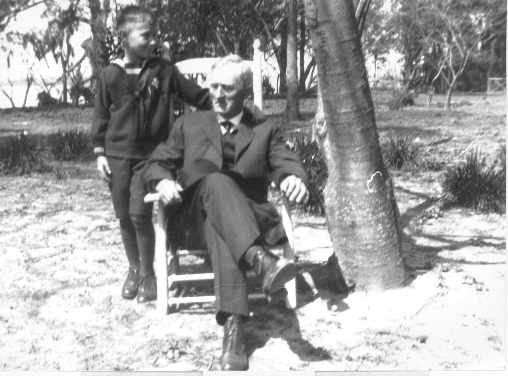 Francis Marion Wilkinson and youngest son, George taken about 1921.
Page 148
Francis Marion Wilkinson and youngest son, George taken about 1921.
Page 148 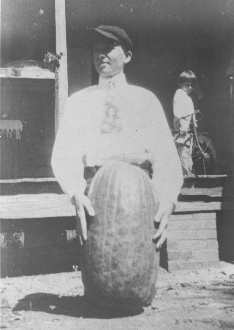 Frank Chilson Wilkinson, with 56 pound watermelon, George Wilkinson
Page 149
Frank Chilson Wilkinson, with 56 pound watermelon, George Wilkinson
Page 149 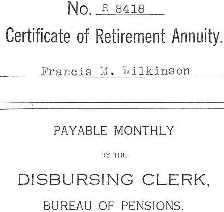 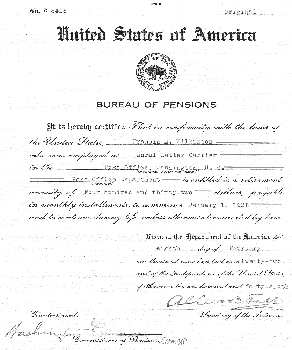 Document (Bureau of Pensions)
Page 150 photo newspaper clipping
June 1, 1922
F.M. Wilkinson rural free delivery carrier goes on pension.
Served 19 years.
After being in active service as a county free delivery carrier for
19 years, Francis M. Wilkinson today retires from duty and hereafter
will receive a pension from Uncle Sam for the rest of his life.
During Mr. Wilkinson’s 19 years on rural route No. 2 he has only been
absent from his post of duty one day and only three days during his
long service has the mail failed to reach its proper destination. This
is indeed a remarkable record, one not surpassed the Daily News believes
in the state. That Mr. Wilkinson has justly won his merited retirement,
pay will not be questioned by any reader. He has made a most careful
and painstaking official and he goes into private life with the best
wishes of his friends and the postoffice department which he has served
so faithfully.
Page 151
About 1924, Dad traded in his model “T” Ford for a car called
a “Star” made by the Durant Motor Co. This Star was a six cylinder job
with cloth top, self starter and stick shift. The salesman took mama for
a drive and showed her how to drive it.
After Chilson left home, that left mama to be the only driver
for over four years. Mama didn’t exactly drive a car, she aimed it and
blew the horn. Some how we all survived with no physical damage to us
or the car.
As a child, I was like horses. I had always been afraid of
those early model cars, and my experience with mama’s driving didn’t do
my nerves any good. I am glad there was not much traffic in those days.
FIRE
It was about 1928 or 1929, we were awakened in the middle
of the night by a loud roaring and popping and snapping and a bright
red glow. FIRE !
There was a farm storage building about 16 feet from our
kitchen. It consisted of 4 rooms lined up side by side in a continus
row, plus a car shelter as a part making 5 units.
The storage rooms all contained cotton and tobacco. The end
section contained tools and Dad’s automobile. Dad was partially deaf,
but the explosion of the car awakened him. Dad’s first impression was
that the kitchen was burning. Mama screamed to me to come down stairs
and bring my trunk with me. I didn’t keep many clothes in the truck,
but I brought the almost empty trunk down. I didn’t know what it was
all about. I thought it was a big truck engine running fast with head
lights on.
Page 152 & 153
When I reached the ground floor, it was as light as day
outside and a loud unfamiliar popping, roaring sound was going on.
Mama said the kitchen and pack house were burning up.
They thought the kitchen was also on fire.
Dad thought everything he had worked for all his life was
being destroyed and he was hysterical. He was wearing an old work shoe
on one foot and a black polished “Sunday” shoe on the other foot. He
was wearing his old working cap and when he passed his Sunday hat, he
threw the cap down and put on the Sunday hat. Mom and Pop were
hauling furniture and clothing out in the yard.
Some of our neighbors came up and one asked for a ladder.
He said he thought they could save the kitchen. Dad told him where to
find a ladder. The shingles were smokeing and so were the boards on
the side of the house. They were just before igniting. These men began
wetting down the side of the house and the roof next to the fire and
they saved the house.
When morning came, Dad had to go to town in the buggy to
get an ax to cut wood to cook with. There was no insurance.
There was a clean up job after the fire. Bruce hauled the
old car remains off. He thought he could salvage most of the engine to
put in a boat.
Shortly thereafter, Dad bought another car. This one was
called a Durant. It had six cylinders, stick gear shift, roll up glass
windows, and it was a two door model. The passenger in front had to get
out and tilt forward the front seat to let a passenger get in the back.
Dad said he should have bought 4 doors. It would have been worth the
hundred dollars difference to keep his seat.
This Durant was the car I learned to drive, at about 14 years
of age. This was before North Carolina required driver’s license.
Dad suspected the fire to be arson. He was afraid to get
the law involved because he was afraid of reprisals. In modern times,
the authorities would automaticaly investigate anyway.
After Dad retired from the postal service, and with the use
of a car instead of horses, he didn’t need as many horses or as many acres
of feed crops. Also, his sons were leaving home, so he had too much land
to cultivate.
Dad started renting and leasing land to tenants. One of
Dad’s first tenants was a foreigner during World War I period. This
man was an Austro-Hungarian. That means that one parent was Austrian,
one Hunganian, and his nurse had been German. He spoke four languages,
including english with a heavy accent.
This man, Mr. A. B. Mary leased the back half of the
cultivated land. He built a stable for the mule, and a 12 x 16 foot
house on it for his hired man, a Mr. Ike Simpson. Mr. Simpson was single,
so his animals were his friends. Along with the mule, he kept kittens.
Page 154
Mama ran a back yard country store, complete with molasses
barrel and pump, kerosene barrell and pump, cheese cutter, tobacco plug
cutter, glass pickel jar, and pickeled pig’s feet keg.
Mr. Simpson would buy 15 cent cans of salmon to feed his
cats, and he would take his fiddle out to the barn and play and sing
to his mules.
Mr. Simpson came up to the store once, and Chilson asked
him what was hanging out the top of his pants? Mr. Simpson explained
that he had worn out his long handled drawers, but had some tops left
over, so he was using them upside down for drawers.
After World War I, Mr. Mary left the farm, so Dad began renting some
of his land to near by farm families from the “colored community”. They
furnished the labor and mule and most of the tools and 2/3 of the seeds
and fertilizer, and dad would furnish 1/3 of seeds and fertilizer and
the land for 1/3 of the crop.
This worked out good for all parties for a long time.
Before the fire, Pop had three tenant families, Amous Guiford,
William Oden ahd his brother, George Oden. In the spring of 1929, the
farmers had just begun to get their crops started when George Oden died.
George had a brother, John, who volunteered to take over for one half of
George’s share, and George’s widow, Carrie was to get the other half of
George’s share.
When the crops were harvested, Carrie decided she wanted
all the tenant’s share. Dad and William Oden tried to tell her that
this was not according to her brother-in-law’s origonal agreement.
He was due his part of the tenant’s share.
Page 155
There were four storage rooms and a garage in the pack
building. One room for each tenant and one for Pop. Carrie settled
up with Dad for her expenses and moved her tobacco and cotton out.
Dad and the other farmers still had tobacco and cotton in the building.
A few nights after Carrie moved her posessions out, all other
share holders lost their tobacco and cotton in the fire. After the fire,
an oil can belonging to Carrie was found in the ashes. Carrie’s mule and
cart had been found wandering around on the loose that night. Carrie’s
boy friend had been an arson suspect before he moved to Washington.
What do you think?
Dad and his tenants always had close contact. They usually
discussed their problems with him or sought him when they needed advice.
On one occasion, a little boy came up and told Mama that his
papa wanted “Midder Pank Wickson down at the Patter Pon”. –Translated –
papa wants Mister Frank Wilkinson down at the tobacco barn.
Another time, a little boy simply said “Papa wants to see Old
Man Frank”.
The tenants also kept up with the current news. Chilson went
to a tobacco barn one day and one of the women working at a “tie horse”
asked Chilson if he had heard that “Uncle Sam” was dead?
What had happened was, President Woodrow Wilson had died of
food poisoning. This woman’s son had a little dog named Woodrow.
Page 156 & 157
HOMELESS
We hear a lot about the homeless and the “street people”.
That is nothing new. Dad had some experience with that situation once.
Dad took in a young man and his wife and little girl about 6
years old once. It was just supposed to be until the young man could find
a job. He just sat around the house most of the day, and no job came
knocking on the door looking for him. He didn’t try to make himself useful
either. He didn’t even offer to cut a little bit of firewood. One day,
after more than two months, Dad asked him if he had found a job yet. “I
think you must want to get rid of me”, he said.
We grew a garden with lots of collards, and we had a smoke
house stocked with meat. Mama cooked collards and hog’s head or pork
almost every day. They almost ate us out of collards and pork. Of course,
Mom served variations in her menue. I rember once when she cooked and
served dinner, the little girl looked at the food and remarked, “I can’t
eat that old mess!”. You can imagine how happy Mom was with that remark.
SCREENS
Insect screens are considered as much a part of the home
as doors and windows. It was not always that way. Window screens
used to come in about three standard heights. These sizes would fit
most windows of all widths. Just raise the window, put the screen in,
slide the telescoping sides out till they touched the window jamb,
let the window down on top of the screen, and Mr. Fly was left out
in the cold. Dad’s house had plenty of window screens when I was
small, but what was to keep insects from coming in the doors?
Mama decided to do something about that. She bought some
screen doors while dad was delivering mail, and Chilson and Joe put them
up. When Dad arrived home, he said she had wasted her money on them.
They were no good. It wasn’t long before Dad would enter and rush to get
the screen door closed before a fly could rush in. He was telling little
kids not to “hold that door open and let the flies in”. It became evident
that
Mom had not wasted her money. Whenever a screen door needed repairs
or replacement, Dad was the one that did it.
Dad had some antique tools that he used occasionally. Some of
them would only be seen in museums now. I remember watching him split
tobacco sticks from straight grain pine logs with a froe and froe club.
A froe was a heavy steel blade that was held against the end of a log and
struck on the back edge with a hardwood club, driving the blade in and
separating the grains of the wood. The froe’s handle was attached at a
90 degree angle instead of straight with the blade as is the case with a
knife or sword.
One type of tobacco stick had to be smoothe and slick so the
tobacco prepared for market could hung across the stick like a cowboy sits
straddle a horse. At the tobacco market, the tobacco was slid off of the
stick without picking up splinters or ripping the leaf.
The smoothing of wood was done with a “draw knife” on wood
clamped in a “shave horse”.
page 158
Document (Bureau of Pensions)
Page 150 photo newspaper clipping
June 1, 1922
F.M. Wilkinson rural free delivery carrier goes on pension.
Served 19 years.
After being in active service as a county free delivery carrier for
19 years, Francis M. Wilkinson today retires from duty and hereafter
will receive a pension from Uncle Sam for the rest of his life.
During Mr. Wilkinson’s 19 years on rural route No. 2 he has only been
absent from his post of duty one day and only three days during his
long service has the mail failed to reach its proper destination. This
is indeed a remarkable record, one not surpassed the Daily News believes
in the state. That Mr. Wilkinson has justly won his merited retirement,
pay will not be questioned by any reader. He has made a most careful
and painstaking official and he goes into private life with the best
wishes of his friends and the postoffice department which he has served
so faithfully.
Page 151
About 1924, Dad traded in his model “T” Ford for a car called
a “Star” made by the Durant Motor Co. This Star was a six cylinder job
with cloth top, self starter and stick shift. The salesman took mama for
a drive and showed her how to drive it.
After Chilson left home, that left mama to be the only driver
for over four years. Mama didn’t exactly drive a car, she aimed it and
blew the horn. Some how we all survived with no physical damage to us
or the car.
As a child, I was like horses. I had always been afraid of
those early model cars, and my experience with mama’s driving didn’t do
my nerves any good. I am glad there was not much traffic in those days.
FIRE
It was about 1928 or 1929, we were awakened in the middle
of the night by a loud roaring and popping and snapping and a bright
red glow. FIRE !
There was a farm storage building about 16 feet from our
kitchen. It consisted of 4 rooms lined up side by side in a continus
row, plus a car shelter as a part making 5 units.
The storage rooms all contained cotton and tobacco. The end
section contained tools and Dad’s automobile. Dad was partially deaf,
but the explosion of the car awakened him. Dad’s first impression was
that the kitchen was burning. Mama screamed to me to come down stairs
and bring my trunk with me. I didn’t keep many clothes in the truck,
but I brought the almost empty trunk down. I didn’t know what it was
all about. I thought it was a big truck engine running fast with head
lights on.
Page 152 & 153
When I reached the ground floor, it was as light as day
outside and a loud unfamiliar popping, roaring sound was going on.
Mama said the kitchen and pack house were burning up.
They thought the kitchen was also on fire.
Dad thought everything he had worked for all his life was
being destroyed and he was hysterical. He was wearing an old work shoe
on one foot and a black polished “Sunday” shoe on the other foot. He
was wearing his old working cap and when he passed his Sunday hat, he
threw the cap down and put on the Sunday hat. Mom and Pop were
hauling furniture and clothing out in the yard.
Some of our neighbors came up and one asked for a ladder.
He said he thought they could save the kitchen. Dad told him where to
find a ladder. The shingles were smokeing and so were the boards on
the side of the house. They were just before igniting. These men began
wetting down the side of the house and the roof next to the fire and
they saved the house.
When morning came, Dad had to go to town in the buggy to
get an ax to cut wood to cook with. There was no insurance.
There was a clean up job after the fire. Bruce hauled the
old car remains off. He thought he could salvage most of the engine to
put in a boat.
Shortly thereafter, Dad bought another car. This one was
called a Durant. It had six cylinders, stick gear shift, roll up glass
windows, and it was a two door model. The passenger in front had to get
out and tilt forward the front seat to let a passenger get in the back.
Dad said he should have bought 4 doors. It would have been worth the
hundred dollars difference to keep his seat.
This Durant was the car I learned to drive, at about 14 years
of age. This was before North Carolina required driver’s license.
Dad suspected the fire to be arson. He was afraid to get
the law involved because he was afraid of reprisals. In modern times,
the authorities would automaticaly investigate anyway.
After Dad retired from the postal service, and with the use
of a car instead of horses, he didn’t need as many horses or as many acres
of feed crops. Also, his sons were leaving home, so he had too much land
to cultivate.
Dad started renting and leasing land to tenants. One of
Dad’s first tenants was a foreigner during World War I period. This
man was an Austro-Hungarian. That means that one parent was Austrian,
one Hunganian, and his nurse had been German. He spoke four languages,
including english with a heavy accent.
This man, Mr. A. B. Mary leased the back half of the
cultivated land. He built a stable for the mule, and a 12 x 16 foot
house on it for his hired man, a Mr. Ike Simpson. Mr. Simpson was single,
so his animals were his friends. Along with the mule, he kept kittens.
Page 154
Mama ran a back yard country store, complete with molasses
barrel and pump, kerosene barrell and pump, cheese cutter, tobacco plug
cutter, glass pickel jar, and pickeled pig’s feet keg.
Mr. Simpson would buy 15 cent cans of salmon to feed his
cats, and he would take his fiddle out to the barn and play and sing
to his mules.
Mr. Simpson came up to the store once, and Chilson asked
him what was hanging out the top of his pants? Mr. Simpson explained
that he had worn out his long handled drawers, but had some tops left
over, so he was using them upside down for drawers.
After World War I, Mr. Mary left the farm, so Dad began renting some
of his land to near by farm families from the “colored community”. They
furnished the labor and mule and most of the tools and 2/3 of the seeds
and fertilizer, and dad would furnish 1/3 of seeds and fertilizer and
the land for 1/3 of the crop.
This worked out good for all parties for a long time.
Before the fire, Pop had three tenant families, Amous Guiford,
William Oden ahd his brother, George Oden. In the spring of 1929, the
farmers had just begun to get their crops started when George Oden died.
George had a brother, John, who volunteered to take over for one half of
George’s share, and George’s widow, Carrie was to get the other half of
George’s share.
When the crops were harvested, Carrie decided she wanted
all the tenant’s share. Dad and William Oden tried to tell her that
this was not according to her brother-in-law’s origonal agreement.
He was due his part of the tenant’s share.
Page 155
There were four storage rooms and a garage in the pack
building. One room for each tenant and one for Pop. Carrie settled
up with Dad for her expenses and moved her tobacco and cotton out.
Dad and the other farmers still had tobacco and cotton in the building.
A few nights after Carrie moved her posessions out, all other
share holders lost their tobacco and cotton in the fire. After the fire,
an oil can belonging to Carrie was found in the ashes. Carrie’s mule and
cart had been found wandering around on the loose that night. Carrie’s
boy friend had been an arson suspect before he moved to Washington.
What do you think?
Dad and his tenants always had close contact. They usually
discussed their problems with him or sought him when they needed advice.
On one occasion, a little boy came up and told Mama that his
papa wanted “Midder Pank Wickson down at the Patter Pon”. –Translated –
papa wants Mister Frank Wilkinson down at the tobacco barn.
Another time, a little boy simply said “Papa wants to see Old
Man Frank”.
The tenants also kept up with the current news. Chilson went
to a tobacco barn one day and one of the women working at a “tie horse”
asked Chilson if he had heard that “Uncle Sam” was dead?
What had happened was, President Woodrow Wilson had died of
food poisoning. This woman’s son had a little dog named Woodrow.
Page 156 & 157
HOMELESS
We hear a lot about the homeless and the “street people”.
That is nothing new. Dad had some experience with that situation once.
Dad took in a young man and his wife and little girl about 6
years old once. It was just supposed to be until the young man could find
a job. He just sat around the house most of the day, and no job came
knocking on the door looking for him. He didn’t try to make himself useful
either. He didn’t even offer to cut a little bit of firewood. One day,
after more than two months, Dad asked him if he had found a job yet. “I
think you must want to get rid of me”, he said.
We grew a garden with lots of collards, and we had a smoke
house stocked with meat. Mama cooked collards and hog’s head or pork
almost every day. They almost ate us out of collards and pork. Of course,
Mom served variations in her menue. I rember once when she cooked and
served dinner, the little girl looked at the food and remarked, “I can’t
eat that old mess!”. You can imagine how happy Mom was with that remark.
SCREENS
Insect screens are considered as much a part of the home
as doors and windows. It was not always that way. Window screens
used to come in about three standard heights. These sizes would fit
most windows of all widths. Just raise the window, put the screen in,
slide the telescoping sides out till they touched the window jamb,
let the window down on top of the screen, and Mr. Fly was left out
in the cold. Dad’s house had plenty of window screens when I was
small, but what was to keep insects from coming in the doors?
Mama decided to do something about that. She bought some
screen doors while dad was delivering mail, and Chilson and Joe put them
up. When Dad arrived home, he said she had wasted her money on them.
They were no good. It wasn’t long before Dad would enter and rush to get
the screen door closed before a fly could rush in. He was telling little
kids not to “hold that door open and let the flies in”. It became evident
that
Mom had not wasted her money. Whenever a screen door needed repairs
or replacement, Dad was the one that did it.
Dad had some antique tools that he used occasionally. Some of
them would only be seen in museums now. I remember watching him split
tobacco sticks from straight grain pine logs with a froe and froe club.
A froe was a heavy steel blade that was held against the end of a log and
struck on the back edge with a hardwood club, driving the blade in and
separating the grains of the wood. The froe’s handle was attached at a
90 degree angle instead of straight with the blade as is the case with a
knife or sword.
One type of tobacco stick had to be smoothe and slick so the
tobacco prepared for market could hung across the stick like a cowboy sits
straddle a horse. At the tobacco market, the tobacco was slid off of the
stick without picking up splinters or ripping the leaf.
The smoothing of wood was done with a “draw knife” on wood
clamped in a “shave horse”.
page 158 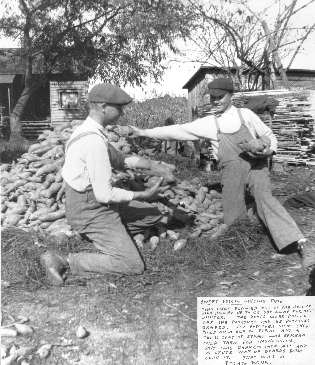 Joe and Chilson Wilkinson at sweet potato harvest time.
Page 159
Dad used some home made, horse drawn plows made of wood to
do a specific job.
For many years, Dad depended on a large scuppernong grape
arbor as a cash crop. All of his arbors probably covered more than
an acre. His largest and best arbor was near the house. I have helped
hand pick more than 12 bushels of grapes a day. They were sold to
stores around town.
Eight quarts is a peck. Four pecks, a bushel. Dad charged
one dollar a peck for a rounded up ten quart bucket full of grapes. He
believed in giving good measure. He would charge one dollar for a bushel
(32 quarts) of sweet potatoes measured in a ten gallon salt mullet wood
tub (40 quarts), rounded up on top.
Back to the grape vines - The grape arbors were just high
enough above the ground for an average man to walk under without bumping
his head. They were supported by post with a forked or a vee notched top.
They were spaced ten feet apart each way. They were split from red cedar
or pitch pine lightwood. The lightwood post sometimes had score marks on
a side indicating they had once been tapped to draw turpentine. I once
asked dad how old the lightwood posts were. He said. “I brought them from
over the river more than fifty years ago”.
Wood rails of cypress or lightwood laid across the posts to form
squares. A grill of weaker rails were laid on the squares to support the vines.
Page 160
Joe and Chilson Wilkinson at sweet potato harvest time.
Page 159
Dad used some home made, horse drawn plows made of wood to
do a specific job.
For many years, Dad depended on a large scuppernong grape
arbor as a cash crop. All of his arbors probably covered more than
an acre. His largest and best arbor was near the house. I have helped
hand pick more than 12 bushels of grapes a day. They were sold to
stores around town.
Eight quarts is a peck. Four pecks, a bushel. Dad charged
one dollar a peck for a rounded up ten quart bucket full of grapes. He
believed in giving good measure. He would charge one dollar for a bushel
(32 quarts) of sweet potatoes measured in a ten gallon salt mullet wood
tub (40 quarts), rounded up on top.
Back to the grape vines - The grape arbors were just high
enough above the ground for an average man to walk under without bumping
his head. They were supported by post with a forked or a vee notched top.
They were spaced ten feet apart each way. They were split from red cedar
or pitch pine lightwood. The lightwood post sometimes had score marks on
a side indicating they had once been tapped to draw turpentine. I once
asked dad how old the lightwood posts were. He said. “I brought them from
over the river more than fifty years ago”.
Wood rails of cypress or lightwood laid across the posts to form
squares. A grill of weaker rails were laid on the squares to support the vines.
Page 160 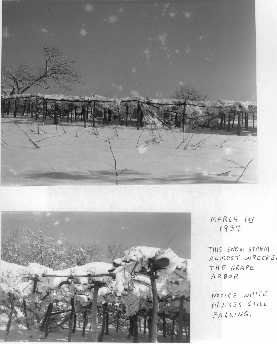 March 1st, 1937 This snow storm almost wrecked the grape arbor.
Notice the white flakes still falling.
Page 161
Good straight grained durable logs became hard to find to make
rails. I have helped him split rails for his arbor. We would drive a steel
wedge or an old ax head in the end of a log. That would crack it on that
end. Then drive hard wood wedges, called gluts in the cracks, forcing the
crack to extend to the other end of the log, splitting it in two. These
pieces were split and re-split till the right size rails were made. That is
the same way Abe Lincoln did it.
Dad finally had to cut down most of his grape vines because the
right kind of rails and posts were not available.
One of the vines he cut down had a truck, or base more than 30
inches in diameter. It looked like a rope with individual stands four or more
inches in diameter.
Dad’s barn was a central 2 room building with a large storage
loft, and 3 horse stables on the east side. The west shed was used to park
the buggy and the cart. Some of the boards in the barn measured 24 inches
wide. He told me the structure was origonally built for $99.00. He had some
minor repair work done on it about 1930, that cost about the same amount –
inflation over the years.
Page 162 illustration
The barn on the farm of F. M. Wilkinson was probably built in the late
eighteen eightys, origonal cost $99.00. 3 horse stables on left, fodder
storage in loft, water pump and manure pile on side, fig bush and tree in back.
Page 163 and 164 and 165
As soon as I was old enough, I had to help keep the wood boxes filled,
take tobacco off of the tobacco sticks, and help pick grapes. I started
out using a little quart bucket to pick and carry them in. From that, I
graduated to a gallon “picking bucket”
.
As I grew older, like the other boys, Dad had me doing
anything on the farm that I was not quite old enough to do. I did my
fishing on a part of my mid day rest break, and week ends. Even then,
on weekends, there were chickens and horses to feed and water and wood
to cut and tote in.
The older boys grew up and moved away, one by one. I was
ten years old when the last one left. That just left Dad with only me
to help him run his farming operations.
I had to reach up to hold the plow handles. If there was
plowing to be done in the early spring, the horse would be hitched to
the plow and tied up waiting for me to return from school. I would
change clothes and plow till sun down and then get in the firewood.
To this day, I don’t know what high school and colledge sports are all a
bout.
As I stated before, I started driving the car at 14 and
was pressed into service delivering Dad’s produce.
I was delivering watermellons to one of Dad’s customers,
named Garfield Clemmons. Garfield looked like the t.v. star, Brodrick
Crawford, except Garfield had a chocolate brown complexion. Garfield
was a restaurant owner who had bought Dad’s melons for years.
As I was bringing in his melons, I noticed one of his
customers sitting alone at a table picking through his food. He
asked Garfield “whats dis?”. Garfield snapped back, “shet ye mouth
and eat it ! Its clean”.
Now that’s the way to handle cranky customers, even
though “the customer is always right”.
An automobiele salesman talked Dad into trading the
Durant in for a 1934 model 2 door Cherolet with about 400 miles
on the odometer. I liked the idea because the gears were hard to
shift in the Durant. You had to get the motor and the car both
turning at just the right speed or the gears would clash. I was
always afraid the gears would strip. The Chevrolet was Dad’s last
car. After his death, Mom drove it a few years and then sold it
to me.
ELECTRICITY
About 1935, Dad decided to have his house wired for
electricity. There was a ceiling light in each room and hall and
I can remember at least two wall outlets. One in the dining room
for his new electric refrigerator and one in his bed room – den
where he plugged in a radio.
Previously to that, he had always used kerosine lamps, and
for refrigeration. Before he bought an old fashioned ice chest, he kept
meats fresh several days in a wood box with 50 pounds of ice, all wrapped
up in many layers of burlap bags.
NOW ABOUT THE RADIO
Dad spent his leisure time reading the Washington Daily News,
the Progressive Farmer Magazine, the Literary Digest Magazine, the Bible,
the R.F.D. News Magazine and occasionaly the World Atlas and listening to
that radio. We used to have programs such as Amos and Andy, Lum and Abner
at the Jot Em Down Store, a horror program called The Squeaking Door to
name a few.
Gwendolyn Wilkinson Herbert was visiting Dad on this
particular occasion. Her husband, Jake Herbert was at their home in
Roanoke, Va.
I was working as night watchman at the F. S. Royster Guano
factory at the time. I had no radio.
Some time during the early part of the night Gwendolyn came
rushing in to the factory office all excited. She wanted to use the
phone to call Jake in Roanoke to see if he was alive and all right.
The family had been sitting around the radio listening to
a program by Orson Wells, entitiled “War Of The Worlds”. That night
millions of Americans thought the United States was invaded by creatures
from Mars. I had no radio so I was quite puzzled by Gwen’s behavior.
Page 166
March 1st, 1937 This snow storm almost wrecked the grape arbor.
Notice the white flakes still falling.
Page 161
Good straight grained durable logs became hard to find to make
rails. I have helped him split rails for his arbor. We would drive a steel
wedge or an old ax head in the end of a log. That would crack it on that
end. Then drive hard wood wedges, called gluts in the cracks, forcing the
crack to extend to the other end of the log, splitting it in two. These
pieces were split and re-split till the right size rails were made. That is
the same way Abe Lincoln did it.
Dad finally had to cut down most of his grape vines because the
right kind of rails and posts were not available.
One of the vines he cut down had a truck, or base more than 30
inches in diameter. It looked like a rope with individual stands four or more
inches in diameter.
Dad’s barn was a central 2 room building with a large storage
loft, and 3 horse stables on the east side. The west shed was used to park
the buggy and the cart. Some of the boards in the barn measured 24 inches
wide. He told me the structure was origonally built for $99.00. He had some
minor repair work done on it about 1930, that cost about the same amount –
inflation over the years.
Page 162 illustration
The barn on the farm of F. M. Wilkinson was probably built in the late
eighteen eightys, origonal cost $99.00. 3 horse stables on left, fodder
storage in loft, water pump and manure pile on side, fig bush and tree in back.
Page 163 and 164 and 165
As soon as I was old enough, I had to help keep the wood boxes filled,
take tobacco off of the tobacco sticks, and help pick grapes. I started
out using a little quart bucket to pick and carry them in. From that, I
graduated to a gallon “picking bucket”
.
As I grew older, like the other boys, Dad had me doing
anything on the farm that I was not quite old enough to do. I did my
fishing on a part of my mid day rest break, and week ends. Even then,
on weekends, there were chickens and horses to feed and water and wood
to cut and tote in.
The older boys grew up and moved away, one by one. I was
ten years old when the last one left. That just left Dad with only me
to help him run his farming operations.
I had to reach up to hold the plow handles. If there was
plowing to be done in the early spring, the horse would be hitched to
the plow and tied up waiting for me to return from school. I would
change clothes and plow till sun down and then get in the firewood.
To this day, I don’t know what high school and colledge sports are all a
bout.
As I stated before, I started driving the car at 14 and
was pressed into service delivering Dad’s produce.
I was delivering watermellons to one of Dad’s customers,
named Garfield Clemmons. Garfield looked like the t.v. star, Brodrick
Crawford, except Garfield had a chocolate brown complexion. Garfield
was a restaurant owner who had bought Dad’s melons for years.
As I was bringing in his melons, I noticed one of his
customers sitting alone at a table picking through his food. He
asked Garfield “whats dis?”. Garfield snapped back, “shet ye mouth
and eat it ! Its clean”.
Now that’s the way to handle cranky customers, even
though “the customer is always right”.
An automobiele salesman talked Dad into trading the
Durant in for a 1934 model 2 door Cherolet with about 400 miles
on the odometer. I liked the idea because the gears were hard to
shift in the Durant. You had to get the motor and the car both
turning at just the right speed or the gears would clash. I was
always afraid the gears would strip. The Chevrolet was Dad’s last
car. After his death, Mom drove it a few years and then sold it
to me.
ELECTRICITY
About 1935, Dad decided to have his house wired for
electricity. There was a ceiling light in each room and hall and
I can remember at least two wall outlets. One in the dining room
for his new electric refrigerator and one in his bed room – den
where he plugged in a radio.
Previously to that, he had always used kerosine lamps, and
for refrigeration. Before he bought an old fashioned ice chest, he kept
meats fresh several days in a wood box with 50 pounds of ice, all wrapped
up in many layers of burlap bags.
NOW ABOUT THE RADIO
Dad spent his leisure time reading the Washington Daily News,
the Progressive Farmer Magazine, the Literary Digest Magazine, the Bible,
the R.F.D. News Magazine and occasionaly the World Atlas and listening to
that radio. We used to have programs such as Amos and Andy, Lum and Abner
at the Jot Em Down Store, a horror program called The Squeaking Door to
name a few.
Gwendolyn Wilkinson Herbert was visiting Dad on this
particular occasion. Her husband, Jake Herbert was at their home in
Roanoke, Va.
I was working as night watchman at the F. S. Royster Guano
factory at the time. I had no radio.
Some time during the early part of the night Gwendolyn came
rushing in to the factory office all excited. She wanted to use the
phone to call Jake in Roanoke to see if he was alive and all right.
The family had been sitting around the radio listening to
a program by Orson Wells, entitiled “War Of The Worlds”. That night
millions of Americans thought the United States was invaded by creatures
from Mars. I had no radio so I was quite puzzled by Gwen’s behavior.
Page 166 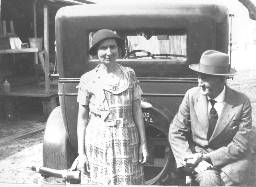 Mom and Pop with POP’S DURANT STAR
His first Star had fabric side curtains like the Ford.
That car was lost in a fire. This second Star had roll up windows.
It was eventually traded for a six cylinder Chevrolet.
That chevy was pop’s last car.
Page 167
Mom and Pop with POP’S DURANT STAR
His first Star had fabric side curtains like the Ford.
That car was lost in a fire. This second Star had roll up windows.
It was eventually traded for a six cylinder Chevrolet.
That chevy was pop’s last car.
Page 167 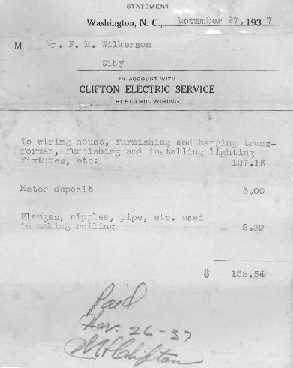 Billing statement Clifton Electric Service.
“To wire house, furnishing and hanging transformer, furnishing and
installing lighting fixtures, etc:
$127.15
Meter deposit 3.00
Flanges, nipples, pipe, etc. used in making railing 2.39
$132.54 Paid Nov 26, 37
W. H. Clifton
This was 1937 prices.
The same house wiring job 50 years later would cost more than a
thousand dollars. The hand rail ($2.39) would be more than $50..
at todays prices…..1990a.d.
Page 168 illustration
The first radio brought into the Wilkinson home was a battery
Atwater-Kent that a salesman left for 30 day’s trial. It had to
have a metal ground rod 6 “ long driven in the soil. It had to
have 100’ of copper areal (antennae) wire 20’ high out of doors.
The best program picked up was K. D. K. A. Pittsburg, along with
loads of static.
In 1938, Frank C. Chilson won a radio on a store “punch board”.
Since he knew dad would probably never buy one, he gave it to Dad.
He thought Dad would enjoy it, which he did. This is the radio
that received the famous “War Of The Worlds” program by Orson Wells.
Page 169
REUNION
On Dad’s 70th birthday, they had a family reunion.
All family members that could attend came, including his children
and their spouses, grand children, sisters, nieces and nephews, in
laws and you name it.
They had a picnic table set up in the breeze way and all
but the very old stood up to eat dinner.
After the party that night, there was a lot of hand-cranked
ice cream left in 2 large freezers. Mr. Joe Pippin, Dad’s brother-in-law
by his first wife, Ida liked ice cream and so did Dad. They sort of had
an un-official ice cream eating contest.
Dad had always liked candy, cade, ice cream and anything
sweet. That was one time he had a chance to eat all he wanted.
Dad enjoyed his big birthday party.
Page 170
By 1929, Dad had been losing money several years by renting
land to tenant farmers. He received one third of the crop as his share
plus his cost of one third of seed and fertilizer.
He started off each year by advancing cash for the cost of
all seeds and fertilizer for tenants, and he advanced additional monies
for fired additional labor to harvest tobacco and cotton. Mechanical
harvesting machines were not invented till later.
That left three tenant farmers oweing him a hefty sum at
the end of the year.
Each tenant planted six acres of tobacco along with cotton
and corn. In those days it took about 12 farm laborers to harvest a barn
of tobacco and they harvested about 5 barns per 6 acres.
Tobacco was selling cheap and Dad’s tenants were just not
making enough money on their crops to pay off their debts. He allowed
them to keep a part of the sales to live on.
After losing money for three years, he decided it was time
to quit. It would be cheaper to let most of the land lay idle and only
plant whatever crops he could tend with my help. He didn’t want to get
into the expense of raising tobacco, so he raised cotton and corn and
contracted 2 acres of sweet peppers for Lang’s Pickel Factory, and he
had his usual cantelopes, watermellons and grapes.
I was 14 years at the time. He had me to drop out of school
that spring to help him farm. He returned me to school the next fall,
but I had to repeat the 8th grade that year. He let most of the land
lay idle the next year..
Page 171
Then Dad started leasing land for “sure rent” (cash) from
that time on. He encountered a problem.
The government established an allotment program for tobacco
based on the amojnt of tobacco acreage produced the previous three years.
When dad had tenant, his farm had 18 acres. Then he stopped. He had
no acres for the yars the alotment was based on. He finally managed to
get an alotment on about 5 acres.
That cut down on the amount of land he could lease for tobacco.
Dad just started cultivating whatever he could do with my
help after school and on Saturdays and summers.
NO MISTAKES
Dad tried never to cheat any one, unless it was himself.
A story he used to tell that amused him concerned a certain
haughty man he had a business transaction with. After he left the man’s
place of business, he discovered a mistake the man had made so he went
back and told him he made a mistake.
The man said, “if I counted it, it’s right”. Dad said, “I
am sorry but you did make a mistake”. The man said, “Frank, I do not make
mistakes, so get out. I do not want to discuss it any more”.
Dad started out but stopped at the door and said, “thank you.
Since you don’t make mistakes, I’l be glad to keep your extra twenty dollars.
Thank you”.
Page 172
CHRISTMAS
AfterDdad retired from the postal service, he usually provided
a feast for Christmas. There was perhaps a roast turkey with oyster
stuffing and all the trimmings, corned ham, pies, several kinds of layer
cakes and a fruit cake soaked with grape wine. That was the only way mama
served wine.
We usually had house guests at Christmas. I rember one time Dad
took me to the woods to get a Christmas tree. I was surprised. I didn’t
think he cared about anything like that. He found a nice shaped holly with
lots of berries and we cut it and brought it to the house and he fixed a stand
and set it up in the end of the dining room
We had house guests at times other than Christmas. Modern guest
usually stay for a few hours visit unless they are from far away. In those
days, guests stayed a few days or a few weeks, even if they only lived a few
miles away.
It was nice to have company, but it was a lot of extra work and
expense on Mom and Dad. Mama as a skinny little 98 pound woman.
Don’t misunderstand this. They did enjoy friends and relatives.
It was just a lot of inconvenience.
Page 173 & 174
TRANSPORTATION
When Dad bought his farm in 1884, there were not too many
good roads through the country and fewer bridges than now. The bridge
across RunyanCreek between Washington and Washington Park was not
there then. Traffic had to cross on a ferry. Dad signed a petition
to have the first bridge built.
Dad did a lot of his travel to and from town by sail boat.
He took loads of produce to town by rowing or pole pushing if sailing
was not practical.
COMMERCIAL RIVER TRAFFIC
There were 5 or 6 saw mills in Washington that received logs by
water. A “dog” would be driven about center of a log and a long chain was
passed through the ring in the end of the dog. The lots were floated side
by side and chained together until they formed a long raft, sometimes a mile
long. The raft was towed up river to the mill, usually by a steam powered
tug boat. A lantern was placed on the back end of the raft, and ocasionally
other signal lights were lit to warn night traffic.
Occasionally, a log would break loose and float away. Dad
salvaged some of them to split for grape vine rails, and I remember one
occasion, he split some logs for tobacco sticks and shingles.
It was not unusual to see more than one long raft moving to
town at the same time.
A lot of New York City’s wood buildings originated in the
forest of Beaufort County, N.C. Those 1,000 ton fertilizer barges carried
cargo's of lumber from local sawmills, located on the Pamlico River to New
York and other northern ports.
There were two fertilizer factories near Dad’s farm. They
were in operation in the early nineteen hundreds and continued to operate
till shortly before World War Two. They brought in raw material in 1,000
ton capacity barges from northern ports. I have seeen as many as six
barges tied up at one factory at a time.
Washington had oyster boats, fish boats, freight line boats
and boats that were the only link between Ocracoke Island and the
mainland. Boats bound for Ocracoke carried vacation passengers, food,
firewood, autos and all other necessities of life.
Ocracoke, Hatteras and Harker’s Islands even used a local
boarding school, The Washington Collegiate Institute, to teach their
children from grade six through twelve.
Several of Dad’s children attended school there. It was
less than half mile from home.
Page 175
Billing statement Clifton Electric Service.
“To wire house, furnishing and hanging transformer, furnishing and
installing lighting fixtures, etc:
$127.15
Meter deposit 3.00
Flanges, nipples, pipe, etc. used in making railing 2.39
$132.54 Paid Nov 26, 37
W. H. Clifton
This was 1937 prices.
The same house wiring job 50 years later would cost more than a
thousand dollars. The hand rail ($2.39) would be more than $50..
at todays prices…..1990a.d.
Page 168 illustration
The first radio brought into the Wilkinson home was a battery
Atwater-Kent that a salesman left for 30 day’s trial. It had to
have a metal ground rod 6 “ long driven in the soil. It had to
have 100’ of copper areal (antennae) wire 20’ high out of doors.
The best program picked up was K. D. K. A. Pittsburg, along with
loads of static.
In 1938, Frank C. Chilson won a radio on a store “punch board”.
Since he knew dad would probably never buy one, he gave it to Dad.
He thought Dad would enjoy it, which he did. This is the radio
that received the famous “War Of The Worlds” program by Orson Wells.
Page 169
REUNION
On Dad’s 70th birthday, they had a family reunion.
All family members that could attend came, including his children
and their spouses, grand children, sisters, nieces and nephews, in
laws and you name it.
They had a picnic table set up in the breeze way and all
but the very old stood up to eat dinner.
After the party that night, there was a lot of hand-cranked
ice cream left in 2 large freezers. Mr. Joe Pippin, Dad’s brother-in-law
by his first wife, Ida liked ice cream and so did Dad. They sort of had
an un-official ice cream eating contest.
Dad had always liked candy, cade, ice cream and anything
sweet. That was one time he had a chance to eat all he wanted.
Dad enjoyed his big birthday party.
Page 170
By 1929, Dad had been losing money several years by renting
land to tenant farmers. He received one third of the crop as his share
plus his cost of one third of seed and fertilizer.
He started off each year by advancing cash for the cost of
all seeds and fertilizer for tenants, and he advanced additional monies
for fired additional labor to harvest tobacco and cotton. Mechanical
harvesting machines were not invented till later.
That left three tenant farmers oweing him a hefty sum at
the end of the year.
Each tenant planted six acres of tobacco along with cotton
and corn. In those days it took about 12 farm laborers to harvest a barn
of tobacco and they harvested about 5 barns per 6 acres.
Tobacco was selling cheap and Dad’s tenants were just not
making enough money on their crops to pay off their debts. He allowed
them to keep a part of the sales to live on.
After losing money for three years, he decided it was time
to quit. It would be cheaper to let most of the land lay idle and only
plant whatever crops he could tend with my help. He didn’t want to get
into the expense of raising tobacco, so he raised cotton and corn and
contracted 2 acres of sweet peppers for Lang’s Pickel Factory, and he
had his usual cantelopes, watermellons and grapes.
I was 14 years at the time. He had me to drop out of school
that spring to help him farm. He returned me to school the next fall,
but I had to repeat the 8th grade that year. He let most of the land
lay idle the next year..
Page 171
Then Dad started leasing land for “sure rent” (cash) from
that time on. He encountered a problem.
The government established an allotment program for tobacco
based on the amojnt of tobacco acreage produced the previous three years.
When dad had tenant, his farm had 18 acres. Then he stopped. He had
no acres for the yars the alotment was based on. He finally managed to
get an alotment on about 5 acres.
That cut down on the amount of land he could lease for tobacco.
Dad just started cultivating whatever he could do with my
help after school and on Saturdays and summers.
NO MISTAKES
Dad tried never to cheat any one, unless it was himself.
A story he used to tell that amused him concerned a certain
haughty man he had a business transaction with. After he left the man’s
place of business, he discovered a mistake the man had made so he went
back and told him he made a mistake.
The man said, “if I counted it, it’s right”. Dad said, “I
am sorry but you did make a mistake”. The man said, “Frank, I do not make
mistakes, so get out. I do not want to discuss it any more”.
Dad started out but stopped at the door and said, “thank you.
Since you don’t make mistakes, I’l be glad to keep your extra twenty dollars.
Thank you”.
Page 172
CHRISTMAS
AfterDdad retired from the postal service, he usually provided
a feast for Christmas. There was perhaps a roast turkey with oyster
stuffing and all the trimmings, corned ham, pies, several kinds of layer
cakes and a fruit cake soaked with grape wine. That was the only way mama
served wine.
We usually had house guests at Christmas. I rember one time Dad
took me to the woods to get a Christmas tree. I was surprised. I didn’t
think he cared about anything like that. He found a nice shaped holly with
lots of berries and we cut it and brought it to the house and he fixed a stand
and set it up in the end of the dining room
We had house guests at times other than Christmas. Modern guest
usually stay for a few hours visit unless they are from far away. In those
days, guests stayed a few days or a few weeks, even if they only lived a few
miles away.
It was nice to have company, but it was a lot of extra work and
expense on Mom and Dad. Mama as a skinny little 98 pound woman.
Don’t misunderstand this. They did enjoy friends and relatives.
It was just a lot of inconvenience.
Page 173 & 174
TRANSPORTATION
When Dad bought his farm in 1884, there were not too many
good roads through the country and fewer bridges than now. The bridge
across RunyanCreek between Washington and Washington Park was not
there then. Traffic had to cross on a ferry. Dad signed a petition
to have the first bridge built.
Dad did a lot of his travel to and from town by sail boat.
He took loads of produce to town by rowing or pole pushing if sailing
was not practical.
COMMERCIAL RIVER TRAFFIC
There were 5 or 6 saw mills in Washington that received logs by
water. A “dog” would be driven about center of a log and a long chain was
passed through the ring in the end of the dog. The lots were floated side
by side and chained together until they formed a long raft, sometimes a mile
long. The raft was towed up river to the mill, usually by a steam powered
tug boat. A lantern was placed on the back end of the raft, and ocasionally
other signal lights were lit to warn night traffic.
Occasionally, a log would break loose and float away. Dad
salvaged some of them to split for grape vine rails, and I remember one
occasion, he split some logs for tobacco sticks and shingles.
It was not unusual to see more than one long raft moving to
town at the same time.
A lot of New York City’s wood buildings originated in the
forest of Beaufort County, N.C. Those 1,000 ton fertilizer barges carried
cargo's of lumber from local sawmills, located on the Pamlico River to New
York and other northern ports.
There were two fertilizer factories near Dad’s farm. They
were in operation in the early nineteen hundreds and continued to operate
till shortly before World War Two. They brought in raw material in 1,000
ton capacity barges from northern ports. I have seeen as many as six
barges tied up at one factory at a time.
Washington had oyster boats, fish boats, freight line boats
and boats that were the only link between Ocracoke Island and the
mainland. Boats bound for Ocracoke carried vacation passengers, food,
firewood, autos and all other necessities of life.
Ocracoke, Hatteras and Harker’s Islands even used a local
boarding school, The Washington Collegiate Institute, to teach their
children from grade six through twelve.
Several of Dad’s children attended school there. It was
less than half mile from home.
Page 175 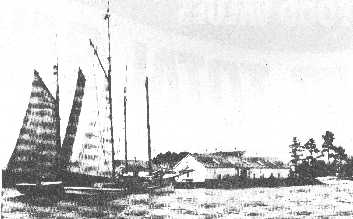 Washington’s water front was a busy port for shiping sea
food, lumber and farm produce from late 1700’s until mid 1900’s.
The Pamlico and Tar Rivers are now chiefly used for pleasure boating.
Page 176
Washington’s water front was a busy port for shiping sea
food, lumber and farm produce from late 1700’s until mid 1900’s.
The Pamlico and Tar Rivers are now chiefly used for pleasure boating.
Page 176 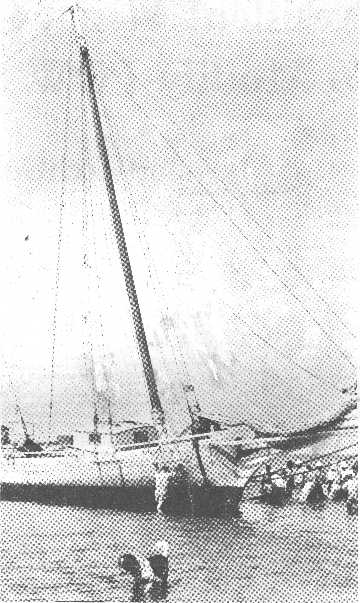 Crossing Under Canopy of Stars
…The Russell L. cut through the waters of the Pamlico times too
numerous to count. One of several carriers that made the trip
between Fowle’s dock in Washington and Ocracoke, the Russell L.
was one of the only means of transportation from the island to
the mainland. As one passenger remembers, “the trip was long
and the boards hard but sleeping under the stars was wonderful”.
The trips were scheduled from dust to dawn.
Page 177
POTATOES
In Dad’s time the local economy depended on timber, seafood
and agriculture. These products were processed and shipped out by water
and later by rail.
Most agricultural products shipped included cotton, corn,
beans and tobacco. Around Aurora on the south side of the river, and
Pantego and Tranters Creek areas the big money crop was Irish potatoes.
Many buyers from large produce houses and dealers in Pittsburg,
New York, Philidelphia, Norfolk and other cities would come to Washington
and bid against each other and make up rail road cars for shipment.
The farmers would bring them to the Atlantic Coast Line dock
in all sizes and quantities in sail boats, gas boats, carts and wagons.
They were packed in pine potato barrels with burlap bagging
tops. Sometimes, they would ship 30-40-50 more cars of potatoes per day
in season, making whole trains of potatoes.
TOO BIG
One of Dad’s cash crops was Irish potatoes. There was a
field of potatoes Dad once raised in some black bottom land. The potatoes
grew quite large and Dad was very proud of his crop. I was sent to the
cooperage shop at Waters Lumber Company, with the long body cart to haul
potato barrels.
He had a crew in the field plowing out and picking up potatoes,
and I helped haul them to the potato docks.
Page 178
There was a long conveyor belt that carried potatoes past
graders and past equipment that washed and dried them and then on into
more barrels.
The man at the grading station complained to Dad about his
large potatoes that Dad was so proud of. He told Dad the large ones
were hollow. He cut one open and it was hollow like a cantalope.
That was something Dad had never heard of before.
Page 179
GROWTH OF MECHANIZED TRANSPORTATION IN EASTERN NC
A GOOD PART OF OUR RAILROAD SYSTEMS IN NC
ORIGINATED IN THE TIMER BUSINESS
During the Civil War, a calvary officer in the union
army, a Captain John L. Roper had seen the massive forest in eastern
North Carolina. He determined to return after the Civil War and enter
the lumber business. In 1868, he returned to eastern North Carolina
and formed the John. L. Roper Lumber Company and erected a saw mill at
the mouth of the Albemarle Canal near Norfolk. He expanded southward
and in 1886 he leased large acreage of timber land from the Albemarle
Swampland Company.
Through this timberland passed the Albemarle and Pantego
Railroad. Other lumber companies sprang up all over eastern North
Carolina including Beaufort County. One section in east Beaufort
County was thoroughly stripped of all trees, ditched and converted
to farm land. There are now areas that are clear as far as the eye
can see, with exception of a little growth on canals and ditch banks.
There were no log trucks to move the timber, so they built
rail lines through the woods to saw mills, and from saw mills to ship
landings and main line rail roads. Oxen and mules pulled logs short
distances.
One old resident near Pinetown told of some of his neighbors
selling timber “on the stump” for as little as one dollar per acre.
Page 180 & 181
With so many rail road locomotives and cars, there had to
be somewhere to take them for repairs. There was a railroad shop in
Pinetown, Beaufort County, N.C. This shop could repair or make any
part of a locomotive. The owner was a Mr. Surry Bowen.
SMALL MOTORCYCLE “GANG”
There were three young men in Beaufort Co. about the turn
of the century who owned motorcycles. They traveled the roadways quite
often, together or separtely. The young men liked to play pranks on
one another and on others.
One night, one of the trio was traveling down a country road
and he saw two lights up ahead coming toward him. Since his two pals
were the only motorcycle riders around, he decided to have some fun by
driving them both off the road. He headed straight between the two
lights.
No one had told him that surry Bowen had bought one of
those automobiles. Incidentally, he walked with a limp after that.
He also knew autos had two head lights.
After Surry Bowen introduced Beaufort County to the
automobile, others appeared.
A man told of the time his grandmother and some
other young women were chopping out a cotton patch beside the
road. They heard a strange rumbling sound approaching on the
road. They saw a monsterous contraption kicking up a dust cloud
heading their way. They threw down their hoes and scattered for
the woods. Each stood behind a tree and watched Surry Bowen drive
by in his new auto.
The trouble with automobiles, they disrupted regular traffic.
Every horse the auto met was terrified. The horse would rear up or pull
to one side, wrecking the equipment, or he would run away.
Horses eventually became accustomed to cars and became
calm in their presence.
Our local rural mail carrier, Frank M. Wilkinson bought
an auto and used it on his mail route.
Page 182 AD
Crossing Under Canopy of Stars
…The Russell L. cut through the waters of the Pamlico times too
numerous to count. One of several carriers that made the trip
between Fowle’s dock in Washington and Ocracoke, the Russell L.
was one of the only means of transportation from the island to
the mainland. As one passenger remembers, “the trip was long
and the boards hard but sleeping under the stars was wonderful”.
The trips were scheduled from dust to dawn.
Page 177
POTATOES
In Dad’s time the local economy depended on timber, seafood
and agriculture. These products were processed and shipped out by water
and later by rail.
Most agricultural products shipped included cotton, corn,
beans and tobacco. Around Aurora on the south side of the river, and
Pantego and Tranters Creek areas the big money crop was Irish potatoes.
Many buyers from large produce houses and dealers in Pittsburg,
New York, Philidelphia, Norfolk and other cities would come to Washington
and bid against each other and make up rail road cars for shipment.
The farmers would bring them to the Atlantic Coast Line dock
in all sizes and quantities in sail boats, gas boats, carts and wagons.
They were packed in pine potato barrels with burlap bagging
tops. Sometimes, they would ship 30-40-50 more cars of potatoes per day
in season, making whole trains of potatoes.
TOO BIG
One of Dad’s cash crops was Irish potatoes. There was a
field of potatoes Dad once raised in some black bottom land. The potatoes
grew quite large and Dad was very proud of his crop. I was sent to the
cooperage shop at Waters Lumber Company, with the long body cart to haul
potato barrels.
He had a crew in the field plowing out and picking up potatoes,
and I helped haul them to the potato docks.
Page 178
There was a long conveyor belt that carried potatoes past
graders and past equipment that washed and dried them and then on into
more barrels.
The man at the grading station complained to Dad about his
large potatoes that Dad was so proud of. He told Dad the large ones
were hollow. He cut one open and it was hollow like a cantalope.
That was something Dad had never heard of before.
Page 179
GROWTH OF MECHANIZED TRANSPORTATION IN EASTERN NC
A GOOD PART OF OUR RAILROAD SYSTEMS IN NC
ORIGINATED IN THE TIMER BUSINESS
During the Civil War, a calvary officer in the union
army, a Captain John L. Roper had seen the massive forest in eastern
North Carolina. He determined to return after the Civil War and enter
the lumber business. In 1868, he returned to eastern North Carolina
and formed the John. L. Roper Lumber Company and erected a saw mill at
the mouth of the Albemarle Canal near Norfolk. He expanded southward
and in 1886 he leased large acreage of timber land from the Albemarle
Swampland Company.
Through this timberland passed the Albemarle and Pantego
Railroad. Other lumber companies sprang up all over eastern North
Carolina including Beaufort County. One section in east Beaufort
County was thoroughly stripped of all trees, ditched and converted
to farm land. There are now areas that are clear as far as the eye
can see, with exception of a little growth on canals and ditch banks.
There were no log trucks to move the timber, so they built
rail lines through the woods to saw mills, and from saw mills to ship
landings and main line rail roads. Oxen and mules pulled logs short
distances.
One old resident near Pinetown told of some of his neighbors
selling timber “on the stump” for as little as one dollar per acre.
Page 180 & 181
With so many rail road locomotives and cars, there had to
be somewhere to take them for repairs. There was a railroad shop in
Pinetown, Beaufort County, N.C. This shop could repair or make any
part of a locomotive. The owner was a Mr. Surry Bowen.
SMALL MOTORCYCLE “GANG”
There were three young men in Beaufort Co. about the turn
of the century who owned motorcycles. They traveled the roadways quite
often, together or separtely. The young men liked to play pranks on
one another and on others.
One night, one of the trio was traveling down a country road
and he saw two lights up ahead coming toward him. Since his two pals
were the only motorcycle riders around, he decided to have some fun by
driving them both off the road. He headed straight between the two
lights.
No one had told him that surry Bowen had bought one of
those automobiles. Incidentally, he walked with a limp after that.
He also knew autos had two head lights.
After Surry Bowen introduced Beaufort County to the
automobile, others appeared.
A man told of the time his grandmother and some
other young women were chopping out a cotton patch beside the
road. They heard a strange rumbling sound approaching on the
road. They saw a monsterous contraption kicking up a dust cloud
heading their way. They threw down their hoes and scattered for
the woods. Each stood behind a tree and watched Surry Bowen drive
by in his new auto.
The trouble with automobiles, they disrupted regular traffic.
Every horse the auto met was terrified. The horse would rear up or pull
to one side, wrecking the equipment, or he would run away.
Horses eventually became accustomed to cars and became
calm in their presence.
Our local rural mail carrier, Frank M. Wilkinson bought
an auto and used it on his mail route.
Page 182 AD 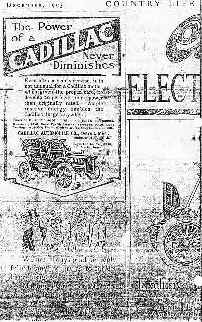 December 1905
The Power of a Cadillac
Page 183 AD
December 1905
The Power of a Cadillac
Page 183 AD 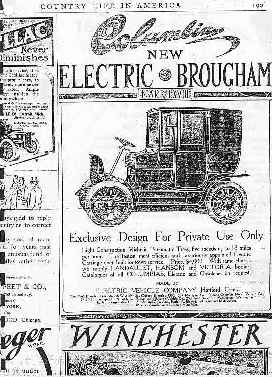 The power of a cadillac
Page 184 AD
The power of a cadillac
Page 184 AD 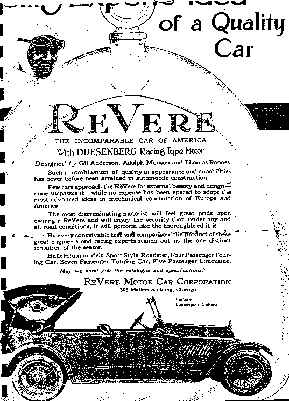 1905
ReVere Motor Car Corporation, Chicago
The incomparable car of America
With Duesenberg racing type motor
Page 185 AD
1905
The George N. Pierce Company, Buffalo, N.Y.
Arrow car
Page 186 AD
1905
ReVere Motor Car Corporation, Chicago
The incomparable car of America
With Duesenberg racing type motor
Page 185 AD
1905
The George N. Pierce Company, Buffalo, N.Y.
Arrow car
Page 186 AD 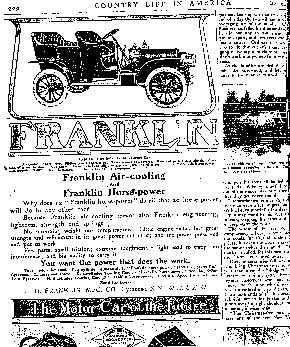 Franklin Type G. 4-cylinder Light Touring Car
Page 187 AD
Franklin Type G. 4-cylinder Light Touring Car
Page 187 AD 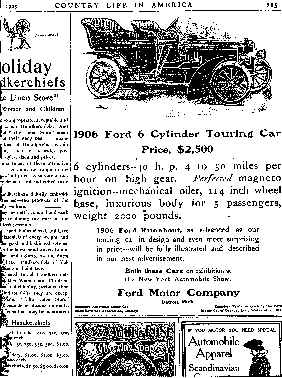 1905
1906 Ford 6 Cylinder Touring Car -- Price, $2,500.00
Page 188 AD
1905
1906 Ford 6 Cylinder Touring Car -- Price, $2,500.00
Page 188 AD  1905
-- The Highest Point of Perfection -- Pope-Toledo Automobiles --
-- 20-H.P. double side entrance $2,800.00 --
Page 189 AD
May 1919
Lexington Minute Man Six
New Style Tourabout – Refined Sport-Model
Page 190 AD
Life Magazine Aug. 21, 1919
Apperson
The eight with eighty less parts
Apperson Bros. Automobile Co., Kokomo, Indiana
Page 191
POSSUM
Back in the so called “Good Old Days”, people ate
anything that walked on four legs except rats, and anything with
wings except vultures.
Baked possum and sweet potato was gourmet food. I remember a possum
Dad caught once. He planned to eat the possum, but since possums eat
anything including food for buzzards, the possum had to be caged and
fed clean food for two or three weeks to clean him.
Dad kept his possum and fed him about three weeks and then
took him to the edge of the woods and turned him loose.
I never got to eat possum. That doesn’t bother me any.
TURTLE
Dad picked up a large turtle once and dressed the meat
out and Mama cooked it. I was quite young but I remember thinking
it tasted delicious.
The next time, Dad came to the house with a mean old ugly
shapping loggerhead. He dressed it out and Mama cooked it. I was older.
I tried to eat some of it but that turtle meat just refused to do down.
I just couldn’t eat it.
That was the last turtle Dad ever prepared to cook.
Page 192
LYE HOMINY
Did you ever go to the grocery store and buy a can of hominy?
Open it and you have kernels of corn bleached snow white. Serve hot
with butter or whatever and it is good but it just does not taste like
the hominy Grandma made.
If you want to make some hominy like Grandma’s lye hominy,
take the wood ashes out of the stove or fireplace and put them in a
large bucket and add enough water to the ashes to fill the pot you will
cook the hominy in. Soak over night.
Go to the barn and shuck and shell about a gallon of corn
kernels. Put the corn in the pot but not too much corn because it will
swell almost three times in volume. Pour the water off the ashes into
the pot of corn. Don’t worry if the water looks muddy, we will take
care of that later.
Bring to a boil and simmer all day or until the skins and
hearts easily slip off the corn kernels. The alkali in the ashes has
caused the skins to come loose. The kernels should be swollen and
tender and the color will be gray-brown.
Wash and soak the hominy in many fresh water changes
until all skins are gone and all rough alkali taste is washed away.
There, you have your finished hominy ready to season and serve.
Do not freeze, instead bring to an occasional boil.
Page 193 & 194
You can cook hominy in your own kitchen by substituting baking soda
instead of alkali from ashes or from a can. Follow the same
procedure as for lye hominy.
CRACKERLING BREAD
Take a couple of cups of corn mean and two heaping
tablespoons of flour and quarter teaspoon salt and a little bit of
baking powder. Stir dry and add one or two eggs. Mix with enough
water to make a good sloppy batter. Stir in a big hand full of
crack’lins. Pour in a greased baking pan and bake at 400 degrees
‘till light brown. Cool and cut in squares and serve.
HOG HEAD AND COLLARDS
Put a large pot on the stove and half full with water
and drop in a half smoked hog head to boil. Bring in the collards
and pick and wash most of the worms off the leaves. After the hog
head has boiled about 3/4 hour, add collards and cook until tender.
If you are serving with corn meal dumplings, mix 1 ½ cups corn meal
with 1 heaping tablespoon flour and a little salt, and just enough
water to make a stiff dough that can be formed into flat biscuit
like pats. Drop these corn meal dumplings in the pot, being sure
each dumplins is submerged in boiling “pot licker”. Cook about
twelve minutes and serve in side dish with collards.
You may omit the corn meal dumplings and serve crack’lin
bread with your collards and hog head.
FEEDING BABIES
In the so-called good old days, when they decided to
feed solid food to a baby, they could no go to the store and buy a
jar of Gerber’s strained spinach or carrots. The adult chewed up
collard greens and corn meal dumplings and put it in the baby’s
mouth. In modern times, that would not be considered sanitary.
Page 195
HOME REMEDIES
The old time folks had remidies for many of their ailments.
For boils and carbuncles, make a poultice of sugar and
lye soap and spread it on a small piece of cloth and bind it to a
head and the puss (dead white corpussels) can be popped or squeezed
out and the sore spot will soon get well.
For sore throat, put a few drops of kerosene on a
teaspoon full of sugar and slowly swallow it.
For ear ache, roast an onion and squeeze the warm onion
juice in the ear.
For croup and deep chest colds, make a poultice of pine
tar and tallow, spread it on a chest-sized piece of wool cloth and
bind it to the chest. When patient gets well, don’t take it all off
at once. He would catch cold. Cut a piece off each day ‘till it is
all gone.
Sterlize cuts and wounds with a liberal bath of kerosene.
Burn several oyster shells to remove all organic binder.
That leaves pure lime. Drop the shells in a pitcher of water. Take
a drink of lime water each day to strenthen bones and teeth.
Page 196
Sulphur and molasses makes a good spring tonic.
Sasafras tea in the spring cleanses the blood.
Dew berry wine cures diarrhea.
Bind a piece of fat salt port to an infection to
help cure it up.
Wear a small bag of asafetida on a string next to
the throat to ward off colds. The smell may ward people off also.
A cold silver spoon held next to the back of the neck
is supposed to help stop nose bleed. If you don’t use the spoon,
it will stop anyway.
Put a sharp ax under the bed to help cut the pain of
childbirth.
Page 197
A COUNTRY HOG KILLIN’
Wait till the weather is cold and crisp and dry. Cut
two forked posts and sink them in the ground so the forks will be
about six feet high and space the posts about twelve to fifteen
apart. Lay a long strong pole across the top. Cut a supply of
strong hardwood sticks about 1 ½ to 2 inches in diameter and 20
to 24 inches long. Taper both ends to a sharp point. You now
have a supply of gambrels.
Cut a supply of firewood and borrow an extra cast
iron kettle that will hold about twenty gallons.
A scalding vat is needed. It looks somewhat like a
miniature flat bottom boat. It has wooden sides ten or twelve
inches high and a sheet metal bottom. If you don’t have one,
try to borrow one. If you can’t get one, bury a barrel half way
in the ground at an angle.
The vat may be about four feet wide and about seven
feet long. Dimentions may vary. Dig a fire trench in the ground
at least two yards longer than the vat and a foot more narrow than
the width of the vat. Set up a sufficently large smoke stack at
one end of the trench to vent the fire. Lay the vat over the
trench. That leaves enough trench in front of the vat to stoke a
fire.
Page 198
Get a few short logs and put some boards across
them to make a low platform. This and the vat are near the l
ong scaffold pole.
Sharpen an ax and every knife in the house. Borrow
a few extra tubs. Stock a supply of rifle bullets.
If you don’t have a cracklin press, try to borrow one
if anybody has one. If you can’t find one, it’s not really necessary.
INVITE THE NEIGHBORS
The busy day arrives. Everyone is up before day light.
The scalding vat and an iron kettle are filled with water and fires
are started under them. Some green pine twigs are dropped in the
vat to make the hog hair come off easier.
Neighbors begin to arrive. Someone shoots some hogs and
they are hauled up by horse drawn cart. Sometimes, farmers prefer to
whack the hogs on the head with the back of an ax instead of shooting.
REMOVING HOG HAIR
Since the water in the vat is hot enough to scald a hog, the
hands must be kept out; so chains are laid across the vat to lift and
turn the hogs.
A hog is put in the vat (or barrel) and after a short time,
the hair is tried. If not hot enough, the hair won’t come loose.
Page 199
If the water is too hot, it cooks the skin. When the men are satisfied
all is well, all parts of the hog is soaked and then taken out and put on
the platform and all hair is pulled or scraped clean. When the hog is
completely bald, it is ready for butchering. A slit is cut through the
skin on each heel, exposing the heel strings.
A couple of men lift the hog up until his hind legs are
straddling the gallows pole. A gambrel is held over the top of the
gallows and a heel string is impaled on either side of the gallows
pole. The meat is now suspended by the heel strings. The men now
go back to de-hairing another hog.
BUTCHERING
A man with a butcher knife slits the belly side of the
hog from tail to throat and spreads the sides of the belly with a
gambrel stick. When that is done, the “chitlins” start tumblin out,
which he catches in a tub, along with the “maw”. The entire digestive
from throat to tail is in the tub. After the chiterling are taken
away, there are still a lot of gadgets left in. He cuts the “goozle”
loose and lifts out the “haslet”. He takes out the kidney and whatever
else he can find. The abdominal cavity of a hog is a bad smelling object.
When the butcher has the hog cleared out, he washes
out the smelly belly.
Page 200
The hogs are later taken down and put on a table and cut up,
such as hams, shoulders, head, tail, back bone “country style” and side
meat. There is a lot of extra trimmings and these trimmings are separated,
fat from lean. If a lot of sausage is desired, larger cuts may be cut up
for sausage meat. All fat pieces are skinned and the skins, ears, snouts
and some other parts arethoroughly boiled, seasoned and poured in shallow
pans to jell. That will be called “souse”.
The lean pieces are ground and seasoned and made into sausage.
The hams, shoulders, sides, tails and heads are chilled and
salted down. The choice parts are later smoked.
CHITTERLINGS
The butcher had produced a tub of “chitlins”. A couple of
women take them over. Any mammal’s interior organs always grow in a
standard fixed position and are usually held in that position by some
type of membrane. A hog’s intestines are held in a fixed position by
a fatty membrene. The women who work on the chitlins call this ruffled
fatty membrane “skirt lard”. This is cut loose and sometimes cooked in
a separate kettle.
This long rope of chitlins and “maw” (stomach) are taken
to a hole in the ground where they “rid” the chitlins, which means they
empty the contents of the digestive system in a hole in the ground.
Page 201
After ridding them, a sharp pointed reed is stuck in the
end of a chitlin and the chitlin is pulled over the reed, turning it
wrong side out and down the reed, a long section at a time. Many
feet can be jammed on a short reed.
The chitlins are washed many, many times on both sides
‘till they are so clean they will lay on the back of your hand without
sliding off.
Some of the chitterlings are then made into sausage casings.
They are laid on a table and a short section at a time is scraped until
the thick white part separates from an inner membrane that looks like a
tube of plastic.
After a sufficient supply of sausage casings are made, the
remainder are looped in a thick rope and are put away to be cooked.
SAUSAGE
The sausage meat is cut in small chunks and put in a large
wash tub and mixed with sage and red pepper and black pepper according
to the makers favorite formula. A sausage grinder is set up and a boy
is put to work turning the grinder. It is then run through a sausage
stuffer and you have sausage links.
Sometimes, they stuff large intestines and they are called
“Tom Thumbs”. The sausage is dried and smoked.
Page 202 illustration
1905
-- The Highest Point of Perfection -- Pope-Toledo Automobiles --
-- 20-H.P. double side entrance $2,800.00 --
Page 189 AD
May 1919
Lexington Minute Man Six
New Style Tourabout – Refined Sport-Model
Page 190 AD
Life Magazine Aug. 21, 1919
Apperson
The eight with eighty less parts
Apperson Bros. Automobile Co., Kokomo, Indiana
Page 191
POSSUM
Back in the so called “Good Old Days”, people ate
anything that walked on four legs except rats, and anything with
wings except vultures.
Baked possum and sweet potato was gourmet food. I remember a possum
Dad caught once. He planned to eat the possum, but since possums eat
anything including food for buzzards, the possum had to be caged and
fed clean food for two or three weeks to clean him.
Dad kept his possum and fed him about three weeks and then
took him to the edge of the woods and turned him loose.
I never got to eat possum. That doesn’t bother me any.
TURTLE
Dad picked up a large turtle once and dressed the meat
out and Mama cooked it. I was quite young but I remember thinking
it tasted delicious.
The next time, Dad came to the house with a mean old ugly
shapping loggerhead. He dressed it out and Mama cooked it. I was older.
I tried to eat some of it but that turtle meat just refused to do down.
I just couldn’t eat it.
That was the last turtle Dad ever prepared to cook.
Page 192
LYE HOMINY
Did you ever go to the grocery store and buy a can of hominy?
Open it and you have kernels of corn bleached snow white. Serve hot
with butter or whatever and it is good but it just does not taste like
the hominy Grandma made.
If you want to make some hominy like Grandma’s lye hominy,
take the wood ashes out of the stove or fireplace and put them in a
large bucket and add enough water to the ashes to fill the pot you will
cook the hominy in. Soak over night.
Go to the barn and shuck and shell about a gallon of corn
kernels. Put the corn in the pot but not too much corn because it will
swell almost three times in volume. Pour the water off the ashes into
the pot of corn. Don’t worry if the water looks muddy, we will take
care of that later.
Bring to a boil and simmer all day or until the skins and
hearts easily slip off the corn kernels. The alkali in the ashes has
caused the skins to come loose. The kernels should be swollen and
tender and the color will be gray-brown.
Wash and soak the hominy in many fresh water changes
until all skins are gone and all rough alkali taste is washed away.
There, you have your finished hominy ready to season and serve.
Do not freeze, instead bring to an occasional boil.
Page 193 & 194
You can cook hominy in your own kitchen by substituting baking soda
instead of alkali from ashes or from a can. Follow the same
procedure as for lye hominy.
CRACKERLING BREAD
Take a couple of cups of corn mean and two heaping
tablespoons of flour and quarter teaspoon salt and a little bit of
baking powder. Stir dry and add one or two eggs. Mix with enough
water to make a good sloppy batter. Stir in a big hand full of
crack’lins. Pour in a greased baking pan and bake at 400 degrees
‘till light brown. Cool and cut in squares and serve.
HOG HEAD AND COLLARDS
Put a large pot on the stove and half full with water
and drop in a half smoked hog head to boil. Bring in the collards
and pick and wash most of the worms off the leaves. After the hog
head has boiled about 3/4 hour, add collards and cook until tender.
If you are serving with corn meal dumplings, mix 1 ½ cups corn meal
with 1 heaping tablespoon flour and a little salt, and just enough
water to make a stiff dough that can be formed into flat biscuit
like pats. Drop these corn meal dumplings in the pot, being sure
each dumplins is submerged in boiling “pot licker”. Cook about
twelve minutes and serve in side dish with collards.
You may omit the corn meal dumplings and serve crack’lin
bread with your collards and hog head.
FEEDING BABIES
In the so-called good old days, when they decided to
feed solid food to a baby, they could no go to the store and buy a
jar of Gerber’s strained spinach or carrots. The adult chewed up
collard greens and corn meal dumplings and put it in the baby’s
mouth. In modern times, that would not be considered sanitary.
Page 195
HOME REMEDIES
The old time folks had remidies for many of their ailments.
For boils and carbuncles, make a poultice of sugar and
lye soap and spread it on a small piece of cloth and bind it to a
head and the puss (dead white corpussels) can be popped or squeezed
out and the sore spot will soon get well.
For sore throat, put a few drops of kerosene on a
teaspoon full of sugar and slowly swallow it.
For ear ache, roast an onion and squeeze the warm onion
juice in the ear.
For croup and deep chest colds, make a poultice of pine
tar and tallow, spread it on a chest-sized piece of wool cloth and
bind it to the chest. When patient gets well, don’t take it all off
at once. He would catch cold. Cut a piece off each day ‘till it is
all gone.
Sterlize cuts and wounds with a liberal bath of kerosene.
Burn several oyster shells to remove all organic binder.
That leaves pure lime. Drop the shells in a pitcher of water. Take
a drink of lime water each day to strenthen bones and teeth.
Page 196
Sulphur and molasses makes a good spring tonic.
Sasafras tea in the spring cleanses the blood.
Dew berry wine cures diarrhea.
Bind a piece of fat salt port to an infection to
help cure it up.
Wear a small bag of asafetida on a string next to
the throat to ward off colds. The smell may ward people off also.
A cold silver spoon held next to the back of the neck
is supposed to help stop nose bleed. If you don’t use the spoon,
it will stop anyway.
Put a sharp ax under the bed to help cut the pain of
childbirth.
Page 197
A COUNTRY HOG KILLIN’
Wait till the weather is cold and crisp and dry. Cut
two forked posts and sink them in the ground so the forks will be
about six feet high and space the posts about twelve to fifteen
apart. Lay a long strong pole across the top. Cut a supply of
strong hardwood sticks about 1 ½ to 2 inches in diameter and 20
to 24 inches long. Taper both ends to a sharp point. You now
have a supply of gambrels.
Cut a supply of firewood and borrow an extra cast
iron kettle that will hold about twenty gallons.
A scalding vat is needed. It looks somewhat like a
miniature flat bottom boat. It has wooden sides ten or twelve
inches high and a sheet metal bottom. If you don’t have one,
try to borrow one. If you can’t get one, bury a barrel half way
in the ground at an angle.
The vat may be about four feet wide and about seven
feet long. Dimentions may vary. Dig a fire trench in the ground
at least two yards longer than the vat and a foot more narrow than
the width of the vat. Set up a sufficently large smoke stack at
one end of the trench to vent the fire. Lay the vat over the
trench. That leaves enough trench in front of the vat to stoke a
fire.
Page 198
Get a few short logs and put some boards across
them to make a low platform. This and the vat are near the l
ong scaffold pole.
Sharpen an ax and every knife in the house. Borrow
a few extra tubs. Stock a supply of rifle bullets.
If you don’t have a cracklin press, try to borrow one
if anybody has one. If you can’t find one, it’s not really necessary.
INVITE THE NEIGHBORS
The busy day arrives. Everyone is up before day light.
The scalding vat and an iron kettle are filled with water and fires
are started under them. Some green pine twigs are dropped in the
vat to make the hog hair come off easier.
Neighbors begin to arrive. Someone shoots some hogs and
they are hauled up by horse drawn cart. Sometimes, farmers prefer to
whack the hogs on the head with the back of an ax instead of shooting.
REMOVING HOG HAIR
Since the water in the vat is hot enough to scald a hog, the
hands must be kept out; so chains are laid across the vat to lift and
turn the hogs.
A hog is put in the vat (or barrel) and after a short time,
the hair is tried. If not hot enough, the hair won’t come loose.
Page 199
If the water is too hot, it cooks the skin. When the men are satisfied
all is well, all parts of the hog is soaked and then taken out and put on
the platform and all hair is pulled or scraped clean. When the hog is
completely bald, it is ready for butchering. A slit is cut through the
skin on each heel, exposing the heel strings.
A couple of men lift the hog up until his hind legs are
straddling the gallows pole. A gambrel is held over the top of the
gallows and a heel string is impaled on either side of the gallows
pole. The meat is now suspended by the heel strings. The men now
go back to de-hairing another hog.
BUTCHERING
A man with a butcher knife slits the belly side of the
hog from tail to throat and spreads the sides of the belly with a
gambrel stick. When that is done, the “chitlins” start tumblin out,
which he catches in a tub, along with the “maw”. The entire digestive
from throat to tail is in the tub. After the chiterling are taken
away, there are still a lot of gadgets left in. He cuts the “goozle”
loose and lifts out the “haslet”. He takes out the kidney and whatever
else he can find. The abdominal cavity of a hog is a bad smelling object.
When the butcher has the hog cleared out, he washes
out the smelly belly.
Page 200
The hogs are later taken down and put on a table and cut up,
such as hams, shoulders, head, tail, back bone “country style” and side
meat. There is a lot of extra trimmings and these trimmings are separated,
fat from lean. If a lot of sausage is desired, larger cuts may be cut up
for sausage meat. All fat pieces are skinned and the skins, ears, snouts
and some other parts arethoroughly boiled, seasoned and poured in shallow
pans to jell. That will be called “souse”.
The lean pieces are ground and seasoned and made into sausage.
The hams, shoulders, sides, tails and heads are chilled and
salted down. The choice parts are later smoked.
CHITTERLINGS
The butcher had produced a tub of “chitlins”. A couple of
women take them over. Any mammal’s interior organs always grow in a
standard fixed position and are usually held in that position by some
type of membrane. A hog’s intestines are held in a fixed position by
a fatty membrene. The women who work on the chitlins call this ruffled
fatty membrane “skirt lard”. This is cut loose and sometimes cooked in
a separate kettle.
This long rope of chitlins and “maw” (stomach) are taken
to a hole in the ground where they “rid” the chitlins, which means they
empty the contents of the digestive system in a hole in the ground.
Page 201
After ridding them, a sharp pointed reed is stuck in the
end of a chitlin and the chitlin is pulled over the reed, turning it
wrong side out and down the reed, a long section at a time. Many
feet can be jammed on a short reed.
The chitlins are washed many, many times on both sides
‘till they are so clean they will lay on the back of your hand without
sliding off.
Some of the chitterlings are then made into sausage casings.
They are laid on a table and a short section at a time is scraped until
the thick white part separates from an inner membrane that looks like a
tube of plastic.
After a sufficient supply of sausage casings are made, the
remainder are looped in a thick rope and are put away to be cooked.
SAUSAGE
The sausage meat is cut in small chunks and put in a large
wash tub and mixed with sage and red pepper and black pepper according
to the makers favorite formula. A sausage grinder is set up and a boy
is put to work turning the grinder. It is then run through a sausage
stuffer and you have sausage links.
Sometimes, they stuff large intestines and they are called
“Tom Thumbs”. The sausage is dried and smoked.
Page 202 illustration 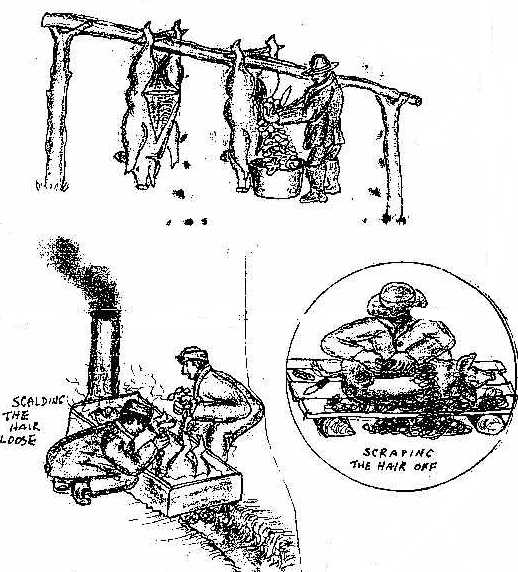 Hog killing day -- Scalding the hair loose -- Scraping the hair off.
Page 203 illustration
Hog killing day -- Scalding the hair loose -- Scraping the hair off.
Page 203 illustration 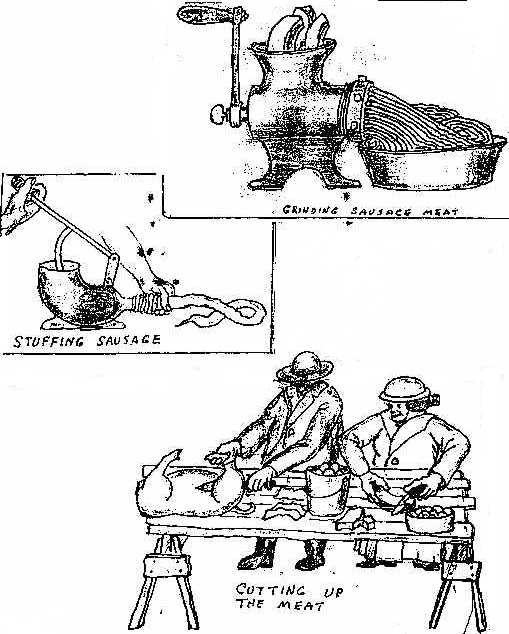 -- Cutting meat & making sausage -- Grinding sausage meat --
-- Stuffing sausage -- Cutting up the meat --
Page 204
LARD AND CRACKLINGS
The fat parts of the hog were skinned and cut in small
chunks and dumped in an iron kettle in the back yard. A fire is
started and one of the women stays with it to keep it stirred with
an old wooden “lard paddle” to keep it cooking evenly and not burn
to the surface of the pot. As the fat cooks, oil runs out of the
bits of meat and the moisture boils out with a popping sound. The
thumping and popping finally stops and the bits of meat “rattle”
when stirred with the paddle. Time to pull the fire away from the
pot. Too much cooking could scorch the lard.
While the fat is still very hot, some twigs of bay
leaves are dipped in for flavor. The bay leaves boil furiously
and pop and snap. She holds on to the bay and when she is ready
she pulls it out.
Five gallon metal cans with handles and lids are
brought up. They are called “lard stands”. A thin cloth is
spread across the top of a stand and the contents of the pot
is dipped and poured in. The liquid lard flows through the
cloth strainer and the cracklings stay on the cloth. If a
press is available, the cracklings are pressed as thin as
cornflakes, extracting the fat. If no press is available,
they are mashed down as much as possible.
The cracklings are also put in a stand.
Page 205
-- Cutting meat & making sausage -- Grinding sausage meat --
-- Stuffing sausage -- Cutting up the meat --
Page 204
LARD AND CRACKLINGS
The fat parts of the hog were skinned and cut in small
chunks and dumped in an iron kettle in the back yard. A fire is
started and one of the women stays with it to keep it stirred with
an old wooden “lard paddle” to keep it cooking evenly and not burn
to the surface of the pot. As the fat cooks, oil runs out of the
bits of meat and the moisture boils out with a popping sound. The
thumping and popping finally stops and the bits of meat “rattle”
when stirred with the paddle. Time to pull the fire away from the
pot. Too much cooking could scorch the lard.
While the fat is still very hot, some twigs of bay
leaves are dipped in for flavor. The bay leaves boil furiously
and pop and snap. She holds on to the bay and when she is ready
she pulls it out.
Five gallon metal cans with handles and lids are
brought up. They are called “lard stands”. A thin cloth is
spread across the top of a stand and the contents of the pot
is dipped and poured in. The liquid lard flows through the
cloth strainer and the cracklings stay on the cloth. If a
press is available, the cracklings are pressed as thin as
cornflakes, extracting the fat. If no press is available,
they are mashed down as much as possible.
The cracklings are also put in a stand.
Page 205 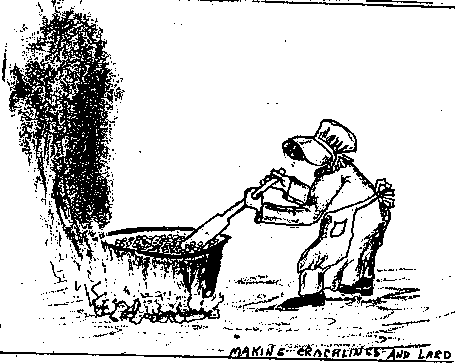 Making cracklings and lard
Page 206
NEIGHBORS
It takes more workers than many families have so it
was customary to invite the neighbors to come to a hog killing.
You were not asking for free help. You were borrowing help.
When the neighbor killed hogs, you went to help him. You felt
shunned if you were not invited.
When the neighbors went home, they were always given
a present of some “fresh” to take with them. It might be back
bone or sausage or a “haslet”, whichever they prefer. If they
had been invited and could not come, some fresh meat was
sometimes sent to them anyway.
A “haslet” consists of heart, liver and “lights”.
The lights are lungs. Slices of liver were usually fried.
Some of the liver may have been roasted in hot coals around
the fire along with sweet potatoes before the haslets were
sent to the house for processing.
Stewed haslet was lungs, heart and some of the
liver cut up and stewed on the kitchen stove in a pot of water.
Ocasionally, they would grind some liver and
season it and stuff it and make liver sausage.
A stand of cracklings was kept in the pantry and
some baked sweet potatoes were kept warm on the back shelf
of the cast iron kitchen stove. For a quick delicious snack,
drop in and pick up a sweet potato and a hand full of
crackerlings. Good !
Page 207 & 208
CHITTERLINGS
This narriator was never fond of “chitlins” but
there are plenty of people who do love them. When the braided
ropes of chitlins get cold, ther are stiff enough to cut up
and put in a pot to cook. I never wanted to be in the house
when chitlins were cooking. They gave off an odor that reminded
me of the stuff that origonally flowed through them.
If pork was to be “salt pickeled”, a brine mixture
was mixed of salt and water. When the right strength of salt
was reached, it became heavy enough to float a fresh egg. This
brine was poured in a barrel and pork was put in and the barrel
was covered with a wood cover.
If meat was not properly attended to, “skippers”
could get in it and ruin it. Skippers were a special breed of
creature that looked like large maggots that could tolerate salt.
My maternal great grandmother once saw a group of
yankee soldiers heading for her home. She knew they would take
anything edible, and she had a smokehouse full of meat, so she
dashed in the smokehouse and stoked up the fire and threw several
strings of red pepper on the fire and came out and locked the door.
The soldiers ordered her to open the smoke house door. She
fumbled with the lock as long as she could so the red pepper
would get a good start at burning. She also warned them that the
smoke house would be full of smoke. When she got the lock opened,
some of them rushed in, intent on taking all her meat. Instead,
they came stumbling out, coughing and temporarily blinded.
“What-cha got in there, woman?”
“I’m sorry, sir, but skippers were getting in my
meat and I had to poison them”.
That was during the civil war. That was the first
incident I have heard of poison gas warfare used in the civil
war. They did not bother her meat.
Page 209
SMOKEHOUSE
Back in the horse and buggy days, it was necessary
to stock a supply of whatever food was available. You couldn’t
run out to the store for supplies to make just one meal at a time.
Dad had his supply of salted and smoked pork in his
smoke house. In addition, he had a barrel of scuppernog grape
wine. Also, half a barrel of salt herring and half barrel of
sauer kraut.
Another item often found in the smoke house was
cucumbers salted down in brine, waiting to be made into pickels.
Dad had thirty or more Mattamuskeet apple trees.
These apples had a dark greenish-brown thick skin, firm flesh,
very delicious distinctive flavor, and somewhat smaller than
the soft sissy varieties found on the store shelves today. He
put barrels of these apples away for winter. This variety of
apple may have been an origonal Native American variety.
Very few are to be found today.
That barrel of grape wine was not sold. Dad
would draw a gallon at the time to give to friends, free.
When it became illegal to sell alcoholic beverages,
he stopped making wine by the barrel. Although he gave it to
friends instead of selling it, he didn’t care to have his
intentions misunderstood.
From that time on, he made only a gallon or half
gallon each year for home use. Mama usually used much of it
to moisten her Christmas fruit cake.
Page 210 illustration
Frank Wilkinson’s last smoke house.
Page 211
CIRCUS DAY
The circus was coming to town. The family was
talking circus and Dad was talking farm work. Just forget
about that circus. There was work to be done on the farm.
The ditch banks were growing up and in a mess. Pretty soon
it would be time to get in the corn. The old corn would have
to be moved on the other side of the barn. That would have
to be done now. No time to waste on a circus.
They boy’s spirits would drop so hard you could
hear them hit bottom.
Dad would go on to the post office and sort his
mail. When he finished sorting, he would be on his way to
deliver. He would go past the rail road depot and the circus
train would be unloading and lining up for the big street
parade. He would see the elephants pushing the big carved
and brightly painted circus wagons around the rail road yard.
The calliope would be warming up. Some of the band members
would be testing their instruments.
As Dad went on down the road delivering his mail,
throngs of people would be heading for town to see this circus
unload, and later, watch the parade, and still later, see the
show. Everyone Dad spoke to on his route was talking circus.
At home, just in the nick of time to get ready to go to town,
the phone would ring.
“Tell those young’uns they might as well go on to
that circus. They won’t get anything done at home anyway”.
It always happened. He just couldn’t let them
miss the circus, regardless of the work.
Page 212
GIVEN AN INCH – TAKE A MILE
There was a certain preacher that was acquainted
with Dad. Like many preachers of the time, he had a large
family, and his children wanted a place to go swimming. He
brought his family one summer day and asked permission to
park his car and his family use the river. Dad granted
permission. A few days later, he came again and brought some
of his friends. Later, his friends brought friends.
One Sunday we went for a drive and stayed off
most of the afternoon. When we arrived back home, the yards,
both front and back, were crowded parking lots. There was
even a horse and cart tied to a tree in the front yard.
Dad met some of the people returning to their
cars and told one man, “you can’t park in my yard, its private”.
The guy replied “I know I can. Every body does”.
You can imagine how that would make a private
home owner feel. Dad met them as they came up and definitely
let them know that this was a private home and private
property and that they were trespassing. That ended that.
FRIENDS
Dad had friends and he had “summer friends”. He
was blessed with a beautiful river shore, and acre of grape
arbors, cantelopes and watermelons. Some friends came to see
him and the family. They were welcome to use his bounty.
Others came to buy his produce.
Page 213
There were others who didn’t come to see anybody. Their cars
would come to a stop. The car doors would explode open and
kids and grown-ups alike would rush for the grape vines and
river. The adults might pause long enough to say, “hello,
Mr. Wilkinson, how’s the grapes?”.
LITTLE HOUSE ON THE PAMLICO
I was married on April 4th, 1937 to Miss Hazel
Waters. We spent our first six weeks in rented quarters in
Washington.
If you recall the litle 12 x 16 foot house in
the back of the farm that Mr. A. B. Mary built during World
War I? It was still there taking up space in the field, and
was not being used for anything.
Dad gave the little building to me and gve
permission to move it on the far west end of his river front.
I dismanteled it and had it hauled to the river lot and I
re-built it. Total cost for new material, 15 cents.
About a year later, I decided it was’nt fair
to Dad, so I leased the lot from him by the year. At first,
Dad didn’t want to take money for it but I insisted. It
made me feel better.
After Dad’s death, the farm was divided equaly
in eight parts – Mama and seven children. It was agreed
upon to give me the section I had started my house on. Mama
asked for the one next to mine. The others drew lots for theirs.
Incidentally, the little house is now a
duplex with one apartment rented.
Page 214
NO SMOKING
Dad used to smoke Prince Albert smoking tobacco
in his pipe and he smoked cigars called “Old Virginia Cheroots”.
When he smoked cigars he had to spit sometimes, or swallow.
No body wants to swallow tobacco juice.
I was driving Dad to town once when he had the
urge to spit. He grabbed the car window crank and gave a
few fast turns and spit a load of tobacco juice against the
window he had just rolled up. I really wanted to laugh, but
I managed to hold it.
As I watched Dad smoke those cigars when I was
a kid, I thought there must be something enjoyable about them.
When I was about ten years old, I decided to try one. I
sneaked one off the mantel piece over the fire place and
went down to the river and sat down behind a big cypress
tree and lit the thing up. There I sat puffing smoke like
a steam engine at full throttle. Pretty soon, I started
getting dizzy. The landscape started tilting at crazy angles.
I realized it was the cigar. I threw it in the river and
stood up, or tried to stand up. I felt queazy in the stomach.
I tried to take a few steps. The landscape would swing up
one way and then down the other way. The trees seemed to be
swaying. My stomach had swarms of butterflies in it. I was
sick. I managed to get to the house and get in my room. I
lay across the bed and almost passed out. That was 2 cigars
I smoked in my lifetime. It was my first (number 1) and my
last (number 2).
Page 215
Making cracklings and lard
Page 206
NEIGHBORS
It takes more workers than many families have so it
was customary to invite the neighbors to come to a hog killing.
You were not asking for free help. You were borrowing help.
When the neighbor killed hogs, you went to help him. You felt
shunned if you were not invited.
When the neighbors went home, they were always given
a present of some “fresh” to take with them. It might be back
bone or sausage or a “haslet”, whichever they prefer. If they
had been invited and could not come, some fresh meat was
sometimes sent to them anyway.
A “haslet” consists of heart, liver and “lights”.
The lights are lungs. Slices of liver were usually fried.
Some of the liver may have been roasted in hot coals around
the fire along with sweet potatoes before the haslets were
sent to the house for processing.
Stewed haslet was lungs, heart and some of the
liver cut up and stewed on the kitchen stove in a pot of water.
Ocasionally, they would grind some liver and
season it and stuff it and make liver sausage.
A stand of cracklings was kept in the pantry and
some baked sweet potatoes were kept warm on the back shelf
of the cast iron kitchen stove. For a quick delicious snack,
drop in and pick up a sweet potato and a hand full of
crackerlings. Good !
Page 207 & 208
CHITTERLINGS
This narriator was never fond of “chitlins” but
there are plenty of people who do love them. When the braided
ropes of chitlins get cold, ther are stiff enough to cut up
and put in a pot to cook. I never wanted to be in the house
when chitlins were cooking. They gave off an odor that reminded
me of the stuff that origonally flowed through them.
If pork was to be “salt pickeled”, a brine mixture
was mixed of salt and water. When the right strength of salt
was reached, it became heavy enough to float a fresh egg. This
brine was poured in a barrel and pork was put in and the barrel
was covered with a wood cover.
If meat was not properly attended to, “skippers”
could get in it and ruin it. Skippers were a special breed of
creature that looked like large maggots that could tolerate salt.
My maternal great grandmother once saw a group of
yankee soldiers heading for her home. She knew they would take
anything edible, and she had a smokehouse full of meat, so she
dashed in the smokehouse and stoked up the fire and threw several
strings of red pepper on the fire and came out and locked the door.
The soldiers ordered her to open the smoke house door. She
fumbled with the lock as long as she could so the red pepper
would get a good start at burning. She also warned them that the
smoke house would be full of smoke. When she got the lock opened,
some of them rushed in, intent on taking all her meat. Instead,
they came stumbling out, coughing and temporarily blinded.
“What-cha got in there, woman?”
“I’m sorry, sir, but skippers were getting in my
meat and I had to poison them”.
That was during the civil war. That was the first
incident I have heard of poison gas warfare used in the civil
war. They did not bother her meat.
Page 209
SMOKEHOUSE
Back in the horse and buggy days, it was necessary
to stock a supply of whatever food was available. You couldn’t
run out to the store for supplies to make just one meal at a time.
Dad had his supply of salted and smoked pork in his
smoke house. In addition, he had a barrel of scuppernog grape
wine. Also, half a barrel of salt herring and half barrel of
sauer kraut.
Another item often found in the smoke house was
cucumbers salted down in brine, waiting to be made into pickels.
Dad had thirty or more Mattamuskeet apple trees.
These apples had a dark greenish-brown thick skin, firm flesh,
very delicious distinctive flavor, and somewhat smaller than
the soft sissy varieties found on the store shelves today. He
put barrels of these apples away for winter. This variety of
apple may have been an origonal Native American variety.
Very few are to be found today.
That barrel of grape wine was not sold. Dad
would draw a gallon at the time to give to friends, free.
When it became illegal to sell alcoholic beverages,
he stopped making wine by the barrel. Although he gave it to
friends instead of selling it, he didn’t care to have his
intentions misunderstood.
From that time on, he made only a gallon or half
gallon each year for home use. Mama usually used much of it
to moisten her Christmas fruit cake.
Page 210 illustration
Frank Wilkinson’s last smoke house.
Page 211
CIRCUS DAY
The circus was coming to town. The family was
talking circus and Dad was talking farm work. Just forget
about that circus. There was work to be done on the farm.
The ditch banks were growing up and in a mess. Pretty soon
it would be time to get in the corn. The old corn would have
to be moved on the other side of the barn. That would have
to be done now. No time to waste on a circus.
They boy’s spirits would drop so hard you could
hear them hit bottom.
Dad would go on to the post office and sort his
mail. When he finished sorting, he would be on his way to
deliver. He would go past the rail road depot and the circus
train would be unloading and lining up for the big street
parade. He would see the elephants pushing the big carved
and brightly painted circus wagons around the rail road yard.
The calliope would be warming up. Some of the band members
would be testing their instruments.
As Dad went on down the road delivering his mail,
throngs of people would be heading for town to see this circus
unload, and later, watch the parade, and still later, see the
show. Everyone Dad spoke to on his route was talking circus.
At home, just in the nick of time to get ready to go to town,
the phone would ring.
“Tell those young’uns they might as well go on to
that circus. They won’t get anything done at home anyway”.
It always happened. He just couldn’t let them
miss the circus, regardless of the work.
Page 212
GIVEN AN INCH – TAKE A MILE
There was a certain preacher that was acquainted
with Dad. Like many preachers of the time, he had a large
family, and his children wanted a place to go swimming. He
brought his family one summer day and asked permission to
park his car and his family use the river. Dad granted
permission. A few days later, he came again and brought some
of his friends. Later, his friends brought friends.
One Sunday we went for a drive and stayed off
most of the afternoon. When we arrived back home, the yards,
both front and back, were crowded parking lots. There was
even a horse and cart tied to a tree in the front yard.
Dad met some of the people returning to their
cars and told one man, “you can’t park in my yard, its private”.
The guy replied “I know I can. Every body does”.
You can imagine how that would make a private
home owner feel. Dad met them as they came up and definitely
let them know that this was a private home and private
property and that they were trespassing. That ended that.
FRIENDS
Dad had friends and he had “summer friends”. He
was blessed with a beautiful river shore, and acre of grape
arbors, cantelopes and watermelons. Some friends came to see
him and the family. They were welcome to use his bounty.
Others came to buy his produce.
Page 213
There were others who didn’t come to see anybody. Their cars
would come to a stop. The car doors would explode open and
kids and grown-ups alike would rush for the grape vines and
river. The adults might pause long enough to say, “hello,
Mr. Wilkinson, how’s the grapes?”.
LITTLE HOUSE ON THE PAMLICO
I was married on April 4th, 1937 to Miss Hazel
Waters. We spent our first six weeks in rented quarters in
Washington.
If you recall the litle 12 x 16 foot house in
the back of the farm that Mr. A. B. Mary built during World
War I? It was still there taking up space in the field, and
was not being used for anything.
Dad gave the little building to me and gve
permission to move it on the far west end of his river front.
I dismanteled it and had it hauled to the river lot and I
re-built it. Total cost for new material, 15 cents.
About a year later, I decided it was’nt fair
to Dad, so I leased the lot from him by the year. At first,
Dad didn’t want to take money for it but I insisted. It
made me feel better.
After Dad’s death, the farm was divided equaly
in eight parts – Mama and seven children. It was agreed
upon to give me the section I had started my house on. Mama
asked for the one next to mine. The others drew lots for theirs.
Incidentally, the little house is now a
duplex with one apartment rented.
Page 214
NO SMOKING
Dad used to smoke Prince Albert smoking tobacco
in his pipe and he smoked cigars called “Old Virginia Cheroots”.
When he smoked cigars he had to spit sometimes, or swallow.
No body wants to swallow tobacco juice.
I was driving Dad to town once when he had the
urge to spit. He grabbed the car window crank and gave a
few fast turns and spit a load of tobacco juice against the
window he had just rolled up. I really wanted to laugh, but
I managed to hold it.
As I watched Dad smoke those cigars when I was
a kid, I thought there must be something enjoyable about them.
When I was about ten years old, I decided to try one. I
sneaked one off the mantel piece over the fire place and
went down to the river and sat down behind a big cypress
tree and lit the thing up. There I sat puffing smoke like
a steam engine at full throttle. Pretty soon, I started
getting dizzy. The landscape started tilting at crazy angles.
I realized it was the cigar. I threw it in the river and
stood up, or tried to stand up. I felt queazy in the stomach.
I tried to take a few steps. The landscape would swing up
one way and then down the other way. The trees seemed to be
swaying. My stomach had swarms of butterflies in it. I was
sick. I managed to get to the house and get in my room. I
lay across the bed and almost passed out. That was 2 cigars
I smoked in my lifetime. It was my first (number 1) and my
last (number 2).
Page 215 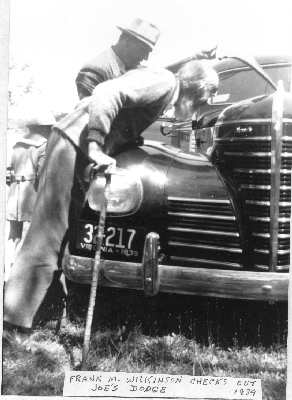 1939 – Pop checks out Joe’s Dodge
page 216 & 217
ALCOHOL
While Dad was in the postal service delivering
mail six days a week, in an open buggy, with just a top on
it, no side curtains, and no wind whield in front, he had
no protection from the wind and weather. Some times in
winter, he would almost freeze.
His gentlemen friends along the route would try
to be helpful and warm him up with a drink of spirits of corn.
The whiskey warmer got to be a habit with him. Most men drank
in those days. There were several prosperous saloons operating
in Washington at that time.
When Dad retired from the postal service, he began
to taper off. Finally, the only alcohol he had was given to him.
NEIGHBORS
The farm bordering Dad’s on the east was once owned
by Mrs. Lucy Myers. Dad was involved with her once concerning
work that required the use of a pitch fork. When he asked her
for a pitch fork, she said, “go cut a forked stick”. That remark
was one Dad never forgot.
After Mrs. Myers’ death, Mrs. Marcia Myers Knott
inherited the property. I personally did cabinet building for
Mrs. Knott and found her to be a lady with a good personality
and easy to work with.
MR. CARROWAY
We had a neighbor, a Mr. Frank Caroway, who leased
the farm from Mrs. Knott. This neighbor had studied for the
ministry and he was an ordained minister. He was a friendly
man and aparently tried to be a good neighbor.
When Mr. Carroway leased the farm, he had Mrs.
Knott to build for him, a house and barn at the north end of
the farm next to the woods. The Rev. Caroway was an average
to good farmer, which was good because farming was actually
his second profession. The house near the woods made it
convenient to go to and from his manufacturing operations
in the woods.
He was an expert moon shine whiskey distiller.
His 13 year old son, Frank, Jr. drove a fast sporty yellow
Chrystler automobile. Frank Jr. had a deep husky voice for
a young boy. He was a chain cigarette smoker. His fingers
were stained yellow with nicotine.
I suspected Little Frank may have delivered
the Rev. Caroway’s merchandise in the fast yellow Chrystler
auto. That was before 13 year old boys had to have a
driver’s license.
Every Christmas, Mr. Caroway would bring Dad a
Christmas present, a jar of his best White Lightning, it
would sit around undisturbed. Finally Mama would buy a block
of camphor gum and dissolve it in the whiskey to make an old
fashioned home remedy to relieve pains and sprains.
Page 218
OVERLAP
Dad discovered to his sorrow that the deed to his
land covered some property claimed by neighbors to the north.
Their deeds covered properties that overlapped. There was a
long drawn out dispute over it. Finally they came to some
kind of settlement over most of it. There was still a square
on the north west corner consisting of about an acre that was
still disputed.
Dad finally settled at his own expense by having
a deed drawn up giving it to the other party.
GRACE
Whenever we sat down to eat, Dad always bowed his
head and said grace.
When I was a small child, I thought he said,
“Good Lord, we thank you for thin Irish mints you had divided
for us to get our souls to heavenly grace, Heavenly babe,
crys ade, amen”.
When I grew older, I decided he said, “Good Lord,
we thank you for the nourishments (nourishments) you have
provided for us to get our souls to heavenly grace. For heaven
we beg, Christ’s sake, amen”.
Page 219
THE LORD WILL BLESS YOU
Back in those “Good Old Days” most merchandise was
shipped in boxes made of wood. Dad used a large “Gold Dust”
laundry soap powder box, fastened to the back of his buggy, as
a sort of luggage carrier. He used it to deliver cantaloupes
to some of his customers in Washington.
There was a family on East Main Street in Washington,
about two miles from Dad’s home that were distant relatives. On
one occasion, Cousin Betty had just spent a week visiting Dad and
was going back to her home with Dad on one of his cantaloupe
delivery trips.
When Dad stopped at her house for her to get out, he
decided to be polite and give her a nice cantaloupe. Cousin Betty
readily accepted and said, “thank you, Frank, the Lord will bless
you”. She put the cantaloupe down and held out her hands for
another. He gave her another. “Thank you, Frank, the Lord will
bless you”. She took it and put it down and held her hands out
for another. He gave her another. “The Lord will bless you”.
She reached for another.
Dad got blessed by the Lord for darned near half his
load of cantaloupes before she stopped reaching out for more.
She couldn’t possibly use all those cantaloupes before they
became too ripe to eat.
Page 220
WHY LIE ABOUT YOUR AGE ?
Cousin Betty had a daughter who was a post office
employee. She worked at the money order section for many years.
When Cousin Fannie applied for the job, she dropped
about ten years off of her age on her job application. Years
later, the lie came back to haunt her. She had to work years
beyond her natural retirement age before she reached her
ficticious age. Served her right.
In her later years, Cousin Fannie didn’t look just
right. She became an elderly lady with coal black hair. Most
people that looked that old would have some gray in their hair.
Not Fannie. Wonder Why?
Page 221
NEIGHBORS TO THE EAST
The Lucy Myers farm, later Marcia Myers Knott farm
has produced some interesting neighbors from time to time. One
farmer planted a tobacco plant bed one spring and proudly showed
Dad his nice young tobacco plants. He had pulled out all the weeds
and tobacco plants and left a lot of little spoon shaped leaves
which he showed to Dad. Dad laughted and told him he had a good
starnd of Mullin plants. Mullin is an herb that looks a little
bit like tobacco but the leaves are very thick and fuzzy.
WILLIS NEIGHBORS
One family that lived on the Myers farm was the Willis
family – Charlie, Rosa, sons - McDonald, Willie Gray, and little
Ernul King, and a daughter Buelah. The children spent a lot of
time with our family. Rosa visited Mama often.
When I was about five years old, Mama overheard Ernul,
same age as me, tell me that he was going to bring some of his
brother’s cigarette butts over and teach me how to smoke.
Mama said a firm NO !
I later made up for it with that darned cigar. Buelah
came over one morning and saw a big wash tub covered with a burlap
bag. Buelah stayed till almost night. She saw Mama start for the
burlap covered tub and Buelah followed her. Mama removed the burlap
from the tub and began selecting tomatoes from the tub. Buelah
remarked in a tone of disapointment, “I thought that was a freezer
of ice cream in there”.
She immediately went home.
Page 222 & 223
Charlie Willis attempted to buy a lot on River Road
from Dad. He made a cash down payment on the lot and never made
any more payments. After a long time, Dad had the sale declared
null and void. Soon after Dad bought the Ford, the Willis children
said ther folks paid for Dad’s new car, referring to the down
payment on the lot.
HELP PICKING MELLONS
When Frank Carroway lived on the Myers farm he had a
hired man named Upchurch.
Dad had his usual mellon crop. Dad would go through
the patch every afternoon and pick his mellons for maket and I would
carry them to the edge of the field and pile them up so they could
be loaded up for sale and delivery next morning.
Dad began to notice that melons he had planned to pick
had already been pulled. Some night visitor was helping him pick
his watermellons.
Mama and I stood watch in the mellon patch till midnight
once but we had to go in. ---Mosquitoes !
One morning, we drove up to the pile of mellons we picked
the afternoon before, to load up. Someone else had loaded up the
whole shipment the night before. We had to start over and gather a
load for market that morning. That was about 50 mellons at 15 cents
to 20 cents each Dad lost that night. That was a lot of money out of
his pocket. And also a lot of hard work wasted for me.
We traced a smooth path out of the field, down one side
and up the other side of the dry ditch where someone had dragged bags
of mellons to the Myers farm. We had reason to believe Mr. Carroway’s
hired man, Mr. Upchurch and possibly someone else had gone in the
watermelon business.
GOOD NEIGHBORS
Mr. Carroway had a married son who lived in the old house
on the Myers place. His son was named Tom. Tom was a quiet sort of
person who stayed to himself a lot, never bothering anyone. Tom became
a friend indeed when in need. He was the one who led the one or two
volunteers who appeared the night of the fire and saved Dad’s house.
BEANS FROM NOWHERE
The last family and their relatives to lease the Myers-Knott
farm was a Tetterton family. The old man died from gun shot wounds, self
inflicted. The family and his son-in-law carried on for a number of years.
They had a tenant in the old house in the middle of the field.
This was Mr. Calvin Know-it-all. Dad referred to Calvin as Mr. Know-it-all
because he was an expert on any subject, including the Bible. He was once
observed “reading” the Bible up side down.
Dad had a vegetable garden in some black land beside a ditch
bank. The garden was about half way between our house and Calvin’s.
Dad had tomatoes and pole beans planted.
Page 224
Mama or Dad would check the bean vines in the late afternoon to see if
they would be ready to pick the next morning. When the next morning
came, the beans were not there.
On one such morning, Mama stepped across the ditch and walked
over to have a short visit with Calvin’s wife. In the course of the
conversation, Mom mentioned that she came out to pick beans.
Calvin’s wife remarked that Calvin had been bringing in a
lot of beans lately.
Calvin had no garden !
JOLLEY
There was once a Mr. and Mrs. Jolley and their baby daughter
who lived at the same house. Mr. Jolley was a little man of about 130
pounds Mrs. Jolley was a tall woman of about 250 pounds. She always wore
knit stockins, long skirts, apron and slat sun bonnet. He tended to the
baby, and chopped grass in the field. She did the plowing. She put the
baby in a card board box at the end of the row and plow up and back and
entertain the baby each time she plowed back.
Mrs. Jolly always wore a sun bonnet. She said “I never
ain’t owned one of them hats”.
When the little girl grew older, she was dressed in coarse
knit stockings, long skirts, apron and little sun bonnet.
Page 225 illustration
About 1923
Mrs. Jolley did the heavy work on the farm
“I’m going to plow the taters and corn today. Put sweetie in a box
at the end of the row and chop out the garden”.
“Yes Lovie”.
Page 226 illustration
When Mrs. Jolley’s little girl started school Mrs. Jolley outfitted
her in a proper wadrobe for school. Apron, long skirts, knit
stockings and a slat sun bonnet.
“That’s a cute costume. Are you in a play or something?”
“No, these are my new school clothes”.
“I think it stinks”.
Page 227 photo
Mark K. Wilkinson
Betty – daughter of Chilson and Alma
Francis Marion Wilkinson
Page 228
STICKS
Green tobacco was fastened on sticks and hung in
cureing barns to dry with controlled heat. The sticks were
about four and one half feet long and one inch square. They
were either split by hand or mill sawn.
Dad stored his tobacco sticks under a tobacco barn
shelter. When Dad was passing the shelter on an occasion, he
noticed something missing. It was his sticks. Several
thousand were missing. He suspected what happened to them.
WOODS JUICE
Dad occasionally made inspection trips through his
woods land. Sometimes, he would walk up on a site that had been
used to manufacture moonshine whiskey. There would be a small
clearing in a thick area screened off by trees and bushes.
There would be ashes and partly burned wood that fired the still.
On one occasion, he found partly burned tobacco sticks and a few
unburned sticks.
HE WANTED THEM OUT
It was dangerous to walk up on a still site because
if the still was there and set up to operate, it was possible that
the owner might be there and shoot at intruders.
There were a few times that Dad did discover stills
with mash barrels and all the trimmings in his woods. He disliked
having moonshiners use his woods. It was also possible for law
officers to find a still in his woods and charge ………
Page 229
him with owning it. He was also afraid to notify the law because
if the officers destroyed it, the moonshiners would blame Dad.
Just to play it safe, if he found a still he would wait
till the moonshiner had time to run off the mash and move the still,
and then he would notify the law. The officers would search the woods
and notify Dad that a still had been in the woods, but had recently
been moved.
CAUGHT WITH THE GOODS
Dad was on his wayto the mail box on RiverRoad, one half
mile from the house, when he saw Mack Smith going in the woods with a
sack of sugar on his back. Dad stopped Mack and told him the sherrif
would search the woods in two days. He did. No still.
Several years later, Mack told me that “Mr. Frank sure
done him a big favor. He gave him time to run his mash off and get
his stuff out before the law came”.
It seems that Dad chased him out of his woods and made a
friend at the same time.
Page 230
1939 – Pop checks out Joe’s Dodge
page 216 & 217
ALCOHOL
While Dad was in the postal service delivering
mail six days a week, in an open buggy, with just a top on
it, no side curtains, and no wind whield in front, he had
no protection from the wind and weather. Some times in
winter, he would almost freeze.
His gentlemen friends along the route would try
to be helpful and warm him up with a drink of spirits of corn.
The whiskey warmer got to be a habit with him. Most men drank
in those days. There were several prosperous saloons operating
in Washington at that time.
When Dad retired from the postal service, he began
to taper off. Finally, the only alcohol he had was given to him.
NEIGHBORS
The farm bordering Dad’s on the east was once owned
by Mrs. Lucy Myers. Dad was involved with her once concerning
work that required the use of a pitch fork. When he asked her
for a pitch fork, she said, “go cut a forked stick”. That remark
was one Dad never forgot.
After Mrs. Myers’ death, Mrs. Marcia Myers Knott
inherited the property. I personally did cabinet building for
Mrs. Knott and found her to be a lady with a good personality
and easy to work with.
MR. CARROWAY
We had a neighbor, a Mr. Frank Caroway, who leased
the farm from Mrs. Knott. This neighbor had studied for the
ministry and he was an ordained minister. He was a friendly
man and aparently tried to be a good neighbor.
When Mr. Carroway leased the farm, he had Mrs.
Knott to build for him, a house and barn at the north end of
the farm next to the woods. The Rev. Caroway was an average
to good farmer, which was good because farming was actually
his second profession. The house near the woods made it
convenient to go to and from his manufacturing operations
in the woods.
He was an expert moon shine whiskey distiller.
His 13 year old son, Frank, Jr. drove a fast sporty yellow
Chrystler automobile. Frank Jr. had a deep husky voice for
a young boy. He was a chain cigarette smoker. His fingers
were stained yellow with nicotine.
I suspected Little Frank may have delivered
the Rev. Caroway’s merchandise in the fast yellow Chrystler
auto. That was before 13 year old boys had to have a
driver’s license.
Every Christmas, Mr. Caroway would bring Dad a
Christmas present, a jar of his best White Lightning, it
would sit around undisturbed. Finally Mama would buy a block
of camphor gum and dissolve it in the whiskey to make an old
fashioned home remedy to relieve pains and sprains.
Page 218
OVERLAP
Dad discovered to his sorrow that the deed to his
land covered some property claimed by neighbors to the north.
Their deeds covered properties that overlapped. There was a
long drawn out dispute over it. Finally they came to some
kind of settlement over most of it. There was still a square
on the north west corner consisting of about an acre that was
still disputed.
Dad finally settled at his own expense by having
a deed drawn up giving it to the other party.
GRACE
Whenever we sat down to eat, Dad always bowed his
head and said grace.
When I was a small child, I thought he said,
“Good Lord, we thank you for thin Irish mints you had divided
for us to get our souls to heavenly grace, Heavenly babe,
crys ade, amen”.
When I grew older, I decided he said, “Good Lord,
we thank you for the nourishments (nourishments) you have
provided for us to get our souls to heavenly grace. For heaven
we beg, Christ’s sake, amen”.
Page 219
THE LORD WILL BLESS YOU
Back in those “Good Old Days” most merchandise was
shipped in boxes made of wood. Dad used a large “Gold Dust”
laundry soap powder box, fastened to the back of his buggy, as
a sort of luggage carrier. He used it to deliver cantaloupes
to some of his customers in Washington.
There was a family on East Main Street in Washington,
about two miles from Dad’s home that were distant relatives. On
one occasion, Cousin Betty had just spent a week visiting Dad and
was going back to her home with Dad on one of his cantaloupe
delivery trips.
When Dad stopped at her house for her to get out, he
decided to be polite and give her a nice cantaloupe. Cousin Betty
readily accepted and said, “thank you, Frank, the Lord will bless
you”. She put the cantaloupe down and held out her hands for
another. He gave her another. “Thank you, Frank, the Lord will
bless you”. She took it and put it down and held her hands out
for another. He gave her another. “The Lord will bless you”.
She reached for another.
Dad got blessed by the Lord for darned near half his
load of cantaloupes before she stopped reaching out for more.
She couldn’t possibly use all those cantaloupes before they
became too ripe to eat.
Page 220
WHY LIE ABOUT YOUR AGE ?
Cousin Betty had a daughter who was a post office
employee. She worked at the money order section for many years.
When Cousin Fannie applied for the job, she dropped
about ten years off of her age on her job application. Years
later, the lie came back to haunt her. She had to work years
beyond her natural retirement age before she reached her
ficticious age. Served her right.
In her later years, Cousin Fannie didn’t look just
right. She became an elderly lady with coal black hair. Most
people that looked that old would have some gray in their hair.
Not Fannie. Wonder Why?
Page 221
NEIGHBORS TO THE EAST
The Lucy Myers farm, later Marcia Myers Knott farm
has produced some interesting neighbors from time to time. One
farmer planted a tobacco plant bed one spring and proudly showed
Dad his nice young tobacco plants. He had pulled out all the weeds
and tobacco plants and left a lot of little spoon shaped leaves
which he showed to Dad. Dad laughted and told him he had a good
starnd of Mullin plants. Mullin is an herb that looks a little
bit like tobacco but the leaves are very thick and fuzzy.
WILLIS NEIGHBORS
One family that lived on the Myers farm was the Willis
family – Charlie, Rosa, sons - McDonald, Willie Gray, and little
Ernul King, and a daughter Buelah. The children spent a lot of
time with our family. Rosa visited Mama often.
When I was about five years old, Mama overheard Ernul,
same age as me, tell me that he was going to bring some of his
brother’s cigarette butts over and teach me how to smoke.
Mama said a firm NO !
I later made up for it with that darned cigar. Buelah
came over one morning and saw a big wash tub covered with a burlap
bag. Buelah stayed till almost night. She saw Mama start for the
burlap covered tub and Buelah followed her. Mama removed the burlap
from the tub and began selecting tomatoes from the tub. Buelah
remarked in a tone of disapointment, “I thought that was a freezer
of ice cream in there”.
She immediately went home.
Page 222 & 223
Charlie Willis attempted to buy a lot on River Road
from Dad. He made a cash down payment on the lot and never made
any more payments. After a long time, Dad had the sale declared
null and void. Soon after Dad bought the Ford, the Willis children
said ther folks paid for Dad’s new car, referring to the down
payment on the lot.
HELP PICKING MELLONS
When Frank Carroway lived on the Myers farm he had a
hired man named Upchurch.
Dad had his usual mellon crop. Dad would go through
the patch every afternoon and pick his mellons for maket and I would
carry them to the edge of the field and pile them up so they could
be loaded up for sale and delivery next morning.
Dad began to notice that melons he had planned to pick
had already been pulled. Some night visitor was helping him pick
his watermellons.
Mama and I stood watch in the mellon patch till midnight
once but we had to go in. ---Mosquitoes !
One morning, we drove up to the pile of mellons we picked
the afternoon before, to load up. Someone else had loaded up the
whole shipment the night before. We had to start over and gather a
load for market that morning. That was about 50 mellons at 15 cents
to 20 cents each Dad lost that night. That was a lot of money out of
his pocket. And also a lot of hard work wasted for me.
We traced a smooth path out of the field, down one side
and up the other side of the dry ditch where someone had dragged bags
of mellons to the Myers farm. We had reason to believe Mr. Carroway’s
hired man, Mr. Upchurch and possibly someone else had gone in the
watermelon business.
GOOD NEIGHBORS
Mr. Carroway had a married son who lived in the old house
on the Myers place. His son was named Tom. Tom was a quiet sort of
person who stayed to himself a lot, never bothering anyone. Tom became
a friend indeed when in need. He was the one who led the one or two
volunteers who appeared the night of the fire and saved Dad’s house.
BEANS FROM NOWHERE
The last family and their relatives to lease the Myers-Knott
farm was a Tetterton family. The old man died from gun shot wounds, self
inflicted. The family and his son-in-law carried on for a number of years.
They had a tenant in the old house in the middle of the field.
This was Mr. Calvin Know-it-all. Dad referred to Calvin as Mr. Know-it-all
because he was an expert on any subject, including the Bible. He was once
observed “reading” the Bible up side down.
Dad had a vegetable garden in some black land beside a ditch
bank. The garden was about half way between our house and Calvin’s.
Dad had tomatoes and pole beans planted.
Page 224
Mama or Dad would check the bean vines in the late afternoon to see if
they would be ready to pick the next morning. When the next morning
came, the beans were not there.
On one such morning, Mama stepped across the ditch and walked
over to have a short visit with Calvin’s wife. In the course of the
conversation, Mom mentioned that she came out to pick beans.
Calvin’s wife remarked that Calvin had been bringing in a
lot of beans lately.
Calvin had no garden !
JOLLEY
There was once a Mr. and Mrs. Jolley and their baby daughter
who lived at the same house. Mr. Jolley was a little man of about 130
pounds Mrs. Jolley was a tall woman of about 250 pounds. She always wore
knit stockins, long skirts, apron and slat sun bonnet. He tended to the
baby, and chopped grass in the field. She did the plowing. She put the
baby in a card board box at the end of the row and plow up and back and
entertain the baby each time she plowed back.
Mrs. Jolly always wore a sun bonnet. She said “I never
ain’t owned one of them hats”.
When the little girl grew older, she was dressed in coarse
knit stockings, long skirts, apron and little sun bonnet.
Page 225 illustration
About 1923
Mrs. Jolley did the heavy work on the farm
“I’m going to plow the taters and corn today. Put sweetie in a box
at the end of the row and chop out the garden”.
“Yes Lovie”.
Page 226 illustration
When Mrs. Jolley’s little girl started school Mrs. Jolley outfitted
her in a proper wadrobe for school. Apron, long skirts, knit
stockings and a slat sun bonnet.
“That’s a cute costume. Are you in a play or something?”
“No, these are my new school clothes”.
“I think it stinks”.
Page 227 photo
Mark K. Wilkinson
Betty – daughter of Chilson and Alma
Francis Marion Wilkinson
Page 228
STICKS
Green tobacco was fastened on sticks and hung in
cureing barns to dry with controlled heat. The sticks were
about four and one half feet long and one inch square. They
were either split by hand or mill sawn.
Dad stored his tobacco sticks under a tobacco barn
shelter. When Dad was passing the shelter on an occasion, he
noticed something missing. It was his sticks. Several
thousand were missing. He suspected what happened to them.
WOODS JUICE
Dad occasionally made inspection trips through his
woods land. Sometimes, he would walk up on a site that had been
used to manufacture moonshine whiskey. There would be a small
clearing in a thick area screened off by trees and bushes.
There would be ashes and partly burned wood that fired the still.
On one occasion, he found partly burned tobacco sticks and a few
unburned sticks.
HE WANTED THEM OUT
It was dangerous to walk up on a still site because
if the still was there and set up to operate, it was possible that
the owner might be there and shoot at intruders.
There were a few times that Dad did discover stills
with mash barrels and all the trimmings in his woods. He disliked
having moonshiners use his woods. It was also possible for law
officers to find a still in his woods and charge ………
Page 229
him with owning it. He was also afraid to notify the law because
if the officers destroyed it, the moonshiners would blame Dad.
Just to play it safe, if he found a still he would wait
till the moonshiner had time to run off the mash and move the still,
and then he would notify the law. The officers would search the woods
and notify Dad that a still had been in the woods, but had recently
been moved.
CAUGHT WITH THE GOODS
Dad was on his wayto the mail box on RiverRoad, one half
mile from the house, when he saw Mack Smith going in the woods with a
sack of sugar on his back. Dad stopped Mack and told him the sherrif
would search the woods in two days. He did. No still.
Several years later, Mack told me that “Mr. Frank sure
done him a big favor. He gave him time to run his mash off and get
his stuff out before the law came”.
It seems that Dad chased him out of his woods and made a
friend at the same time.
Page 230 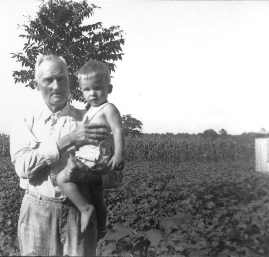 Pop holding grandson, Robert--Walter’s son, Summer – 1934.
Page 231
GOOD IMPRESSIONS
It was sometime in the summer of 1936, that Dad’s youngest
son, George wanted mom and dad to meet someone special. George had met
a pretty little young lady with golden hair, and had been dating her
almost a year. George was very interested in this girl and wanted his
mom and dad to share some of his enthusiasm, so he arranged for them to
meet her. She was invited to have a Sunday dinner at Dad’s house.
Miss Hazel Waters was nervous and very anxious to do
everything just right and make a good impression.
The big day came. George brought Miss Waters home and
introduced her to Mom and Dad.
Every thing went along just right. Dinner was served.
Everyone was seated at the table and the dinner was being enjoyed by all.
Miss Waters was seated next to Dad. She was very anxious
to do everything just right. She reached for something. It happened!
Her wrist struck her iced tea glass and dumped the contents exactly
center, in Dad’s lap !
Good first impressions ! Fortunately, Dad took it in
good humor.
Page 232 Photo
Pop holding grandson, Robert--Walter’s son, Summer – 1934.
Page 231
GOOD IMPRESSIONS
It was sometime in the summer of 1936, that Dad’s youngest
son, George wanted mom and dad to meet someone special. George had met
a pretty little young lady with golden hair, and had been dating her
almost a year. George was very interested in this girl and wanted his
mom and dad to share some of his enthusiasm, so he arranged for them to
meet her. She was invited to have a Sunday dinner at Dad’s house.
Miss Hazel Waters was nervous and very anxious to do
everything just right and make a good impression.
The big day came. George brought Miss Waters home and
introduced her to Mom and Dad.
Every thing went along just right. Dinner was served.
Everyone was seated at the table and the dinner was being enjoyed by all.
Miss Waters was seated next to Dad. She was very anxious
to do everything just right. She reached for something. It happened!
Her wrist struck her iced tea glass and dumped the contents exactly
center, in Dad’s lap !
Good first impressions ! Fortunately, Dad took it in
good humor.
Page 232 Photo 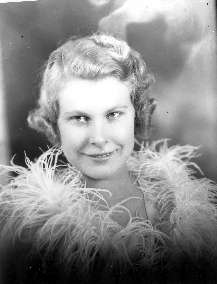 This pretty young lady was Miss Hazel Waters – 1935
Page 233
Dad was always a hard worker and he had a lot of endurance.
I remember once when he was about 75 years of age, he had a young man,
as strong as an ox, hired to help us strip fodder. Dad could easily
strip 4 rows to that man 2 rows. I will not say how well I could do.
I never could keep up with Dad doing anything, unless he slowed down.
Our mail box was located at the end of the lane on River
road about one half mile from the house. When I was young and not doing
anything else, I went to get the mail. As I grew older, Dad usually
went after the mail. Ordinarily, the walk was good for him.
It happened after I was married and living near by. Dad was
over eighty years old at the time.
Dad started out to get the mail one bitter cold windy day.
After he was on his way, he realized he needed a heavier coat, but
decided to go on fast anyway and try to beat the cold. He got as far
as one of the tobacco barns on the way, and he stopped under the barn
shelter to sit down and catch his breath. He had severe pains in his
chest. He stayed at the barn till he thought he could go on. His
determination carried him there and back, one mile, but when he reached
the house, he was almost incoherent, and wracked with pain. Mama
thought it was a heart attack.
He possibly had angina because he had always had foods
with hevy fat content.
He didn’t see a doctor about his attack at that time.
You didn’t see a doctor in those days unless you were sick.
This attack wore off.
Page 234
Dad plowed his garden till he was about eighty years old.
He had to give up gardening. Old Josh, the plow horse died. Josh was
old also. His teeth had been bad for some time, so Dad had been feeding
him wheat bran and preprared commercial horse food.
KIDS AND GROWN UPS
When Dad’s children were growing up, we all addressed him as
“PaPa”. When I am speaking of him, I refer to him as my daddy or as my
father.
We also used two words you won’t find in your dictionary.
The words were “yessir” and “nosir”. It would have been a hanging crime
to say a flat yes or no to our dad. Yessir, it would have been.
I remember an occasion, I heard Dad talking to a young grand
child. Dad ask the child a question. The child answered yes. I was
positively flabbergasted. I had never considered what would happen if a
child said yes or no to an adult. Yes and no was for child to child or
adult to adult. Never, never child to adult.
DAD’S ATTACK
From time to time after Dad’s apparent heart attack on his
trip to the mail box, he had more attacks. He finally did see a doctor
who gave him medication for kidney disorder.
Page 235
SLEEPING HABIT
As I remember back to the nineteen and twenties, Dad slept
on a feather bed covered with home made patch work quilts. He wore a
shirt for pajama top. Later, Mama made him some night shirts. They looked
like shirts that didn’t stop growing till they reached his knees.
His alarm clock hung over his head, suspended from the high-back
iron bead-stead. There was a chair by his bed upon which rested his
Eveready 2 cell flash light.
They on’t make them that good now. I still have that flash light,
and I use it rewquently. It is over 70 years old ! Try and make your new
plastic light last seven years.
Page 236 illustration
Testing razor for sharpness
Every Sunday morning Frank Wilkinson shaved whether he needed a
shave or not. He started by “Stropping” his straight razor back and fourth
on a leather strap made for the purpose. When he thought the razor was sharp,
he would yank a hair out of his head and hold it up and whack at it with the
razor. If it cut the hair off, it was sharp. He used soap and a brush to
lather up. He shaved with that straight razor until his hand became too shakey
to hold the razor safely. Then he let his beard grow
Page 237
TOWN OF BATH
A lot of history has been made on the banks of the Pamlico River.
In colonial times, there was a town on the Pamlico River about 50 miles from
Ocracoke Inlet that became a leading colonial port. It originally was called
The New Colony of Pamptico. In 1696 it was named Bath County. On March 8,
1705, the Town of Bath was the first town to be incorporated in North Carolina.
The Tuscorora indians assembled on Indian Island a few miles down
river and planned to wipe the town out. They made vicious raids on Bath,
killing and burning. Some residents fled through the woods to New Bern.
In 1711, they killed John Lawson who helped found Bath. They
killed the wrong man. Lawson had decried the mistreatment of indians by the
white settlers.
PIRATE
In the early 1700’s a well known sea captain temporarily retired
to Plum Point just south of Bath. He married a Bath woman named Mary Ormand.
This captain was Edward Teach, better known as the pirate Blackbeard. Teach
liked Bath and Bath liked Teach. The town treasured the booty he brought
from his raids.
Blackbeard was a hard drinker, had an iron will and a vicious
temper.
He was offered a pardon by the king so he surrendered to Gov.
Charles Eden, who for a share of his prizes, allowed him to continue piracy
under protection of the law.
Virginia Gov. Alexander Spottswood feared Blackbeard would
organize a pirate kingdom from a fortress on Ocracoke Island. So he sent
Royal Navy Lt. Robert Maynard to capture or kill him. Maynard ambushed him
and after a fierce bloody battle, killed him.
Page 238
It was one of the bloodiest pirate battles ever recorded. Lt.
Maynard ambushed Blackbeard’s ship off Ocracoke on November 22, 1718.
Blackbeard’s first broadside killed 20 British sailors on the
two ships under Maynard’s command and crippled one of the vessels. Under
cover of smoke and fire, Maynard sent his ship’s dozen survivors to the
protection of the hold. Blackbeard, seeing only a hand full of Maynard’s
men on deck, led a boarding party of 14, crying “cut them to pieces”!
The surviving sailors swarmed on to the deck and caught the
pirate by surprise. The hand to hand fighting was fierce and the deck
was soon awash with blood and battered bodies. Blackbeard struggled until
his last breath, finally dropping with 20 cutlass wounds and 5 bullets.
Maynard nailed the pirate’s head to his bowsprit for the return
voyage.
There is an old tale that claims Blackbeard’s headless body
swam around the ship 3 times before it sank.
After the American Revolution, Bath began to hit the skids.
Newer settlers headed west. In 1785, the county seat was moved to
Washington, 16 miles away at the head of the Pamlico River.
The oldest house still standing in North Carolina is the
Palmer-Marsh House in Bath. The oldest church in continued use in North
Carolina is St. Thomas Church in Bath, built in 1734.
Bath is now a sleepy little town with a population of about 200.
Page 239
POSTMASTER
While Francis M. Wilkinson was with the U. S. Postal Service,
Washington had a post master named N. Henry Moore. Mr. Moore was well
liked in the community. When I was in primary grades in school, I had
to walk a route that Mr. Moore sometimes traveled. If he passed, he
would stop and give me a ride as far as he was going on my route. I
appreciated it. After I became a man, I contracted the building of a
small dwelling for Mr. Moore, which he rented to his nephew.
Mr. Moore had a back injury when he was an infant, resulting
in his being short, especially from the waste up, but that apparently
never seemed to have any affect on him.
In the late summer of 1915, Mr. Henry Moore and his brother,
Allen left Bay View heading for Washington. They had to make a stop
in Bath. They were arrested for indecent exposure. They were wearing
bathing suits on a public street in Bath for all to see.
Those scandalous bathings suits consisted of bathing trunks
with the leg part of the trunks only covering down to the knees.
The tops of the bathing suits were like tee shirts with sleeves
almost down to the elbows, and shirt bottoms draped half way down
to the knees. These indecent bathing suits were only covered with
rain coats. How Shameful !
Sept. 13, 1918: At the trial which
Was held at Bath Saturday, Post-
Master N. Henry Moore and Allan
Moore were each fined two dollars
And costs for indecent exposure. The
Other members of the party who visited
Bath a week ago Sunday were Released
with fines.
The trial was the result of a trip
through Bath on which the visitors
were attired in bathing suits and
rain coats. This seemed to greatly
shock the sense of propriety of the
natives.
Page 240 & 241
RIDE ‘EM, COWBOY !
It was about 1930. Dad had hired some men to cut some cord
wood in his woods land on River Road, now 4 lane, N.C. #32.
I was assigned the job of hauling it up to the old home wood
pile with the horse, Josh, and the cart. I had loaded about a quarter
cord of green pine wood in the cart and I gave Josh the command to go.
He moved about four feet and then put on brakes. That was called
“baulking”. I did everything in the book except building a fire under
him. That wouldn’t work because he might move just far enough to pull
the cart over the fire.
I had heard that if you unhitch a baulking horse and get on his
back and ride him a while, he will go when you hitch him back up.
I unhooked the chains from the hanes, unfastened the belly band,
lifted the shaves and unhooked the cart saddle chains and let the shaves
down. That only left the bridle and collar and hames.
I climbed aboard and the horse took off for the house in high
gear with pedal to the floor. I was riding bare back so I held on to
the collar and hames. I had never ridden a horse before. Josh ran
almost home before I could get him to stop. That half mile was the
longest ride I ever took in my life.
Each time he would bound forward, he would toss me in the air.
Just as I was coming down to meet his back, he would be prancing up to
meet me half way. I never realized a fat horse could have such a hard
sharp back bone.
I was holding on to the collar and hames for dear life. That
was my only permanent contact with the horse. My sitting contact
resembled a basket ball player dribbleing a basket ball on the ground.
When Josh finally stopped, I slid to the ground but couldn’t
stand up. My legs buckeled under me.
When I finally managed to walk, I took Josh back to the woods
and hitched him to the cart. The trick worked. On command, he started
at a running gate and didn’t slow to a walk ‘till he got to the road.
For several days, I enjoyed standing more than sitting. That
was my first and last horse back ride.
Illustration:
Page 242 Photo
1936 – 1938 During shipping season George Wilkinson worked for F. S.
Royster Fertilizer Co. for $12.50 per week as bookkeeper.
Costume – white shirt and tie. Also overalls. Worked as night
watchman during the slack season.
Page 243
ENGLISH
I remember reading an article concerning antique bits and
pieces of the English language that are hold-overs from Elizabethan
England. There is some of the Old English to be heard on the Outer
Banks of North Carolina.
Go to Ocracoke Island and you might hear a native say “oy
think tharl be a hoy toyd tonoyt”. Translated, I think there will
be high tide tonight.
The article I read also mentioned some words Dad used, such
as “haint” which means, have not. Sentence = I hain’t got the time.
It would make us smile when Dad would look across the Pamlico
River on a clear, windless day, and he would say, “the water is kam
and clair”. (Calm and Clear), “Air you sure”? (Are you sure?), “I
don’t have airy one”. (I don’t have a single one).
When I was a child, I didn’t think Dad used good English.
It just happened that he grew up in an area where the people used
some Old English instead of Modern English.
Otherwise, his grammer and English was good for an
un-schooled person.
Page 244
KITCHENS –OLD
In the “Good Old Days”, Dad’s mother cooked in a fireplace.
Cooking fireplaces were equipped with a crane to hang an iron cooking
pot. This crane was a metal arm fastened to the side of the fireplace
and was hinged so it could swing out over the harth so the cook could
tend the pot and then swing it back in over the fire.
There was an iron utensil with a domed lid. It was some what
like a turkey roaster. It was called a Dutch oven. Hot coals could
be piled around it for baking. Some fireplaces had a bricked in oven.
The frying was done in a “spider”. The spider was a long
legged iron frying pan that was placed over live coals.
The water was drawn from an open well that was dug in the
ground deep enough to reach water. The sides of the well were usually
boxed in with wood to keep the dirt sides from collapsing inward.
Sometimes, they used a large hollow log.
A large iron kettle or “wash pot” was used out of doors for
boiling laundry and also for cooking fat, called “trying out” lard
for the year’s supply of cooking fat. Apple butter was also cooked
in wash pots.
TEA
Old time folks couldn’t buy coffee and tea, so they drank
yaupon (yo-pon as in pond) tea. Yaupon is a small tree-like bush
found on the Outer Banks of North Carolina and occasionally found inland.
Yaupon is sometimes used as an ornamental plant in modern
yards. It has small dark green leaves and large bunches of small
bright orange color berries around Christmas time.
Page 245
Many old time families had a yaupon bush from which they
picked the leaves for tea. The leaves were roasted in a wash pot
till they were properly done and then stored for tea. The brewed
tea was usually sweetened with molasses. Sugar was either unavailable,
or too expensive. All the old people I talked with say they hated
yaupon tea. I heard of one man who buried his father, and came home
from the grave yard and took the ax and immediately chopped the
yaupon bush down.
KITCHENS – SLIGHTLY MODERN
The kitchen my mom cooked in was more “modern”. It had a
wood burning cook stove in the north corner with a window on either
side. The stove had an oven that was built so that the fire
surrounded it on 3 ½ sides. The stove also provided the kitchen
with ample heat in both winter and summer. There was an iron
warming shelf on the back of the stove that often held juicy warm
baked sweet potatoes.
There was a small shelf on one wall next to the stove that
held the light fixture, an oil lamp, for illumination for night
cooking.
The west corner of the kitchen had a small shelf about 5
feet high to hold another kerosene oil lamp. There was a larger
shelf lower in that corner to hold the kitchen plumbing. The
plumbing consisted of a galvanzed metal bucket, full of water and
a tin dipper. Used water and garbage was poured in a large slop
bucket on the floor.
About the year 1923, Mom bought a galvanized………..
Page 246
metal sink and ran the waste kitchen water under the house.
That’s where I dug for fishing worms.
The south corner of the kitchen had an old fashioned
“pie safe” with door panels make of preforated sheet metal punched
in fancy patterns. The legs of the pie safe stood in can lids full
of kerosene to keep the ants out.
Left over food was stored in the safe for the next meal.
There was a table in the center of the kitchen that served
as a work counter.
There was a door in the east corner of the kitchen that
opened into the pantry where the flour barrel, the meal tub and the
wooden sugar bucket stood. Shelves in the 6 foot by 8 foot pantry
held canned goods, preserves, pickels, large pots and pans and other
utensils. Several strings of dried red peppers hung in the pantry.
About the year 1922, Mama bought a new Perfection Four Burner
oil stove for summer use.
The kitchen and the dining rooms both had doors that opened
on the back porch, but no connecting door. There was a pass-thru
window and shelf to get food and dishes from room to room, but you
had to walk around to get from room to room.
Mama finally bought a door and Chilson cut a hole in the
partition and installed the door.
On a side of the kitchen near the stove was the fire-wood
box. Beside the wood box was a small ladder back chair. You could
open the oven door and sit in the chair and dry or warm your feet
in the edge of the oven.
Page 247
The cat slept under the stove. The big tea kettle on the
stove provided all the hot running water needed.
There was a coffee grinder fastened to the wall.
Green coffee beans were bought by the pound and were put
in a large biscuit pan and they were roasted to a brown color. They
were ready to grind and brew drinking coffee.
When there was time to spare, especially in cold weather,
family members would gather in the kitchen. Sometimes, they would
bring in extra chairs from the dining room to sit in. The kitchen
was a sort of gathering place, even for guests.
ALWAYS A FIRST TIME
Once, when Dad was 83 years of age, he was sitting in the
kitchen, and Mom was busy preparing a meal. She needed a can
opened and since he wasn’t doing anything, she gave him the can and
the old time one piece can opener and asked him to open it for her.
“Oh Dolly, I don’t know how to open it”. “Oh yes you do.
Go ahead. I need it now”. So Dad took it and fumbled around
working on it and finally opened it, cutting a finger in the process.
As he gave it to her, he said, “that is the first time I have ever
opened a can”. She had not realized he didn’t know how but he did
it. First can he ever opened, at age 83.
Page 248
This pretty young lady was Miss Hazel Waters – 1935
Page 233
Dad was always a hard worker and he had a lot of endurance.
I remember once when he was about 75 years of age, he had a young man,
as strong as an ox, hired to help us strip fodder. Dad could easily
strip 4 rows to that man 2 rows. I will not say how well I could do.
I never could keep up with Dad doing anything, unless he slowed down.
Our mail box was located at the end of the lane on River
road about one half mile from the house. When I was young and not doing
anything else, I went to get the mail. As I grew older, Dad usually
went after the mail. Ordinarily, the walk was good for him.
It happened after I was married and living near by. Dad was
over eighty years old at the time.
Dad started out to get the mail one bitter cold windy day.
After he was on his way, he realized he needed a heavier coat, but
decided to go on fast anyway and try to beat the cold. He got as far
as one of the tobacco barns on the way, and he stopped under the barn
shelter to sit down and catch his breath. He had severe pains in his
chest. He stayed at the barn till he thought he could go on. His
determination carried him there and back, one mile, but when he reached
the house, he was almost incoherent, and wracked with pain. Mama
thought it was a heart attack.
He possibly had angina because he had always had foods
with hevy fat content.
He didn’t see a doctor about his attack at that time.
You didn’t see a doctor in those days unless you were sick.
This attack wore off.
Page 234
Dad plowed his garden till he was about eighty years old.
He had to give up gardening. Old Josh, the plow horse died. Josh was
old also. His teeth had been bad for some time, so Dad had been feeding
him wheat bran and preprared commercial horse food.
KIDS AND GROWN UPS
When Dad’s children were growing up, we all addressed him as
“PaPa”. When I am speaking of him, I refer to him as my daddy or as my
father.
We also used two words you won’t find in your dictionary.
The words were “yessir” and “nosir”. It would have been a hanging crime
to say a flat yes or no to our dad. Yessir, it would have been.
I remember an occasion, I heard Dad talking to a young grand
child. Dad ask the child a question. The child answered yes. I was
positively flabbergasted. I had never considered what would happen if a
child said yes or no to an adult. Yes and no was for child to child or
adult to adult. Never, never child to adult.
DAD’S ATTACK
From time to time after Dad’s apparent heart attack on his
trip to the mail box, he had more attacks. He finally did see a doctor
who gave him medication for kidney disorder.
Page 235
SLEEPING HABIT
As I remember back to the nineteen and twenties, Dad slept
on a feather bed covered with home made patch work quilts. He wore a
shirt for pajama top. Later, Mama made him some night shirts. They looked
like shirts that didn’t stop growing till they reached his knees.
His alarm clock hung over his head, suspended from the high-back
iron bead-stead. There was a chair by his bed upon which rested his
Eveready 2 cell flash light.
They on’t make them that good now. I still have that flash light,
and I use it rewquently. It is over 70 years old ! Try and make your new
plastic light last seven years.
Page 236 illustration
Testing razor for sharpness
Every Sunday morning Frank Wilkinson shaved whether he needed a
shave or not. He started by “Stropping” his straight razor back and fourth
on a leather strap made for the purpose. When he thought the razor was sharp,
he would yank a hair out of his head and hold it up and whack at it with the
razor. If it cut the hair off, it was sharp. He used soap and a brush to
lather up. He shaved with that straight razor until his hand became too shakey
to hold the razor safely. Then he let his beard grow
Page 237
TOWN OF BATH
A lot of history has been made on the banks of the Pamlico River.
In colonial times, there was a town on the Pamlico River about 50 miles from
Ocracoke Inlet that became a leading colonial port. It originally was called
The New Colony of Pamptico. In 1696 it was named Bath County. On March 8,
1705, the Town of Bath was the first town to be incorporated in North Carolina.
The Tuscorora indians assembled on Indian Island a few miles down
river and planned to wipe the town out. They made vicious raids on Bath,
killing and burning. Some residents fled through the woods to New Bern.
In 1711, they killed John Lawson who helped found Bath. They
killed the wrong man. Lawson had decried the mistreatment of indians by the
white settlers.
PIRATE
In the early 1700’s a well known sea captain temporarily retired
to Plum Point just south of Bath. He married a Bath woman named Mary Ormand.
This captain was Edward Teach, better known as the pirate Blackbeard. Teach
liked Bath and Bath liked Teach. The town treasured the booty he brought
from his raids.
Blackbeard was a hard drinker, had an iron will and a vicious
temper.
He was offered a pardon by the king so he surrendered to Gov.
Charles Eden, who for a share of his prizes, allowed him to continue piracy
under protection of the law.
Virginia Gov. Alexander Spottswood feared Blackbeard would
organize a pirate kingdom from a fortress on Ocracoke Island. So he sent
Royal Navy Lt. Robert Maynard to capture or kill him. Maynard ambushed him
and after a fierce bloody battle, killed him.
Page 238
It was one of the bloodiest pirate battles ever recorded. Lt.
Maynard ambushed Blackbeard’s ship off Ocracoke on November 22, 1718.
Blackbeard’s first broadside killed 20 British sailors on the
two ships under Maynard’s command and crippled one of the vessels. Under
cover of smoke and fire, Maynard sent his ship’s dozen survivors to the
protection of the hold. Blackbeard, seeing only a hand full of Maynard’s
men on deck, led a boarding party of 14, crying “cut them to pieces”!
The surviving sailors swarmed on to the deck and caught the
pirate by surprise. The hand to hand fighting was fierce and the deck
was soon awash with blood and battered bodies. Blackbeard struggled until
his last breath, finally dropping with 20 cutlass wounds and 5 bullets.
Maynard nailed the pirate’s head to his bowsprit for the return
voyage.
There is an old tale that claims Blackbeard’s headless body
swam around the ship 3 times before it sank.
After the American Revolution, Bath began to hit the skids.
Newer settlers headed west. In 1785, the county seat was moved to
Washington, 16 miles away at the head of the Pamlico River.
The oldest house still standing in North Carolina is the
Palmer-Marsh House in Bath. The oldest church in continued use in North
Carolina is St. Thomas Church in Bath, built in 1734.
Bath is now a sleepy little town with a population of about 200.
Page 239
POSTMASTER
While Francis M. Wilkinson was with the U. S. Postal Service,
Washington had a post master named N. Henry Moore. Mr. Moore was well
liked in the community. When I was in primary grades in school, I had
to walk a route that Mr. Moore sometimes traveled. If he passed, he
would stop and give me a ride as far as he was going on my route. I
appreciated it. After I became a man, I contracted the building of a
small dwelling for Mr. Moore, which he rented to his nephew.
Mr. Moore had a back injury when he was an infant, resulting
in his being short, especially from the waste up, but that apparently
never seemed to have any affect on him.
In the late summer of 1915, Mr. Henry Moore and his brother,
Allen left Bay View heading for Washington. They had to make a stop
in Bath. They were arrested for indecent exposure. They were wearing
bathing suits on a public street in Bath for all to see.
Those scandalous bathings suits consisted of bathing trunks
with the leg part of the trunks only covering down to the knees.
The tops of the bathing suits were like tee shirts with sleeves
almost down to the elbows, and shirt bottoms draped half way down
to the knees. These indecent bathing suits were only covered with
rain coats. How Shameful !
Sept. 13, 1918: At the trial which
Was held at Bath Saturday, Post-
Master N. Henry Moore and Allan
Moore were each fined two dollars
And costs for indecent exposure. The
Other members of the party who visited
Bath a week ago Sunday were Released
with fines.
The trial was the result of a trip
through Bath on which the visitors
were attired in bathing suits and
rain coats. This seemed to greatly
shock the sense of propriety of the
natives.
Page 240 & 241
RIDE ‘EM, COWBOY !
It was about 1930. Dad had hired some men to cut some cord
wood in his woods land on River Road, now 4 lane, N.C. #32.
I was assigned the job of hauling it up to the old home wood
pile with the horse, Josh, and the cart. I had loaded about a quarter
cord of green pine wood in the cart and I gave Josh the command to go.
He moved about four feet and then put on brakes. That was called
“baulking”. I did everything in the book except building a fire under
him. That wouldn’t work because he might move just far enough to pull
the cart over the fire.
I had heard that if you unhitch a baulking horse and get on his
back and ride him a while, he will go when you hitch him back up.
I unhooked the chains from the hanes, unfastened the belly band,
lifted the shaves and unhooked the cart saddle chains and let the shaves
down. That only left the bridle and collar and hames.
I climbed aboard and the horse took off for the house in high
gear with pedal to the floor. I was riding bare back so I held on to
the collar and hames. I had never ridden a horse before. Josh ran
almost home before I could get him to stop. That half mile was the
longest ride I ever took in my life.
Each time he would bound forward, he would toss me in the air.
Just as I was coming down to meet his back, he would be prancing up to
meet me half way. I never realized a fat horse could have such a hard
sharp back bone.
I was holding on to the collar and hames for dear life. That
was my only permanent contact with the horse. My sitting contact
resembled a basket ball player dribbleing a basket ball on the ground.
When Josh finally stopped, I slid to the ground but couldn’t
stand up. My legs buckeled under me.
When I finally managed to walk, I took Josh back to the woods
and hitched him to the cart. The trick worked. On command, he started
at a running gate and didn’t slow to a walk ‘till he got to the road.
For several days, I enjoyed standing more than sitting. That
was my first and last horse back ride.
Illustration:
Page 242 Photo
1936 – 1938 During shipping season George Wilkinson worked for F. S.
Royster Fertilizer Co. for $12.50 per week as bookkeeper.
Costume – white shirt and tie. Also overalls. Worked as night
watchman during the slack season.
Page 243
ENGLISH
I remember reading an article concerning antique bits and
pieces of the English language that are hold-overs from Elizabethan
England. There is some of the Old English to be heard on the Outer
Banks of North Carolina.
Go to Ocracoke Island and you might hear a native say “oy
think tharl be a hoy toyd tonoyt”. Translated, I think there will
be high tide tonight.
The article I read also mentioned some words Dad used, such
as “haint” which means, have not. Sentence = I hain’t got the time.
It would make us smile when Dad would look across the Pamlico
River on a clear, windless day, and he would say, “the water is kam
and clair”. (Calm and Clear), “Air you sure”? (Are you sure?), “I
don’t have airy one”. (I don’t have a single one).
When I was a child, I didn’t think Dad used good English.
It just happened that he grew up in an area where the people used
some Old English instead of Modern English.
Otherwise, his grammer and English was good for an
un-schooled person.
Page 244
KITCHENS –OLD
In the “Good Old Days”, Dad’s mother cooked in a fireplace.
Cooking fireplaces were equipped with a crane to hang an iron cooking
pot. This crane was a metal arm fastened to the side of the fireplace
and was hinged so it could swing out over the harth so the cook could
tend the pot and then swing it back in over the fire.
There was an iron utensil with a domed lid. It was some what
like a turkey roaster. It was called a Dutch oven. Hot coals could
be piled around it for baking. Some fireplaces had a bricked in oven.
The frying was done in a “spider”. The spider was a long
legged iron frying pan that was placed over live coals.
The water was drawn from an open well that was dug in the
ground deep enough to reach water. The sides of the well were usually
boxed in with wood to keep the dirt sides from collapsing inward.
Sometimes, they used a large hollow log.
A large iron kettle or “wash pot” was used out of doors for
boiling laundry and also for cooking fat, called “trying out” lard
for the year’s supply of cooking fat. Apple butter was also cooked
in wash pots.
TEA
Old time folks couldn’t buy coffee and tea, so they drank
yaupon (yo-pon as in pond) tea. Yaupon is a small tree-like bush
found on the Outer Banks of North Carolina and occasionally found inland.
Yaupon is sometimes used as an ornamental plant in modern
yards. It has small dark green leaves and large bunches of small
bright orange color berries around Christmas time.
Page 245
Many old time families had a yaupon bush from which they
picked the leaves for tea. The leaves were roasted in a wash pot
till they were properly done and then stored for tea. The brewed
tea was usually sweetened with molasses. Sugar was either unavailable,
or too expensive. All the old people I talked with say they hated
yaupon tea. I heard of one man who buried his father, and came home
from the grave yard and took the ax and immediately chopped the
yaupon bush down.
KITCHENS – SLIGHTLY MODERN
The kitchen my mom cooked in was more “modern”. It had a
wood burning cook stove in the north corner with a window on either
side. The stove had an oven that was built so that the fire
surrounded it on 3 ½ sides. The stove also provided the kitchen
with ample heat in both winter and summer. There was an iron
warming shelf on the back of the stove that often held juicy warm
baked sweet potatoes.
There was a small shelf on one wall next to the stove that
held the light fixture, an oil lamp, for illumination for night
cooking.
The west corner of the kitchen had a small shelf about 5
feet high to hold another kerosene oil lamp. There was a larger
shelf lower in that corner to hold the kitchen plumbing. The
plumbing consisted of a galvanzed metal bucket, full of water and
a tin dipper. Used water and garbage was poured in a large slop
bucket on the floor.
About the year 1923, Mom bought a galvanized………..
Page 246
metal sink and ran the waste kitchen water under the house.
That’s where I dug for fishing worms.
The south corner of the kitchen had an old fashioned
“pie safe” with door panels make of preforated sheet metal punched
in fancy patterns. The legs of the pie safe stood in can lids full
of kerosene to keep the ants out.
Left over food was stored in the safe for the next meal.
There was a table in the center of the kitchen that served
as a work counter.
There was a door in the east corner of the kitchen that
opened into the pantry where the flour barrel, the meal tub and the
wooden sugar bucket stood. Shelves in the 6 foot by 8 foot pantry
held canned goods, preserves, pickels, large pots and pans and other
utensils. Several strings of dried red peppers hung in the pantry.
About the year 1922, Mama bought a new Perfection Four Burner
oil stove for summer use.
The kitchen and the dining rooms both had doors that opened
on the back porch, but no connecting door. There was a pass-thru
window and shelf to get food and dishes from room to room, but you
had to walk around to get from room to room.
Mama finally bought a door and Chilson cut a hole in the
partition and installed the door.
On a side of the kitchen near the stove was the fire-wood
box. Beside the wood box was a small ladder back chair. You could
open the oven door and sit in the chair and dry or warm your feet
in the edge of the oven.
Page 247
The cat slept under the stove. The big tea kettle on the
stove provided all the hot running water needed.
There was a coffee grinder fastened to the wall.
Green coffee beans were bought by the pound and were put
in a large biscuit pan and they were roasted to a brown color. They
were ready to grind and brew drinking coffee.
When there was time to spare, especially in cold weather,
family members would gather in the kitchen. Sometimes, they would
bring in extra chairs from the dining room to sit in. The kitchen
was a sort of gathering place, even for guests.
ALWAYS A FIRST TIME
Once, when Dad was 83 years of age, he was sitting in the
kitchen, and Mom was busy preparing a meal. She needed a can
opened and since he wasn’t doing anything, she gave him the can and
the old time one piece can opener and asked him to open it for her.
“Oh Dolly, I don’t know how to open it”. “Oh yes you do.
Go ahead. I need it now”. So Dad took it and fumbled around
working on it and finally opened it, cutting a finger in the process.
As he gave it to her, he said, “that is the first time I have ever
opened a can”. She had not realized he didn’t know how but he did
it. First can he ever opened, at age 83.
Page 248 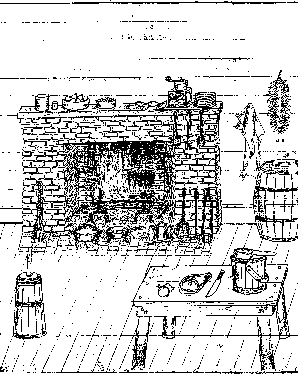 Great Grandmother’s Kitchen
Page 249
Great Grandmother’s Kitchen
Page 249 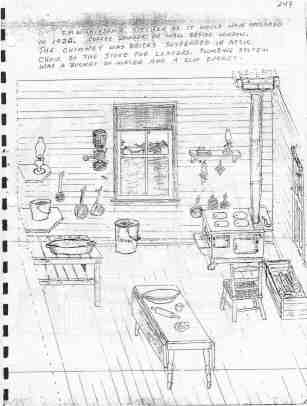 F. M. Wilkinson’s kitchen as it would have appeared in 1920.
Coffee grinder on wall beside window. The chimney was bricks
suspended in attic. Chair by the stove for loafers. Plumbing
system was a bucket of water and a slop bucket.
Page 250
F. M. Wilkinson’s kitchen as it would have appeared in 1920.
Coffee grinder on wall beside window. The chimney was bricks
suspended in attic. Chair by the stove for loafers. Plumbing
system was a bucket of water and a slop bucket.
Page 250 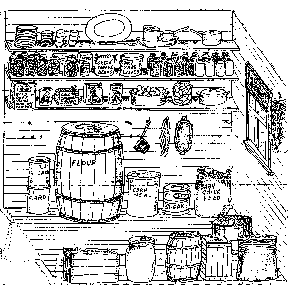 The F.M. Wilkinson kitchen pantry looked somewhat like this in
1920. Very little food came ready prepared and boxed.
Page 251
OUT OF THE MOUTHS OF BABES
When little George was about 7 years old, Dad bought an
organ for Mama. It had a full size keyboard, and lots of stops
to adjust for variation of sound. There were two foot pedals
approximately 4” wide and 10” long, covered with carpet material.
To play the organ, it was necessary to pump the pedals alternately
to furnish compressed air to blow the reeds.
The cabinet work of the organ was beautifully carved and
turned from solid wallnut wood. When cleaned and polished, the
organ was a handsome instrument.
Mama and Dad had company one Sunday soon after acquiring
the organ, and they were anxious to show off the new instrument.
The company was invited in the parlour and Mom played them a tune
to show it off.
Little George helped by giving a few details. He said,
“it’s second hand and we got it for $30.00”.
Sometimes, kids are blabber mouths.
Page 252
LARGE FAMILIES
In the 1800’s and early 1900’s, a person could not operate
a farm without a large family or a supply of cheap labor. Some
farmers had tennants with large families that could be hired cheap.
That was before they had tractors that worked from four to
a dozen rows at a time, pulling tools that did several operations
in one pass. Large harvesting machines can pick more cotton, corn
or beans in an hour than a crew of laborers can pick in several days.
That was also before herbicides replaced hand chopping weeds
and grass from row crops. That was also before insecticides replaced
hand picking worms off tobacco and other crops, leaf by leaf.
William Henry Wilkinson raised three girls and two boys to
adults. His daughter, Emily Wilkinson Ross told her grandson that
she was the eldest of twelve children. That means that of twelve
births, only five survived. Infant mortality was high in those
days. Many diseases that could wipe out a whole family of children
in those days are no longer a threat. Modern babies usually receive
pre-natal and post natal care that was unknown in those days.
William Henry Wilkinson’s son, Francis Marion W. also lost
some children at an early age; of eleven births, seven survived.
Modern medical care might have saved most of them.
Page 253
DAD’S FAMILY
Although Dad never expressed his feelings about his sons
and daughter in actual words, he was quite proud of them. He was
always happy when his children came to visit him.
For children of an uneducated country farmer, most of them
managed to acquire a fairly good education, and they could earn their
living without doing hard physical labor like he had most of his life.
Guy and myself were exceptions. Guy was a showman and entertainer.
I eventually became a carpenter, cabinet maker and house contractor.
We didn’t appreciate him when we were growing up. But when
we became adults and realized the difficulties Dad faced trying to
raise a family with debits to pay of, little education and hard
times, I think he was GREAT !
Page 254
The following photographs are pictures of Frank Wilkinson
and his family as he knew them ----
Walter Marion Wilkinson and family
Bruce Arnold Wilkinson and family
Guy Vernon Wilkinson and family
Gwendolyn Caroline Wilkinson and family
Joseph Garland Wilkinson and wife
Francis Chilson Wilkinson and family
And finally –
George and Hazel Wilkinson
Page 255 Photo
At about age 80, Dad’s hand became too shakey to use his straight razor
Page 256 Photo
Francis Marion Wilkinson – Mary Koonce Wilkinson
Page 257 Photo
Francis Chilson Wilkinson, Alma M. Wilkinson, Guy Wilkinson,
Mary K. Wilkinson, Joseph G. Wilkinson.
Gathered on the east side of the old F. M. Wilkinson home.
Page 258 Photo
Frank, Alma, Clara, Guy, Hazel, George, Mom, Gwen
George, Alma, Joe, Clara, Mom, Guy, Hazel, Gwen
Page 259 Photo
John, Guy, Joe, Frank, Alma, Gwen 8-19-1971
John Korback was Gwen’s second husband
Back row:
John, Clara, Guy, Joe, Alma, Frank
Front row: 8-19-1971,
Bessie, young girl Christine, Jerrys daughter, Gwen, Mary W.
Page 260 Photo
Walter M. Wilkinson
Page 261 Photo
Walter Marion Wilkinson
Page 262 Photo
Walter’s first wife: Violet Katharine Wilkinson
Page 263 Photo
Walter’s second wife: Evelyn George Wilkinson
This pictue was Evelyn learning to row a boat on the Pamlico River.
Page 264 Photo
Walter Marion Wilkinson,
wife – Evelyn George Wilkinson and son Robert G. Wilkinson
Page 265 Photo
Bruce Arnold Wilkinson
Page 266 Photo
Bessie Ricks Wilkinson, wife of Bruce Wilkinson
Page 267 Photo
Billie, Bessie, Tommy, Bruce Jr.
Bruce Wilkinson and Bessie Ricks Wilkinson
Page 268 Photo
Guy Vernon Wilkinson
Page 269 Photo
Genevieve Gordon Wilkinson, first wife of Guy V. Wilkinson
Page 270 Photo
Clara Gaither Wilkinson, Guy Vernon Wilkinson
Page 271 Photo
George Lowman and wife, Jacqueline Wilkinson Lowman
Guy V. Wilkinson and wife, Clara Gaither Wilkinson
Page 272 Photo
Gwendolyn Caroline Wilkinson
Page 273 Photo
Gwendolyn Caroline Wilkinson
Page 274 Photo
Gwendolyn Caroline Wilkinson and first husband,
Jake Herbert and his son, William Herbert.
Gwen and second husband, John Korback
pictue made Aug 19, 1971.
Page 275 Photo
Joseph Garland Wilkinson
Page 276 Photo
Helen Powell Wilkinson
Page 277 Photo
Joseph G. Wilkinson
Served in World War II in the U.S. Navy as Chief Pharmacist Mate.
Page 278 Photo
Mr. and Mrs.
Helen Powell Wilkinson
Joseph G. Wilkinson
Page 279 Photo
Francis Chilson Wilkinson
Page 280 Photo
Alma Manning Wilkinson (Mrs. Frank C. Wilkinson)
Page 281 Photo
Jerry, Alma, Mary, Frank Jr., Frank Sr. with Betty on bottom step
Page 282 Photo
Francis Chilson Wilkinson and family
Alma Manning Wilkinson, Children: Betty Gwen and Gerald F.
Alma and Chilson
After the death of his father, he stopped using his middle
name and used his first name, Frank.
Page 283 Photo
George K. Wilkinson 1936
Page 284 Photo
Hazel Waters Wilkinson {photo} made in 1936 by George
Page 285 Photo
Hazel, George, Mary K. Wilkinson
Page 286 Photo
View north across part of the Frank Wilkinson farm. The
photographer was standing on the top of the kitchen. The
shed in the foreground was built to replace part of one
that burned.
In the middle is a dark patch that is beans in the garden.
Three tobacco barns are midway before the line of trees in
the horizon.
Page 287 Photo
The home of Francis Marion Wilkinson
The original parts of this house are pre-civil war dated.
The frame work under the floors was hand hewn from heart
pine logs and mortised together and pinned with wood pegs.
One chimney sits on a foundation of large ballast stones
from the West Indies.
Page 288 Photo
Front of:
Frank Wilkinson’s house as it faces south toward river.
Page 289 Photo Monday, Jan. 6, 1936
Snow on land. 3 ½ inches of ice on the Pamlico River.
Page 290 Blank
Page 291
WILKINSON FAMILY NOTES
Page 292
PIPPIN FAMILY NOTES
Page 293
THIS AND THE FOLLOWING
TWO SHEETS ARE FROM A
FAMILY TREE PREPARED FOR
THE PIPPIN FAMILY
OUR FAMILY TREE TRACED BACK TO:
SILAS AND ELIZABETH PIPPIN, PARENTS OF:
WILLIAM F. PIPPIN
Birth – 12-15-1838
Deaths – 1-4-1920
AND
JOSEPH AND L. F. MOORE, PARENTS OF:
EMILY ANN MOORE
Birth – 12-31-1843
Death – 2-14-1929
WILLIAM F. PIPPING AND EMILY ANN MOORE WERE
MARRIED ON 11-23-1865. THEIR CHILDREN AND
FAMILIES ARE LISTED ON THE PAGES FOLLOWING
WITH THE INFORMATION WE WERE ABLE TO
OBTAINED.
Page 294
KEY TO THIS BOOKLET
WILLIAM F. PIPPIN AND EMILY ANN PIPPIN
CHILDREN
LULA J. PIPPIN
IDA E. PIPPIN
MATIE L. PIPPIN
WILLIAM JOSEPH PIPPIN
LUCY PIPPIN
MACON F. PIPPIN
FAMILY OF IDA E. PIPPIN AND FRANCIS M. WILKINSON
IDA E. PIPPIN
Birth – 12/15/1868
Death – 12/31/1906
Married
Date
FRANCIS M. WILKINSON
Birth – 7/6/1856
Death – 3/2/2943
Page 295
1. Walter M. Wilkinson
Birth – 2/11/1892
2. Bruce A. Wilkinson
Birth - / /1895
Death 8/31/1986
Married - Bessie Ricks
3. Guy V. Wilkinson
Birth – 5/16/1896
Death – 1/3/1984
Married – Clara Wilkinson
Birth
Death
A. Jacquelyn Wilkinson
Birth
Death
Married - ? Lowman
Birth
Death
4 North Cherry Street
Bloomingdale, Ga 31302
4. Gwendolen C. Wilkinson
Birth – 7/2/1898
Death – 8/24/1984
Married – John Korbach
Birth
Death
5. Joseph G. Wilkinson
Birth – 1/4/1902
Death –
Married –
927 Isabella Avenue
Washington, NC 27889
6. Frank C. Wilkinson
Birth – 6/6/1904
Death – 7/23/1978
7. George K. Wilkinson – half brother
Birth
Death
Page 296 Blank
Page 297 Newspaper Articles
Jan. 6, 1984 Guy Vernon Wilkinson Obit
Feb. 14, 1983 Mary W. Edwards Obit
Sept. 2, 1986 Bruce A. Wilkinson, Sr. Obit
Aug. 20, 1990 Bessie R. Wilkinson Obit
Funeral Services are Held Today for Mr. Wilkinson
Page 297 Obit transcriptions below:
January 6, 1984
GUY VERNON WILKINSON
Guy Vernon Wilkinson, 88 died Thursday at his home in North Shores.
Services will be held at the Oden Bonner Chapel Saturday at 2 p.m.
with Rev. Ralph Epps officiating. Burial will be in Pamlico Gardens.
Mr. Wilkinson was born May 16, 1896 to the late Frances M. and
Ida Pippin Wilkinson. He was a retired circus owner and a veteran
of World War I, a member of the First United Methodist Church, and
of Lodge 104, A.F. & A.M., Sudan Temple, and American Legion Post.
No. 15.
Surviving is his wife, Clara Gaither Wilkinson; a daughter, Ms.
Jackie Loman, of Savannah, Ga.; two brothers, Bruce Wilkinson, of
Tulsa, Okla.; and Joe Wilkinson of Washington; four grandchildren
and one great-grandchild.
Pallbearers will be Calvin Gaither, Merrill Daniels, Dr. George
Miller, Ed Karnowski, Ralph Gaither and Ed Bean.
The family will receive friends at the home, 923 Isabella Ave.,
North Shores.
September 2, 1986
BRUCE A. WILKINSON SR.
Bruce A. Wilkinson Sr., 93, of 1432 S. Troost Ave. in Tulsa,
Okla. died Sunday at his home.
The funeral and burial will be held in Tulsa at a time to be
announced.
Wilkinson was born in North Shores in Beaufort County, the son
of the late Francis M. and Ida Pippin Wilkinson. He was a
retired hospital business manager.
He is survived by his wife, Mrs. Bessie Ricks Wilkinson; one
son, William Wilkinson of Tulsa; one brother, Joseph Wilkinson
of North Shores; one half-brother, George Wilkinson of North
Shores, and five grandchildren.
In lieu of flowers, memorials should be sent to a favorite
charity.
Monday, February 14, 1983
MARY W. EDWARDS
Mrs. Mary Wilkinson Edwards, 96 resident of North Shores,
died at home Saturday evening.
Graveside services will be held at the family plot in Oakdale
Cemetery at 2 p.m. Tuesday, conducted by Merrill Daniels. The
body will remain at Paul Funeral Home until 1:30 p.m. Tuesday.
Mrs. Edwards was born on May 8, 1886 in Jones County, daughter
of the late George W. and Mariah Heritage Koonce. She graduated
from Massey Business College in Richmond. She was a former employee
of the Washington Daily News, J.K. Hoyt Department Store and Kugler
Lumber Co. as a bookkeeper.
Her first marriage was to Frank M. Wilkinson, who died on March
2, 1943. Her second marriage was to George A. Edwards, who
preceded her in death on July 22, 1973
Surviving is a son, George J. Wilkinson, of Washington; four
stepsons, Bruce A. Wilkinson, of Tulsa, Oklahoma; Guy V. and Jospeh
C. Wilkinson, both of North Shores and Harley A. Edwards of
Washington; three step-daughters, Mrs. Dot Woolard of Washington,
Mrs Elmer Weatherly of Norfolk and Mrs. Martha Cowper of Conway.
The family will be at the home of her son, George Wilkinson, in
North Shores.
Aug 20, 1990
BESSIE R. WILKINSON
TULSA, Okla. – Bessie Wilson Ricks Wilkinson, 90, died in Tulsa,
Okla. Aug 15.
A memorial service was held Saturday at Fitzgerald Funeral
Service in Tulsa.
Mrs. Wilkinson was the daughter of the late William Hyman and
BessieWilson Ricks of Greenville.
She was married to Bruce Arnold Wilkinson who died in 1986.
She is survived by a son, William Ricks Wilkinson of Tulsa,
and a sister, Imogene Ricks Floyd of Richmond, Va.
FUNERAL SERVICES ARE HELD TODAY FOR MR. WILKINSON
The funeral of Francis Marion Wilkinson was held this afternoon
at 2:30 o’clock from his home which is on the Pamlico river near
Washington. The service was conducted by Dr. M. O. Fletcher.
Mr. Wilkinson was born at Chocowinity on July 20, 1856, the son
of William Henry Wilkinson and his wife, Caroline Lewis. He
was twice married, first to Miss Ida Pippin, and after her death
to Miss Mary Koonce, who faithfully and tenderly cared for him in
his declining years.
Mr. Wilkinson was a farmer. He was a man of integrity, and
noted for his unusual energy. In addition to his farm work, he
was appointed and served as mail carrier, being one of the first
rural mail carriers in this county. This service lasted nineteen
years. When he reached the age of retirement in 1921, and from
then on as long as he was at all active, he devoted his entire
time to his farming operations.
Besides his wife, the following children survive him: Walter _
Wilkinson, Houston, Texas; Bruce A. Wilkinson, Mockville, N.C.;
Joseph Wilkinson of the United States Navy, Frank C. Wilkinson,
Richmond, Va.; Mrs. J. H. Herbert, Roanoke, Va.; and George
Wilkinson, who lives near the home of his father.
Page 298
Nov. 2, 1970
MRS. HELEN P. WILKINSON DIES
Mrs. Helen P. Wilkinson, age 64 (crossed out age 62 inserted)
of Rt. 2, Washington died in the Beaufort County hospital Monday
night at 10:30 o’clock after a critical illnss of two weeks.
She had been in failing health for the past two years.
Mrs. Wilkinson was born in Morganton, Ga. June 16, 1906 (crossed
out 8 inserted), daughter of Mrs. Myrtle Smith Powell and the late
John C. Powell. She was a graduate of the Atlanta Normal college
in Atlanta, Ga., and retired as Placement officer with the FCC in
Washington, D. C. in 1952. Since her retirement, she had been
making her home here.
She was a member of the First United Methodist church, and the
Woman’s society of Christian service.
Mrs. Wilkinson was married to Joseph G. Wilkinson of this………….
Feb 24, 1946
Surviving besides her husband and mother, both of Rt. 2,
Washington are three brothers, John F. Powell and James E. Powell,
both of alexandria, Va., and Col. Roy B. Powell of the U.S. air
Force in Hawaii; three sisters, Mrs alyce Gartrell of Arlington, V
a., and
Smith and Mrs. Agnes Cloud of Alexandria, Va.; one niece, Mrs.
Nancy Schmitt and one great-niece, Cynthia Schmitt of Alexandria,
Va.
Funeral Services will be held at the chapel of the Paul Funeral
home Thursday morning at 11 o’clock by the Rev. Horace Garris.
Burial will follow in Oakdale Cemetery.
Funeral services for Mrs. Helen P. Wilkinson, age 64, of Rt. 2
Washington (North Shores) will be held at the chapel of the Paul
Funeral home Thursday morning at 11 o’clock conducted by the Rev.
Horace S. Garris. Burial will follow in Oakdale Cemetery.
The following will serve as pallbearers: George A. Phillips,
Murl Daniels, George W. Taylor, Richard J. Ross, Clifton Weatherly
and Blake C. Lewis.
Mrs. Wilkinson died in the Beaufort County hospital Mondaynight
following an illness of two years.
Surviving are her husband and mother, three brothers and three
sisters.
Monday, April 5, 1982
ALMA MANNING WILKINSON
SEMINOLE, Fl – Mrs. Alma Manning Wilkinson died in a Seminole
hospital Friday morning following a critical illness of three
months. She was 75.
Graveside services are 2 p.m. Wednesday from the Wilkinson
family plot in Oakdale Cemetery, Rev. Ralph Epps officiating.
Surviving: son Gerald F. Wilkinson of Richmond, Va.; daughter
Mrs Betty Smith Miller of Maderia Beach, FL; brothers Dallas W.
Manning of Newark, DL, Lesley Manning of Richmond and Larry
Manning of Roanoke, Va; sister Mrs. Thelma White of Grifton;
and seven grandchildren and three great-grandchildren.
She was born in Greenville Oct. 30, 1906 to the late Thadeous
and Florence Manning. Her husband, Frank C. Wilkinson, died
July 23, 1978.
She was a member of Faith United Methodist Church; and a former
resident of Richmond.
The body will be at Paul Funeral Home, Washington until the
funeral hour.
July 24, 1978
FRANK C. WILKINSON
Frank Chilson Wilkinson, age 74 of St. Petersburg, Fla., died
at a hospitl there Saturday morning following an illness of
several weeks.
Graveside funeral services will be held at the family plot in
Oakdale Cemetery at 2 p.m. Thursday, conducted by the Rev.
Odell Walker.
Mr. Wilkinson was born in Washington, son of the late Francis M.
and Ida Pippin Wilkinson. He was a retired sales representative
for Union Underwear Co. and had been living in Florida the past
six years. He was a former resident of Richmond, Va. He was a
former member of Grace Covenant Presbyterian Church in Richmond
and Faith United Methodist Church in Seminole, Fla. He was a
member of Tuckehoe Masonic Lodge, A.F. and A.M. of Richmond, a
member of the Scottish Rite bodies and a Shriner.
He is survived by his wife, Alma Manning Wilkinson; one son,
Jerry Wilkinson of Richmond; one daughter, Mrs. Betty W. Smith
of Treasure Island, Fla.; seven grandchildren; three brothers
Bruce of Tulsa, Okla, Guy and Joe Wilkinson, both of North Shores,
Re. 2 Washington; one sister, Mrs. Gwendolyn W. Korback of Norfolk,
Va; his step-mother, Mrs. Mary W. Edwards of North Shores.
Visitation will be at Paul Funeral Home from 12-2 p.m. Thursday.
The family will be at the Wilkinson homes, North Shores.
Wednesday, Aug 25, 198_
GWENDOLEN KORBACH
Gwendolen Wilkinson Korbach, age 33, of 1349 Bayville Ave.,
Norfolk, Va., died at her home Monday evening at 7 p.m.
Services will be held Thursday at 1 p.m. at the chapel of
Paul Funeral Home in Washington, with the Rev. Ralph Epps,
pastor of the First United Methodist Church, officiating.
Burial will be in Oakdale Cemetery.
Serving as pallbearers wil be Merrill Daniels, Aubrey Pippin,
Ed Karnowski, George Phillips and Clyde Gaither.
In lieu of flowers, the family suggests that memorial
contributions be made to the Arthritic Foundation of Norfolk,
Va.
Mrs. Korbach was born in Washington on July 2, 1898,
daughter of the late Francis M. and Ida Pippin Wilkinson.
Reared in Washington, she attended the local schools and
Washington Collegiate Institute. She attended Nursing School
in Wilmington, Delaware.
She was a retired Registered Nurse and a member of St.
John’s Lutheran Church.
Surviving are two grandchildren; four great-grandchildren;
three brothers; Joe G. Wilkinson and Guy Wilkinson, both of
Washington; and Bruce Wilkinson, of Tulsa Oklahoma; her
stepmother, Mrs. Mary K. Edwards of Washington; and a
half-brother, George Wilkinson, also of Washington.
Page 298 Newspaper Articles
Nov. 2, 1970 Mrs. Helen P. Wilkinson Obit
Apr. 5, 1982 Alma Manning Wilkinson Obit
July 24, 1978 Frank C. Wilkinson Obit
Aug. 25, 198_ Gwendolen Korbach Obit
Page 299 Blank
Page 300
THE FOLLOWING ARE
COPIES OF OLD
HAND WRITTEN
DEEDS TO LAND
THAT EVENTUALLY
BECAME
THE FARM OF
FRANCIS MARION WILKINSON
THESE DEEDS
DATED
1824
1877-1878
1884
page 301 Deed
Dec. 21, 1824 – 200 acres deeded to John McWilliams by:
Joseph B. Hinton, Allen Grist, James O.K. Williams, Richard Hines.
Page 302 Deed
Page 303 Deed
Page 304 Deed
Thomas B. Browen, Aon________ Waters
F. M. McWilliams to Francis C. Dowty
Page 305 Deed
Page 306 Deed
Page 307 Deed
Page 308 Deed
Dated Jan. 5, 1878 Jno. D. Doughty and wife to Jno B. Ross
Page 309 Deed
Page 310 Deed
Page 311 Deed
Page 312 Deed
Page 313 ?
Page 314 Deed
North Carolina Beaufort County
Page 315 Deed
Page 316
The following 2 sheets are a copy of a mortgage
John B. ross and wife, Emily W. made to F. M. Wilkinson
for the loan of $500.00 @ 8% interest, on July 1, 1884.
PAYABLE
July 1, 1887 or the 27 acres of land could be sold at
the court house door.
It was signed by: John B. Ross and wife, Emily W. Ross
On Dec. 30, 1884, this 27 acres of land was included
in a plot of 83 acres Frank Wilkinson bought from the Rosses
for $1800.00.
Page 317 Deed
Page 318 Deed
Page 319 Deed
Page 320 Deed
Page 321 Newspaper Article –
Tideland Scrapbook –
Civil War Scene Here
Tideland Scrapbook
Civil War Scene Here
(Reprinted From Daily News Files)
When the Federal forces occupied Washington they
built many forts around the town, not so much for the protection
of the town as to give work to the many Negroes who flocked to
Washington after theyhad run away from the farms.
A large fort was built on the East end of the town near the
Norfolk and Southern station named Fort McKibben. From this
point a line of breastworks was continued around the town to
the river on the west end.
About the middle of the breastworks was a large fort called Fort
Washington. On the line of fortification between Fort McKibben
and Fort Washington, where the old Bunyon road enters the town
was another large Fort named Fort Hamilton.
At the left of Fort Washington there was still another Fort
erected and named Fort Gourard. This Fort was near the river
about the site of the present Eureka Lumber company mill. The
only remains of these forts is a small mound and ditch near the
present colored school building.
Fort Jack was another fort built by the Yankees and was located
on the Chocowinity road where the N. & S. railroad crosses the
hardsurface road.
“THE BLOCKADE”
Just in front of the Edmund H. Harding home on Short drive there
may be seen remains of the “Blockade”, the Yankees drove pilings
all the way acorss the river and ran a heavy chain from one to
the other to prevent gunboats from coming down that were supposed
to be under construction “hid in the woods somewhere up Tar River”.
It seems ridiculous that men of the U. S. Navy could have believed
any such thing as this, but this is the story of the “Blockade”.
On September 6, 1862 the Confederates, under General Matin, made
an attempt to recapture the town. The streets were swept by
artillery fire and a large number on both sides were killed and
wounded. It was during this battle that the “Pickette” Yankee
gunboat blew up and her captain and 19 men were killed. This boat
was lying just past the present county bridge line and until the
dredge boat threw up the sand bar in the middle of the river, the
bones of the old gun boat could be seen at low tide. The Union
gunboat “Louisiana” shelled the town during this engagement and
not a house within seven blocks escaped fire.
COWARDLY ACT
The Yankees did no more cowardly thing in all the war than they
did when they set fire to the town of Washington. Several fires
had been set during the occupation of the town by the Yankees, but
the worst came on April 30, 1884 when only old people and children
were left in town and the Yankees started to evacuate Washington.
There was no reason either military or otherwise for the burning
of the town. The town hall was located next to the Presbyterian
church on gladden street and in it was the old hand fire engine,
all the fire protection that Washington had. Before the fire was
set the Yankees went to the town hall and took the fire hose in
the street and cut it up in pieces about a foot long. All of the
churches in town were burned in the fire except the Episcopal
church, what was not burned until after the Yankees left. And
so one sees the war end with only 500 people in Washington broken
in body, money all gone, homes destroyed where only four years
before lived a happy, prosperous people numbering approximately
3,800.
COMMISSIONED IN ARMY
Elizabeth Mutter Blount Hoyt, known to her family and many
friends as “Aunt Bet” had the singular distinction of holding a
commission in the Confederate army, the only commission issued
to any woman in this section of the state, having been was made
clerk of the commissary department on the staff of her
brother-in-law, Major William E. DeMille. For her faithful
service she received a barrell of snuff which she sold after
the war for $12.00 in greenbacks.
“Aunt Bet” died a loyal rebel. She could never love the Stars
and Stripes for with all the men of her family away at war she
was forced to kiss the flag of the United States and swear
allegiance to it. The ceremony took place on the courthouse steps.
She was also forced to play the organ in Old St. Peter’s church
at the funeral of a Yankee captain who died here and whose body
was carried away on a war ship.
“Aunt Bet” died at the age of 82, still a loyal Confederate and
her tombstone in Oakdale cemetery bears the C.S.A. that was put
on tombstones of those who bore arms for the South.
Page 323 & 323a Newspaper Article - Civil War
Sentiments Here Before Secession
Under the picture: STAR FLAG –
The original symbol of Washington’s pro-Confederate
sentiments hangs in Washington High School. The
flag was made in April, 1861 and was presented to
the Washington Grays, the first unit of Beaufort
County marching to war.
Sentiments Here Before Secession - **Editor’s note:
Following is the first of a five part series of
articles covering the history of Washington and
Beaufort county during the War Between the States.
This first article tells of Washington’s political
sentiment just before the war.
By PETER GALUSZKA FOR THE DAILY NEWS
CIVIL WAR NO. 1.
”You can get no troops from North Carolina.”
News of Governor John W. Ellis’s reply to President Abraham
Lincoln’s request for two brigades of North Carolina militiamen
to put down the southern “insurrection” reached Washington and
Beaufort County on April 16, 1861, the day after the telegram
was received in the White House.
Four weeks later, Beaufort county sent Edwards J. Warren and
William J. Ellison to Raleigh for a special convention called
by the state General Assembly.
It took an hour for the roll call of the 115 delegates from
throughout the state when the day of the convention came on
May 20, 1861. Immediately following the roll call, Beaufort
county’s two representatives voted with the rest of the
delegates on the two ordinances before the floor.
The assembly hall erupted into cheers after the ordinances
unanimously passed.
But Beaufort county’s representatives did not cheer. The
joined the other delegates from conservative, Whig, and
formerly pro-Union counties. They sullenly looked down
at the floor. They said nothing.
They said nothing because they knew what the ordinances
meant. Seceding from the Union and ratifying the constitution
of the Confederate States of America could mean only civil war.
A WHIG STRONGHOLD
In the years before secession, Washington lay deeply
inside a Whig stronghold.
The eighth congressional district, including Beaufort,
Craven Lenoir, Pitt, Greene, Tyrrell, Wayne, and Jones
counties had traditionally been pro-Whig and pro-Union.
The Democratic party, on the other hand, amplified southern
regionalism and slavery disputes.
Beaufort county had seen the influence of the migration
of a group of leaders from New England twenty years before
the secessionist convention. A group of young men had moved
to Eastern Carolina in the 1840’s and with them came Daniel
Webster’s idea, keen legal training and a style of social
enlightenment.
Slavery had never been an economic issue in the county.
Ten men owned twenty five percent of all the slaves.
There were a few large plantations and many small farms.
IMPORTANT PORT
But what Washington lacked in the popular image of the
antebellum South, it had in terms of commerce, merchants,
and sailing ships.
With a population of close to 2,000 people, the town
was a major port of entry to North Carolina. Sailing
ships jammed busy wharves where the Stewart Parkway now
passes. The sloops and schooners, most of shallow draft
to ply the Pamlico river, hauled lumber, tar, turpentine,
cotton and tobacco to the West Indies and northern ports.
The warehouses around Water street stocked furniture,
molasses, fruits, spices, and textiles from Jamaica,
London, Trinidad, Philadelphia and Dakar.
Washington was a place of “hard drinking, fast horses,
high living,” as well legal proficiency. In the old
Beaufort county courthouse several lawbooks classics of
trials were heard. The small river city became a mecca
for university professors, writers and scholars. Many
made their retreats in Washington.
DISTINCT ECONOMICS
Elsewhere in the south, the cotton gin had guaranteed
the continuation of the “peculiar institution” of slavery.
The economy had become a cotton kingdom in Georgia,
South Carolina, Mississippi, and Alabama.
In the North, textile mill sweatshops in such places as
Lawrence, Massachusetts and Pawtucket, Rhode Island…….
Soaked up Irish, German and Italian immigrants as fast
as they could step from ship gangplanks. The two
economies had bcome distinctly different.
Like most of North Carolina, Beaufort county and Washington
were caught in the middle.
HOT DEBATES.
Issues were hotly debated throughout the county. A
consensus of the people and county leaders disliked the
self-righteous Northern abolitionist as much as they did
the southern political hacks who blew the slavery question
into emotional fanaticism.
Some county leaders advocated slavery and secession;
notably William Blount Rodman.
In 1859, just before the arguments exploded into gunfire,
Washington attorney Edward J. Warren published a commentary
in the New York Tribune.
Warren pleaded to the Tribune readership that northerners
not make it difficult for the Southern Whigs to help
preserve the Union. The article urged that northerners be
sensible, that they perceive the differences between the
two regions and use restrain and good judgment in their
relations with the South.
Warren’s commentary prompted a lengthy, critical editorial
from Horace Greely.
COLLISION COURSE
A year later, Beaufort county grimly greeted the news of
the election of Abraham Lincoln from Illinois.
In December, 1860 south Carolina seceded from the Union.
Two months _____ Carolina, Georgia, Florida, Mississippi,
Alabama and Lousiana started the Confederate States of
America.
The North Carolina General Assembly voted that a special
convention be held to determine North Carolina’s future.
Secessionists were fired with the news of their neighbors
secession and by reports that splinter state militiamen
had taken over Federal forts in Wilmington.
On February 28, Beaufort county voted with conservatives
to keep the state in the Union. The swampy eastern and
the mountainous western counties led the conservative
victory.
LINCOLN CALLS FOR TROOPS
But on April 15, President Lincoln wired Governor John
Ellis for two immediately available militia regiments to
fill his call for 75,000 troops nation-wide to put down
the “insurrection” of the seceded states.
Wasting no time, Ellis telegraphed his negative reply
to Lincoln and, during the same day, ordered state
militiamen to occupy the United States Arsenal at
Fayetteville, the United States mint at Charlotte,
and several Federal forts in the state.
Lincoln had gone too far. His call for troops squelched
the safely valve of the Whig conservatives who had kept
North Carolina in the Union. Now Whigs energetically
advocated secession.
North Carolina seceded during the second convention
on May 20. Seseccion came with almost total support
from Beaufort county.
WASHINGTON PREPARES FOR WAR
Washington began war preparations in the month before
the secessionist convention. Anticipating a secessionist
vote, Governor Ellis called for 20,000 volunteers for the
Confederate Army. By May the Washington Grays were organized
(Company A., Seventh North Carolina Artillery Regiment).
Thomas Sparrow was appointed captain of the Grays, the
first of eleven companies totalling 1,100 men from Beaufort
County who would leave for battle under the Confederate banner.
Other Beaufort county units included Kennedy’s Artillery, the
McMillan Artillery, Rodman’s Battery, Whitehurst’s Battery,
Jeff Davis Rifles, Southern Guards, Pamlico Rifles, Confederate
Guards, the Beaufort Ploughboys and the Star Boys.
A “Military Sewing Circle” was formed by Washington women,
often known as the toughest Confederates of all. Miss M. M.
Hoyt was placed in charge of the group which provided uniforms,
flags, and socks.
THE POMP AND GLORY
Diaries of children during the early days of the war indicate
that Washington was intrigued with the pomp of new uniforms,
the exciting chatter of victories, and the thrill of fathers,
husbands, and brothers drilling in the streets.
In the weeks following the convention, the Washington
Grays were ordered to sail to Portsmouth Island just south
of Ocracoke to stand ready to repel Union attempts to take
Fort Hatteras.
WEDDING DRESS DONATED
Mrs. Thomas Myers donated her satin wedding dress, a treasured
possession, to be made into a white strip for a Confederate
flag sewn by Washington women.
Just before the Grays embarked for Portsmouth, Miss Clara
Hoyt presented the flag to Captain Sparrow in a ceremony
before a large crown. Miss Hoyt delivered a moving speech
and thirteen satin-clad, white-dressed young women appeared,
each representing a Southern state.
Women wept when the Grays’ transport steamer disappeared
down the Pamlico near Hill point.
The women wept again, when, on August 29, 1861, the entire
unit of the Washington Grays was captured by the Union
Navy while defending Fort Hatteras.
Page 324 Newspaper Article –Civil War II –
Washington Grays Tried To Protect Fort Hatteras
Page 325-327 Newspaper Article:
(Confederate Bushwackers) (Demolition)
Under the picture: OCCUPATION –
Federal troops hoist the United States flag near the Beaufort
County Court house. Union combatants arrived the afternoon of
March 21 by gunboat, marched to the courthouse, and declared
that consequences would follow should anything happen to the
flag. Some Washingtonians applauded but others sneered.
(From Harper’s Weekly)
From: Page 6 –WASHINGTON DAILY NEWS-
WASHINGTON,NC. Mar.27,1973
Washington Grays Tried to Protect Fort Hatteras
**Editor’s note:
Following is the second of a series of articles concerning
Washington’s role in the War Between the States. The first
unit from Beaufort county to go to war tried to protect Fort
Hattaras from capture. This article covers the first year of
the Federal occupation of Washington.
By PETER GALUSZKA
FOR THE DAILY NEWS
CIVIL WAR II
CIVIL WAR SECTION TWO (2) Capturing Fort Hatteras was the
first step Lincoln’s admirals took in bottling up the Carolina
coastline. Supply lines from North Carolina to the Confederate
armies in Virginia would thin and dwindle if the Union navy
could stop all maritime deliveries from Europe.
A fleet of Union ships surrounded Ft. Hatteras and pounded it
with gunfire. The Washington Grays’ stationed at Ocracoke
Island, received orders to relieve Hatteras.
The Grays’ boats skimmed the geysers of near-misses from Union
cannon during the sunset of August 28, 1861.
By early afternoon of the next day, the Confederate guns
were silenced and Commodore Barron, Confederate commander
at Hatteras, surrendered all 700 troops on the island.
The Grays, commanded by Captain Thomas Sparrow, were removed
to a prison camp at Ft. Warren on an island in Boston harbor.
Several of the Grays had been wounded during the Hatteras fight.
At Ft. Warren, one wounded man, Private Samuel Lanier died.
Mothers, wives, and daughters anxiously awaited word from
their captured men. Mail was permitted, although it passed
through both Union and Confederate censors. Several of the
Grays bypassed mail censors by pasting letters between the
pages of books and sewing notes inside gifts _______sent
to Washington.
The Grays were exchanged in February, 1862 for the Union
prisoners and they returned to Washington. Later they
were re-organized and sent to Fort Fisher, one of the most
important posts in the Confederency. The installation
commanded the mouth of the Cape Fear river. Several miles
from the river mouth, Wilmington served as the chief
blockade-runner ports for the Confederate states.
BEGINNING OF THE END
During the first year of hostilities, Washington’s young
men drilled and marched to battle. In the first year,
1100 men, most of the young men in the county; left in
uniform. Some units of Washington’s eleven companies
were sent to Virginia. Others had home duty and built
forts at Hill’s Point and Swan Point to protect approaches
to Washington on the Pamlico river.
The town buzzed with excitement when the first reports of
Confederate victories came. Many citizens thought, perhaps
naively, that war wasn’t such a bad thing. But the young
men who left Washington in marching formation would not see
the town standing again. They did not know it at the time.
Washington’s citizens did not know it either. But they
had an idea when, on March 13, 1862, early in the morning
just after daybreak, they could hear the dull booming coming
from the south, miles past the far bank of the Pamlico river.
The sound they heard was the cannon of Federal gunboats shelling
Confederate emplacements in New Bern, thirty-five miles away.
THE OCCUPATION
Within the next two days New Bern fell and Washington’s
Confederate protection of a regiment of Georgia troops
evacuated the town. Families in Washington prepared to
take refuge at friends farms further inland.
On the morning of March 21, a convoy of Union ships came
into view down the Pamlico from Washington near Blounts Bay.
The flotilla had stopped. Before the Confederates had
evacuated the town, they had driven rows of pilings into
the river bottom between Hill’s point and Swan Point. The
Federal convoy could not pass the barricade stretching
across the wide river like teeth in a hair comb.
The gunboat Delaware penetrated the blockade and a few
hours later two companies of the Twenty-fourth Massachusetts
Infantry set foot on the wharves in Washington. With a
musical marching band they paraded to the Beaufort county
courthouse, raised the United States flag, and collected as
many of Washington’s inhabitants as they could find.
Colonel Stevenson told the civilian crown that if the United
States flag fluttering over the courthouse was insulted in
any manner, the town would suffer the consequences.
PERMANENT GARRISON ARRIVES
The units left and a permanent garrison arrived with a
bevy of gunboats several days later. The Twenty-fourth
Massachusetts Infantry, the Third New York Artillery and
Cavalry, along with other artillery units set up camp in
the town.
Several gunboats, squat 150 long river craft, anchored in
the Pamlico river off Washington. Sporting 30 pound guns
with many smaller pieces, the gunboats could shell the
riverside for several miles from their positions. The
shallow draft paddle steamers chugged up and down the Tar
river and tidal creeks. Some of the boats were formerly
harbor ferries for northern ports.
The U.S.S. Louisiana, the Commodore Hull, Commodore Perry,
the U.S.S. Pickett, the U.S.S. Ceres, and the U.S.S. Delaware
along with other gunboats, transports, and sloops remained
around Washington.
Under the picture: CONFEDERATE BUSHWACKERS –Two Federal
pickets around Washington meet their death at the end of
bayonettes during the summer of 1862. Confederate
bushwackers snuck up on sentry positions and killed the
soldiers.
(Leslie’s Newspaper)
page 326
Under the picture:
DEMOLITION – Federal troops near Swan
Point explode demolitions on Confederate barricades jutting
up from the river bottom. Both sides erected rows of pilings
across the two mile wide river to keep enemy ships from
reaching Washington.
(From Harper’s Weekly)
The troops searched civilian homes for weapons. Diaries of
some Washington women during the occupation state that they
were the butt of obscene jokes and gestures. Singing
southern songs in local taverns was prohibited.
PART OF BURNSIDE EXPEDITION
The Union occupation troops in Washington were part of the
General Burnside expedition which seized New Bern. Burnside
wanted to insure that river ports such as New Bern and
Washington could not be used by Confederate blockade runners.
Also, the Union war planners had a more strategic reason for
occupying river towns.
Wilmington, just 90 miles south of Washington, was the most
important shipment center for the Confederacy. Vital heavy
war goods, including English cannon and gunpowder, were
shipped in by blockade running vessels.
About 60 miles west of Washington, following the present-day
route of the Seaboard Coastline railway stretched the
Wilmington-Weldon railroad
The W & W line was referred to as General Lee’s jugular vein.
Heavy equipment, cannon, muskets, food, wagons, and clothing
moved up the railway from Wilmington to Lee’s forces in Virginia.
Federal military strategists thought that if they held small
North Carolina ports, they might be able to, at some time,
launch an attack on the railroad and cut off Lee’s supplies.
THE BATTLE AT TRANTER’S CREEK
Close to Washington, the Confederate forces held Pitt county,
parts of Greenville, and sections of Martin and Craven counties.
In late May, 1862, the Confederates prepared to attack
Washington and recapture it.
The Forty-four North Carolina Infantry Regiment massed on the
Beaufort-Pitt county line near Tranter’s Creek. But Union
scouts found the position of the Confederate troops.
Colonel Potter, Union commander in Washington, sent dispatches
to New Bern and within a day two more gunboats and more troops
steamed up the Pamlico river.
Close to Hardison’s Mill Colonel George B. Singeltary’s
Forty-fourth North Carolina Infantrymen stripped a bridge
over Tranter’s Creek of its boards. The Confederate force
covered their position on the west side of the creek.
On the morning of June 3, a Union force, including eight
companies from the Twenty-fourth Massachusetts Infantry,
two artillery pieces, and the Third New York Cavalry,
reached the bridge and opened fire.
The musket volleys were brisk, loud, but brief. Confederate
Colonel Singeltary’s skull was shattered by a musket ball.
The U.S.S. Pickett moved up the Tar river and her big guns
lobbed shells into the Confederate position.
Fearful of being cut off by a land force from the Pickett,
the Forty-fourth North Carolina retreated to Greenville with
the Pickett’s shells screeching after them.
ANOTHER TRY
During the summer months, two Union guards posted on the
perimeter of Washington were grabbed during the night and
stabbed by Confederate bushwackers. At the end of the
summer, the Confederates tried again to take Washington.
At 4:00 a.m. on September 6, Confederate cavalry horse hooves,
two companies strong, clattered down the Greenville road.
The cavalrymen were backed by artillery.
Following were the Seventeenth and Fifty-fifth Regiments of
North Carolina Infantry, and Kennedy’s Artillery, an original
Beaufort county units. The force, commanded by Brigadier
General James G. Martin took a position between the Tar river
and the Greenville road.
But in the pre-dawn darkness just before the Confederate
charge, Union campfires were burning. Some units of the
Washington occupation force were preparing for a dawn march
to Plymouth and soldiers were mounted up, armed, and ready.
The Confederate cavalrymen penetrated past Bridge street and
the Presbyterian church.
They took what was then the Academy building, used as a Federal
barracks and a battery of four cannon.
With muskets popping and cannon roaring, four companies of
Union cavalry charged down Main, Second and Third streets,
pushing the Confederates back to Bridge street. Confederate
musket volleys stopped the Union cavalry.
The gunboat howitzers slammed shell after shell into the
western section of Washington. Rounds from the Louisiana
and the Pickett, both anchored off Washington, pinned
down the Confederate lines.
PICKETT BLOWS UP
Suddenly in the midst of the battle on shore, the Pickett
burst her superstructure in a loud explosion. Boards,
cannon, and human beings flew into the air and sheets of
flame licked upwards from her hull. Twenty Union sailors
and officers were killed instantly. She sank rapidly.
The fight continued until 7:00 a.m. General Martin’s men
withdrew to Greenville with fifteen prisoners and four cannon.
By noon, the Federal troops found more than 30 men dead.
More than 50 were wounded. The bodies of Confederate dead
were tossed into a mass grave. A few civilian women were
permitted to nurse the wounded.
Later that day, troops searched all the homes in the
city for weapons. They claimed that during the attack
civilians had fired upon Federal troops from windows,
porches, and doors.
Others displayed their arms to the Federals and claimed
they were shooting at the Confederates.
To be continued….............
Section III missing
{We would love to get a copy of this section if anyone has it) CRW
Page 328-333 Newspaper Article – Seventeen Day Siege
Editors Note: The following is the story of the 17 day siege of
Washington in the spring of 1863. The story is the fourth in a
series of articles concerning Washington during the War Between
the States.
By PETER GALUSZKA
FOR THE DAILY NEWS
SECTION FOUR CIVIL WAR
Company G of the Fifth Rhode Island Infantry grumbled when
Lt. Odiorne came with marching orders at 5:30 the evening of
Sunday, March 15, 1863. The troops mounted their gear, canteens,
muskets, and ammunition.
Two hours later Company G packed the decks of the U.S.S. Escort.
Riding very low in the water, the gunboat steamed down the Neuse
river from New Bern. Stray newspapers lay on the decks. The
papers were passed among soldiers who could read. The rest
slept on the decks.
At 3:00 o’clock in the afternoon of the next day, the Escort
docked in Washington. Many townspeople stood in the streets
watching the soldiers disembark. Members of Company G saw that
the houses in town were pocked with grape shot and one was
perforated with eight inch shell holes.
The town was well fortified. Company G moved to Washington’s
west end and set up camp in a cornfield.
At least 1160 Federal troops occupied the town. Units included
eight companies of the Twenty-Seventh Massachusetts, one company
of the First North Carolina Volunteer Infantry, one company of
the Third New York Calvary, and battery G of the Third New York
artillery along with the new arrived Rhode Island troops.
The gunboats Louisiana, Eagle, and Commodore Hull lay at anchor
in the Pamlico.
Monday night, March 16, was cold and Company G experimented with
blankets to keep the chill from their tents.
The next day, they were greeted with the loud bark of the eight
inch cannon of the Louisiana. The howl of shells zipping
through the air made a peculiar sound before the crash came
several miles away. In the days to come Company G would learn
to appreciate the screeching howl, the calling card of the
Louisiana.
They would because on March 17, 1863 over 15,000 confederate
soldiers were marching to take Washington.
HILLS MISSION
General Robert E. Lee had ordered his crack subordinate
General Daniel H. Hill to move into Eastern Carolina. Lee
wanted Hill’s men to gather food from farms in the broad
fertile coastal planes of North Carolina. He also wanted to
insure that no Union troops cut the Wilmington Weldon Railroad.
Company G knew the confederates were coming but they didn’t
know how many of them. They knew there would be a fight but
unlike most of the Union troops occupying Washington, the men
of Company G were veterans. They were not fearful or anxious
about the smell of gunpowder, the scream of shells, or
approaching enemy phalanxes. During the violent gale that
blew up in the afternoon of Wednesday, March 18 Company G was
largely indifferent.
CAMPFIRES SEEN
A day and a half passed. Units were routed out at 3:30 on
Saturday morning. From their posts in blockhouses they could
see the light of fires through the mist down the river. Two
Confederate deserters had said that Hill’s forces were just
20 miles away but were bogged down in the rain.
On Monday a steamer with ten days rations docked in Washington,.
The rest of the week passed with no incidents and a great deal
of rainfall.
Rumors swept among the garrison troops. There were campfires
down the river every night. But there were no Confederates.
CONTACT MADE
Monday, March 30, General John Foster and his staff arrived
from Plymouth to inspect fortifications. By late morning,
Company G and Company A moved out with rifles and canteens.
Their unit with 12 cavalrymen and a three inch cannon
clattered over the Tar river bridge and headed down the New
Bern road. They were on a reconnaissance patrol to check
the land south of Washington.
One mile down the road they halted. A shell from the
Louisiana crashed ahead of them.
The rumors they had heard were made credible when they
found a Confederaate canteen on recently constructed
earthworks ahead several hundred yards. They approached a
brook. Fifty yards from it, three musket volleys rang out.
Dispersing, the two companies formed skirmish lines. Buck
and ball shot and half round “Mississippi” bullets plinked
around them.
The Union troops ran for cover. Several men splashed into
the brook but it was too deep to walk. They could escape
only by fleeing up the New Bern road.
Dust billowed up from the roads as the men of companies A
and G sprinted north. Just when they were out of range
of the confederate rifles they heard the familiar
half-chugging, half-shrieking sound of the Louisian’s
eight inch gun. Shells covered their retreat.
FEDERALS PUSHED BACK
All around the Washington countryside, the same thing was
happening. Federal pickets and gun positions outside of
city limits were repulsed by the approaching Confederates.
At dawn the next day, the First North Carolina Volunteers
(Union troops called Buffaloes) fought with Confederates
at Rodman’s Point. They could retreat only by paddling
skiffs and flatboats up the river to Washington.
Confederates chased them to the river bank and the boat
got away under a hail of heavy fire. But one flatboat ran
aground and would not pull free. All men on board lay
prone for their lives.
A black man on board spoke out, “someone has to die and
it might as well be me,” He stood up, splashed into the
water and pushed the flatboat free. Five bullets riddled
his upper abdomen, he fell into the boat. Onshore at
Washington, doctors amputated one of the man’s legs and
part of his forearm. He died shortly afterwards.
The Confederates took Rodman’s Point. Several hours later
Washington was just down the muzzles of highly accurate
Whitworth guns. The breech-loading pieces, valuable
because of their scarcity, were purchased from Great
Britain and brought in at Wilmington. They could
accurately shoot at much greater distances than any
other pieces the Confederates had. Their payloads
packed a mighty wallop.
CIVILIANS STAY
On March 31, General Daniel Hill sent messengers carrying
white flags to Washington.
Federal General Foster refused to permit the men inside
the fortifications. He sent officers to meet them.
Hill summoned the Federal troops to surrender. He offered
a 24 hour truce for the old men, women, and children to
evacuate the town.
Foster replied, “Go back and tell them if they want
Washington to come and take it.”
None of the women and children were permitted to leave
town. General Hill calmly heard the reply to his offer
when his messengers returned. When he was told of the
Union commander, Hill exclaimed, “My God, is General
Foster here?”
SIEGE BEGINS
The next day, Confederate artillery pieces opened up
on Washington. The 17 day siege had begun.
The Confederates controlled both banks of the Pamlico
river. Daniel’s brigade with five regiments and
Pettigrew’s brigade with six regiments of infantrymen
occupied the south bank, protecting artillery emplacements
at Fort Hill and Rodman’s Point. Garnett’s brigade
with six regiments of cavalrymen occupied the north bank.
Swan Point bristled with cannon.
Under the picture: ESCORT RUN – In a dramatic effort
to retroop and resupply besieged Federal troops in
Washington, the Union gunboat Escort with 500 men aboard
steamed through the Confederate blockage on the Pamlico
river. The Escort ran a ten mile distance under heavy
fire past all confederate batteries that fired from both
banks of the river. She successfully reached Washington.
(Leslie’s Newspaper)
The Union forces were bottled up at Washington. Relief
could come from New Bern and Plymouth but both paths of
entry were taken by Confederates.
BLOCKADE
But capturing Washington was not Hill’s primary objective.
His orders called for gathering food and supplies from
Eastern North Carolina and sending them to Lee in Virginia.
Taking the town by force would doubtlessly be a very bloody
prospect, one Hill wasn’t seriously considering. He could
starve the Federals out of town. Union troops could be
resupplied only by the river. Hill’s forces started a
blockade of Washington.
During the first day of siege, Confederate shell fire
struck Fort Hamilton and moved in patterns across town.
A Whitworth shell smashed into a blockhouse ripping the
interior and also overturning a box of cayenne pepper.
Survivors inside sneezed violently.
Gunboats in Washington returned fire. But the Louisiana
and the Commodore Hull ran aground when a stiff westerly
wind blew water out of the river. Stuck, the Commodore
Hull was hit over 100 times. Several shells exploded on
her decks and three crewmen were wounded.
Two Whitworth guns on Rodman’s Point exploded when
Confederates tried firing homemade gunfire. But the
shells kept falling.
Foster sent word to the gunboats and transports that
had congregated just below Confederate artillery range
in Blount’s Bay. Foster’s messengers plied water in
small boats under the noses of Confederate guns.
Foster’s order calling for the landing of a brigade of
troops could not be carried out.
Action continued for the next few days. Gunboats
steamed to Hill Point to duel with Confederate batteries.
However, the Union artillery on the boats could not be
elevated to a degree to reach the emplacements on the
river bank cliffs. The Confederate guns barked from
high bluffs.
TAKING SHELTER
During the siege, Washington’s townspeople could not
safely leave their homes. The gunfire began at dawn
and ended at dusk.
Families massed in basements. Toys, lamps, books,
blankets, stoves, sewing, and knitting were brought
inside. Women cooked through the night and brought
covered dish dinners to the basements for the day’s
firefight.
When they emerged to sleep in their homes at night,
civilians would find sections of their houses missing,
a kitchen shattered, a roof shorn off, gaping holes
in the sides of buildings.
After the first days, the routine became settled.
Families would rise at 5:00 a.m., retreat to the
basement, and come up at 7:00 p.m.
One mother prepared to take her family to a friend’s
basement at 4:30 one morning. They were hurrying.
The mother went to her eight year old son’s room where
he lay asleep.
NEAR MISS
The boy did not wake up and the mother treatened to
leave him. Just as she was pretending to depart
through the bedroom door, a cannon shell penetrated
the wall of the house, knocked a round hole in the
bed board several inches above the boy’s head, and
crashed into the backyard.
SUPPLIES DWINDLE
A week after the siege began, the supplies of the
Federal troops began to diminish. The 1160 men had
a great deal of coffee but no meat and almost no bread.
Page 330
The Confederates knew that Union ammunition supplies
were limited. They schemed to make the Federals
waste rounds. Horsemen would ride into the firing
lines in front of the Federal fortifications. Rounds
would be fired and the horsemen would slowly ride away.
GIMMICKS
The Union troops used the same gimmicks. During a
battle lull one day before the siege, a Federal regimental
band struck up “Dixie”. In seconds, Confederate shells
struck the breastworks.
Union spotters would climb the top of Fort Washington,
wait for a distant flash, scream “Rodman’s or Widow’s”
and the men would duck according to the call. Specific
Confederate batteries always hit the same targets.
The dueling continued and Union ammunition supplies became
low. After midnight on April 9, two schooners with 15
tons of munitions docked in Washington.
Miraculously, the schooners ran the Confederate blockade.
But the Confederates were concerned with other matters.
General Spinola was marching from New Bern to relieve
Washington with 7,407 Union troops.
GENERAL BY- JESUS
General Spinola’s force was large.
Included were the Third, fifth, Eighth, Seventeenth,
and Forty-third Massachusetts infantry along with Rigg’s,
Ashbury’s, Howell’s, Belger’s, and Ransom’s batteries.
They left New Bern on Wednesday, April 8. At noon the
next day, they ran directly into Pettigrew.
Belger’s artillery battery had been ordered by Spinola
to move up to the rolling land pocked with swamps near
the Ruff grist mill on Blounts Creek. Spinola had
reports that the Confederates were especially tough
around Blounts Creek. They protected Fort Hill.
When the Belger batteries reached a small bridge near
the mill, volleys cracked from Confederates hiding in
the high ground. In two hours, eleven Union troops
were wounded. The Confederates had field artillery
spraying cannister into the bridge and the swamps
around it.
General Spinola withdrew and his troops march back to
New Bern. His officers had reported that going ahead
was a “forlorn hope”.
Spinola was reputed as being more of a politician than
a military leader. The force of 7,407 begrudgingly
trampled to New Bern cursing their leader. They called
him “Pis-Nola” and “General By-Jesus”.
They thought that the Confederates in the area were
actually a much smaller force than Spinola had thought.
At least half of the Confederates were across the Pamlico
with no way to cross.
Spinola often wore high, stiff, white collars. Although
they were in fashion at the time, they clashed with
Spinola’s uniform. As he rode south to New Bern, the
white collars irritated his troops. As his horse’s
tail whipped one soldier in the face, he muttered
“General Dickey”.
THE ESCORT RUN
The Union guns badly needed the 15 tons of ammunition
brought in by schooners. They were further replenished
by the run of the U.S.S. Escort.
On the night of April 13, the Escort ran the Confederate
blockade with more troops, supplies, and ammunition.
The Escort pilot knew the river well. He had calcalated
the range of the Parrot, Whitworth, and 12 pound cannon
of the Confederates. He ran a daring course just out
of range of one Confederate battery and just in range
of another.
Cannon boomed up and down the river as the
Escort chugged on. Her masts were clipped and shot
peppered her sides. Her men fell wounded.
Confederate infantrymen ran up the river banks in vain.
Past Hills’ Point and Swan Point, around the barricades
of cypress logs and pillings, and past the Rodman
Point batteries the Escort steamed. Cannon muzzles
flashed and water geysers shot into the air.
The Escort docked in Washington with her body damaged
and her engines hot. Her supplies insured the survival
of the occupation force.
VANISHED
On April 15, Hill received orders to take his troops
and return to Virginia. Lee needed him for the invasion
of Pennsylvania.
All the Confederates slipped away from Washington.
The shelling stopped. The light from the campfires faded.
The Union soldiers sent out scouting parties.
One patrol of scouts crept to Rodman’s Point. They
beached their small boat, stumbled about the cypress
trees and avoided the briars as they stepped onto dry
land.
No sign of the Confederates. The land had been the
location of a Whitworth cotton battery.
One man saw some remains of cannon. They looked as if
the _____had exploded. But there were no confederates.
A private shouted. Tacked to a tree was a handwritten
sign. It bore the signature of Company K of the Thirty
Second Regiment of North Carolina Volunteers.
It read: “Yankees, we leave you, not because we cannot
take Washington, but because it is not worth taking’ and
besides the climate is not agreeable. A man should be
amphibioous to inhabit it. We leave you a few bursted
guns, some strey with shot, and a man and a brother who
was rescued from the waves to which foray among his equals
consigned him. But this tribute we pay you; you have
acted with much gallantry during the brief siege. We
salute the pilot of the Escort”
TEXT:
IMPORTANT FROM NORTH CAROLINA
The Siege of Washington Raised and
The Rebel Earthworks Destroyed
By the Union Troops
The Fortitude and Pluck of Gerneral Fos-
ter’s Little Band
Gen. Foster’s Troops at Port Royal Anxious to
Return to Their Old Chief.
ARRIVAL OF GENERAL NAGLEE AND STAFF.
Details of the Brilliant and Successful
Dash of General Naglee and
Staff Upon the Enemy.
What a few Determined Men May
Accomplish,
& c &c &c
Newbern, N. C., April 21, 1503.
The rebels have abandoned their attack on Washington,
N.C., giving it up as a hopeless task. The fortitude and
plucky perservance with which General Foster and his little
band of twelve hundred men held out successfully and kept
at bay for many days and nights seventeen thousand of the
enemy constitute an achievement without a parallel in the
history of the war, and one which has endeared this popular
and victorieous leader still more strongly to his command.
Gen. Heckman’s brigade, which arrived here from Port
Royal, with the rest of Gen. Foster’s troops still at that
place, are so anxious to return to this department that they
offer to re-enlist for the war if they can be allowed to
return to the Old North State and fight under their old
commander.
As order was promulgated on the 19th inst. By Goo.
Foster ordering all the rebel sympathizers and government
paupers outside of our lines.
Gene. Naglee and staff arrived here from New York
last Tuesday, and left the next day at the head of an
expedition in pursuit of the enemy. The return of this
gallant and distinguished hero was the occasion of a
tate.log.
NORTHERN ACCOUNT - This April 25, 1863 New York
Tribune headline spells out the end of the seventeen
day siege of Washington. The story was featured on an
off-lead position on the front page. The text indicates
a strong pro-Union bias and subjective reporting. The
story was filed from New Bern on April 21, just several
days after the Confederates stopped siege of the town.
Page 331
Returning Rebels Found The Homes Were No More
“Washington Was Level Mass Of Smoulders”
Editor’s note: Following is the last in a series of
articles about Washington during the War Between The
States. It covers the burning of Washington in 1864.
By PETER GALUSZKA
FOR THE DAILY NEWS
One out of every twenty of the Beaufrot county men
who had left their farms and stores in gray uniform
did not return after Lee surrendered at Appamattox.
But when the nineteen out of twenty men walked, rode,
or were carried back home, they found that their home
existed no longer.
The eyes of Washington’s 500 inhabitants burned
deeply in their sockets. Children were unclothed
and underfed. Older folk gazed down at the dirt,
the wrinkles stretching across their foreheads
multiplied, and another part of them passed away.
Dead hulks of mules gathered flies in the streets.
Everywhere was the acrid stink of straw and mud and
burned wood.
A 19 year old engineer, a 27 year old brigadier
general, an unknown quantity of whiskey. In three
days little was left of Washington. Aside from
scattered skeletons of frame houses, the city was
a level mass of smolders.
There was no military reason for the arson and
vandalism that occurred in the last hours of the
two year occupation of Washington by United
States troops.
Months after the last Federal units left by
steamboats at 4:00 p.m. April 30, 1864, a Federal
Board of Investigation declared “there could be
no pallation of the utterly lawless and wanton
character of the burning”.
The Federals had remained undaunted during the
17 day siege in the spring of 1863. After Hill’s
troops withdrew, the Union garrison forced the
people to swear to loyalty oaths. Freed slaves
continued to congregate behind forts and
breastworks and it became tougher for residents
to go beyond the picket lines.
But there was never any reason for the arson
and vandalism. Garrison duty was not oppressive.
The local people did not deserve the inhuman act.
If anything, the Union troops in Washington bore
the hot stares of southern patriots and the cold
stares of prostitutes.
THE RAM ALBEMARLE
It all began when 19 year-old Gilbert Elliot won
a Confederate contract to build an ironclad from
scratch near Scotland Neck during the last months
of 1863.
Union gunboats controlled the Albemarle and Pamlico
sounds along with most of the tributaries. In
coastal Carolina action, the Federals could always
grab toe-holds of land because they were backed by
the heavy guns of their river fleets.
On the banks of the Roanoke river, Gilbert Elliot
along with professional naval architects, put
together the craft that could clean the waters of
Yankees. The ram Albemarle had two coats of two
inch thick armor and two two hundred horsepower
engines. She had an 18 foot prow that could mash
any wooden hull of a gunboat. She carried heavy
guns. And she was made with the last scraps of
iron the South could muster. During battle, men
inside her said the hits of shellfire on the iron
sides sounded like rainfall.
In March, 1864 the C.S.S. Albemarle was floated
down the Roanoke at high tide. She headed for the
Federal stronghold at Plymouth..
PLYMOUTH TAKEN
At 4:00 p.m. Sunday, April 17, Brigadier general
Robert F. Hoke’s men had surrounded Plymouth. The
27year –old Confederate general pushed his forces
around the Union fortifiications. At 10:00 a.m.
April 20, a white flag fluttered over the town.
The Albemarle, using Plymouth as a port, took her
toll of federal gunboats. Hoke was promoted to
Major general by President Jefferson Davis.
VICTORY
The capture of Plymouth was both a psychological
and strategic victory for the Confederates. The
tide of the war had turned against the South at
Gettysburg. One victory in hard times encouraged
Confederate soldiers fighting everywhere in a 1200
mile span.
Strategically, the Confederates could begin a sweep
south and clear Union forces from Washington and
New Bern. The Confederates could strengthen Eastern
North Carolina as a blockade-runner port area and a
breadbasket for their troops.
The sweep began several days after the Plymouth victory.
Major general Hoke marched south to Washington.
EVACUATION
Washington garrison commander Brigadier general
Edward Harland was ordered by telegram from General
U.S. Grant to evacuate Washington on April 26. He
made preparations and sent for transports from New Bern.
During the wait for the evacuation steamers the
occupation forces of over 1,000 men went wild. They
broke into houses and took furniture, silverware,
and jewelry. They ripped up books, drapery, and
heirlooms.
They told the blacks that they would die. Some
blacks panicked and fled town. Others joined in
the looting.
Shop windows were smashed and merchandise was taken.
Stables were raided and leather goods were removed.
Home owners protesting the entry and pillage of their
home were silenced under the bores of pistols and
muskets. Women were insulted and some were assaulted.
In his report General I.N. Palmer, a Federal commander,
took no sympathy in the actions of Union soldiers.
He wrote: “The army vandals did not even respect the
charitable institutions but bursting open the doors of
the Masonic and Odd Fellows pillaged them both and
hawked about the streets the regalia and the jewels.”
Washington’s citizens had been excited the week before
by the news of the capture of Plymouth. Now, they
huddled inside their homes hoping that the gangs
roaming the city could not pick their house for pillage.
Whiskey from stores and government stocks was
distributed to the bands. The violence increased.
Steamers arrived to take the troops away. Three days
had passed since the plunder of Washington had begun.
FIRE
It was the afternoon of April 30. Union troops
entered a fire station near the Presbyterian church
on Gladden street. They found fire hoses and with
axes, sabers, and knives, hacked them into small pieces
each about a foot long. They laughed at the irony
of plugging a footlong hose into a fire water pump.
Other soldiers entered the stables on the William DeMill
wharf. When they came outside a haze of smoke trickled
from the stable windows. Soon the building was blazing
and the fire was running up the block. Officers shouted
but winked and gave no orders to put the fire out.
FORTS BLOWN UP
An explosion jarred horrified onlookers. Another followed.
The Union troops were blowing up forts with exploxives.
Blacks hurried into the countryside. They carried all of
their belongings on their backs. They would walk through
the smoke from the south side of town, an explosion would
hurt their ears; debris would rain down, and a sea of
cries would ring out.
FIRE FIGHTING USELESS
Townspeople tried to prevent their homes from burning.
Men splashed pails of water on the wooden sides of their
homes. They could see neighbors’ houses succomb to the
approaching flames one by one, Mrs. John Tayloe’s, Mrs.
Gregory’s. Metal fixtures became too hot to touch. One
man saved his home from the fire by blowing up the
abandoned homes of neighbors around him.
Churches were blazing.
People were burned simply by walking outside. Two hours
after the fire began, a roar developed that could be heard
around the countryside for miles. It came from oxygen
sucked in to feed the flames. Men working to save their
belongings had to shout to each other over the howl of
the inferno.
The Tar river bridge was burned. The soldiers had left.
Gunboat silhouettes could be seen down the river.
Townspeople feared they would be shelled by gunboat cannon.
By next morning most of the flames had died. The fire burned
from the Pamlico river to the northern side of town. At
least an eight block area, one half of the town, was leveled.
CONFEDERATES COME
Hoke had laid siege to Washington on April 27 but he soon
left for New Bern. Shortly afterwards he returned to
Virginia where his men were seriously needed.
Detachments from Hoke’s force remained around Washington
and witnessed the huge mushroom cloud of smoke billow up
from the river banks. They shot at Union troops evacuating
the town. Several days after the burning squads entered
the city.
ANOTHER FIRE
Two weeks later, another fire ripped through Washington.
It started accidentally near the Lafayette Hotel on the
corner of Main and Market streets. With no firefighting
equipment, the remaining half of Washington that had
escaped the Federal arson, now was a mass of ashes.
THE WAR’S END
U. S. General I. N. Palmer wrote in his report on the
looting and burning of Washington that in the period of
the three war years “no town gave more freely of its men
and means and no town suffered more for the cause of the
Confederacy.”
Many southern town suffered during the War Between the
States and Washington, just as the rest, would suffer
again through reconstruction, the carpetbaggers, the
Kl Klux Klan and the racial tension.
It took at least 15 years for Washington to resemble
her pre-war state.
Washington had never really wanted war, but the war
came. She had helped lead a futile effort for
rationality and reason just before the war, but at
the very end, she suffered from an act of sheer madness.
Despite the bulk of her manpower sent to the
Confederate armies, the Confederate leaders never
considered the town worth much bloodshed. Despite
her one-time pro-Union sentiments, Union soldiers
burned her to the ground.
Page 329 Newspaper Article – Escort Run
Page 330 Newspaper Article–Continued(Important From NC)
Page 331 Newspaper Article –
Returning Rebels Found the Homes Were No More
Page 332 Map -
Showing the Defense of the Washington Federal Troops
Page 333 Newspaper Article – Continues
Page 334 NewspaperArticle - Incidents of the Siege
Under the picture:
Town of Washington, N. C. – Effect of two shells, fired at the same,
on a rebel cotton battery, opposite Washington, N. C., April 12.-
From a sketch by SOLON M. ALLIS, Zist, Ma------
INCIDENTS OF THE SIEGE.
Our correspondent says:
“ I send you a sketch showing the effects of two shells,
fired nearly at the same minute, upon the Cotton battery
of the rebels opposite Castle Island. One of them cut
off a tree-top, in which sat a rebel officer, viewing
us through his spyglass. While he was indulging his
curiosity down he came, spyglass and all. The other
shell burst among the cotton bales, setting them on
fire. This effectually silenced this battery. These
little incidents occurred on Sunday, April 13th, just
three days before the rebels abandoned the open
prosecution of the siege. They still retained their
batteries in the woods opposite Little Washington until
they were driven out of them by our gunboats, which
opened a pretty lively fire on the 16th of April. My
sketch gives the exact position of them. In the
foreground you will notice a large building, the
headquarters of a North Carolina company. These
brave soldiers had pierced the walls for musketry;
and made every preparation for a deadly resistance
had the enemy ventured to storm us.”
Page 335 – Continued – Map of Washington,
Tar River, N.C. showing the rebel batteries,
and the National Defences during the siege of April……
Under the picture: Map of Washington, Tar River, N.C.
showing the rebel batteries, and the national defenses
during the sixth (?) of April – Taken by Solon M. Allis
of the 21st.
The reproductions shown on this page were photographed
from a Civil War era newspaper courtesy of E. E. Register.
Register is an authority on paper money while other interest
of his include old publications and hard money.
“The pictures in that newspaper are an artist’s conception
of the Union attack on Washington (N.C .), Register noted.
“Reporters in those days carried an artist with them instead
of a photographer.”
“Yeah, the pictures show the site where the Picket was sunk
and that wharf they’re making into a café,” he pointed out.
“I understand it (the rendering) is pretty accurate.
One thing particular about the newspaper that Register noticed
is that it’s made from a higher quality newsprint than most
newspapers at the time.
When it comes to United States artifacts, Register has “contacts
all over eastern North Carolina and the eastern United States
for that matter,” he revealed.
“I came across that newspater {Frank Leslie’s Illustrated
Newspaper) through a trade,” he explained. “I had a Civil
War bond and this boy from New Bern called me to see what I
wanted for it. Since the newspaper had something about
Washington in it and was in good condition I traded the bond
for it.”
Another notable item of Register’s is a $1000 Civil War Bond
issued by the Bank of Washington on February 25, 1865. A bank
commissioner by the name of Blount, signed it.
Once the bond matured the holder could redeem each one of the
notes on a staggered schedule. They each paid the holder a
portion of the original $1000 investment plus interest, said
Register. However, this particular bond was never redeemed
and is known as a broken bank note due to the discontinuation
of federal financial backing during the Civil War.
“The first (federal) paper money in this country was printed
in 1862,” noted Register. Prior to this, “each bank printed
their own and it was more or less like our present day checks.
The liability was left to the issuing bank”. The bills were
only printed on one side.
He added that when the Civil War broke out the U.S. government
declared all regional money useless. Consequently the U.S.
Treasury began printing all of the paper money to be used and
only this money was assigned any value.
With paper at a high premium, many notes were reprinted on the
previously blank side.
A Raleigh-Gaston Railroad note is also in Register’s possession.
It entitled the original holder to 15 shares of the railroad’s
stock. Now defunct, the railroad merged with Atlantic Seaboard.
This was later reorganized as the present day Seaboard Coastline
Railroad.
Register became interested in the history of U.S. currency in
the late 50’s. “I just happened tp pick up a Virginia newspaper
and there was an article in there about a counterfeit 1916 D.
dime, “ he remembered. “I just got interested and kept right on
going.” He added, “If you look into things like old money and
such and study it seriously enough it makes you appreciate the
present a whole lot more.
Page 336 – Map – City of Washington, Since the Civil War –
Washington in the Civil War
Page 337 Newspaper Article – Community Information –Washington–
The playground of the Pamlico
054805 copyright* 1990 by Carolina Telephone
COMMUNITY INFORMATION
WASHINGTON
The Playground of the Pamlico
History
The town was established by James Bonner, November 30, 1771.
First called Forks of the Tar, the name was changed in 1776 to
Washington in honor of General George Washington, making the
Original Washington the first town to be named after this hero
and revered gentleman.
The Town of Washington played a strategic role during the War for
Independence. With the ports of Savannah, Charles Town and
Wilmington under British siege, the Continental Army relied on
Washington as a supply port.
Washington fell to Federal troops early during the War Between
the States. The town was devastated. On April 30, 1864,
Federal troops started fires and pillaged the community before
their departure.
Major fighting took place at Hills Point, seven miles below the
town where Federal batteries were established. It was there that
the Yankee Steamer “Louisianna” was sunk by Confederate guns.
Population
Estimates: City – 10,000 County 45, 355
Location
Washington is in the western part of Beaufort County, in the
east-central portion of the Coastal Plains. Located on the
navigable Pamlico River, Washington is 136 miles south of Norfolk,
Virginia, and 105 miles east of Raleigh, N.C. Highways serving
the area include U.S. 17, U.S. 264, N.C. 33 and I-95. Washington
is the port of entry to ancient Bath, flowery Terra Ceia, wild fowl
Lake Mattamuskeet, and the commercial and sport fishing of Pamlico
Sound and the Outer Banks
Climate
Annual averages: Temperature – 61.9 degrees, Rainfall – 52.84
inches, Snowfall – 2.3 inches.
Government
Form of City Government: Plan D, Manager-Council, elected
biennially. Form of County Government: Manager-Commissioners.
Taxes (July 1, 1989)
City: $.66 per $100 valuation. County: $.43 per $100 valuation.
Education
Four elementary schools, two high schools, Beaufort Community College.
Medical
Beaufort County Hospital, completed in 1958 has 41 doctors.
There is one clinic, 12 dentists and a comprehensive Mental Health
Treatment Center in the area.
Transportation - Certified Motor Freight Carriers
Name Terminal Facility Driving Time
Estes Local
Overnite Kinston 65 minutes
McLean Kinston 65 minutes
Thurston Williamston 30 minutes
Pilot New Bern 50 minutes
Roadway Greenville 30 minutes
Railway Service: Southern Railway
Air Service
Local Airport: 4.500 foot lighted concrete surface.
Charter service available. Air freight service available.
Waterways:
Pamlico River – Barge service available
Nearest Port, Morehead City
(Channel Depth – 35 feet, Driving Time – 90 minutes)
Commercial
Washington is a wholesale, as well as retail, shipping
center and tobacco market town. Financial institutions
include 3 banks, 2 savings and loan associations, and
the Industrial Revenue Bond Authority.
Services
Police Department: City – 27 fulltime, county 18
Fire Department: Fulltime – 18, volunteers – 35, Equipment
(Motorized)–9, Equipment (rescue)–1, fire Insurance Rating–8.
Industrial
Local manufacturing in the area includes textile yarn,
garments, truck bodies, boats, lumber, mattresses, ice
cream, furniture, electrical appliances, filters and valves.
Industrial Park, 167 Acres, is located on Hwy 264 West
on the north side.
Courtesy- Carolina Telephone Co.
~~~~~~~~~~~~~~~~~~~ THE END ~~~~~~~~~~~~~~~~~
The F.M. Wilkinson kitchen pantry looked somewhat like this in
1920. Very little food came ready prepared and boxed.
Page 251
OUT OF THE MOUTHS OF BABES
When little George was about 7 years old, Dad bought an
organ for Mama. It had a full size keyboard, and lots of stops
to adjust for variation of sound. There were two foot pedals
approximately 4” wide and 10” long, covered with carpet material.
To play the organ, it was necessary to pump the pedals alternately
to furnish compressed air to blow the reeds.
The cabinet work of the organ was beautifully carved and
turned from solid wallnut wood. When cleaned and polished, the
organ was a handsome instrument.
Mama and Dad had company one Sunday soon after acquiring
the organ, and they were anxious to show off the new instrument.
The company was invited in the parlour and Mom played them a tune
to show it off.
Little George helped by giving a few details. He said,
“it’s second hand and we got it for $30.00”.
Sometimes, kids are blabber mouths.
Page 252
LARGE FAMILIES
In the 1800’s and early 1900’s, a person could not operate
a farm without a large family or a supply of cheap labor. Some
farmers had tennants with large families that could be hired cheap.
That was before they had tractors that worked from four to
a dozen rows at a time, pulling tools that did several operations
in one pass. Large harvesting machines can pick more cotton, corn
or beans in an hour than a crew of laborers can pick in several days.
That was also before herbicides replaced hand chopping weeds
and grass from row crops. That was also before insecticides replaced
hand picking worms off tobacco and other crops, leaf by leaf.
William Henry Wilkinson raised three girls and two boys to
adults. His daughter, Emily Wilkinson Ross told her grandson that
she was the eldest of twelve children. That means that of twelve
births, only five survived. Infant mortality was high in those
days. Many diseases that could wipe out a whole family of children
in those days are no longer a threat. Modern babies usually receive
pre-natal and post natal care that was unknown in those days.
William Henry Wilkinson’s son, Francis Marion W. also lost
some children at an early age; of eleven births, seven survived.
Modern medical care might have saved most of them.
Page 253
DAD’S FAMILY
Although Dad never expressed his feelings about his sons
and daughter in actual words, he was quite proud of them. He was
always happy when his children came to visit him.
For children of an uneducated country farmer, most of them
managed to acquire a fairly good education, and they could earn their
living without doing hard physical labor like he had most of his life.
Guy and myself were exceptions. Guy was a showman and entertainer.
I eventually became a carpenter, cabinet maker and house contractor.
We didn’t appreciate him when we were growing up. But when
we became adults and realized the difficulties Dad faced trying to
raise a family with debits to pay of, little education and hard
times, I think he was GREAT !
Page 254
The following photographs are pictures of Frank Wilkinson
and his family as he knew them ----
Walter Marion Wilkinson and family
Bruce Arnold Wilkinson and family
Guy Vernon Wilkinson and family
Gwendolyn Caroline Wilkinson and family
Joseph Garland Wilkinson and wife
Francis Chilson Wilkinson and family
And finally –
George and Hazel Wilkinson
Page 255 Photo
At about age 80, Dad’s hand became too shakey to use his straight razor
Page 256 Photo
Francis Marion Wilkinson – Mary Koonce Wilkinson
Page 257 Photo
Francis Chilson Wilkinson, Alma M. Wilkinson, Guy Wilkinson,
Mary K. Wilkinson, Joseph G. Wilkinson.
Gathered on the east side of the old F. M. Wilkinson home.
Page 258 Photo
Frank, Alma, Clara, Guy, Hazel, George, Mom, Gwen
George, Alma, Joe, Clara, Mom, Guy, Hazel, Gwen
Page 259 Photo
John, Guy, Joe, Frank, Alma, Gwen 8-19-1971
John Korback was Gwen’s second husband
Back row:
John, Clara, Guy, Joe, Alma, Frank
Front row: 8-19-1971,
Bessie, young girl Christine, Jerrys daughter, Gwen, Mary W.
Page 260 Photo
Walter M. Wilkinson
Page 261 Photo
Walter Marion Wilkinson
Page 262 Photo
Walter’s first wife: Violet Katharine Wilkinson
Page 263 Photo
Walter’s second wife: Evelyn George Wilkinson
This pictue was Evelyn learning to row a boat on the Pamlico River.
Page 264 Photo
Walter Marion Wilkinson,
wife – Evelyn George Wilkinson and son Robert G. Wilkinson
Page 265 Photo
Bruce Arnold Wilkinson
Page 266 Photo
Bessie Ricks Wilkinson, wife of Bruce Wilkinson
Page 267 Photo
Billie, Bessie, Tommy, Bruce Jr.
Bruce Wilkinson and Bessie Ricks Wilkinson
Page 268 Photo
Guy Vernon Wilkinson
Page 269 Photo
Genevieve Gordon Wilkinson, first wife of Guy V. Wilkinson
Page 270 Photo
Clara Gaither Wilkinson, Guy Vernon Wilkinson
Page 271 Photo
George Lowman and wife, Jacqueline Wilkinson Lowman
Guy V. Wilkinson and wife, Clara Gaither Wilkinson
Page 272 Photo
Gwendolyn Caroline Wilkinson
Page 273 Photo
Gwendolyn Caroline Wilkinson
Page 274 Photo
Gwendolyn Caroline Wilkinson and first husband,
Jake Herbert and his son, William Herbert.
Gwen and second husband, John Korback
pictue made Aug 19, 1971.
Page 275 Photo
Joseph Garland Wilkinson
Page 276 Photo
Helen Powell Wilkinson
Page 277 Photo
Joseph G. Wilkinson
Served in World War II in the U.S. Navy as Chief Pharmacist Mate.
Page 278 Photo
Mr. and Mrs.
Helen Powell Wilkinson
Joseph G. Wilkinson
Page 279 Photo
Francis Chilson Wilkinson
Page 280 Photo
Alma Manning Wilkinson (Mrs. Frank C. Wilkinson)
Page 281 Photo
Jerry, Alma, Mary, Frank Jr., Frank Sr. with Betty on bottom step
Page 282 Photo
Francis Chilson Wilkinson and family
Alma Manning Wilkinson, Children: Betty Gwen and Gerald F.
Alma and Chilson
After the death of his father, he stopped using his middle
name and used his first name, Frank.
Page 283 Photo
George K. Wilkinson 1936
Page 284 Photo
Hazel Waters Wilkinson {photo} made in 1936 by George
Page 285 Photo
Hazel, George, Mary K. Wilkinson
Page 286 Photo
View north across part of the Frank Wilkinson farm. The
photographer was standing on the top of the kitchen. The
shed in the foreground was built to replace part of one
that burned.
In the middle is a dark patch that is beans in the garden.
Three tobacco barns are midway before the line of trees in
the horizon.
Page 287 Photo
The home of Francis Marion Wilkinson
The original parts of this house are pre-civil war dated.
The frame work under the floors was hand hewn from heart
pine logs and mortised together and pinned with wood pegs.
One chimney sits on a foundation of large ballast stones
from the West Indies.
Page 288 Photo
Front of:
Frank Wilkinson’s house as it faces south toward river.
Page 289 Photo Monday, Jan. 6, 1936
Snow on land. 3 ½ inches of ice on the Pamlico River.
Page 290 Blank
Page 291
WILKINSON FAMILY NOTES
Page 292
PIPPIN FAMILY NOTES
Page 293
THIS AND THE FOLLOWING
TWO SHEETS ARE FROM A
FAMILY TREE PREPARED FOR
THE PIPPIN FAMILY
OUR FAMILY TREE TRACED BACK TO:
SILAS AND ELIZABETH PIPPIN, PARENTS OF:
WILLIAM F. PIPPIN
Birth – 12-15-1838
Deaths – 1-4-1920
AND
JOSEPH AND L. F. MOORE, PARENTS OF:
EMILY ANN MOORE
Birth – 12-31-1843
Death – 2-14-1929
WILLIAM F. PIPPING AND EMILY ANN MOORE WERE
MARRIED ON 11-23-1865. THEIR CHILDREN AND
FAMILIES ARE LISTED ON THE PAGES FOLLOWING
WITH THE INFORMATION WE WERE ABLE TO
OBTAINED.
Page 294
KEY TO THIS BOOKLET
WILLIAM F. PIPPIN AND EMILY ANN PIPPIN
CHILDREN
LULA J. PIPPIN
IDA E. PIPPIN
MATIE L. PIPPIN
WILLIAM JOSEPH PIPPIN
LUCY PIPPIN
MACON F. PIPPIN
FAMILY OF IDA E. PIPPIN AND FRANCIS M. WILKINSON
IDA E. PIPPIN
Birth – 12/15/1868
Death – 12/31/1906
Married
Date
FRANCIS M. WILKINSON
Birth – 7/6/1856
Death – 3/2/2943
Page 295
1. Walter M. Wilkinson
Birth – 2/11/1892
2. Bruce A. Wilkinson
Birth - / /1895
Death 8/31/1986
Married - Bessie Ricks
3. Guy V. Wilkinson
Birth – 5/16/1896
Death – 1/3/1984
Married – Clara Wilkinson
Birth
Death
A. Jacquelyn Wilkinson
Birth
Death
Married - ? Lowman
Birth
Death
4 North Cherry Street
Bloomingdale, Ga 31302
4. Gwendolen C. Wilkinson
Birth – 7/2/1898
Death – 8/24/1984
Married – John Korbach
Birth
Death
5. Joseph G. Wilkinson
Birth – 1/4/1902
Death –
Married –
927 Isabella Avenue
Washington, NC 27889
6. Frank C. Wilkinson
Birth – 6/6/1904
Death – 7/23/1978
7. George K. Wilkinson – half brother
Birth
Death
Page 296 Blank
Page 297 Newspaper Articles
Jan. 6, 1984 Guy Vernon Wilkinson Obit
Feb. 14, 1983 Mary W. Edwards Obit
Sept. 2, 1986 Bruce A. Wilkinson, Sr. Obit
Aug. 20, 1990 Bessie R. Wilkinson Obit
Funeral Services are Held Today for Mr. Wilkinson
Page 297 Obit transcriptions below:
January 6, 1984
GUY VERNON WILKINSON
Guy Vernon Wilkinson, 88 died Thursday at his home in North Shores.
Services will be held at the Oden Bonner Chapel Saturday at 2 p.m.
with Rev. Ralph Epps officiating. Burial will be in Pamlico Gardens.
Mr. Wilkinson was born May 16, 1896 to the late Frances M. and
Ida Pippin Wilkinson. He was a retired circus owner and a veteran
of World War I, a member of the First United Methodist Church, and
of Lodge 104, A.F. & A.M., Sudan Temple, and American Legion Post.
No. 15.
Surviving is his wife, Clara Gaither Wilkinson; a daughter, Ms.
Jackie Loman, of Savannah, Ga.; two brothers, Bruce Wilkinson, of
Tulsa, Okla.; and Joe Wilkinson of Washington; four grandchildren
and one great-grandchild.
Pallbearers will be Calvin Gaither, Merrill Daniels, Dr. George
Miller, Ed Karnowski, Ralph Gaither and Ed Bean.
The family will receive friends at the home, 923 Isabella Ave.,
North Shores.
September 2, 1986
BRUCE A. WILKINSON SR.
Bruce A. Wilkinson Sr., 93, of 1432 S. Troost Ave. in Tulsa,
Okla. died Sunday at his home.
The funeral and burial will be held in Tulsa at a time to be
announced.
Wilkinson was born in North Shores in Beaufort County, the son
of the late Francis M. and Ida Pippin Wilkinson. He was a
retired hospital business manager.
He is survived by his wife, Mrs. Bessie Ricks Wilkinson; one
son, William Wilkinson of Tulsa; one brother, Joseph Wilkinson
of North Shores; one half-brother, George Wilkinson of North
Shores, and five grandchildren.
In lieu of flowers, memorials should be sent to a favorite
charity.
Monday, February 14, 1983
MARY W. EDWARDS
Mrs. Mary Wilkinson Edwards, 96 resident of North Shores,
died at home Saturday evening.
Graveside services will be held at the family plot in Oakdale
Cemetery at 2 p.m. Tuesday, conducted by Merrill Daniels. The
body will remain at Paul Funeral Home until 1:30 p.m. Tuesday.
Mrs. Edwards was born on May 8, 1886 in Jones County, daughter
of the late George W. and Mariah Heritage Koonce. She graduated
from Massey Business College in Richmond. She was a former employee
of the Washington Daily News, J.K. Hoyt Department Store and Kugler
Lumber Co. as a bookkeeper.
Her first marriage was to Frank M. Wilkinson, who died on March
2, 1943. Her second marriage was to George A. Edwards, who
preceded her in death on July 22, 1973
Surviving is a son, George J. Wilkinson, of Washington; four
stepsons, Bruce A. Wilkinson, of Tulsa, Oklahoma; Guy V. and Jospeh
C. Wilkinson, both of North Shores and Harley A. Edwards of
Washington; three step-daughters, Mrs. Dot Woolard of Washington,
Mrs Elmer Weatherly of Norfolk and Mrs. Martha Cowper of Conway.
The family will be at the home of her son, George Wilkinson, in
North Shores.
Aug 20, 1990
BESSIE R. WILKINSON
TULSA, Okla. – Bessie Wilson Ricks Wilkinson, 90, died in Tulsa,
Okla. Aug 15.
A memorial service was held Saturday at Fitzgerald Funeral
Service in Tulsa.
Mrs. Wilkinson was the daughter of the late William Hyman and
BessieWilson Ricks of Greenville.
She was married to Bruce Arnold Wilkinson who died in 1986.
She is survived by a son, William Ricks Wilkinson of Tulsa,
and a sister, Imogene Ricks Floyd of Richmond, Va.
FUNERAL SERVICES ARE HELD TODAY FOR MR. WILKINSON
The funeral of Francis Marion Wilkinson was held this afternoon
at 2:30 o’clock from his home which is on the Pamlico river near
Washington. The service was conducted by Dr. M. O. Fletcher.
Mr. Wilkinson was born at Chocowinity on July 20, 1856, the son
of William Henry Wilkinson and his wife, Caroline Lewis. He
was twice married, first to Miss Ida Pippin, and after her death
to Miss Mary Koonce, who faithfully and tenderly cared for him in
his declining years.
Mr. Wilkinson was a farmer. He was a man of integrity, and
noted for his unusual energy. In addition to his farm work, he
was appointed and served as mail carrier, being one of the first
rural mail carriers in this county. This service lasted nineteen
years. When he reached the age of retirement in 1921, and from
then on as long as he was at all active, he devoted his entire
time to his farming operations.
Besides his wife, the following children survive him: Walter _
Wilkinson, Houston, Texas; Bruce A. Wilkinson, Mockville, N.C.;
Joseph Wilkinson of the United States Navy, Frank C. Wilkinson,
Richmond, Va.; Mrs. J. H. Herbert, Roanoke, Va.; and George
Wilkinson, who lives near the home of his father.
Page 298
Nov. 2, 1970
MRS. HELEN P. WILKINSON DIES
Mrs. Helen P. Wilkinson, age 64 (crossed out age 62 inserted)
of Rt. 2, Washington died in the Beaufort County hospital Monday
night at 10:30 o’clock after a critical illnss of two weeks.
She had been in failing health for the past two years.
Mrs. Wilkinson was born in Morganton, Ga. June 16, 1906 (crossed
out 8 inserted), daughter of Mrs. Myrtle Smith Powell and the late
John C. Powell. She was a graduate of the Atlanta Normal college
in Atlanta, Ga., and retired as Placement officer with the FCC in
Washington, D. C. in 1952. Since her retirement, she had been
making her home here.
She was a member of the First United Methodist church, and the
Woman’s society of Christian service.
Mrs. Wilkinson was married to Joseph G. Wilkinson of this………….
Feb 24, 1946
Surviving besides her husband and mother, both of Rt. 2,
Washington are three brothers, John F. Powell and James E. Powell,
both of alexandria, Va., and Col. Roy B. Powell of the U.S. air
Force in Hawaii; three sisters, Mrs alyce Gartrell of Arlington, V
a., and
Smith and Mrs. Agnes Cloud of Alexandria, Va.; one niece, Mrs.
Nancy Schmitt and one great-niece, Cynthia Schmitt of Alexandria,
Va.
Funeral Services will be held at the chapel of the Paul Funeral
home Thursday morning at 11 o’clock by the Rev. Horace Garris.
Burial will follow in Oakdale Cemetery.
Funeral services for Mrs. Helen P. Wilkinson, age 64, of Rt. 2
Washington (North Shores) will be held at the chapel of the Paul
Funeral home Thursday morning at 11 o’clock conducted by the Rev.
Horace S. Garris. Burial will follow in Oakdale Cemetery.
The following will serve as pallbearers: George A. Phillips,
Murl Daniels, George W. Taylor, Richard J. Ross, Clifton Weatherly
and Blake C. Lewis.
Mrs. Wilkinson died in the Beaufort County hospital Mondaynight
following an illness of two years.
Surviving are her husband and mother, three brothers and three
sisters.
Monday, April 5, 1982
ALMA MANNING WILKINSON
SEMINOLE, Fl – Mrs. Alma Manning Wilkinson died in a Seminole
hospital Friday morning following a critical illness of three
months. She was 75.
Graveside services are 2 p.m. Wednesday from the Wilkinson
family plot in Oakdale Cemetery, Rev. Ralph Epps officiating.
Surviving: son Gerald F. Wilkinson of Richmond, Va.; daughter
Mrs Betty Smith Miller of Maderia Beach, FL; brothers Dallas W.
Manning of Newark, DL, Lesley Manning of Richmond and Larry
Manning of Roanoke, Va; sister Mrs. Thelma White of Grifton;
and seven grandchildren and three great-grandchildren.
She was born in Greenville Oct. 30, 1906 to the late Thadeous
and Florence Manning. Her husband, Frank C. Wilkinson, died
July 23, 1978.
She was a member of Faith United Methodist Church; and a former
resident of Richmond.
The body will be at Paul Funeral Home, Washington until the
funeral hour.
July 24, 1978
FRANK C. WILKINSON
Frank Chilson Wilkinson, age 74 of St. Petersburg, Fla., died
at a hospitl there Saturday morning following an illness of
several weeks.
Graveside funeral services will be held at the family plot in
Oakdale Cemetery at 2 p.m. Thursday, conducted by the Rev.
Odell Walker.
Mr. Wilkinson was born in Washington, son of the late Francis M.
and Ida Pippin Wilkinson. He was a retired sales representative
for Union Underwear Co. and had been living in Florida the past
six years. He was a former resident of Richmond, Va. He was a
former member of Grace Covenant Presbyterian Church in Richmond
and Faith United Methodist Church in Seminole, Fla. He was a
member of Tuckehoe Masonic Lodge, A.F. and A.M. of Richmond, a
member of the Scottish Rite bodies and a Shriner.
He is survived by his wife, Alma Manning Wilkinson; one son,
Jerry Wilkinson of Richmond; one daughter, Mrs. Betty W. Smith
of Treasure Island, Fla.; seven grandchildren; three brothers
Bruce of Tulsa, Okla, Guy and Joe Wilkinson, both of North Shores,
Re. 2 Washington; one sister, Mrs. Gwendolyn W. Korback of Norfolk,
Va; his step-mother, Mrs. Mary W. Edwards of North Shores.
Visitation will be at Paul Funeral Home from 12-2 p.m. Thursday.
The family will be at the Wilkinson homes, North Shores.
Wednesday, Aug 25, 198_
GWENDOLEN KORBACH
Gwendolen Wilkinson Korbach, age 33, of 1349 Bayville Ave.,
Norfolk, Va., died at her home Monday evening at 7 p.m.
Services will be held Thursday at 1 p.m. at the chapel of
Paul Funeral Home in Washington, with the Rev. Ralph Epps,
pastor of the First United Methodist Church, officiating.
Burial will be in Oakdale Cemetery.
Serving as pallbearers wil be Merrill Daniels, Aubrey Pippin,
Ed Karnowski, George Phillips and Clyde Gaither.
In lieu of flowers, the family suggests that memorial
contributions be made to the Arthritic Foundation of Norfolk,
Va.
Mrs. Korbach was born in Washington on July 2, 1898,
daughter of the late Francis M. and Ida Pippin Wilkinson.
Reared in Washington, she attended the local schools and
Washington Collegiate Institute. She attended Nursing School
in Wilmington, Delaware.
She was a retired Registered Nurse and a member of St.
John’s Lutheran Church.
Surviving are two grandchildren; four great-grandchildren;
three brothers; Joe G. Wilkinson and Guy Wilkinson, both of
Washington; and Bruce Wilkinson, of Tulsa Oklahoma; her
stepmother, Mrs. Mary K. Edwards of Washington; and a
half-brother, George Wilkinson, also of Washington.
Page 298 Newspaper Articles
Nov. 2, 1970 Mrs. Helen P. Wilkinson Obit
Apr. 5, 1982 Alma Manning Wilkinson Obit
July 24, 1978 Frank C. Wilkinson Obit
Aug. 25, 198_ Gwendolen Korbach Obit
Page 299 Blank
Page 300
THE FOLLOWING ARE
COPIES OF OLD
HAND WRITTEN
DEEDS TO LAND
THAT EVENTUALLY
BECAME
THE FARM OF
FRANCIS MARION WILKINSON
THESE DEEDS
DATED
1824
1877-1878
1884
page 301 Deed
Dec. 21, 1824 – 200 acres deeded to John McWilliams by:
Joseph B. Hinton, Allen Grist, James O.K. Williams, Richard Hines.
Page 302 Deed
Page 303 Deed
Page 304 Deed
Thomas B. Browen, Aon________ Waters
F. M. McWilliams to Francis C. Dowty
Page 305 Deed
Page 306 Deed
Page 307 Deed
Page 308 Deed
Dated Jan. 5, 1878 Jno. D. Doughty and wife to Jno B. Ross
Page 309 Deed
Page 310 Deed
Page 311 Deed
Page 312 Deed
Page 313 ?
Page 314 Deed
North Carolina Beaufort County
Page 315 Deed
Page 316
The following 2 sheets are a copy of a mortgage
John B. ross and wife, Emily W. made to F. M. Wilkinson
for the loan of $500.00 @ 8% interest, on July 1, 1884.
PAYABLE
July 1, 1887 or the 27 acres of land could be sold at
the court house door.
It was signed by: John B. Ross and wife, Emily W. Ross
On Dec. 30, 1884, this 27 acres of land was included
in a plot of 83 acres Frank Wilkinson bought from the Rosses
for $1800.00.
Page 317 Deed
Page 318 Deed
Page 319 Deed
Page 320 Deed
Page 321 Newspaper Article –
Tideland Scrapbook –
Civil War Scene Here
Tideland Scrapbook
Civil War Scene Here
(Reprinted From Daily News Files)
When the Federal forces occupied Washington they
built many forts around the town, not so much for the protection
of the town as to give work to the many Negroes who flocked to
Washington after theyhad run away from the farms.
A large fort was built on the East end of the town near the
Norfolk and Southern station named Fort McKibben. From this
point a line of breastworks was continued around the town to
the river on the west end.
About the middle of the breastworks was a large fort called Fort
Washington. On the line of fortification between Fort McKibben
and Fort Washington, where the old Bunyon road enters the town
was another large Fort named Fort Hamilton.
At the left of Fort Washington there was still another Fort
erected and named Fort Gourard. This Fort was near the river
about the site of the present Eureka Lumber company mill. The
only remains of these forts is a small mound and ditch near the
present colored school building.
Fort Jack was another fort built by the Yankees and was located
on the Chocowinity road where the N. & S. railroad crosses the
hardsurface road.
“THE BLOCKADE”
Just in front of the Edmund H. Harding home on Short drive there
may be seen remains of the “Blockade”, the Yankees drove pilings
all the way acorss the river and ran a heavy chain from one to
the other to prevent gunboats from coming down that were supposed
to be under construction “hid in the woods somewhere up Tar River”.
It seems ridiculous that men of the U. S. Navy could have believed
any such thing as this, but this is the story of the “Blockade”.
On September 6, 1862 the Confederates, under General Matin, made
an attempt to recapture the town. The streets were swept by
artillery fire and a large number on both sides were killed and
wounded. It was during this battle that the “Pickette” Yankee
gunboat blew up and her captain and 19 men were killed. This boat
was lying just past the present county bridge line and until the
dredge boat threw up the sand bar in the middle of the river, the
bones of the old gun boat could be seen at low tide. The Union
gunboat “Louisiana” shelled the town during this engagement and
not a house within seven blocks escaped fire.
COWARDLY ACT
The Yankees did no more cowardly thing in all the war than they
did when they set fire to the town of Washington. Several fires
had been set during the occupation of the town by the Yankees, but
the worst came on April 30, 1884 when only old people and children
were left in town and the Yankees started to evacuate Washington.
There was no reason either military or otherwise for the burning
of the town. The town hall was located next to the Presbyterian
church on gladden street and in it was the old hand fire engine,
all the fire protection that Washington had. Before the fire was
set the Yankees went to the town hall and took the fire hose in
the street and cut it up in pieces about a foot long. All of the
churches in town were burned in the fire except the Episcopal
church, what was not burned until after the Yankees left. And
so one sees the war end with only 500 people in Washington broken
in body, money all gone, homes destroyed where only four years
before lived a happy, prosperous people numbering approximately
3,800.
COMMISSIONED IN ARMY
Elizabeth Mutter Blount Hoyt, known to her family and many
friends as “Aunt Bet” had the singular distinction of holding a
commission in the Confederate army, the only commission issued
to any woman in this section of the state, having been was made
clerk of the commissary department on the staff of her
brother-in-law, Major William E. DeMille. For her faithful
service she received a barrell of snuff which she sold after
the war for $12.00 in greenbacks.
“Aunt Bet” died a loyal rebel. She could never love the Stars
and Stripes for with all the men of her family away at war she
was forced to kiss the flag of the United States and swear
allegiance to it. The ceremony took place on the courthouse steps.
She was also forced to play the organ in Old St. Peter’s church
at the funeral of a Yankee captain who died here and whose body
was carried away on a war ship.
“Aunt Bet” died at the age of 82, still a loyal Confederate and
her tombstone in Oakdale cemetery bears the C.S.A. that was put
on tombstones of those who bore arms for the South.
Page 323 & 323a Newspaper Article - Civil War
Sentiments Here Before Secession
Under the picture: STAR FLAG –
The original symbol of Washington’s pro-Confederate
sentiments hangs in Washington High School. The
flag was made in April, 1861 and was presented to
the Washington Grays, the first unit of Beaufort
County marching to war.
Sentiments Here Before Secession - **Editor’s note:
Following is the first of a five part series of
articles covering the history of Washington and
Beaufort county during the War Between the States.
This first article tells of Washington’s political
sentiment just before the war.
By PETER GALUSZKA FOR THE DAILY NEWS
CIVIL WAR NO. 1.
”You can get no troops from North Carolina.”
News of Governor John W. Ellis’s reply to President Abraham
Lincoln’s request for two brigades of North Carolina militiamen
to put down the southern “insurrection” reached Washington and
Beaufort County on April 16, 1861, the day after the telegram
was received in the White House.
Four weeks later, Beaufort county sent Edwards J. Warren and
William J. Ellison to Raleigh for a special convention called
by the state General Assembly.
It took an hour for the roll call of the 115 delegates from
throughout the state when the day of the convention came on
May 20, 1861. Immediately following the roll call, Beaufort
county’s two representatives voted with the rest of the
delegates on the two ordinances before the floor.
The assembly hall erupted into cheers after the ordinances
unanimously passed.
But Beaufort county’s representatives did not cheer. The
joined the other delegates from conservative, Whig, and
formerly pro-Union counties. They sullenly looked down
at the floor. They said nothing.
They said nothing because they knew what the ordinances
meant. Seceding from the Union and ratifying the constitution
of the Confederate States of America could mean only civil war.
A WHIG STRONGHOLD
In the years before secession, Washington lay deeply
inside a Whig stronghold.
The eighth congressional district, including Beaufort,
Craven Lenoir, Pitt, Greene, Tyrrell, Wayne, and Jones
counties had traditionally been pro-Whig and pro-Union.
The Democratic party, on the other hand, amplified southern
regionalism and slavery disputes.
Beaufort county had seen the influence of the migration
of a group of leaders from New England twenty years before
the secessionist convention. A group of young men had moved
to Eastern Carolina in the 1840’s and with them came Daniel
Webster’s idea, keen legal training and a style of social
enlightenment.
Slavery had never been an economic issue in the county.
Ten men owned twenty five percent of all the slaves.
There were a few large plantations and many small farms.
IMPORTANT PORT
But what Washington lacked in the popular image of the
antebellum South, it had in terms of commerce, merchants,
and sailing ships.
With a population of close to 2,000 people, the town
was a major port of entry to North Carolina. Sailing
ships jammed busy wharves where the Stewart Parkway now
passes. The sloops and schooners, most of shallow draft
to ply the Pamlico river, hauled lumber, tar, turpentine,
cotton and tobacco to the West Indies and northern ports.
The warehouses around Water street stocked furniture,
molasses, fruits, spices, and textiles from Jamaica,
London, Trinidad, Philadelphia and Dakar.
Washington was a place of “hard drinking, fast horses,
high living,” as well legal proficiency. In the old
Beaufort county courthouse several lawbooks classics of
trials were heard. The small river city became a mecca
for university professors, writers and scholars. Many
made their retreats in Washington.
DISTINCT ECONOMICS
Elsewhere in the south, the cotton gin had guaranteed
the continuation of the “peculiar institution” of slavery.
The economy had become a cotton kingdom in Georgia,
South Carolina, Mississippi, and Alabama.
In the North, textile mill sweatshops in such places as
Lawrence, Massachusetts and Pawtucket, Rhode Island…….
Soaked up Irish, German and Italian immigrants as fast
as they could step from ship gangplanks. The two
economies had bcome distinctly different.
Like most of North Carolina, Beaufort county and Washington
were caught in the middle.
HOT DEBATES.
Issues were hotly debated throughout the county. A
consensus of the people and county leaders disliked the
self-righteous Northern abolitionist as much as they did
the southern political hacks who blew the slavery question
into emotional fanaticism.
Some county leaders advocated slavery and secession;
notably William Blount Rodman.
In 1859, just before the arguments exploded into gunfire,
Washington attorney Edward J. Warren published a commentary
in the New York Tribune.
Warren pleaded to the Tribune readership that northerners
not make it difficult for the Southern Whigs to help
preserve the Union. The article urged that northerners be
sensible, that they perceive the differences between the
two regions and use restrain and good judgment in their
relations with the South.
Warren’s commentary prompted a lengthy, critical editorial
from Horace Greely.
COLLISION COURSE
A year later, Beaufort county grimly greeted the news of
the election of Abraham Lincoln from Illinois.
In December, 1860 south Carolina seceded from the Union.
Two months _____ Carolina, Georgia, Florida, Mississippi,
Alabama and Lousiana started the Confederate States of
America.
The North Carolina General Assembly voted that a special
convention be held to determine North Carolina’s future.
Secessionists were fired with the news of their neighbors
secession and by reports that splinter state militiamen
had taken over Federal forts in Wilmington.
On February 28, Beaufort county voted with conservatives
to keep the state in the Union. The swampy eastern and
the mountainous western counties led the conservative
victory.
LINCOLN CALLS FOR TROOPS
But on April 15, President Lincoln wired Governor John
Ellis for two immediately available militia regiments to
fill his call for 75,000 troops nation-wide to put down
the “insurrection” of the seceded states.
Wasting no time, Ellis telegraphed his negative reply
to Lincoln and, during the same day, ordered state
militiamen to occupy the United States Arsenal at
Fayetteville, the United States mint at Charlotte,
and several Federal forts in the state.
Lincoln had gone too far. His call for troops squelched
the safely valve of the Whig conservatives who had kept
North Carolina in the Union. Now Whigs energetically
advocated secession.
North Carolina seceded during the second convention
on May 20. Seseccion came with almost total support
from Beaufort county.
WASHINGTON PREPARES FOR WAR
Washington began war preparations in the month before
the secessionist convention. Anticipating a secessionist
vote, Governor Ellis called for 20,000 volunteers for the
Confederate Army. By May the Washington Grays were organized
(Company A., Seventh North Carolina Artillery Regiment).
Thomas Sparrow was appointed captain of the Grays, the
first of eleven companies totalling 1,100 men from Beaufort
County who would leave for battle under the Confederate banner.
Other Beaufort county units included Kennedy’s Artillery, the
McMillan Artillery, Rodman’s Battery, Whitehurst’s Battery,
Jeff Davis Rifles, Southern Guards, Pamlico Rifles, Confederate
Guards, the Beaufort Ploughboys and the Star Boys.
A “Military Sewing Circle” was formed by Washington women,
often known as the toughest Confederates of all. Miss M. M.
Hoyt was placed in charge of the group which provided uniforms,
flags, and socks.
THE POMP AND GLORY
Diaries of children during the early days of the war indicate
that Washington was intrigued with the pomp of new uniforms,
the exciting chatter of victories, and the thrill of fathers,
husbands, and brothers drilling in the streets.
In the weeks following the convention, the Washington
Grays were ordered to sail to Portsmouth Island just south
of Ocracoke to stand ready to repel Union attempts to take
Fort Hatteras.
WEDDING DRESS DONATED
Mrs. Thomas Myers donated her satin wedding dress, a treasured
possession, to be made into a white strip for a Confederate
flag sewn by Washington women.
Just before the Grays embarked for Portsmouth, Miss Clara
Hoyt presented the flag to Captain Sparrow in a ceremony
before a large crown. Miss Hoyt delivered a moving speech
and thirteen satin-clad, white-dressed young women appeared,
each representing a Southern state.
Women wept when the Grays’ transport steamer disappeared
down the Pamlico near Hill point.
The women wept again, when, on August 29, 1861, the entire
unit of the Washington Grays was captured by the Union
Navy while defending Fort Hatteras.
Page 324 Newspaper Article –Civil War II –
Washington Grays Tried To Protect Fort Hatteras
Page 325-327 Newspaper Article:
(Confederate Bushwackers) (Demolition)
Under the picture: OCCUPATION –
Federal troops hoist the United States flag near the Beaufort
County Court house. Union combatants arrived the afternoon of
March 21 by gunboat, marched to the courthouse, and declared
that consequences would follow should anything happen to the
flag. Some Washingtonians applauded but others sneered.
(From Harper’s Weekly)
From: Page 6 –WASHINGTON DAILY NEWS-
WASHINGTON,NC. Mar.27,1973
Washington Grays Tried to Protect Fort Hatteras
**Editor’s note:
Following is the second of a series of articles concerning
Washington’s role in the War Between the States. The first
unit from Beaufort county to go to war tried to protect Fort
Hattaras from capture. This article covers the first year of
the Federal occupation of Washington.
By PETER GALUSZKA
FOR THE DAILY NEWS
CIVIL WAR II
CIVIL WAR SECTION TWO (2) Capturing Fort Hatteras was the
first step Lincoln’s admirals took in bottling up the Carolina
coastline. Supply lines from North Carolina to the Confederate
armies in Virginia would thin and dwindle if the Union navy
could stop all maritime deliveries from Europe.
A fleet of Union ships surrounded Ft. Hatteras and pounded it
with gunfire. The Washington Grays’ stationed at Ocracoke
Island, received orders to relieve Hatteras.
The Grays’ boats skimmed the geysers of near-misses from Union
cannon during the sunset of August 28, 1861.
By early afternoon of the next day, the Confederate guns
were silenced and Commodore Barron, Confederate commander
at Hatteras, surrendered all 700 troops on the island.
The Grays, commanded by Captain Thomas Sparrow, were removed
to a prison camp at Ft. Warren on an island in Boston harbor.
Several of the Grays had been wounded during the Hatteras fight.
At Ft. Warren, one wounded man, Private Samuel Lanier died.
Mothers, wives, and daughters anxiously awaited word from
their captured men. Mail was permitted, although it passed
through both Union and Confederate censors. Several of the
Grays bypassed mail censors by pasting letters between the
pages of books and sewing notes inside gifts _______sent
to Washington.
The Grays were exchanged in February, 1862 for the Union
prisoners and they returned to Washington. Later they
were re-organized and sent to Fort Fisher, one of the most
important posts in the Confederency. The installation
commanded the mouth of the Cape Fear river. Several miles
from the river mouth, Wilmington served as the chief
blockade-runner ports for the Confederate states.
BEGINNING OF THE END
During the first year of hostilities, Washington’s young
men drilled and marched to battle. In the first year,
1100 men, most of the young men in the county; left in
uniform. Some units of Washington’s eleven companies
were sent to Virginia. Others had home duty and built
forts at Hill’s Point and Swan Point to protect approaches
to Washington on the Pamlico river.
The town buzzed with excitement when the first reports of
Confederate victories came. Many citizens thought, perhaps
naively, that war wasn’t such a bad thing. But the young
men who left Washington in marching formation would not see
the town standing again. They did not know it at the time.
Washington’s citizens did not know it either. But they
had an idea when, on March 13, 1862, early in the morning
just after daybreak, they could hear the dull booming coming
from the south, miles past the far bank of the Pamlico river.
The sound they heard was the cannon of Federal gunboats shelling
Confederate emplacements in New Bern, thirty-five miles away.
THE OCCUPATION
Within the next two days New Bern fell and Washington’s
Confederate protection of a regiment of Georgia troops
evacuated the town. Families in Washington prepared to
take refuge at friends farms further inland.
On the morning of March 21, a convoy of Union ships came
into view down the Pamlico from Washington near Blounts Bay.
The flotilla had stopped. Before the Confederates had
evacuated the town, they had driven rows of pilings into
the river bottom between Hill’s point and Swan Point. The
Federal convoy could not pass the barricade stretching
across the wide river like teeth in a hair comb.
The gunboat Delaware penetrated the blockade and a few
hours later two companies of the Twenty-fourth Massachusetts
Infantry set foot on the wharves in Washington. With a
musical marching band they paraded to the Beaufort county
courthouse, raised the United States flag, and collected as
many of Washington’s inhabitants as they could find.
Colonel Stevenson told the civilian crown that if the United
States flag fluttering over the courthouse was insulted in
any manner, the town would suffer the consequences.
PERMANENT GARRISON ARRIVES
The units left and a permanent garrison arrived with a
bevy of gunboats several days later. The Twenty-fourth
Massachusetts Infantry, the Third New York Artillery and
Cavalry, along with other artillery units set up camp in
the town.
Several gunboats, squat 150 long river craft, anchored in
the Pamlico river off Washington. Sporting 30 pound guns
with many smaller pieces, the gunboats could shell the
riverside for several miles from their positions. The
shallow draft paddle steamers chugged up and down the Tar
river and tidal creeks. Some of the boats were formerly
harbor ferries for northern ports.
The U.S.S. Louisiana, the Commodore Hull, Commodore Perry,
the U.S.S. Pickett, the U.S.S. Ceres, and the U.S.S. Delaware
along with other gunboats, transports, and sloops remained
around Washington.
Under the picture: CONFEDERATE BUSHWACKERS –Two Federal
pickets around Washington meet their death at the end of
bayonettes during the summer of 1862. Confederate
bushwackers snuck up on sentry positions and killed the
soldiers.
(Leslie’s Newspaper)
page 326
Under the picture:
DEMOLITION – Federal troops near Swan
Point explode demolitions on Confederate barricades jutting
up from the river bottom. Both sides erected rows of pilings
across the two mile wide river to keep enemy ships from
reaching Washington.
(From Harper’s Weekly)
The troops searched civilian homes for weapons. Diaries of
some Washington women during the occupation state that they
were the butt of obscene jokes and gestures. Singing
southern songs in local taverns was prohibited.
PART OF BURNSIDE EXPEDITION
The Union occupation troops in Washington were part of the
General Burnside expedition which seized New Bern. Burnside
wanted to insure that river ports such as New Bern and
Washington could not be used by Confederate blockade runners.
Also, the Union war planners had a more strategic reason for
occupying river towns.
Wilmington, just 90 miles south of Washington, was the most
important shipment center for the Confederacy. Vital heavy
war goods, including English cannon and gunpowder, were
shipped in by blockade running vessels.
About 60 miles west of Washington, following the present-day
route of the Seaboard Coastline railway stretched the
Wilmington-Weldon railroad
The W & W line was referred to as General Lee’s jugular vein.
Heavy equipment, cannon, muskets, food, wagons, and clothing
moved up the railway from Wilmington to Lee’s forces in Virginia.
Federal military strategists thought that if they held small
North Carolina ports, they might be able to, at some time,
launch an attack on the railroad and cut off Lee’s supplies.
THE BATTLE AT TRANTER’S CREEK
Close to Washington, the Confederate forces held Pitt county,
parts of Greenville, and sections of Martin and Craven counties.
In late May, 1862, the Confederates prepared to attack
Washington and recapture it.
The Forty-four North Carolina Infantry Regiment massed on the
Beaufort-Pitt county line near Tranter’s Creek. But Union
scouts found the position of the Confederate troops.
Colonel Potter, Union commander in Washington, sent dispatches
to New Bern and within a day two more gunboats and more troops
steamed up the Pamlico river.
Close to Hardison’s Mill Colonel George B. Singeltary’s
Forty-fourth North Carolina Infantrymen stripped a bridge
over Tranter’s Creek of its boards. The Confederate force
covered their position on the west side of the creek.
On the morning of June 3, a Union force, including eight
companies from the Twenty-fourth Massachusetts Infantry,
two artillery pieces, and the Third New York Cavalry,
reached the bridge and opened fire.
The musket volleys were brisk, loud, but brief. Confederate
Colonel Singeltary’s skull was shattered by a musket ball.
The U.S.S. Pickett moved up the Tar river and her big guns
lobbed shells into the Confederate position.
Fearful of being cut off by a land force from the Pickett,
the Forty-fourth North Carolina retreated to Greenville with
the Pickett’s shells screeching after them.
ANOTHER TRY
During the summer months, two Union guards posted on the
perimeter of Washington were grabbed during the night and
stabbed by Confederate bushwackers. At the end of the
summer, the Confederates tried again to take Washington.
At 4:00 a.m. on September 6, Confederate cavalry horse hooves,
two companies strong, clattered down the Greenville road.
The cavalrymen were backed by artillery.
Following were the Seventeenth and Fifty-fifth Regiments of
North Carolina Infantry, and Kennedy’s Artillery, an original
Beaufort county units. The force, commanded by Brigadier
General James G. Martin took a position between the Tar river
and the Greenville road.
But in the pre-dawn darkness just before the Confederate
charge, Union campfires were burning. Some units of the
Washington occupation force were preparing for a dawn march
to Plymouth and soldiers were mounted up, armed, and ready.
The Confederate cavalrymen penetrated past Bridge street and
the Presbyterian church.
They took what was then the Academy building, used as a Federal
barracks and a battery of four cannon.
With muskets popping and cannon roaring, four companies of
Union cavalry charged down Main, Second and Third streets,
pushing the Confederates back to Bridge street. Confederate
musket volleys stopped the Union cavalry.
The gunboat howitzers slammed shell after shell into the
western section of Washington. Rounds from the Louisiana
and the Pickett, both anchored off Washington, pinned
down the Confederate lines.
PICKETT BLOWS UP
Suddenly in the midst of the battle on shore, the Pickett
burst her superstructure in a loud explosion. Boards,
cannon, and human beings flew into the air and sheets of
flame licked upwards from her hull. Twenty Union sailors
and officers were killed instantly. She sank rapidly.
The fight continued until 7:00 a.m. General Martin’s men
withdrew to Greenville with fifteen prisoners and four cannon.
By noon, the Federal troops found more than 30 men dead.
More than 50 were wounded. The bodies of Confederate dead
were tossed into a mass grave. A few civilian women were
permitted to nurse the wounded.
Later that day, troops searched all the homes in the
city for weapons. They claimed that during the attack
civilians had fired upon Federal troops from windows,
porches, and doors.
Others displayed their arms to the Federals and claimed
they were shooting at the Confederates.
To be continued….............
Section III missing
{We would love to get a copy of this section if anyone has it) CRW
Page 328-333 Newspaper Article – Seventeen Day Siege
Editors Note: The following is the story of the 17 day siege of
Washington in the spring of 1863. The story is the fourth in a
series of articles concerning Washington during the War Between
the States.
By PETER GALUSZKA
FOR THE DAILY NEWS
SECTION FOUR CIVIL WAR
Company G of the Fifth Rhode Island Infantry grumbled when
Lt. Odiorne came with marching orders at 5:30 the evening of
Sunday, March 15, 1863. The troops mounted their gear, canteens,
muskets, and ammunition.
Two hours later Company G packed the decks of the U.S.S. Escort.
Riding very low in the water, the gunboat steamed down the Neuse
river from New Bern. Stray newspapers lay on the decks. The
papers were passed among soldiers who could read. The rest
slept on the decks.
At 3:00 o’clock in the afternoon of the next day, the Escort
docked in Washington. Many townspeople stood in the streets
watching the soldiers disembark. Members of Company G saw that
the houses in town were pocked with grape shot and one was
perforated with eight inch shell holes.
The town was well fortified. Company G moved to Washington’s
west end and set up camp in a cornfield.
At least 1160 Federal troops occupied the town. Units included
eight companies of the Twenty-Seventh Massachusetts, one company
of the First North Carolina Volunteer Infantry, one company of
the Third New York Calvary, and battery G of the Third New York
artillery along with the new arrived Rhode Island troops.
The gunboats Louisiana, Eagle, and Commodore Hull lay at anchor
in the Pamlico.
Monday night, March 16, was cold and Company G experimented with
blankets to keep the chill from their tents.
The next day, they were greeted with the loud bark of the eight
inch cannon of the Louisiana. The howl of shells zipping
through the air made a peculiar sound before the crash came
several miles away. In the days to come Company G would learn
to appreciate the screeching howl, the calling card of the
Louisiana.
They would because on March 17, 1863 over 15,000 confederate
soldiers were marching to take Washington.
HILLS MISSION
General Robert E. Lee had ordered his crack subordinate
General Daniel H. Hill to move into Eastern Carolina. Lee
wanted Hill’s men to gather food from farms in the broad
fertile coastal planes of North Carolina. He also wanted to
insure that no Union troops cut the Wilmington Weldon Railroad.
Company G knew the confederates were coming but they didn’t
know how many of them. They knew there would be a fight but
unlike most of the Union troops occupying Washington, the men
of Company G were veterans. They were not fearful or anxious
about the smell of gunpowder, the scream of shells, or
approaching enemy phalanxes. During the violent gale that
blew up in the afternoon of Wednesday, March 18 Company G was
largely indifferent.
CAMPFIRES SEEN
A day and a half passed. Units were routed out at 3:30 on
Saturday morning. From their posts in blockhouses they could
see the light of fires through the mist down the river. Two
Confederate deserters had said that Hill’s forces were just
20 miles away but were bogged down in the rain.
On Monday a steamer with ten days rations docked in Washington,.
The rest of the week passed with no incidents and a great deal
of rainfall.
Rumors swept among the garrison troops. There were campfires
down the river every night. But there were no Confederates.
CONTACT MADE
Monday, March 30, General John Foster and his staff arrived
from Plymouth to inspect fortifications. By late morning,
Company G and Company A moved out with rifles and canteens.
Their unit with 12 cavalrymen and a three inch cannon
clattered over the Tar river bridge and headed down the New
Bern road. They were on a reconnaissance patrol to check
the land south of Washington.
One mile down the road they halted. A shell from the
Louisiana crashed ahead of them.
The rumors they had heard were made credible when they
found a Confederaate canteen on recently constructed
earthworks ahead several hundred yards. They approached a
brook. Fifty yards from it, three musket volleys rang out.
Dispersing, the two companies formed skirmish lines. Buck
and ball shot and half round “Mississippi” bullets plinked
around them.
The Union troops ran for cover. Several men splashed into
the brook but it was too deep to walk. They could escape
only by fleeing up the New Bern road.
Dust billowed up from the roads as the men of companies A
and G sprinted north. Just when they were out of range
of the confederate rifles they heard the familiar
half-chugging, half-shrieking sound of the Louisian’s
eight inch gun. Shells covered their retreat.
FEDERALS PUSHED BACK
All around the Washington countryside, the same thing was
happening. Federal pickets and gun positions outside of
city limits were repulsed by the approaching Confederates.
At dawn the next day, the First North Carolina Volunteers
(Union troops called Buffaloes) fought with Confederates
at Rodman’s Point. They could retreat only by paddling
skiffs and flatboats up the river to Washington.
Confederates chased them to the river bank and the boat
got away under a hail of heavy fire. But one flatboat ran
aground and would not pull free. All men on board lay
prone for their lives.
A black man on board spoke out, “someone has to die and
it might as well be me,” He stood up, splashed into the
water and pushed the flatboat free. Five bullets riddled
his upper abdomen, he fell into the boat. Onshore at
Washington, doctors amputated one of the man’s legs and
part of his forearm. He died shortly afterwards.
The Confederates took Rodman’s Point. Several hours later
Washington was just down the muzzles of highly accurate
Whitworth guns. The breech-loading pieces, valuable
because of their scarcity, were purchased from Great
Britain and brought in at Wilmington. They could
accurately shoot at much greater distances than any
other pieces the Confederates had. Their payloads
packed a mighty wallop.
CIVILIANS STAY
On March 31, General Daniel Hill sent messengers carrying
white flags to Washington.
Federal General Foster refused to permit the men inside
the fortifications. He sent officers to meet them.
Hill summoned the Federal troops to surrender. He offered
a 24 hour truce for the old men, women, and children to
evacuate the town.
Foster replied, “Go back and tell them if they want
Washington to come and take it.”
None of the women and children were permitted to leave
town. General Hill calmly heard the reply to his offer
when his messengers returned. When he was told of the
Union commander, Hill exclaimed, “My God, is General
Foster here?”
SIEGE BEGINS
The next day, Confederate artillery pieces opened up
on Washington. The 17 day siege had begun.
The Confederates controlled both banks of the Pamlico
river. Daniel’s brigade with five regiments and
Pettigrew’s brigade with six regiments of infantrymen
occupied the south bank, protecting artillery emplacements
at Fort Hill and Rodman’s Point. Garnett’s brigade
with six regiments of cavalrymen occupied the north bank.
Swan Point bristled with cannon.
Under the picture: ESCORT RUN – In a dramatic effort
to retroop and resupply besieged Federal troops in
Washington, the Union gunboat Escort with 500 men aboard
steamed through the Confederate blockage on the Pamlico
river. The Escort ran a ten mile distance under heavy
fire past all confederate batteries that fired from both
banks of the river. She successfully reached Washington.
(Leslie’s Newspaper)
The Union forces were bottled up at Washington. Relief
could come from New Bern and Plymouth but both paths of
entry were taken by Confederates.
BLOCKADE
But capturing Washington was not Hill’s primary objective.
His orders called for gathering food and supplies from
Eastern North Carolina and sending them to Lee in Virginia.
Taking the town by force would doubtlessly be a very bloody
prospect, one Hill wasn’t seriously considering. He could
starve the Federals out of town. Union troops could be
resupplied only by the river. Hill’s forces started a
blockade of Washington.
During the first day of siege, Confederate shell fire
struck Fort Hamilton and moved in patterns across town.
A Whitworth shell smashed into a blockhouse ripping the
interior and also overturning a box of cayenne pepper.
Survivors inside sneezed violently.
Gunboats in Washington returned fire. But the Louisiana
and the Commodore Hull ran aground when a stiff westerly
wind blew water out of the river. Stuck, the Commodore
Hull was hit over 100 times. Several shells exploded on
her decks and three crewmen were wounded.
Two Whitworth guns on Rodman’s Point exploded when
Confederates tried firing homemade gunfire. But the
shells kept falling.
Foster sent word to the gunboats and transports that
had congregated just below Confederate artillery range
in Blount’s Bay. Foster’s messengers plied water in
small boats under the noses of Confederate guns.
Foster’s order calling for the landing of a brigade of
troops could not be carried out.
Action continued for the next few days. Gunboats
steamed to Hill Point to duel with Confederate batteries.
However, the Union artillery on the boats could not be
elevated to a degree to reach the emplacements on the
river bank cliffs. The Confederate guns barked from
high bluffs.
TAKING SHELTER
During the siege, Washington’s townspeople could not
safely leave their homes. The gunfire began at dawn
and ended at dusk.
Families massed in basements. Toys, lamps, books,
blankets, stoves, sewing, and knitting were brought
inside. Women cooked through the night and brought
covered dish dinners to the basements for the day’s
firefight.
When they emerged to sleep in their homes at night,
civilians would find sections of their houses missing,
a kitchen shattered, a roof shorn off, gaping holes
in the sides of buildings.
After the first days, the routine became settled.
Families would rise at 5:00 a.m., retreat to the
basement, and come up at 7:00 p.m.
One mother prepared to take her family to a friend’s
basement at 4:30 one morning. They were hurrying.
The mother went to her eight year old son’s room where
he lay asleep.
NEAR MISS
The boy did not wake up and the mother treatened to
leave him. Just as she was pretending to depart
through the bedroom door, a cannon shell penetrated
the wall of the house, knocked a round hole in the
bed board several inches above the boy’s head, and
crashed into the backyard.
SUPPLIES DWINDLE
A week after the siege began, the supplies of the
Federal troops began to diminish. The 1160 men had
a great deal of coffee but no meat and almost no bread.
Page 330
The Confederates knew that Union ammunition supplies
were limited. They schemed to make the Federals
waste rounds. Horsemen would ride into the firing
lines in front of the Federal fortifications. Rounds
would be fired and the horsemen would slowly ride away.
GIMMICKS
The Union troops used the same gimmicks. During a
battle lull one day before the siege, a Federal regimental
band struck up “Dixie”. In seconds, Confederate shells
struck the breastworks.
Union spotters would climb the top of Fort Washington,
wait for a distant flash, scream “Rodman’s or Widow’s”
and the men would duck according to the call. Specific
Confederate batteries always hit the same targets.
The dueling continued and Union ammunition supplies became
low. After midnight on April 9, two schooners with 15
tons of munitions docked in Washington.
Miraculously, the schooners ran the Confederate blockade.
But the Confederates were concerned with other matters.
General Spinola was marching from New Bern to relieve
Washington with 7,407 Union troops.
GENERAL BY- JESUS
General Spinola’s force was large.
Included were the Third, fifth, Eighth, Seventeenth,
and Forty-third Massachusetts infantry along with Rigg’s,
Ashbury’s, Howell’s, Belger’s, and Ransom’s batteries.
They left New Bern on Wednesday, April 8. At noon the
next day, they ran directly into Pettigrew.
Belger’s artillery battery had been ordered by Spinola
to move up to the rolling land pocked with swamps near
the Ruff grist mill on Blounts Creek. Spinola had
reports that the Confederates were especially tough
around Blounts Creek. They protected Fort Hill.
When the Belger batteries reached a small bridge near
the mill, volleys cracked from Confederates hiding in
the high ground. In two hours, eleven Union troops
were wounded. The Confederates had field artillery
spraying cannister into the bridge and the swamps
around it.
General Spinola withdrew and his troops march back to
New Bern. His officers had reported that going ahead
was a “forlorn hope”.
Spinola was reputed as being more of a politician than
a military leader. The force of 7,407 begrudgingly
trampled to New Bern cursing their leader. They called
him “Pis-Nola” and “General By-Jesus”.
They thought that the Confederates in the area were
actually a much smaller force than Spinola had thought.
At least half of the Confederates were across the Pamlico
with no way to cross.
Spinola often wore high, stiff, white collars. Although
they were in fashion at the time, they clashed with
Spinola’s uniform. As he rode south to New Bern, the
white collars irritated his troops. As his horse’s
tail whipped one soldier in the face, he muttered
“General Dickey”.
THE ESCORT RUN
The Union guns badly needed the 15 tons of ammunition
brought in by schooners. They were further replenished
by the run of the U.S.S. Escort.
On the night of April 13, the Escort ran the Confederate
blockade with more troops, supplies, and ammunition.
The Escort pilot knew the river well. He had calcalated
the range of the Parrot, Whitworth, and 12 pound cannon
of the Confederates. He ran a daring course just out
of range of one Confederate battery and just in range
of another.
Cannon boomed up and down the river as the
Escort chugged on. Her masts were clipped and shot
peppered her sides. Her men fell wounded.
Confederate infantrymen ran up the river banks in vain.
Past Hills’ Point and Swan Point, around the barricades
of cypress logs and pillings, and past the Rodman
Point batteries the Escort steamed. Cannon muzzles
flashed and water geysers shot into the air.
The Escort docked in Washington with her body damaged
and her engines hot. Her supplies insured the survival
of the occupation force.
VANISHED
On April 15, Hill received orders to take his troops
and return to Virginia. Lee needed him for the invasion
of Pennsylvania.
All the Confederates slipped away from Washington.
The shelling stopped. The light from the campfires faded.
The Union soldiers sent out scouting parties.
One patrol of scouts crept to Rodman’s Point. They
beached their small boat, stumbled about the cypress
trees and avoided the briars as they stepped onto dry
land.
No sign of the Confederates. The land had been the
location of a Whitworth cotton battery.
One man saw some remains of cannon. They looked as if
the _____had exploded. But there were no confederates.
A private shouted. Tacked to a tree was a handwritten
sign. It bore the signature of Company K of the Thirty
Second Regiment of North Carolina Volunteers.
It read: “Yankees, we leave you, not because we cannot
take Washington, but because it is not worth taking’ and
besides the climate is not agreeable. A man should be
amphibioous to inhabit it. We leave you a few bursted
guns, some strey with shot, and a man and a brother who
was rescued from the waves to which foray among his equals
consigned him. But this tribute we pay you; you have
acted with much gallantry during the brief siege. We
salute the pilot of the Escort”
TEXT:
IMPORTANT FROM NORTH CAROLINA
The Siege of Washington Raised and
The Rebel Earthworks Destroyed
By the Union Troops
The Fortitude and Pluck of Gerneral Fos-
ter’s Little Band
Gen. Foster’s Troops at Port Royal Anxious to
Return to Their Old Chief.
ARRIVAL OF GENERAL NAGLEE AND STAFF.
Details of the Brilliant and Successful
Dash of General Naglee and
Staff Upon the Enemy.
What a few Determined Men May
Accomplish,
& c &c &c
Newbern, N. C., April 21, 1503.
The rebels have abandoned their attack on Washington,
N.C., giving it up as a hopeless task. The fortitude and
plucky perservance with which General Foster and his little
band of twelve hundred men held out successfully and kept
at bay for many days and nights seventeen thousand of the
enemy constitute an achievement without a parallel in the
history of the war, and one which has endeared this popular
and victorieous leader still more strongly to his command.
Gen. Heckman’s brigade, which arrived here from Port
Royal, with the rest of Gen. Foster’s troops still at that
place, are so anxious to return to this department that they
offer to re-enlist for the war if they can be allowed to
return to the Old North State and fight under their old
commander.
As order was promulgated on the 19th inst. By Goo.
Foster ordering all the rebel sympathizers and government
paupers outside of our lines.
Gene. Naglee and staff arrived here from New York
last Tuesday, and left the next day at the head of an
expedition in pursuit of the enemy. The return of this
gallant and distinguished hero was the occasion of a
tate.log.
NORTHERN ACCOUNT - This April 25, 1863 New York
Tribune headline spells out the end of the seventeen
day siege of Washington. The story was featured on an
off-lead position on the front page. The text indicates
a strong pro-Union bias and subjective reporting. The
story was filed from New Bern on April 21, just several
days after the Confederates stopped siege of the town.
Page 331
Returning Rebels Found The Homes Were No More
“Washington Was Level Mass Of Smoulders”
Editor’s note: Following is the last in a series of
articles about Washington during the War Between The
States. It covers the burning of Washington in 1864.
By PETER GALUSZKA
FOR THE DAILY NEWS
One out of every twenty of the Beaufrot county men
who had left their farms and stores in gray uniform
did not return after Lee surrendered at Appamattox.
But when the nineteen out of twenty men walked, rode,
or were carried back home, they found that their home
existed no longer.
The eyes of Washington’s 500 inhabitants burned
deeply in their sockets. Children were unclothed
and underfed. Older folk gazed down at the dirt,
the wrinkles stretching across their foreheads
multiplied, and another part of them passed away.
Dead hulks of mules gathered flies in the streets.
Everywhere was the acrid stink of straw and mud and
burned wood.
A 19 year old engineer, a 27 year old brigadier
general, an unknown quantity of whiskey. In three
days little was left of Washington. Aside from
scattered skeletons of frame houses, the city was
a level mass of smolders.
There was no military reason for the arson and
vandalism that occurred in the last hours of the
two year occupation of Washington by United
States troops.
Months after the last Federal units left by
steamboats at 4:00 p.m. April 30, 1864, a Federal
Board of Investigation declared “there could be
no pallation of the utterly lawless and wanton
character of the burning”.
The Federals had remained undaunted during the
17 day siege in the spring of 1863. After Hill’s
troops withdrew, the Union garrison forced the
people to swear to loyalty oaths. Freed slaves
continued to congregate behind forts and
breastworks and it became tougher for residents
to go beyond the picket lines.
But there was never any reason for the arson
and vandalism. Garrison duty was not oppressive.
The local people did not deserve the inhuman act.
If anything, the Union troops in Washington bore
the hot stares of southern patriots and the cold
stares of prostitutes.
THE RAM ALBEMARLE
It all began when 19 year-old Gilbert Elliot won
a Confederate contract to build an ironclad from
scratch near Scotland Neck during the last months
of 1863.
Union gunboats controlled the Albemarle and Pamlico
sounds along with most of the tributaries. In
coastal Carolina action, the Federals could always
grab toe-holds of land because they were backed by
the heavy guns of their river fleets.
On the banks of the Roanoke river, Gilbert Elliot
along with professional naval architects, put
together the craft that could clean the waters of
Yankees. The ram Albemarle had two coats of two
inch thick armor and two two hundred horsepower
engines. She had an 18 foot prow that could mash
any wooden hull of a gunboat. She carried heavy
guns. And she was made with the last scraps of
iron the South could muster. During battle, men
inside her said the hits of shellfire on the iron
sides sounded like rainfall.
In March, 1864 the C.S.S. Albemarle was floated
down the Roanoke at high tide. She headed for the
Federal stronghold at Plymouth..
PLYMOUTH TAKEN
At 4:00 p.m. Sunday, April 17, Brigadier general
Robert F. Hoke’s men had surrounded Plymouth. The
27year –old Confederate general pushed his forces
around the Union fortifiications. At 10:00 a.m.
April 20, a white flag fluttered over the town.
The Albemarle, using Plymouth as a port, took her
toll of federal gunboats. Hoke was promoted to
Major general by President Jefferson Davis.
VICTORY
The capture of Plymouth was both a psychological
and strategic victory for the Confederates. The
tide of the war had turned against the South at
Gettysburg. One victory in hard times encouraged
Confederate soldiers fighting everywhere in a 1200
mile span.
Strategically, the Confederates could begin a sweep
south and clear Union forces from Washington and
New Bern. The Confederates could strengthen Eastern
North Carolina as a blockade-runner port area and a
breadbasket for their troops.
The sweep began several days after the Plymouth victory.
Major general Hoke marched south to Washington.
EVACUATION
Washington garrison commander Brigadier general
Edward Harland was ordered by telegram from General
U.S. Grant to evacuate Washington on April 26. He
made preparations and sent for transports from New Bern.
During the wait for the evacuation steamers the
occupation forces of over 1,000 men went wild. They
broke into houses and took furniture, silverware,
and jewelry. They ripped up books, drapery, and
heirlooms.
They told the blacks that they would die. Some
blacks panicked and fled town. Others joined in
the looting.
Shop windows were smashed and merchandise was taken.
Stables were raided and leather goods were removed.
Home owners protesting the entry and pillage of their
home were silenced under the bores of pistols and
muskets. Women were insulted and some were assaulted.
In his report General I.N. Palmer, a Federal commander,
took no sympathy in the actions of Union soldiers.
He wrote: “The army vandals did not even respect the
charitable institutions but bursting open the doors of
the Masonic and Odd Fellows pillaged them both and
hawked about the streets the regalia and the jewels.”
Washington’s citizens had been excited the week before
by the news of the capture of Plymouth. Now, they
huddled inside their homes hoping that the gangs
roaming the city could not pick their house for pillage.
Whiskey from stores and government stocks was
distributed to the bands. The violence increased.
Steamers arrived to take the troops away. Three days
had passed since the plunder of Washington had begun.
FIRE
It was the afternoon of April 30. Union troops
entered a fire station near the Presbyterian church
on Gladden street. They found fire hoses and with
axes, sabers, and knives, hacked them into small pieces
each about a foot long. They laughed at the irony
of plugging a footlong hose into a fire water pump.
Other soldiers entered the stables on the William DeMill
wharf. When they came outside a haze of smoke trickled
from the stable windows. Soon the building was blazing
and the fire was running up the block. Officers shouted
but winked and gave no orders to put the fire out.
FORTS BLOWN UP
An explosion jarred horrified onlookers. Another followed.
The Union troops were blowing up forts with exploxives.
Blacks hurried into the countryside. They carried all of
their belongings on their backs. They would walk through
the smoke from the south side of town, an explosion would
hurt their ears; debris would rain down, and a sea of
cries would ring out.
FIRE FIGHTING USELESS
Townspeople tried to prevent their homes from burning.
Men splashed pails of water on the wooden sides of their
homes. They could see neighbors’ houses succomb to the
approaching flames one by one, Mrs. John Tayloe’s, Mrs.
Gregory’s. Metal fixtures became too hot to touch. One
man saved his home from the fire by blowing up the
abandoned homes of neighbors around him.
Churches were blazing.
People were burned simply by walking outside. Two hours
after the fire began, a roar developed that could be heard
around the countryside for miles. It came from oxygen
sucked in to feed the flames. Men working to save their
belongings had to shout to each other over the howl of
the inferno.
The Tar river bridge was burned. The soldiers had left.
Gunboat silhouettes could be seen down the river.
Townspeople feared they would be shelled by gunboat cannon.
By next morning most of the flames had died. The fire burned
from the Pamlico river to the northern side of town. At
least an eight block area, one half of the town, was leveled.
CONFEDERATES COME
Hoke had laid siege to Washington on April 27 but he soon
left for New Bern. Shortly afterwards he returned to
Virginia where his men were seriously needed.
Detachments from Hoke’s force remained around Washington
and witnessed the huge mushroom cloud of smoke billow up
from the river banks. They shot at Union troops evacuating
the town. Several days after the burning squads entered
the city.
ANOTHER FIRE
Two weeks later, another fire ripped through Washington.
It started accidentally near the Lafayette Hotel on the
corner of Main and Market streets. With no firefighting
equipment, the remaining half of Washington that had
escaped the Federal arson, now was a mass of ashes.
THE WAR’S END
U. S. General I. N. Palmer wrote in his report on the
looting and burning of Washington that in the period of
the three war years “no town gave more freely of its men
and means and no town suffered more for the cause of the
Confederacy.”
Many southern town suffered during the War Between the
States and Washington, just as the rest, would suffer
again through reconstruction, the carpetbaggers, the
Kl Klux Klan and the racial tension.
It took at least 15 years for Washington to resemble
her pre-war state.
Washington had never really wanted war, but the war
came. She had helped lead a futile effort for
rationality and reason just before the war, but at
the very end, she suffered from an act of sheer madness.
Despite the bulk of her manpower sent to the
Confederate armies, the Confederate leaders never
considered the town worth much bloodshed. Despite
her one-time pro-Union sentiments, Union soldiers
burned her to the ground.
Page 329 Newspaper Article – Escort Run
Page 330 Newspaper Article–Continued(Important From NC)
Page 331 Newspaper Article –
Returning Rebels Found the Homes Were No More
Page 332 Map -
Showing the Defense of the Washington Federal Troops
Page 333 Newspaper Article – Continues
Page 334 NewspaperArticle - Incidents of the Siege
Under the picture:
Town of Washington, N. C. – Effect of two shells, fired at the same,
on a rebel cotton battery, opposite Washington, N. C., April 12.-
From a sketch by SOLON M. ALLIS, Zist, Ma------
INCIDENTS OF THE SIEGE.
Our correspondent says:
“ I send you a sketch showing the effects of two shells,
fired nearly at the same minute, upon the Cotton battery
of the rebels opposite Castle Island. One of them cut
off a tree-top, in which sat a rebel officer, viewing
us through his spyglass. While he was indulging his
curiosity down he came, spyglass and all. The other
shell burst among the cotton bales, setting them on
fire. This effectually silenced this battery. These
little incidents occurred on Sunday, April 13th, just
three days before the rebels abandoned the open
prosecution of the siege. They still retained their
batteries in the woods opposite Little Washington until
they were driven out of them by our gunboats, which
opened a pretty lively fire on the 16th of April. My
sketch gives the exact position of them. In the
foreground you will notice a large building, the
headquarters of a North Carolina company. These
brave soldiers had pierced the walls for musketry;
and made every preparation for a deadly resistance
had the enemy ventured to storm us.”
Page 335 – Continued – Map of Washington,
Tar River, N.C. showing the rebel batteries,
and the National Defences during the siege of April……
Under the picture: Map of Washington, Tar River, N.C.
showing the rebel batteries, and the national defenses
during the sixth (?) of April – Taken by Solon M. Allis
of the 21st.
The reproductions shown on this page were photographed
from a Civil War era newspaper courtesy of E. E. Register.
Register is an authority on paper money while other interest
of his include old publications and hard money.
“The pictures in that newspaper are an artist’s conception
of the Union attack on Washington (N.C .), Register noted.
“Reporters in those days carried an artist with them instead
of a photographer.”
“Yeah, the pictures show the site where the Picket was sunk
and that wharf they’re making into a café,” he pointed out.
“I understand it (the rendering) is pretty accurate.
One thing particular about the newspaper that Register noticed
is that it’s made from a higher quality newsprint than most
newspapers at the time.
When it comes to United States artifacts, Register has “contacts
all over eastern North Carolina and the eastern United States
for that matter,” he revealed.
“I came across that newspater {Frank Leslie’s Illustrated
Newspaper) through a trade,” he explained. “I had a Civil
War bond and this boy from New Bern called me to see what I
wanted for it. Since the newspaper had something about
Washington in it and was in good condition I traded the bond
for it.”
Another notable item of Register’s is a $1000 Civil War Bond
issued by the Bank of Washington on February 25, 1865. A bank
commissioner by the name of Blount, signed it.
Once the bond matured the holder could redeem each one of the
notes on a staggered schedule. They each paid the holder a
portion of the original $1000 investment plus interest, said
Register. However, this particular bond was never redeemed
and is known as a broken bank note due to the discontinuation
of federal financial backing during the Civil War.
“The first (federal) paper money in this country was printed
in 1862,” noted Register. Prior to this, “each bank printed
their own and it was more or less like our present day checks.
The liability was left to the issuing bank”. The bills were
only printed on one side.
He added that when the Civil War broke out the U.S. government
declared all regional money useless. Consequently the U.S.
Treasury began printing all of the paper money to be used and
only this money was assigned any value.
With paper at a high premium, many notes were reprinted on the
previously blank side.
A Raleigh-Gaston Railroad note is also in Register’s possession.
It entitled the original holder to 15 shares of the railroad’s
stock. Now defunct, the railroad merged with Atlantic Seaboard.
This was later reorganized as the present day Seaboard Coastline
Railroad.
Register became interested in the history of U.S. currency in
the late 50’s. “I just happened tp pick up a Virginia newspaper
and there was an article in there about a counterfeit 1916 D.
dime, “ he remembered. “I just got interested and kept right on
going.” He added, “If you look into things like old money and
such and study it seriously enough it makes you appreciate the
present a whole lot more.
Page 336 – Map – City of Washington, Since the Civil War –
Washington in the Civil War
Page 337 Newspaper Article – Community Information –Washington–
The playground of the Pamlico
054805 copyright* 1990 by Carolina Telephone
COMMUNITY INFORMATION
WASHINGTON
The Playground of the Pamlico
History
The town was established by James Bonner, November 30, 1771.
First called Forks of the Tar, the name was changed in 1776 to
Washington in honor of General George Washington, making the
Original Washington the first town to be named after this hero
and revered gentleman.
The Town of Washington played a strategic role during the War for
Independence. With the ports of Savannah, Charles Town and
Wilmington under British siege, the Continental Army relied on
Washington as a supply port.
Washington fell to Federal troops early during the War Between
the States. The town was devastated. On April 30, 1864,
Federal troops started fires and pillaged the community before
their departure.
Major fighting took place at Hills Point, seven miles below the
town where Federal batteries were established. It was there that
the Yankee Steamer “Louisianna” was sunk by Confederate guns.
Population
Estimates: City – 10,000 County 45, 355
Location
Washington is in the western part of Beaufort County, in the
east-central portion of the Coastal Plains. Located on the
navigable Pamlico River, Washington is 136 miles south of Norfolk,
Virginia, and 105 miles east of Raleigh, N.C. Highways serving
the area include U.S. 17, U.S. 264, N.C. 33 and I-95. Washington
is the port of entry to ancient Bath, flowery Terra Ceia, wild fowl
Lake Mattamuskeet, and the commercial and sport fishing of Pamlico
Sound and the Outer Banks
Climate
Annual averages: Temperature – 61.9 degrees, Rainfall – 52.84
inches, Snowfall – 2.3 inches.
Government
Form of City Government: Plan D, Manager-Council, elected
biennially. Form of County Government: Manager-Commissioners.
Taxes (July 1, 1989)
City: $.66 per $100 valuation. County: $.43 per $100 valuation.
Education
Four elementary schools, two high schools, Beaufort Community College.
Medical
Beaufort County Hospital, completed in 1958 has 41 doctors.
There is one clinic, 12 dentists and a comprehensive Mental Health
Treatment Center in the area.
Transportation - Certified Motor Freight Carriers
Name Terminal Facility Driving Time
Estes Local
Overnite Kinston 65 minutes
McLean Kinston 65 minutes
Thurston Williamston 30 minutes
Pilot New Bern 50 minutes
Roadway Greenville 30 minutes
Railway Service: Southern Railway
Air Service
Local Airport: 4.500 foot lighted concrete surface.
Charter service available. Air freight service available.
Waterways:
Pamlico River – Barge service available
Nearest Port, Morehead City
(Channel Depth – 35 feet, Driving Time – 90 minutes)
Commercial
Washington is a wholesale, as well as retail, shipping
center and tobacco market town. Financial institutions
include 3 banks, 2 savings and loan associations, and
the Industrial Revenue Bond Authority.
Services
Police Department: City – 27 fulltime, county 18
Fire Department: Fulltime – 18, volunteers – 35, Equipment
(Motorized)–9, Equipment (rescue)–1, fire Insurance Rating–8.
Industrial
Local manufacturing in the area includes textile yarn,
garments, truck bodies, boats, lumber, mattresses, ice
cream, furniture, electrical appliances, filters and valves.
Industrial Park, 167 Acres, is located on Hwy 264 West
on the north side.
Courtesy- Carolina Telephone Co.
~~~~~~~~~~~~~~~~~~~ THE END ~~~~~~~~~~~~~~~~~
More on the War of Rebellion
Hertford County, NC - War of the Rebellion Official Records
~This letter is from the book:
The War of the Rebellion,
A Compilation of the Official Records of the Union & Confederate Armies,
Vol. LI (51), pg. 568, Chapter LXIII.
STATE OF NC, EXECUTIVE DEPARTMENT, Raleigh, June 6, 1862.
Major General T. H. HOLMES: GENERAL:
I have been reliably informed that there is a considerable quantity
of cotton in the county of Hertford, which may be seized by the enemy
at any time. If it has not already come to the enemy's knowledge that
this cotton is within their reach, such information will no doubt be
conveyed to them, which will tempt them to invade the county where it
is, and it may then be too late to effectually destroy it. In the town
of Mursfreesborough and vicinity I am informed there are several hundred
bales. In the town of Winton and vicinity I am informed there are probably
as many as 300 or 400 bales, probably more than that number.
At a little village called Harrellsville I am also informed that there
are as many as 700 bales of cotton, though it is said to be hid about in
the woods and swamps. There may be also some cotton in or near Colerain,
Bertie County, but I am not informed that there is. Murfreesborough is
twelve miles from Winton by land, and about eighteen or twenty miles by
water. It is situated on the Meherrin, which empties in the Chowan about
half a mile this side of Winton. This river is from twenty to twenty-five
feet deep from its mouth up to the town of Murfreesborogh. Winton is
immediately on the Chowan, and the cotton there is likely to be seized
at any time. Harrellsville is just twelve miles from Winton by land, and
about the same distance by water, though not immediately on the Chowan.
It is about two miles and a half from the river. Colerain is about twenty
miles from Harrellsville and immediately on the Chowan. I acquiant you of
these facts so that you may take such steps as will best serve to prevent
it from falling into the enemy's hands.
Very respectfully, yours, HENRY T. CLARK. [First endorsement.]
HEADQUARTERS DEPARTMENT OF NC,
Goldsborough, June 6, 1862.
Respectfully referred to Colonel Daniel, who will take immediate measures
to have the cotton destroyed, using citizens or soldiers at his discretion.
T. H. HOLMES, Major-General.
[Second endorsement.] HDQRS. THIRD BRIGADES,
DEPT. OF NC, Garysburg, NC, June 8, 1862.
Captain Cowles, commanding company First Cavalry, will take immediate
steps to have this cotton destroyed, if it has not been already burned,
agreeably to order previously received from these headquarters. Also,
if practicable, a lot of cotton which I am informed is at a place called
Riddicksville.
JUNIUS DANIEL.
~~~~~~~~~~~~~~~~~~~~~~~~~~~~~~~~~~~~~~~~~~~~~~~
Vol. XXIV, pg. 403, Chapter XLI. CORRESPONDENCE, ETC.(UNION).
GETTY'S HEADQUARTERS, October 30, 1863. Major-General FOSTER:
I have received following telegram from Major Wetherill, commanding
outpost, Suffolk: Private John Wynton, alias Dunn, Irishman, Sixty-second
Georgia Cavalry, got permission to cross the river to bring turkeys, and
came in with horse, saddle, &c. Crossed South Quay Ferry at sunset
yesterday. Colonel Griffin's headquarters at Murfrees Station, 4 miles
from South Quay, on the railroad. Griffin's light battery is at Weldon
with five or six companies between Garysburg and Weldon. Griffin's picket
on Chowan and Blackwater start at Colerain, below Winton, and extend to
South Quay. Here the zouaves have a picket of 4 men and officer, at
William Lawrence's. Wynton states that there is to be a grand ball at
Vaughn's house, half a mile this side of Murfrees Station, on the 5th of
November; officers are circulating tickets about Gatesville. The major
of the guerrillas who captured the boat at South Mills spends most of
his time between Gatesville and Reddick's. Rylander's battalion of
infantry is at Franklin. The stations picketed by Griffin's men from
South Quay to Colerain are as follows: South Quay, 1 sergeant, 4 infantry;
1 corporal, mounted. Cherry Grove, no pickets. Manning's Ferry, 1 corporal,
6 privates, 2 on post; the reserve station 4 miles back. Bartonville,
6 privates, 2 on post; reserve half mile back; three-quarters of the time
no picket there. Flay Island, at fork of Chowan and Meherrin, 6 privates,
reserve 3 1/2 miles back. Winton, 6 privates and sergeant. California,
3 1/2 miles below Winton, 6 privates and 1 corporal. Colerain, 17 miles
below California, 6 privates and 1 corporal. It will be observed that
Waineoake Ferry, between Cherry Grove and Manning's Ferry, is not picketed,
and Cherry Grove only occasionally. The horse belongs to J. Wynton; cost
him $900. One pair Colt's army pistols cost $200, his private property.
Shall the man be retained here until his horse rests, and then sent to
headquarters with guard, and can any arrangement be made that he could
receive anything for his horse and arms? I would send scout out to
Gatesville to pick up officers distributing ball tickets, but it might
interfere with the ball. Possibly the commanding general might desire
some United States cavalry to attend on the night of the 5th of November.
Wynton suggests if our troops are to attend the ball that the force start
early in the night, traveling rapidly to South Quay, sending 2 soldiers in
citizens' clothes in buggy in advance, who, on arriving at the ferry at
Lawrence, would call for the flat. The pickets collect the ferriage, and
are anxious to bring passengers over. The flat could thus be secured and
picketed captured. GEO. W. GETTY, Brigadier-General, Commanding.
HEADQUARTERS ARMY OF THE POTOMAC, October 31, 1863-6. 30 p. m.
Major-General FRENCH: I learn from General Buford that General Merritt
has gone to Elk Run (town), and Colonel Devin is on the road from Bealeton
to Morrisville. They are both picketing to the front and toward Kelly's
Ford and Ellis' Ford. General Buford will advise you of everything of any
importance that transpires. He knows nothing about the report of the
advance of a brigade of rebel infantry toward Morrisville or elsewhere.
A. A. HUMPHREYS,
Major-General, Chief of Staff.
~~~~~~~~~~~~~~~~~~~~~~~~~~~~~~~~~~~~~~~~~~~~~~
Vol IX, Pages 193-194, Chapter XX. BATTLE OF ROANOKE ISLAND, NC.
(Union) HEADQUARTERS DEPARTMENT OF NC, Roanoke Island, NC,
February 23, 1862.
GENERAL:
Since my dispatch of the 20th, of which I inclose a duplicate,
the expedition up the Chowan has returned, having reached as far
as Winton. On the approach of the gunboat Delaware to the town a
negro woman was discovered on the shore motioning the boat to
approach.
On arriving within 300 yards of the landing a large ambush of
from 600 to 1,000 men was discovered, and before the boat could
be stopped she was within easy musket range of the men, when
they poured a volley into her, literally riddling the wheel-house
and the upper joiner work, but fortunately no one was killed;
nearly all the men were below. Several of those on deck had
ball-holes through their clothes. Captain Rowan, who was on
deck, and Colonel Hawkins, in the rigging made most miraculous
escapes. The gunboats in the rear immediately hurried up, and
by the use of a few shells dispersed the force, when the Ninth
New York, under Colonel Hawkins, was landed. It was ascertained,
after landing, that this negro woman had been sent down by her
master, one of the captains, for the purpose of deceiving the
boats, which was readily done, as it had been reported to the
flag-officer and myself that but a few days before 500 loyal
people at that place had raised the American flag. It was
determined by Captain Rowan and Colonel Hawkins to burn all
the military stores that could not be removed, with the
store-houses and the quarters occupied by the troops, which
constituted almost the entire town, there not being over twenty
houses in the place. In one of the store-houses there was a large
quantity of bacon, that could not be taken away by our people
and it was also burned, together with all the heavy camp equipage,
and, in fact, everything that could not be transported by our
gunboats. The winds shifting after the fire was started caused
the destruction of some few houses not occupied by the soldiers.
It was ascertained during the stay at Winton that the Blackwater,
the river up which the expedition was destined for the purpose
of destroying the railroad bridge, had been effectually blockaded
by the falling of trees across it at its narrowest parts, thus
rendering it almost impassable. The expedition, therefore,
returned, leaving some gunboats at Elizabeth City and the mouth
of the Chowan. I have two expeditions organized in connection
with the Navy to move upon Plymouth, at the mouth of the Roanoke,
and Middletown, the outlet of Mattamuskeet Lake, the former
commanded by Brigadier-General Foster and the latter by
Brigadier-General Parke. They were to have started yesterday
morning, but the dense for that prevails here a greater part of
the time prevented the possibility of the vessels moving in the
sound. In my next I will send you duplicates of instructions given
to these two generals. The enemy is, I learn, very much disstracted
by these frequent dashes on their coast, and seem to have but little
idea where the next blow will be aimed. Before the end of the present
week I hope to report to you some important movements, which are
dependent upon the arrival of the naval ammunition, which has been
hourly expected for several days. The health of the command continues
excellent, and the drill and discipline is being perfected by the
commanders of brigades. Our supplies, particularly coal, are not
arriving as rapidly as I could desire. Clothing sent to us from
Philadelphia is now being issued, and we shall need an additional
supply of fully the amount originally sent. The drawers and shirts
are said to be very poor.
I have the honor to be, general, respectfully, your obedient servant,
A. E. BURNSIDE,
Brigadier-General,
Commanding Department of NC.
~~~~~~~~~~~~~~~~~~~~~~~~~~~~~~~~~~~~~~~~~~~
Vol IX, Page 195, Chapter XX. (Union) BATTLE OF ROANOKE ISLAND, NC.
Report of Colonel Rush C. Hawkins, Ninth New York Infantry.
STEAMER VIRGINIA, Off Roanoke Island, N. C., February 21, 1862.
SIR: Agreeably to your orders of the 17th instant I called upon Captain
Rowan, and made arrangements to embark my regiment on board of some of
the gunboats of his division for the purpose of proceeding up the
Blackwater and Nottoway Rivers and destroying the bridges of the Seaboard
and Roanoke Railroad. At 12 m. of the 18th instant the regiment embarked
and the expedition got underway, and that night anchored off the mouth
of the Roanoke River, where it remained until 10 a.m.. of the 19th
instant, and then commenced its journey up the Chowan River. Nothing of
importance occurred until about 3.30 p.m.. The flag-steamer Delaware
was about 1 mile ahead of any of the other boats. I was on the
cross-trees of the mainmast, where I had been on the lookout for about
two hours. The steamer was within 350 yards of the wharf at Winton when
I discovered the high bank, which we were nearing very rapidly, was
covered with Confederate soldiers. I immediately gave the alarm, but not
in time to change our course until the steamer had got within 100 yards
of the shore, when we received the whole fire of about 700 infantry or
more, which continued until we had passed out of range up the river,
where we turned around and commenced shelling the town, the enemy
returning the fire with four pieces of artillery from the shore. In
the meantime the gunboat Perry, having come within range, commenced
firing from below. Soon after the enemy was dislodged and retired, when
the Delaware returned down the river, receiving four shots as she passed
the wharf. The whole fleet came to an anchor about7 miles below Winton.
A consultation was held, and it was agreed to return the next morning
and burn the town if found to be occupied by the rebels. About 11.30 a.m..
of the 20th instant our gunboats arrived and took their positions, some
above, some below, and others opposite to the town, when our guns
commenced firing, and in twenty minutes after my regiment landed,
accompanied by three boat guns, under the command of Lieutenant Flusser,
of the gunboat Perry. The guns were placed in positions so as to command
the approaches to the town; the regiment drawn up in line awaiting the
attack of the enemy. In the mean time parties of observation were sent
out in all directions. It was soon ascertained that the enemy had
retreated as soon as our force appeared in sight that morning, leaving
everything behind except their arms and accouterments. Six companies of
my regiment took possession of the main approach to the town and I
commenced making a personal inspection of all the buildings. I found
that nearly all of them had been taken possession of and had been
occupied by the Confederate troops as quarters and store-houses. I then
ordered that every building containing stores for the enemy and occupied
by them as quarters should be fired, and placed guards in the others to
see that they were not disturbed or destroyed. The property destroyed
belonging to the Confederate forces consisted of bacon, corn-meal,
flour, sugar, powder, mess-pans, camp-kettles, knap-sacks, haversacks,
canteens, &c., the whole worth not less than $10,000. This, I believe,
is the first instance during the war on our side where fire has
accompanied the sword. It is to be regretted that such severe measures
have to be adopted; they can only be justified upon two grounds-first,
retaliation for trying to decoy us into a trap at the time of the firing
into the Delaware. Evidence of this is that a negress, the property of
one of the Confederate officers, was sent down to the wharf by her master
to beckon the boat in to the wharf, when we were all to be slaughtered,
or in the words of the negress, "Dey said dat dey wan't goin' to let
anybody lib at all, but was goin' to kill ebery one's of'em." I infer
from this that we were to received no quarter.
Second, the buildings fired had been taken possession of by and were in
the use of the rebel forces as store-houses and quarters, which forces
had been raised, supported, and used by the States in rebellion for the
purpose of subverting the Constitution and the laws of the United States.
From information obtained at Winton we came to the conclusion that it
would be impossible for us to accomplish the original object and aim of
the expedition, so it had to be abandoned. The forces at Winton, as near
as I could ascertain, consisted of the First Battalion North Carolina
Volunteers (six companies), under the command of Lieutenant Colonel
William T. Williams; one battery of light artillery; one company of the
Southampton cavalry, and one or two companies of the North Carolina
Militia, the whole under the command of Lieutenant-Colonel Williams.
I am happy to inform you that none of our forces were injured. The enemy
sustained some loss from the fire of our gunboats on the 19th, but I am
not able to state how many were either killed or wounded. The troops under
my command and the officers and sailors on board of the gunboats behaved
exceedingly well, and performed all of their various duties with great
promptness and alacrity. I feel greatly indebted to Commodore S. C. Rowan
and the lieutenants of the U. S. Navy, in command of the gunboats, for
their kind care and attention to the comforts and wants of my regiment,
and also of for their hearty co-operation in trying to carry out the
object of the expedition.
I am, most faithfully, your obedient servant,
RUSH C. HAWKINS,
Colonel Ninth Regiment New York Volunteers.
___________________________________________________________________
|
 The Good Ole Days!